Bhutan holding India's hand has flatly refused to take back the verified refugees of Khudunabari camp. Thimpu still claims that the evicted refugees are not bonafide Bhutanese nationals despite being the victims of ethnic cleansing. This, obviously, is a slap on the face of the international community, especially the United Nations High Commissioner for Refugees (UNHCR) which should have taken strong stand on the repatriation of the verified refugees. It, instead, is advocating the third country settlement. In fact India and some European countries, which are advocating pluralism, democracy and human rights in third world countries, have backed the development projects in Bhutan, overlooking the refugee impasse. India says it is a bilateral matter though the refugees entered Nepal via India's chicken neck corridor. No matter how it deems the refugee impasse, India cannot ignore its responsibility citing it a bilateral matter. The international community knows it well that India has sided with Bhutan on the repatriation process.
The double stand adopted by India and some Western countries on the refugee right to return to their country illustrates that the so-called democratic countries are protecting the tinpot dictator. Such stand apparently encourages Bhutan to evict more people. Bhutan would have taken back all the refugees had Delhi asked the tinpot dictator to do so. Similarly, Switzerland, Denmark and other Nordic countries should have exerted pressure on the dictator to take back the refugees. But these countries continue to back the development projects in that country. The Bhutanese dictator has drafted the constitution without seeking any refugee consent. Has there been any dictator who has drafted a democratic constitution that met the people's aspirations? If Jigme Singye Wangchuck is a benevolent dictator, then why does he hesitate to take back his people?
The royal fossil Nagendra Bikram Shah handpicked by the royal regime as foreign minister committed another blunder. He deceived the one hundred thousand refugees instead of helping them repatriate to their homeland. The royal fossil agreed on the Bhutanese proposal --- the host country would initiate a process of assimilation. The 14 rounds of ministerial level bilateral talks produced no tangible result on the repartition process. What it did was that it stalled the bilateral talks and the verification team proved what the tinpot dictator was lying to the international community. Until the verification of Khudunabari camp, the dictator had claimed the people languishing at UNHCR-sponsored camps were not bona-fide refugees. The December 22 incident that led to pelting of stones at Bhutan's Joint Verification Team took place after the team used abusive language and strict conditions for the refugees. Such incident should not have delayed the refugee repatriation. Now India must understand this and help the refugees return to their homeland. The UNHCR should also respect what the refugees wish, and not what it wants.
The Sorry Saga of Bhutan's North
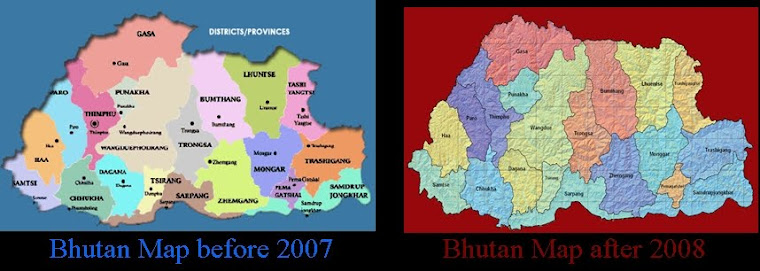
Click over the map to know the differences
Tuesday, November 4, 2008

Protracted refugee situation
By Dr Dhurba Rizal
No one chooses to be a refugee. Being a refugee means more than living in exile and depending on others. One of the most complex and difficult problems facing UNHCR today is that of protracted refugee situations. Over 64% of refugees in the world today are trapped in protracted refugee situations. Unwanted by their home country, grudgingly tolerated by their Nepalis hosts and of little interest to the international community, over 106000 Bhutanese refugees have been warehoused for more than a decade in the Jhapa and Morang district of Eastern Nepal.
Certain crimes lie beyond the scope of repentance. From torture to denationalization and ethnic cleansing, many of the rights violations experienced by refugees count amongst those grave injustices in the world for which it is impossible to truly make amends. More generally, the prolonged encampment of refugee populations has led to the violation of a number of rights contained in the 1951 UN Convention relating to the Status of Refugees. Faced with the restrictions, refugees become dependent on subsistence-level assistance, or less, and lead lives of poverty, frustration and unrealized potential.
They are frustrated and often dependent on others to find a solution to their plight. This is exactly the reason why they are now sitting on an indefinite hunger strike in front of UN House. This also indicates the level of frustration in the refugee community. Unresolved Bhutanese refugee situation represents a significant political phenomenon as well as a humanitarian problem. Protracted refugee situation often leads to a number of political and security concerns for host country, the country of origin, regional actors and the international community.
Through the simplifying lens of theory, it appears that if Bhutan created the refugees, then it should shoulder the challenge to take back its citizens. Not surprisingly, however, reality complicates the picture painted by theory. The negotiation between Bhutan and Nepal, the identification of the bonafide nationals, the terms and conditions for such identification and repatriation were all dictated by Bhutan. It has totally ignored the UNHCR and international community. It has been acquiesced by Nepal and tacitly supported by India. Bhutan government is steadfast in its resolve to continue the dead lock as it will give time to the regime to consolidate its hold on power by bringing artificially engineered demographic balance.
Time has come for us to ask: Why do these innocent refugees have to suffer? Is it a crime to become a refugee? Is this due to weak and partisan leadership among refugees, who have failed to aggregate and articulate their interests to deal with such complex human crisis? Is it due to disappointing response of India to the long-standing refugee affair? Is it due to declining interest of the USA, European Union and International Community? Are these people forgotten by International media like CNN and BBC, who claims to be the voice of the voiceless? Is a permanent and durable solution to the Bhutanese refugee crises evaporating? These questions can only raise and resonate the conflict of "Values and Interests" among the stakeholders of Bhutanese refugees crisis.
It is an unequal fight between the voiceless refugees and the government in power. The refugee policies, practices and solution are determined by the predominant power struggle for regional and global dominance. Political, socio-cultural and economic freedom, freedom from ideological constraints, freedom to define a new code of morality, which defines peace and security, democracy, human rights and sustainable development, can become truly universal values only if exercised alike without hidden interests and double standards. If we believe in these values, which we preach to others, then stakeholders of refugee crisis should intervene with utmost seriousness to support the cause of refugee and tame the regime. It is time to convey to Bhutan that the ultimate achievement of Gross National Happiness is intrinsically linked to the larger framework of inclusive democracy -- politically, economically and socio-culturally.
Bhutanese refugees continue to stagnate in over-crowded camps, which have neither the political nor the economic capacity to solve the problem. How can international community forget that Bhutan has created the largest per capita refugee population in the world? They are the one to tell the world that there are over a hundred thousand people, who have had their lives on hold for more than 15 years. How much longer would the world have them wait? If International community fails, they have to share in the blame for not having done enough, when there is the time for these voiceless refugees. It is only by redefining international solidarity in these terms, that we can hope to solve
the problem of refugees. Notwithstanding the growing significance of the problem, protracted Bhutanese refugee situations have not yet featured prominently on the international political agenda of major world power including the USA and India.
In the past, chronic and recurring refugee problems in Europe, Southeast Asia and Latin America have been resolved through comprehensive plans of action, involving not only humanitarian actors but also a range of political, security and development actors. Such an integrated approach is also needed to effectively resolve the protracted Bhutanese refugee crisis. The situation of the Bhutanese refugees has reached an impasse. The bilateral process has so far totally failed to respect the rights of the refugees or to achieve a durable solution for them. It is time for the international community and donor states of Nepal and Bhutan to convene an international conference, bringing all stakeholders together, including UN agencies and refugee representatives, to devise a comprehensive solution to this protracted refugee situation that meets international standards and gives due consideration to durable solutions. India, the US, European Union, Nepal and donor countries to Bhutan, should take active measures to ensure that refugee problem is resolved in full compliance with international human rights standards. If not resolved now, the refugee problem would fester and the role of the UNHCR and international community would be reduced to "simply administering human misery". The UNHCR has rightly said that "the consequence of having so many human beings in a static state include wasted lives, squandered resources and increased threats to security."
(The author is a visiting professor to the USA)
No one chooses to be a refugee. Being a refugee means more than living in exile and depending on others. One of the most complex and difficult problems facing UNHCR today is that of protracted refugee situations. Over 64% of refugees in the world today are trapped in protracted refugee situations. Unwanted by their home country, grudgingly tolerated by their Nepalis hosts and of little interest to the international community, over 106000 Bhutanese refugees have been warehoused for more than a decade in the Jhapa and Morang district of Eastern Nepal.
Certain crimes lie beyond the scope of repentance. From torture to denationalization and ethnic cleansing, many of the rights violations experienced by refugees count amongst those grave injustices in the world for which it is impossible to truly make amends. More generally, the prolonged encampment of refugee populations has led to the violation of a number of rights contained in the 1951 UN Convention relating to the Status of Refugees. Faced with the restrictions, refugees become dependent on subsistence-level assistance, or less, and lead lives of poverty, frustration and unrealized potential.
They are frustrated and often dependent on others to find a solution to their plight. This is exactly the reason why they are now sitting on an indefinite hunger strike in front of UN House. This also indicates the level of frustration in the refugee community. Unresolved Bhutanese refugee situation represents a significant political phenomenon as well as a humanitarian problem. Protracted refugee situation often leads to a number of political and security concerns for host country, the country of origin, regional actors and the international community.
Through the simplifying lens of theory, it appears that if Bhutan created the refugees, then it should shoulder the challenge to take back its citizens. Not surprisingly, however, reality complicates the picture painted by theory. The negotiation between Bhutan and Nepal, the identification of the bonafide nationals, the terms and conditions for such identification and repatriation were all dictated by Bhutan. It has totally ignored the UNHCR and international community. It has been acquiesced by Nepal and tacitly supported by India. Bhutan government is steadfast in its resolve to continue the dead lock as it will give time to the regime to consolidate its hold on power by bringing artificially engineered demographic balance.
Time has come for us to ask: Why do these innocent refugees have to suffer? Is it a crime to become a refugee? Is this due to weak and partisan leadership among refugees, who have failed to aggregate and articulate their interests to deal with such complex human crisis? Is it due to disappointing response of India to the long-standing refugee affair? Is it due to declining interest of the USA, European Union and International Community? Are these people forgotten by International media like CNN and BBC, who claims to be the voice of the voiceless? Is a permanent and durable solution to the Bhutanese refugee crises evaporating? These questions can only raise and resonate the conflict of "Values and Interests" among the stakeholders of Bhutanese refugees crisis.
It is an unequal fight between the voiceless refugees and the government in power. The refugee policies, practices and solution are determined by the predominant power struggle for regional and global dominance. Political, socio-cultural and economic freedom, freedom from ideological constraints, freedom to define a new code of morality, which defines peace and security, democracy, human rights and sustainable development, can become truly universal values only if exercised alike without hidden interests and double standards. If we believe in these values, which we preach to others, then stakeholders of refugee crisis should intervene with utmost seriousness to support the cause of refugee and tame the regime. It is time to convey to Bhutan that the ultimate achievement of Gross National Happiness is intrinsically linked to the larger framework of inclusive democracy -- politically, economically and socio-culturally.
Bhutanese refugees continue to stagnate in over-crowded camps, which have neither the political nor the economic capacity to solve the problem. How can international community forget that Bhutan has created the largest per capita refugee population in the world? They are the one to tell the world that there are over a hundred thousand people, who have had their lives on hold for more than 15 years. How much longer would the world have them wait? If International community fails, they have to share in the blame for not having done enough, when there is the time for these voiceless refugees. It is only by redefining international solidarity in these terms, that we can hope to solve
the problem of refugees. Notwithstanding the growing significance of the problem, protracted Bhutanese refugee situations have not yet featured prominently on the international political agenda of major world power including the USA and India.
In the past, chronic and recurring refugee problems in Europe, Southeast Asia and Latin America have been resolved through comprehensive plans of action, involving not only humanitarian actors but also a range of political, security and development actors. Such an integrated approach is also needed to effectively resolve the protracted Bhutanese refugee crisis. The situation of the Bhutanese refugees has reached an impasse. The bilateral process has so far totally failed to respect the rights of the refugees or to achieve a durable solution for them. It is time for the international community and donor states of Nepal and Bhutan to convene an international conference, bringing all stakeholders together, including UN agencies and refugee representatives, to devise a comprehensive solution to this protracted refugee situation that meets international standards and gives due consideration to durable solutions. India, the US, European Union, Nepal and donor countries to Bhutan, should take active measures to ensure that refugee problem is resolved in full compliance with international human rights standards. If not resolved now, the refugee problem would fester and the role of the UNHCR and international community would be reduced to "simply administering human misery". The UNHCR has rightly said that "the consequence of having so many human beings in a static state include wasted lives, squandered resources and increased threats to security."
(The author is a visiting professor to the USA)
Bhutani refugees
Editorial in Samaya, 30 June
World Refugee Day came and went this week, and it was just a formality. For the 100,000 plus Bhutani refugees who have been living in camps for the past 14 years in Jhapa and Morang there is no hope of any positive developments this year.
The UNHCR which has been trying to get the refugees repatriated to Bhutan or assimilated in the host country Nepal is now also working on third country resettlement. For the refugees, this can be a good option but not the best one. The UNHCR blames mainly Nepal for opposing resettlement in third countries. Nepal's position is that Bhutan needs to take back some of its people as per the bilateral agreement. The Bhutani refugee leadership agrees with this.
Obviously, the issue of refugees is closely linked to the protection of human rights and democracy in Bhutan. A royal dictatorship can perhaps heap injustices on a minority for some time. But ultimately the people will be victorious, and this has been proven by the recent events in the refugees' host country. Unfortunately, the lack of an organised pro-democracy movement has bolstered the harsh crackdowns by the Bhutani regime. Neighbouring democratic country India and the UN have been indirectly helping the anti-human rights and anti-democratic crackdowns by the Bhutani king against his own minority peoples.
It may appear to be in the short-term interest of some of the refugees, especially women and children, to be resettled in third countries. But to be forever torn apart from their country, community, culture and families can only be a last resort. It is important to restart the bilateral ministerial-level talks between Nepal and Bhutan to resolve the issue. Nepal must also remind New Delhi that its neutrality has helped the Bhutan king to continue with his activities against the refugees. Such repressive behaviour will be a challenge in efforts to fight terrorism in South Asia. It is also a test for King Jigme who seems to want to devolve his power and usher in democracy. He must remember that democracy isn't possible by violating the basic human rights of his minority population. That will just set back democracy.
World Refugee Day came and went this week, and it was just a formality. For the 100,000 plus Bhutani refugees who have been living in camps for the past 14 years in Jhapa and Morang there is no hope of any positive developments this year.
The UNHCR which has been trying to get the refugees repatriated to Bhutan or assimilated in the host country Nepal is now also working on third country resettlement. For the refugees, this can be a good option but not the best one. The UNHCR blames mainly Nepal for opposing resettlement in third countries. Nepal's position is that Bhutan needs to take back some of its people as per the bilateral agreement. The Bhutani refugee leadership agrees with this.
Obviously, the issue of refugees is closely linked to the protection of human rights and democracy in Bhutan. A royal dictatorship can perhaps heap injustices on a minority for some time. But ultimately the people will be victorious, and this has been proven by the recent events in the refugees' host country. Unfortunately, the lack of an organised pro-democracy movement has bolstered the harsh crackdowns by the Bhutani regime. Neighbouring democratic country India and the UN have been indirectly helping the anti-human rights and anti-democratic crackdowns by the Bhutani king against his own minority peoples.
It may appear to be in the short-term interest of some of the refugees, especially women and children, to be resettled in third countries. But to be forever torn apart from their country, community, culture and families can only be a last resort. It is important to restart the bilateral ministerial-level talks between Nepal and Bhutan to resolve the issue. Nepal must also remind New Delhi that its neutrality has helped the Bhutan king to continue with his activities against the refugees. Such repressive behaviour will be a challenge in efforts to fight terrorism in South Asia. It is also a test for King Jigme who seems to want to devolve his power and usher in democracy. He must remember that democracy isn't possible by violating the basic human rights of his minority population. That will just set back democracy.
Last resort for refugees
By Swami Devi Bhakta Lamitarey
A simple man in lion cloth, who was once thrown out of the first class compartment in South African train because of his racial identity, compelled the mighty British Empire to retreat from the Indian sub-continent, and eventually leading to the collapse of colonial domination around the world. He was not armed with muscle power or sophisticated weapons. He had humility, passion for truth, and unshakable faith in peace and justice. He conducted morning and evening prayers to seek God's blessing; he practiced the philosophy of wining hearts and minds of the people through forgiveness. He fought for communal harmony: for him religion had no place if it created suffering to people; he sided with the downtrodden, calling them Harizan, people of God.
A man who had equal respect for all religions, who had built impeachable rapport with the Christians as well as the Buddhists, but he was a religious person without a religion. Eventually, the mighty British empire submitted at the humility of the Mahatma; India was given freedom on August 15, 1947.
Similarly, Martin Luther King experimented with the philosophy of non-violence. America had no heritage of Buddha or the karmic theory of rebirth, which gives solace to sufferings here on earth by giving the hope of a meritorious life hereafter.
Martin Luther King paraded thousands of satyagrahis in the streets of Washington DC, demanding equality for the black Americans at jobs, school enrollment and ownership of land and properties. He succeeded to change the minds of the Anglo Saxon, and secured the rights of the Black Americans.
The notorious apartheid regime of South Africa was defeated not with armed struggle but with the passive movement of the innocent native Africans. Nelson Mandela, embraced the philosophy of Mahatma Gandhi to give direction to the South African Congress, and that really won the hearts and minds of the international community.
Understandably, there were youth activists posturing violence, but it was never used in a mass scale. It is like Newton's law of motion: every action has equal and opposite reaction. If violence is used to defeat an enemy; sure enough, you can expect a similar response. And it is going to take a long time to bring peace and stability as we have seen in Darjeeling district. The principle of non-violence is not dead; it is being well applied by the noble laureate, Ang Sang Su Ki, of Myanmar. She knows very well that resorting to violence will entice the military junta to import more weapons and to strangle the voice for freedom and liberty with more draconian measures.
The human rights and democratic struggle in Bhutan did not start with proper planning and in-depth consideration. It was an emotional response to the racial policy of Bhutan which restricted the Lhotsampa population the use of Nepali language, practice of Nepali culture, and arbitrary disenfranchisement of citizenship rights of Bhutanese people, particularly those of Nepali ethnicity, during the census re-enumeration exercises of 1988. The peaceful protest movement of 1990 was preceded by the decapitation of Kailash Dahal and Balaram Giri, and that was perhaps done with the influence of tea garden politics as the earlier activists had taken shelter at Garganda Tea Estate.
Quite possibly, the brutal massacre of the satyagarhis by the royal government in 1954 in Sarbhang had left a deep scar in the minds of Bhutanese people about the practicality of peaceful resistance in a reactionary and feudal society like Bhutan. It required tremendous effort and soul-searching evaluation to convince the refugee youths to profess faith in peaceful struggle for establishment of human rights and democracy in Bhutan.
In the 1990s Bhutan People Party too had given a call for satyagraha movement. Later Bhutan National Democratic Party had announced launching of satyagraha inside the country if Bhutan failed to repatriate the refugees with honor and dignity.
Finally, the elderly citizens of Timai camps took the lead, that also at a time when there were no agitation activities in the Bhutanese movement. They have decided to organize peaceful activities under the banner of satyagraha movement. After organizing a year-long sitting dharna at Timai camps, the elderly citizens have managed to receive support of Bhutan National Democratic Party, Bhutanese Refugee Representative Repatriation Committee, and Druk National Congress (kuenley) to continue with their peaceful struggle.
On 17 December 2005, the elderly citizens organized mass demonstration at Mechi Bridge (Indo-Nepal border), where a delegation of Indo-Bhutan Friendship Society, under the leadership of former Union Minister Shri Satya Prakash Malvia, addressed the gathering of 3000 strong refugees where it was emphasized that the only way for the refugees to reach Bhutan was to follow the path shown by Mahatma Gandhi. Other speakers were from Gandhi Peace Foundation, prominent individuals and social workers from India.
It might sound ridiculous to reactionary individuals to believe in peaceful struggle when the barrel of the guns are setting the tone of the political struggle in Nepal, the host country for the refuges during the last 15 years. The youths are in the forefront to question the relevance of Mahatma's philosophy for ushering changes in Bhutan.
The peaceful wait of fifteen years has not delivered anything, and the reactionary forces in Thimphu have not relaxed a bit to show cultural tolerance towards the Lhotsampa community. Nevertheless, it would be unfair to bundle everyone in the same basket. Bhutan is avowedly a Buddhist country and there are people who have the concept of moral rights and wrongs. Except for some cabinet members, the vast majority of the Bhutanese people are worried about the state of present impasse in finding an amicable resolution of the refugee problem.
Therefore, it is time for everybody to rally around satyagraha Movement, giving unconditional support to the effort made by the elderly people of Timai camps. There is a need to move out from the camp politics: do adequate lobbying in Bhutan, India and abroad.
A simple man in lion cloth, who was once thrown out of the first class compartment in South African train because of his racial identity, compelled the mighty British Empire to retreat from the Indian sub-continent, and eventually leading to the collapse of colonial domination around the world. He was not armed with muscle power or sophisticated weapons. He had humility, passion for truth, and unshakable faith in peace and justice. He conducted morning and evening prayers to seek God's blessing; he practiced the philosophy of wining hearts and minds of the people through forgiveness. He fought for communal harmony: for him religion had no place if it created suffering to people; he sided with the downtrodden, calling them Harizan, people of God.
A man who had equal respect for all religions, who had built impeachable rapport with the Christians as well as the Buddhists, but he was a religious person without a religion. Eventually, the mighty British empire submitted at the humility of the Mahatma; India was given freedom on August 15, 1947.
Similarly, Martin Luther King experimented with the philosophy of non-violence. America had no heritage of Buddha or the karmic theory of rebirth, which gives solace to sufferings here on earth by giving the hope of a meritorious life hereafter.
Martin Luther King paraded thousands of satyagrahis in the streets of Washington DC, demanding equality for the black Americans at jobs, school enrollment and ownership of land and properties. He succeeded to change the minds of the Anglo Saxon, and secured the rights of the Black Americans.
The notorious apartheid regime of South Africa was defeated not with armed struggle but with the passive movement of the innocent native Africans. Nelson Mandela, embraced the philosophy of Mahatma Gandhi to give direction to the South African Congress, and that really won the hearts and minds of the international community.
Understandably, there were youth activists posturing violence, but it was never used in a mass scale. It is like Newton's law of motion: every action has equal and opposite reaction. If violence is used to defeat an enemy; sure enough, you can expect a similar response. And it is going to take a long time to bring peace and stability as we have seen in Darjeeling district. The principle of non-violence is not dead; it is being well applied by the noble laureate, Ang Sang Su Ki, of Myanmar. She knows very well that resorting to violence will entice the military junta to import more weapons and to strangle the voice for freedom and liberty with more draconian measures.
The human rights and democratic struggle in Bhutan did not start with proper planning and in-depth consideration. It was an emotional response to the racial policy of Bhutan which restricted the Lhotsampa population the use of Nepali language, practice of Nepali culture, and arbitrary disenfranchisement of citizenship rights of Bhutanese people, particularly those of Nepali ethnicity, during the census re-enumeration exercises of 1988. The peaceful protest movement of 1990 was preceded by the decapitation of Kailash Dahal and Balaram Giri, and that was perhaps done with the influence of tea garden politics as the earlier activists had taken shelter at Garganda Tea Estate.
Quite possibly, the brutal massacre of the satyagarhis by the royal government in 1954 in Sarbhang had left a deep scar in the minds of Bhutanese people about the practicality of peaceful resistance in a reactionary and feudal society like Bhutan. It required tremendous effort and soul-searching evaluation to convince the refugee youths to profess faith in peaceful struggle for establishment of human rights and democracy in Bhutan.
In the 1990s Bhutan People Party too had given a call for satyagraha movement. Later Bhutan National Democratic Party had announced launching of satyagraha inside the country if Bhutan failed to repatriate the refugees with honor and dignity.
Finally, the elderly citizens of Timai camps took the lead, that also at a time when there were no agitation activities in the Bhutanese movement. They have decided to organize peaceful activities under the banner of satyagraha movement. After organizing a year-long sitting dharna at Timai camps, the elderly citizens have managed to receive support of Bhutan National Democratic Party, Bhutanese Refugee Representative Repatriation Committee, and Druk National Congress (kuenley) to continue with their peaceful struggle.
On 17 December 2005, the elderly citizens organized mass demonstration at Mechi Bridge (Indo-Nepal border), where a delegation of Indo-Bhutan Friendship Society, under the leadership of former Union Minister Shri Satya Prakash Malvia, addressed the gathering of 3000 strong refugees where it was emphasized that the only way for the refugees to reach Bhutan was to follow the path shown by Mahatma Gandhi. Other speakers were from Gandhi Peace Foundation, prominent individuals and social workers from India.
It might sound ridiculous to reactionary individuals to believe in peaceful struggle when the barrel of the guns are setting the tone of the political struggle in Nepal, the host country for the refuges during the last 15 years. The youths are in the forefront to question the relevance of Mahatma's philosophy for ushering changes in Bhutan.
The peaceful wait of fifteen years has not delivered anything, and the reactionary forces in Thimphu have not relaxed a bit to show cultural tolerance towards the Lhotsampa community. Nevertheless, it would be unfair to bundle everyone in the same basket. Bhutan is avowedly a Buddhist country and there are people who have the concept of moral rights and wrongs. Except for some cabinet members, the vast majority of the Bhutanese people are worried about the state of present impasse in finding an amicable resolution of the refugee problem.
Therefore, it is time for everybody to rally around satyagraha Movement, giving unconditional support to the effort made by the elderly people of Timai camps. There is a need to move out from the camp politics: do adequate lobbying in Bhutan, India and abroad.
Saturday, March 29, 2008


Bhutan opposition threatens to resign over unfair election
Small party vows to resign from Himalayan country's first elected parliament
DESHAKALYAN CHOWDHURY/AFP/Getty ImagesA Bhutanese polling officer (R) prepares to disconnects the Electronic Voting Mechine (EVM) in the presence of the other polling officers at the end of counting at a polling center in Thimphu on March ...
NEW DELHI -- After a century of absolute royal rule, when politics moved at a glacial pace, the Himalayan kingdom of Bhutan became the world's newest democracy this week.
Yesterday it almost became a one-party state as members of its fledgling opposition said the country's first-ever general election had been unfair and they would resign from parliament.
The People's Democratic Party (PDP) won only two seats in the 47-member assembly, but both candidates said they would not take up their seats, alleging civil servants from the capital Thimpu had unfairly influenced the results after campaigning closed.
"We found that thousands of people descended on our villages, civil servants and people from the towns," said Tashi Tsering, a PDP spokesman.
"They went and did a lot of informal campaigning, which had a big influence on the results. This is completely against the law."
Bhutanese turned out in huge numbers to vote in the polls after the king urged them to embrace democracy. Thimpu was deserted as many people returned to their villages.
But everyone was shocked by the result, a landslide in favour of the Druk Phuensum Tshogpa (DPT), which won 45 seats.
Political analysts said the vote was an endorsement of Jigmi Thinley, the DPT leader and a former prime minister. He is also a close advisor to the kings of Bhutan and a staunch monarchist.
But it was also a vote, they said, against the king's relatives by marriage who were seen as having used their influence to buy land cheaply and dominate business.
Sangay Ngedup, the PDP leader, is another former prime minister and uncle of the present king. He was thought to be popular with older rural voters for his record as agriculture minister, but lost his riding to a school teacher.
"With two members in opposition, that hardly constitutes an opposition," said Mr. Tsering.
"They felt they would rather use their resignations to try and get the election commission to look into these matters."
He added the PDP was not asking for a re-run of the polls.
"What we would like is that those responsible for breaking the law are held to account," he said.
The DPT declined to comment.
Kunzang Wangdi, Bhutan's chief election commissioner, said any resignations had to be submitted to the speaker once parliament convened.
"The election was free and fair and witnessed by the international media and independent observers," he said.
Reuters © 2008
DESHAKALYAN CHOWDHURY/AFP/Getty ImagesA Bhutanese polling officer (R) prepares to disconnects the Electronic Voting Mechine (EVM) in the presence of the other polling officers at the end of counting at a polling center in Thimphu on March ...
NEW DELHI -- After a century of absolute royal rule, when politics moved at a glacial pace, the Himalayan kingdom of Bhutan became the world's newest democracy this week.
Yesterday it almost became a one-party state as members of its fledgling opposition said the country's first-ever general election had been unfair and they would resign from parliament.
The People's Democratic Party (PDP) won only two seats in the 47-member assembly, but both candidates said they would not take up their seats, alleging civil servants from the capital Thimpu had unfairly influenced the results after campaigning closed.
"We found that thousands of people descended on our villages, civil servants and people from the towns," said Tashi Tsering, a PDP spokesman.
"They went and did a lot of informal campaigning, which had a big influence on the results. This is completely against the law."
Bhutanese turned out in huge numbers to vote in the polls after the king urged them to embrace democracy. Thimpu was deserted as many people returned to their villages.
But everyone was shocked by the result, a landslide in favour of the Druk Phuensum Tshogpa (DPT), which won 45 seats.
Political analysts said the vote was an endorsement of Jigmi Thinley, the DPT leader and a former prime minister. He is also a close advisor to the kings of Bhutan and a staunch monarchist.
But it was also a vote, they said, against the king's relatives by marriage who were seen as having used their influence to buy land cheaply and dominate business.
Sangay Ngedup, the PDP leader, is another former prime minister and uncle of the present king. He was thought to be popular with older rural voters for his record as agriculture minister, but lost his riding to a school teacher.
"With two members in opposition, that hardly constitutes an opposition," said Mr. Tsering.
"They felt they would rather use their resignations to try and get the election commission to look into these matters."
He added the PDP was not asking for a re-run of the polls.
"What we would like is that those responsible for breaking the law are held to account," he said.
The DPT declined to comment.
Kunzang Wangdi, Bhutan's chief election commissioner, said any resignations had to be submitted to the speaker once parliament convened.
"The election was free and fair and witnessed by the international media and independent observers," he said.
Reuters © 2008
Gross national sadness

Norwegian Refugee Council sets record straight on Bhutan
By Gyan Subba
Geo-politics is all about double standards and national interest. The Americans invade Iraq, ostensibly to restore democracy and get rid of Saddam, but everyone knows it is about oil.
NRC Reports: Bhutan Norwegian Refugee Council, Oslo January 2008 ISBN: 978 82 7411 176 1 http://www.nrc.no/
India backs Nepal’s democracy movement, but is in bed with the Burmese junta. Everyone knows it’s about gas.
But how does one explain India’s outright support for Bhutan’s eviction of 100,000 refugees, and its help in transporting them to Nepal. It can’t only be about hydropower.
Not just New Delhi, the ‘international community’ has been a mute by-stander to the world’s biggest refugee crisis in per-capita terms—Bhutan’s eviction of one-sixth of its population 17 years ago. There is more media coverage and outrage about 22,000 Tibetan refugees in Nepal than five times as many Bhutanis. Could it be because most Bhutani refugees are not Buddhists?
Finally, some Europeans seem to have taken notice that something is rotten in the kingdom of Bhutan. The Norwegian Refugee Council has timed its newsletter covering the refugee crisis for Bhutan’s first election this week. And to set things right for past neglect, it is a sharp indictment of the gross violation of human rights of its citizens perpetrated by the Druk regime.
‘Despite the extensive abuse of its own population, the country has—to a large extent—managed to avoid criticism in the international media,’ writes NRC Reports editor, Richard Skretteberg. ‘On the contrary, the media has often helped perpetuate the myth of an exotic land of happiness. However, what we have before us is a silent tragedy occurring in a media-created Shangri-la.’
Better late than never to say this. Finally someone in Europe has picked up what the Nepali media has been banging its head on for nearly two decades to get the world to take notice.
NRC Reports goes on to highlight the threats, detentions, confiscation of property that led to the original ethnic cleansing in 1991, and the Bhutani regime’s delaying tactics on their return with the direct collusion of India.
‘India bears a significant responsibility for finding a solution for the Bhutanese refugees…but the greater responsibility lies with Bhutan itself,” adds Skretteberg.
The NRC Reports also pokes holes in Bhutan’s ‘democratic elections’ this week.
The 2005 census in Bhutan has defined 13 percent of the population, mostly Lhotsampas, as non-nationals which means 82,000 Bhutanis within Bhutan weren’t allowed to vote in this week’s elections.
‘Exclusion of an ethnic group before an elections cannot be considered real democratisation,’ says the Report.
The report says there can be only three durable solutions to the crisis: repatriation to Bhutan, local integration in Nepal or resettlement. On repatriation, it accuses the Bhutani regime of being intrasigent and not even allowing back those classified as genuine Bhutanis in 2003. Local integration would be Nepal’s responsibility and Kathmandu has also been dragging its feet on extending citizenship even to those born in the camps and Bhutanis married to Nepalis after coming here.
The resettlement option for 85,000 Bhutanis to settle in western countries has created tension within the camps and the report calls on the resettlement to be entirely voluntary and the refugees allowed to retain the right to return to Bhutan.
What the report does not shed light on is the biggest mystery of all: how a tiny country of 700,000 people can arm-twist a giant neighbour of one billion people and charm western politicians and foreign aid bureaucrats to get away with ethnic cleansing. Not only is Bhutan not punished, it is now being congratulated for having ‘democratic elections’.
Coutesy: Nepali times
First of 60,000 refugees from Bhutan arrive in U.S.
First group, 121 refugees, arrives to resettle in New York, Chicago, other cities
U.S. has agreed to take 60,000 refugees; six other nations taking 10,000 each
Refugees are ethnic Nepalis who were forced into exile, human rights group says
Some refugees don't want to come to U.S., still hoping to return to Bhutan
KATHMANDU, Nepal (CNN) -- Bhutanese refugees began arriving in the United States on Tuesday, the first wave of what the United Nations describes as one of the world's largest resettlement efforts.
The U.S. has offered to resettle 60,000 of the estimated 107,000 Bhutanese refugees of Nepalese origin now living in seven U.N. camps in southeastern Nepal -- their home for the past 17 years. Six other nations -- Australia, Canada, Norway, Netherlands, New Zealand and Denmark -- have offered to resettle 10,000 each.
"Once they arrive, they will be sent to different cities around the U.S.," said David Derthick, a spokesman for the International Organization for Migration, which is screening and transporting the refugees.
The first group, arriving throughout the week, includes 121 refugees. They are being sent to New York; Chicago, Illinois; Syracuse, New York; St. Louis, Missouri; and other cities, the International Organization for Migration said.
The United Nations said several families had arrived in New York as of Tuesday, and more are en route to locations in Texas, Arizona and Maryland.
So far, however, only about 25,000 of the refugees have registered for resettlement, according to the U.N. High Commissioner for Refugees Web site, and not many more than 10,000 are expected to leave Nepal by the end of the year.
Bhutan, wedged between China and India, is a Buddhist kingdom about half the size of the U.S. state of Indiana. It's considered one of the world's most isolated countries and the government strictly regulates foreign influences, including tourism, to preserve the country's Buddhist culture. See Bhutan on a map »
The country had no electricity, paved roads, cars, telephones or postal service until the 1960s. It allowed access to television and the Internet only in 1999.
Bhutan stripped the minority ethnic Nepalis of their citizenship and forced them into exile in the early 1990s, allegedly in an attempt to ensure a homogenous culture, according to the independent, nongovernmental group Human Rights Watch. Many of the Nepalis have taken up arms and joined with violent Maoist rebels, the group said.
The refugees claim they were forced to leave Bhutan by security forces, but Bhutan has disputed whether all are truly refugees.
Some 15 rounds of talks between Nepal and Bhutan have failed to resolve the issue.
The United States' resettlement plan has divided the refugee community, as members disagree over whether it is best to resettle in the United States or hang onto hopes of returning to Bhutan.
A report posted on the UNHCR Web site quotes refugees who have chosen to go to the United States.
"We chose to resettle because there was no other outlet," said refugee Jay Narayan Adhikari. "Talks between Nepal and Bhutan have produced no results."
"Everyone says 'America, America, America,' but I don't know much about it," said his wife, Sita, according to the U.N. report. "It's only for the sake of the children that we are ready to go."
Nearby, the Bajgai family was separating because of its large size. Three children were leaving first, to be joined by the others later, the report said. Two of the daughters were crying as they packed their bags, but their mother told them: "Why are you crying? We have nothing here anyway. We will join you soon. Our future will be brighter there."
Of the 25,000 who have registered for resettlement, more than 12,000 names have been submitted for consideration for host countries, mainly the United States, the UNHCR said. More refugees are expected to register after they hear how those in the first group have been integrated into new homes, it said.
Bhutan became the world's newest democracy on Monday when an election ended more than 100 years of royal rule in the South Asian nation. Watch Bhutanese line up to vote »
Officials in Bhutan declared the first elections in the Himalayan kingdom a resounding success.
Officials said 79.4 percent of the country's 318,465 registered voters went to the polls -- a surprisingly large turnout for a populace that had largely said they preferred to remain under the rule of their revered king.
But many Bhutanese changed their minds after former King Jigme Singye Wangchuck went around the country pitching his case for the elections.
U.S. has agreed to take 60,000 refugees; six other nations taking 10,000 each
Refugees are ethnic Nepalis who were forced into exile, human rights group says
Some refugees don't want to come to U.S., still hoping to return to Bhutan
KATHMANDU, Nepal (CNN) -- Bhutanese refugees began arriving in the United States on Tuesday, the first wave of what the United Nations describes as one of the world's largest resettlement efforts.
The U.S. has offered to resettle 60,000 of the estimated 107,000 Bhutanese refugees of Nepalese origin now living in seven U.N. camps in southeastern Nepal -- their home for the past 17 years. Six other nations -- Australia, Canada, Norway, Netherlands, New Zealand and Denmark -- have offered to resettle 10,000 each.
"Once they arrive, they will be sent to different cities around the U.S.," said David Derthick, a spokesman for the International Organization for Migration, which is screening and transporting the refugees.
The first group, arriving throughout the week, includes 121 refugees. They are being sent to New York; Chicago, Illinois; Syracuse, New York; St. Louis, Missouri; and other cities, the International Organization for Migration said.
The United Nations said several families had arrived in New York as of Tuesday, and more are en route to locations in Texas, Arizona and Maryland.
So far, however, only about 25,000 of the refugees have registered for resettlement, according to the U.N. High Commissioner for Refugees Web site, and not many more than 10,000 are expected to leave Nepal by the end of the year.
Bhutan, wedged between China and India, is a Buddhist kingdom about half the size of the U.S. state of Indiana. It's considered one of the world's most isolated countries and the government strictly regulates foreign influences, including tourism, to preserve the country's Buddhist culture. See Bhutan on a map »
The country had no electricity, paved roads, cars, telephones or postal service until the 1960s. It allowed access to television and the Internet only in 1999.
Bhutan stripped the minority ethnic Nepalis of their citizenship and forced them into exile in the early 1990s, allegedly in an attempt to ensure a homogenous culture, according to the independent, nongovernmental group Human Rights Watch. Many of the Nepalis have taken up arms and joined with violent Maoist rebels, the group said.
The refugees claim they were forced to leave Bhutan by security forces, but Bhutan has disputed whether all are truly refugees.
Some 15 rounds of talks between Nepal and Bhutan have failed to resolve the issue.
The United States' resettlement plan has divided the refugee community, as members disagree over whether it is best to resettle in the United States or hang onto hopes of returning to Bhutan.
A report posted on the UNHCR Web site quotes refugees who have chosen to go to the United States.
"We chose to resettle because there was no other outlet," said refugee Jay Narayan Adhikari. "Talks between Nepal and Bhutan have produced no results."
"Everyone says 'America, America, America,' but I don't know much about it," said his wife, Sita, according to the U.N. report. "It's only for the sake of the children that we are ready to go."
Nearby, the Bajgai family was separating because of its large size. Three children were leaving first, to be joined by the others later, the report said. Two of the daughters were crying as they packed their bags, but their mother told them: "Why are you crying? We have nothing here anyway. We will join you soon. Our future will be brighter there."
Of the 25,000 who have registered for resettlement, more than 12,000 names have been submitted for consideration for host countries, mainly the United States, the UNHCR said. More refugees are expected to register after they hear how those in the first group have been integrated into new homes, it said.
Bhutan became the world's newest democracy on Monday when an election ended more than 100 years of royal rule in the South Asian nation. Watch Bhutanese line up to vote »
Officials in Bhutan declared the first elections in the Himalayan kingdom a resounding success.
Officials said 79.4 percent of the country's 318,465 registered voters went to the polls -- a surprisingly large turnout for a populace that had largely said they preferred to remain under the rule of their revered king.
But many Bhutanese changed their minds after former King Jigme Singye Wangchuck went around the country pitching his case for the elections.
12000 Bhutanese refugees to be resettled in US and other countries
Kathmandu, Mar 25:
Out of 108,000 Bhutanese refugees living in seven camps in Goldhap Refugee Camp of Jhapa in eastern Nepal, 12,000 persons have been referred for resettlement in seven different countries.
The process of interviewing refugees who are interested on the resettlement proposal will continue, United Nations High Commissioner for Refugees (UNHCR) yesterday said. The UNHCR has referred slightly more than 11,000 persons for resettlement to the United States of America and approximately 800 persons to Australia, slightly more than 150 to New Zealand, and smaller numbers to Canada, Denmark, the Netherlands and Norway.''To date, over 2,500 persons have been accepted by the US, which will interview refugees on a regular basis at the International Organisation for Migration (IOM) office in Damak'' the state run media quoted UNHCR officials as saying at a press conference in Jhapa. UNHCR informed that more than 100 persons have already been accepted by New Zealand. Many refugees have been interviewed by officers from Australia and are in various stages of processing.Other countries have also accepted smaller numbers - Canada 29, Denmark 13, Netherlands 32 and Norway has accepted 24 persons. The Nepal government has provided exit permission and travel documents to over 600 persons who would be departing for resettlement. Fewer than 20 refugees were left for resettlement in 2006 and 2007, according to UNHCR. By March-end 2008, it is anticipated that over 200 persons would have departed to third countries. ''This trend will continue with more departures scheduled for each month. By the end of 2008, IOM anticipates that 1,500 persons will be leaving for third countries each month,'' UNHCR said. The organisation estimates that by the end of 2008, more than 10,000 persons will be departed for new homes, many of them to the US. The US has said it will provide at least 60,000 resettlement places but will consider more if there is a need. Australia, Canada, Denmark, New Zealand, the Netherlands and Norway are considering providing in total up to 10,000 resettlement places for these refugees over several years. Canada will begin interviewing refugees later this year and other resettlement countries will also travel to Nepal during 2008 to do the same, UNHCR informed.
--- UNI
Out of 108,000 Bhutanese refugees living in seven camps in Goldhap Refugee Camp of Jhapa in eastern Nepal, 12,000 persons have been referred for resettlement in seven different countries.
The process of interviewing refugees who are interested on the resettlement proposal will continue, United Nations High Commissioner for Refugees (UNHCR) yesterday said. The UNHCR has referred slightly more than 11,000 persons for resettlement to the United States of America and approximately 800 persons to Australia, slightly more than 150 to New Zealand, and smaller numbers to Canada, Denmark, the Netherlands and Norway.''To date, over 2,500 persons have been accepted by the US, which will interview refugees on a regular basis at the International Organisation for Migration (IOM) office in Damak'' the state run media quoted UNHCR officials as saying at a press conference in Jhapa. UNHCR informed that more than 100 persons have already been accepted by New Zealand. Many refugees have been interviewed by officers from Australia and are in various stages of processing.Other countries have also accepted smaller numbers - Canada 29, Denmark 13, Netherlands 32 and Norway has accepted 24 persons. The Nepal government has provided exit permission and travel documents to over 600 persons who would be departing for resettlement. Fewer than 20 refugees were left for resettlement in 2006 and 2007, according to UNHCR. By March-end 2008, it is anticipated that over 200 persons would have departed to third countries. ''This trend will continue with more departures scheduled for each month. By the end of 2008, IOM anticipates that 1,500 persons will be leaving for third countries each month,'' UNHCR said. The organisation estimates that by the end of 2008, more than 10,000 persons will be departed for new homes, many of them to the US. The US has said it will provide at least 60,000 resettlement places but will consider more if there is a need. Australia, Canada, Denmark, New Zealand, the Netherlands and Norway are considering providing in total up to 10,000 resettlement places for these refugees over several years. Canada will begin interviewing refugees later this year and other resettlement countries will also travel to Nepal during 2008 to do the same, UNHCR informed.
--- UNI
Over 100 Bhutanese Exiles in Nepal being resettled in United States – UN
Refugees in Goldhap camp in eastern Nepal25 March 2008 – One of the largest refugee resettlement operations in the world has been launched this week, with more than 100 Bhutanese refugees in eastern Nepal heading to the United States to begin new lives, the United Nations High Commissioner for Refugees (UNHCR) reported.
“This is the largest movement of refugees from Nepal’s camps so far, and the pace will pick up in the coming months,” agency spokesperson Jennifer Pagonis told reporters in Geneva.
By the close of 2008, over 10,000 refugees are expected to leave Nepal for resettlement in the US, Canada, Australia, New Zealand, Denmark, the Netherlands and Norway.
Currently, there are more than 107,000 refugees – who left Bhutan in the early 1990s – residing in seven camps in eastern Nepal.
Some 25,000 refugees have registered for resettlement, UNHCR said. The agency has submitted more than 12,000 names to third countries, mostly to the US.
“More refugees are expected to come forward for resettlement after they hear of how the first groups integrate in their new homes,” Ms. Pagonis noted, adding that others are holding out for a chance to return to Bhutan.
Earlier this month, UNHCR appealed for funds after a devastating fire destroyed 95 per cent of the Goldhap refugee camp and left most of its 9,770 residents homeless.
“This is the largest movement of refugees from Nepal’s camps so far, and the pace will pick up in the coming months,” agency spokesperson Jennifer Pagonis told reporters in Geneva.
By the close of 2008, over 10,000 refugees are expected to leave Nepal for resettlement in the US, Canada, Australia, New Zealand, Denmark, the Netherlands and Norway.
Currently, there are more than 107,000 refugees – who left Bhutan in the early 1990s – residing in seven camps in eastern Nepal.
Some 25,000 refugees have registered for resettlement, UNHCR said. The agency has submitted more than 12,000 names to third countries, mostly to the US.
“More refugees are expected to come forward for resettlement after they hear of how the first groups integrate in their new homes,” Ms. Pagonis noted, adding that others are holding out for a chance to return to Bhutan.
Earlier this month, UNHCR appealed for funds after a devastating fire destroyed 95 per cent of the Goldhap refugee camp and left most of its 9,770 residents homeless.
Subscribe to:
Comments (Atom)