The Bhutanese Society of Kentucky (BSK) held its annual cultural program today at Iroquois High School, the school where largest number of Bhutanese students are studying under ESL program.
The annual cultural program absorbed much of the time of BSK board members and it was quite a assiduous planning, which also included the program of honoring high school students who graduated since 2009.
High school graduates being honored
The program became successful in making the young dancers and singers participate in the program and rejuvenate their talents together with showing the cultural dress, according to the organizers.
Young girls and women donned with sari, lehanga and kurta salwar became the point of attraction for the local guests. Martin Kinny, the ESL director of JCPS, attended the event as the chief guest who handed medals of recognition to the high school graduates.
Some attractions were the Deusi song by Bhutanese singer, Govinda Phuyel; dance on Bhailinisong by Yashoda Phuyel and Leela Subedi; solo song daali daali ma.. by Bindya Rasaili while the stage was rocked by Jeet Limbu with the old time song of Gopal Yonjan, Uhile ta bajeko pala ma …jutta ma herda thuloma her buhari herda sano ma her.
Special to the program was guest Dr. Govinda Rizal who flew to Kentucky from Philippines to meet his parents some days ago.
Similarly, Suhas Kulkarni the director of Office of Globalization at the Mayor’s office and his wife Surekha Kulkarni arrived late to the program to exchange the felicitations of Deepawali.
This letter, signed by the following signatories, was sent to Indian Prime Minister, Narendra Modi, on June 14, as he prepares to visit Bhutan from June 15. BNS has published this letter retaining its original content. An unofficial Hindi translation of this letter by BNS is available here.
Dear Mr. Prime Minister,
Please accept the heartiest felicitations and congratulations on your assumption of the prestigious Office of the Prime Minister of the Republic of India. The landslide victory that you have achieved truly reflects your dynamic leadership and commitment of the Bharatiya Janata Party (BJP) towards the Indian nationals.
Indian Prime Minister, Narendra Modi (Picture courtesy: Mr. Modi’s publicly shared profile)
Mr. PM, we are also honored to know that Bhutan is the first country of your state visit. As we become confident that such a visit will take the Indo-Bhutan friendship to a new height, we also take this opportunity to draw your attention towards the plight of the Bhutanese refugees.
Mr. PM, you are visiting a country that has expelled over 100,000 of innocent citizens simply for raising their voices for democracy, human rights and equality in the kingdom. Unfortunately, these citizens have been rendered stateless for over 22 years as Bhutan is never in favor of accepting them back home. Nepal, which still continues to host thousands of these refugees letting others to resettle in the western countries, has failed to negotiate with Bhutan in finding an amicable solution of the crisis. Refugees, their leaders and the international community strongly believe that the right to return home of these refugees is completely vested on the Indian mercy. It is a matter of extreme sadness that none of the former governments of India paid attention towards this standoff.
Mr. PM, in your own words, your government is fully dedicated to poor, youth and women. The exiled Bhutanese populace not only comprises of poor, youth and women, but also hundreds of victims of torture, rape and other forms of state-sponsored suppression. We implore you to question the King, Jigme Khesar, and your Bhutanese counterpart, Tshering Tobgay, about fate of these citizens, pathetic situations of their relatives inside the country and political prisoners.
Mr. PM, reminding you of all aforementioned issues, we wholeheartedly appeal you to kindly make it your priority to generously engage India’s influential leadership in allowing all Bhutanese to fully exercise democracy and human rights, as Indian and global citizens do, thereby pressing the Government of Bhutan to accept dignified return of all willing citizens from exile.
Lastly, we wish you and your government the very best in your official tenure as a leader of the world’s largest democracy in the years ahead.
Govinda Rizal, PhD. Lodrai Gaylegphug, Bhutan Currently in Kyoto, Japan Email: govindarizal@gmail.com, Skype: GovindaRizal
Parsuram Sharma-Luital Melbourne Victoria Australia
Bholanath Shiwakoti Chirang Bhutan Currently in Arora, Colorado, USA
Narayan Sharma Philadelphia, Pennsylvania, USA
DP Basnet Alexandria, Virginia, USA
Narad Adhikari Springfield, Massachusetts, USA
Mohan Bhandari Roanoke, Virginia, USA
Devendra Gautam Chirang, Bhutan Currently in Sydney, NSW, Autralia
Upendra Dahal Gelephu, Bhutan Currently in Pittsburgh, Pennsylvania, USA
Mohan Tamang California, USA
Hari Subedi Albquerque, New Mexico, USA
Tara Dhungana Ohio, USA
Sushil Niroula South Australia (Adelaide), Australia
Rudra Kuikel Samdrup Jongkhar, Bhutan Currently in Salt Lake City, Utah, USA
Tikaram Adhikari Chirang, Bhutan Currently in Winnipeg, Manitoba, Canada.
CB Dahal Northland, Wellington, New Zealand
KB Chauhan Former Assembly Member, Dagapela, Bhutan Currently in Arizona, USA
Y.P Dhungel Sydney, NSW, Australia
Thugten Dorjee Drukpa, Horsens Denmark
T B Gurung Pittsburgh, Pennsylvania, USA
Padam Rizal Harrisburg Pennsylvania, USA
Ram BK Chhetri The Hague, The Netherlands
Kuber Poudel Chhetri Dalim-Bhangtar, Bhutan Currently in Las Vegas, NV
Tulashi Upreti Chirang, Bhutan Current in Lexington, Kentucky, USA
Resettlement of Bhutanese refugees took an unprecedented turn when one hundred thousand Bhutanese refugees got resettled in eight countries, US being the largest receiver.
Assistt Secy Nisha Desai with Dr. Prakash Sharan Mahat Photo Courtesy: Kantipur
Despite this fact of ‘successful resettlement’, UNHCR in Nepal has issues pending resettlement, particularly of those families who are separated and those who wish repatriation, albeit minimal.
In order to give a sort of ultimatum, UNHCR has alerted refugees of imminent closure of resettlement process in a bulletin issued 18 August, 2016. According to the bulletin nailed at information boards of refugee camps, the purpose of the information is to announce the phasing out of resettlement by 2017.
While it has clearly outlined the effort by UNHCR to allow as much time and flexibility for the refugees to apply for resettlement, it does not say about what will happen to those seeking repatriation.
UNHCR bulletin in camps Photo: Govinda Rizal
According to one firsthand account of a camp resident BNS received, there is a kind of apathy towards the lone elderly folks whose family members have chosen resettlement. They are already vulnerable, and their hope for repatriation is still grim; the advocacy groups for repatriation themselves facing setbacks.
The issue of divorcees, who are either registered refugees, Nepalese or Indian citizen, is nowhere considered in the bulletin. The UNHCR field workers held meetings at sector level, discussed with people about the opportunity of resettlement that many refugees around the world are not able to get, but do not have any handy solution for people’s cases like this. According to a source, many such divorcees, especially the men, have moved closer to camps, hoping to take chance of resettlement.
People who were reported ‘missing’ by the family members to clear their resettlement process, are now back to the camp, falling outside the bracket of resettlement process. There is no talk about such ‘missing’ persons.
One interesting fact BNS could reveal from this account is the arrival of fresh refugees, either directly from Bhutan or from India, particularly those who fled after 1997 protest in eastern Bhutan. Some of their family members who had registered in camps earlier are resettled in the US.
Another category of people are the absentees from camp, even during the three vital censuses that determined the refugee status. Their case is ‘de-registered’ in RCU data because of long absence. The UNHCR bulletin does not mention about their fate.
Abandoned huts in Beldangi refugee camp. Photo: Govinda Rizal
This source also mentions about a section of voiceless people who do not find right place to tell their story and know how to do about it. They find no one to advocate for them, nor they see right person to approach their case. They say, ‘we have no money to spend.’
Meanwhile, fresh report from Kathmandu received by BNS mentions of a group of ten people from camps currently in Kathmandu to lobby the Home Ministry on behalf of census absentees. They met the Home Minister of Nepal at his residence and requested for considering the absentees for refugee ID cards.
In a news report published in Kantipur, September 3, US urged Nepal to assimilate the remaining refugees, which according to the news, is turned down by Nepal. In a meeting with foreign minister Dr. Prakash Sharan Mahat, US Assistant Secretary of State, Nisha Desai Bishwal urged the government of Nepal to ‘keep the remaining refugees’ after the end of resettlement process. Nepal has been reiterating that they must be returned to Bhutan, whatever number, and that Bhutan must accept its citizen.
The UNHCR has announced in the bulletin that it will not accept any application for resettlement after December 31, 2016.
As per the bulletin 1,04,750 people have been resettled until July 31, 2016. It also has the links to report any fraud activities suspected- nepjhfrd@unhcr.org or fraudrscsouthasia@iom.int
Dr. Govinda Rizal from Nepal partially contributed to this report-Editor
In early June 2017, Indian defense intelligentsia found Chinese People Liberation Army (PLA) active near Doka-la plateau at the four-state junction between Bhutan, Tibet (China), and Sikkim and West Bengal (India). Between November 2015 and June 2017 about 10 kilometers of roads were constructed in the region that was under dispute for a long time. The construction included 2.3 Kilometer road in the eastern notch of East Sikkim and about 8 km inside western highland of Sombaykha block, Ha district of Bhutan.
Ever since the Bhutan began to appear in maps Dok-la, a part of Doklam plateau was on the map. Doklam plateau is the Tee area of strategic location worth owning. Any country would fight to own such a strategic point and the three countries have anchored their wants.
Bhutan owns it, China wants it and India stunts its use.
For several years, around the month of May, Indian news media have been keeping the Bhutan-China border issues in their annual to-do list of news. The June 2017 episode was a sequel of the past years’ exercises. Indian defense leaders cautioned the leaders in Thimphu regarding the Chinese approach from the west. Thimphu responded hypo-seriously at par the annual China- India ritual. The ritual gained no recognition.
In the mid of June 2017, the director general of the Border Roads Organization (BRO) of India, Lt Gen SK Shrivastava visited Bhutan. In Bhutan BRO that has been working in the name of project DANTAK since 1961 has been constructing and maintaining roads along the Indian border and supervising the international border. On 20th June 2017, senior army officers of India and China had a meeting over the crossing over of China-India borders by each other’s forces. The two sides had repeatedly accused each other of cross-over at Sikkim (India) – Tibet (China) border 200 meters to 2 kilometers west of Bhutan border. The conclusion of the meeting was not made public, most probably because there was no conclusion at all.
Bhutan received an appraisal of the situation. The Bhutanese side agreed to send a démarche to Chinese authorities through its diplomatic channel. The démarche carried the words of Indian government and the authority of the Bhutanese government. Although the démarche was sent through a diplomatic channel, its contents got leaked to the media. It had an impact. Both the Indian and Chinese media gave priority to the news. With Bhutan under its cordon, the Indian news media waged a war of words against China. The Chinese media, which used to be quiet and calculated, was hyperactive this time. Chinese diplomats namely, Lu Kang, the Director-General, Department of Information, Ministry of Foreign Affairs and Foreign Ministry spokesman Geng Shuang fueled the debate with their responses. A volley of claims and accusations were exchanged between the two sides of the Himalayas.
The torrent of news from both the sides of the Himalayas made the people think there was a war in the otherwise desolated plateau. The Chinese authorities claimed that they had a perpetual understanding with the Bhutanese side. The Indian authorities announced that it would be solved diplomatically. The official announcements got into a ditch of news propagandas.
Doklam which in Dzongkha and Tibetan languages means a ‘rocky path’ was an out-of-bound region for both the Bhutanese and Tibetans, since the 1960s. Herders of both countries frequently used the region for pasture. The rocky path turned into a desolated region after the Bhutan –China border disagreements began to spill to the public since 1988.
Both Bhutan and China claim the region based on some maps of independent times in their histories. Several scholars believe that it was a region of Tibet instead of Bhutan to justify the Chinese claim. Tibet got independence from China in 1912 and lost its sovereignty back to China in 1951. During the independent Tibet era, there was no civilization in the plateau. However, the major trade route between Bengal (India) and Tibet passed from the vicinity of the plateau. China produces the maps of the region before the Tibetan Independence as its claim over the area.
On the Bhutanese side, it’s not a claim but an effort to prevent cede of the region. Bhutan was unified in the seventeenth century but the borders are amoebic until today.
China, with its area of about 250 Bhutans, won’t grab the plateau at the cost of blooming bilateral camaraderie. It desperately wants the strategic site in exchange for more land in the north. It wants to tryst with Bhutan outside the influence of India. Until 2010, Bhutan and China had borders issues to resolve in at least seven regions. Technical teams from both the countries have prepared maps and resolutions in unison. The remaining contention has been over Doklam region that is associated with the security concern of India. India perceives the icicle shaped Yadong County between Bhutan and Sikkim as a Chinese claw near its wasp-waist that connects its north eastern states to the mainland India. Chinese fleets have been traveling thousands of miles to reach South Asia crossing three seas and two oceans, making the trade expensive. If roads connect Yadong and South Asian cities, the travel time will decrease by a week. The distance from Dok-la Plateau to Banglabanda Zero Point or the gateway to Bangladesh is less than 150 km by land or about 100 km aerial distance. No one can rule out the Chinese planners’ mulling over strategies to connect to the Bay of Bengal via Yadong. If the connection is not possible through agreements, and the plateau is with China, it could be used in the disagreement. The ongoing Indian cacophony seems more out of the fear of its security, pretexts for protective measures than an altruistic protection to Bhutan.
About 25 kilometers north of the disputed Dok-la is another region of the dispute between Bhutan and China. This area of dispute has been bulged on both the sides for the sake of dispute. At least 2.4 km of the Xigase-Yadong providential road 204 is inside the disputed region on the Chinese side. If Yadong and Damthang (Ha) towns are connected by roads, which are about 40 kilometers apart, it would provide Bhutan with an access by roads to the second country after India. Bhutan and China had agreed in 1998 to work to solve border dispute keeping the status of pre-1959 until an agreement for complete border demarcation. The two sides met at least two dozen times for border talks.
Two districts in Bhutan, Samchi and Ha, adjacent to Doklam region have been bearing the brunt of unsolved Bhutan- China border dispute. India has been a guiding force in Bhutan’s overall as well and selective developments. More than 2500 kilometers of roads in Bhutan are constructed at the India’s initiatives and support, since 1961. Until a year back, Samchi was kept as the only district in Bhutan that was not connected to other districts with a road. Ha was connected to the capital with a road. People travelling between adjacent Samchi and Ha districts had to travel through India and three districts in Bhutan making the two districts 300 km far from each other by roads. In absence of a road and permission to construct one, the people of Ha who wanted to travel to Silliguri in the west had to travel East, south, and west. While Silliguri, the largest Indian city near to Bhutan is the trade center of Bhutan and the North east India, Ha hosts headquarter of Indian Military Training Team (IMTRAT) in Bhutan. The IMTRAT headquarter in Ha is within the vicinity of the Yadong County. IMTRAT imparts training to Bhutanese soldiers. The strategy of the isolation of Ha and Samchi turned out to be faulty and futile. A road construction was initiated to connect Ha to Silliguri through Samchi. Once completed, it will shorten the time of travel between Silliguri and Ha by at least seven hours. On one hand the road connecting Ha and India is near to completion; on the other hand, China seems contented at its negotiation with Bhutan. The contention of Chinese authorities and docile expression of Bhutanese government confirm that the two sides have reached an agreement. Bhutanese leaders who update Indian counterparts on all types of developments must be waiting for a ripe time to do so. Until 2007, Bhutan used to inform India everything regarding its foreign relation. The provision was done away by the India-Bhutan Friendship Treaty, 2007. However, Bhutan’s defense, economy, and finance are pegged on India. It remains India’s responsibility to intervene than interfere when it perceives Bhutan wrestling against an odd. At the peoples’ level, most Indians perceive Bhutan as India’s protectorate. Most Chinese people put Bhutan and Sikkim in one story.
Bhutanese government has distanced itself from China, to feel safe and be protected by India. In 2012, the former Prime Minister of Bhutan tried to be friendly with China. India taught him and his party a lesson. On the eve of the 2013-election, India withdrew the subsidy on fuel and oriented the people to vote for a party more loyal to India. A party of it choice came to the power and India released the budget for Bhutan. India has been Bhutan’s sugar daddy since the start of the latter’s five-year plans in 1960s. Indian money and Bhutanese tact characterize the Bhutan-India relationship. In the past, Indian government instilled Sikkim fear in Bhutanese rulers against its southern population and instigated the local leaders of Southern Bhutan to rise against their rulers. It led to an eviction of one fifth or about fifty percent of Southern Bhutanese from Bhutan. The evicted Bhutanese landed up as refugees in Nepal and struggled for repatriation for decades. India acted as a valve. It used its military force to ferry the people from Bhutan to Nepal and to prevent their return to Bhutan. When the refugees were in Nepal, India used them against Bhutan as a bait of bargain. Indian rebels hiding in Bhutan were negated and India owned the construction and use of hydro-electricity power in Bhutan, among others. Today majority of the Bhutanese refugees are resettled in third countries and the remaining refuges are being locally integrated, India feels its anchor has weakened.
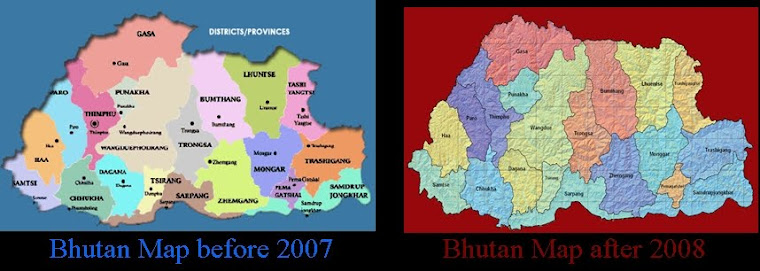
Back in 2007, Bhutan published a map without Mount Kulakangri, its tallest mountain. It appeared ceded to China. Moreover, there was news in the academic circle that Bhutan wanted to cede Samchi district to India with all its Southern Bhutanese population dumped there. Soon after the 2008 elections in Bhutan, the people in exile apprised the new members of the parliament regarding the loss of Bhutan’s mountains, official publication of a faulty map and reduction of the size of the country. The members were silent after a brief discussion in the assembly. School books still mention Kulakangri as the Bhutan’s tallest mountain. The Bhutanese lawmakers, rulers and Indian government silently accepted the faulty map and loss of 8500 Km sq of the land. It makes little sense of the hue and cry when the Chinese proposal is for an exchange of 269 sq Km land in the west in return for 495 sq km land in the north.
While India and China are partners in several fronts, the border between them has been the bone of contention. The two countries fought a bloody war in 1962 and they take pride in not having exchanged a slap there after. India has been finding it difficult to accept China’s intimacy with Pakistan and Nepal. It’s preventive on Bhutan. While India has been a patron to Bhutan, diplomats of two countries in Asia namely Bangladesh and China always highly regard Bhutan. Bhutan was the first country to recognize an independent Bangladesh and the first country to support China’s membership in United Nations Organization.
The present tussle between the two neighbors is not over a grave issue but it seems a pretext to a weighty agenda. The present truce has given a reason to India to post more soldiers in Bhutan. On the justification of the present discontentment India may carry out a nuclear test soon and China may follow it as its repercussion. Both the nuclear powers seem prepared for tests and are inventing convincing reasons. While the big dragon has called the small dragon for a tryst, the elephant trumpets its loss of a partner. The two countries may not waste a bullet for the Dok-la issue; however, the media of the two countries are in a war.
The Bhutanese population now scattered around the world is undergoing an exasperating struggle of identity, longing, and extinction. The Bhutanese society is no more confined to Bhutan or a geographical location but has reached Nepal, India and the first world countries. Those in Bhutan live in suffocation with their identities acculturated by the Drukpa rulers’ one race hegemony imposed on all the citizens. Bhutanese struggling for survival in Nepal and India live either as refugees-if they are recognized and counted by the United Nations High Commission for Refugees (UNHCR)- if not are stateless. The third group is the latest batch of people who were purged from the refugee camps in Nepal to the core group countries. They neither have the ways and means to retain their Bhutanese identity nor the flexibility to shun the former and adopt the host identity. The new generation growing up in Bhutan is Drukpa Camouflaged, in Nepal is Nepalized non-Nepali-citizen, and in the first world countries is a chimera of old and new identities that fit neither.
BackgroundIn the 1990s, about one hundred thirty thousand Bhutanese Citizens were purged out of Bhutan through a systematic depopulation exercise carried out to create and retain a sustainable majority of the anti-democratic forces of the ruling regime. The Drukpa Government run by a few elite families in the name of Royal Government of Bhutan (RGoB) designed and carried out a phase-wise expulsion. The counter-effect was immediate. People resorted appealing to the power centers for citizens’ rights. The rulers used the appeal as a tool to sieve the people- those supporting the appeal from others supporting the expulsion. The appeal supporters were aligned against the expulsion supporters. The rapid increase in the number of victims of phase-wise expulsion gave a mass strength to the extent that hundreds of thousands of otherwise silent, suppressed, voiceless people took to streets loudly expressing their discontents. They demanded the end to inequality and introduction of reforms and respect. The mass demonstration that made the power centers insecure was alleged anti-government, anti-nation and anti-monarchy. People participating in or supporting the movement and their relatives were scrapped off their citizenships making them nude of any rights. Most of them were expelled en-masse, others had their citizenships revoked. The expulsion from Bhutan began the internationalization of Bhutanese nationality and their issues of identities in the world. India that separates Nepal from Bhutan acted as a valve facilitating the movement of people from Bhutan to Nepal only. Bhutanese thus landed up as refugees in Nepal.
There were sequences of dialogues and negotiations between the governments of Nepal and Bhutan; both governments denied accepting the people as the subject of their responsibilities. They were treated as the objects increasing friction coefficient between the two states. United States Government (USG) with diplomacy behind the curtains, intervened the deadlocks, scattered the Bhutanese refugees from Asia to different parts of the world in such a way that they never make a majority anywhere. Today, the Bhutanese society randomly crumbled and scattered in more than ten countries is in a transition of identities.
The IdentityPresent-day Bhutan was inhabited since time immemorial. But the written history- more especially the publicly available written history – shows the peak of an iceberg from a distance. People moved in from different directions. Most of the written history that has appeared until now had passed the censorship of the rulers and have shaved off the history of the existence of nationalities other than the ruler’s families. The country carries two names Bhutan used by the Bhutanese people, and Druk by the Drukpa people. The world betters know the country as Bhutan. At the present, there are more than twenty different ethnic, indigenous and tribal groups using at least forty dialects and languages. However, ongoing conflict is between the Bhutanese and the Drukpas- both claiming majority. Drukpas by virtue of being in the center of power for the last four centuries has been positioning themselves as the maker and owner of the nation sidelining Bhutanese and other tribal, indigenous and ethnic groups.
National IdentityPeople passed through civil wars and survived wars with the neighbors. The wars with the then British in India confined the land within a limited boundary giving birth to a state. One state with two names, Bhutan and Druk, came into recognition with present set up of the population with reduced but ongoing migration to and from alldirection. Drukpas ruled over the Bhutanese. Drukpas in power center began a gradual to the forceful acculturation of the nationals of all backgrounds into Drukpahood. The term Bhutan and Bhutanese outstood more flamboyant than the terms Druk and Drukpas. As a natural consensual evolution Drukpas held the power centers and term Bhutan and Bhutanese were used to designate the state and it’s descriptive. While it started as a check and balance that Drukpas got to rule and the country’s name was Bhutan. By being in the power for a long time, Drukpas and people with their phenotypes began to be known as both Drukpas and Bhutanese and separate Bhutanese identity was at stake- fast dissolving. They had to either stay identity-less or rise to prominence. The rulers designed several new identities to name the Bhutanese people. They were called Southern Bhutanese (Lhotsampa in Dzongkha). It meant either the Bhutanese identity was reduced from the national to a regional identity or they were treated as the newcomers yet to be upgraded to Bhutanese by default. Rulers positioning themselves as the only native of the land began to see other citizens as latecomers, lesser citizens, unequal citizens, competitors, and enemies. They began to demand an absolute obedience of a master-slave relationship. Drukpas began to act as celestial, God-appointed rulers and considered the Bhutanese as their de facto servers. The plurality of Bhutan was lost to the one-nation-one-people policy of the Drukpa rulers.
Linguistic IdentityBhutan has millennium old dialects but no native languages. The Drukpas migrated from Tibet with several Tibetan dialects.Bhutanese have several dialects and use the Nepali language as their lingua franca. Based on the language too, Drukpas began to feel acculturated. New language by name Dzongkha was developed between 1950 and 1970 monde greening several Tibetan dialects and regional languages.Dzongkha is thus the youngest language of the country. The new language was nurtured forcibly silencing other national languages. Discriminated based on the use of Nepali language, the Bhutanese people were further marginalized from the central power linguistically. In 1953, when the national assembly was formed, four languages Nepali, Tsangla, English, and Dzongkha were used in the parliament. Nepali was removed from the official usage; from school curriculum since 1990 and from the parliament since 2008. Even today, people speaking Nepali language are marginalized. The power-holders consider Nepali an invasive language and have designed to control its usage. Dzongkha is promoted as one of the two official languages- the other is English- and the only national language. Several high-level positions in powerful policy-making bodies are reserved for the native Dzongkha speakers thus sidelining other languages as unimportant and non-national. The sentiments of other language speakers are never considered. The rulers profess and enforce that all people accept Dzongkha happily after renouncing their own traits. The concept of equality is that all people must act like Drukpas to feel and be equal. Dzongkha means the language of the palace dwellers. The law demands the people who live outside the palace follow the language of the palace- the Dzongkha.
Acculturation if Not ExpulsionA wave of democracy in the world and rise of political consciousness in people made the rulers wary of democracy and the rule of the majority. The rulers had been enjoying the privileges based on the birth. The rulers’ families, though it is said to have a celestial beginning, actually rose to the power centers through bloodiest and the most merciless civil wars, hooliganism, deception, murder and brutal control over the vanquished. The present rulers who inherit the roles and responsibilities of their forefathers to rule also inherit the legacy of bloodbaths and the rule of tyranny. As they reap the benefits from their ancestral harvest, it’s also their duty to correct their forefathers’ mistakes. Should people get a fair opportunity to select their leaders, they would select people of their phenotype, language, culture and background than the people born to certain families. This concept is a threat to the people enjoying higher position in the power pyramid based on the birth in the families accepted as close by the rulers. The need and fear of majority come to play. The power holders and power-privilege holders would be a minority among the minority. They didn’t want to surrender their privileges. They categorized Bhutanese people into seven categories as per their ‘divide and expel’ policy and asked them to leave the country phase-wise according to their whimsical classification. Only the Bhutanese people were categorized for expulsion. The Drukpas began to promote the ethnic nationalism. They were crowned as the only Chauvinist nationalists to save the country and Bhutanese people were targeted as intruders, colonizers, and parasites to their benefits. Drukpa youths were instigated, brain-washed, and supplied with arms to expel their fellow citizens. Families were divided and members of a family had to leave the country in different phases.
Bhutanese people asked their representatives and influential leaders closer to the power centers to intervene on the categorization and expulsion. The power centers took the appeal as a hindrance to the expulsion. The leaders were given ultimatum either to support the rulers or leave the country. The people’s representatives and local leaders had to choose between the loyalty to tyranny to remain in the country and enjoy the privileges that came from the mercy of the rulers or support the voiceless, suppressed, marginalized people and share their fate. Bhutanese society was split into two- loyal to the power centers and loyal to the people. Those loyal to the people were expelled from the country. The result was what the powerful ruler had wanted. Both the splits of Bhutanese society were the losers. The rulers didn’t allow the Bhutanese people loyal to the power centers their freedom. They had to adopt the rulers’ language, culture, costumes, and customs. The Bhutanese culture, their language, tradition were banned. Drukpa traditions, language, and culture were enforced through one-way legislation. Those who were expelled landed in neighboring India and were later dumped into Nepal citing the proximity of the language they speak. It wasn’t a mass migration for a better life but a rampant run for lives. The people in power assume the role of a sole owner of the country and impose their hegemony to replace the identity and even the existence of other weaker communities, minorities, and groups. The minorities in Bhutan are living a disguise life. They present themselves before the powerful rulers; express artificial satisfaction at assuming rulers’ identity as their own. They hide the pain of losing their identity with the happiness of imposed false identity. About half of the Bhutanese people remained in the country at the cost of their identity. They have sacrificed their cultural identity at the altar of the power hegemony. The other half of the population that landed up in the exile as refugees had their identity and freedom but no state and rights of a citizen. They became more vulnerable, voiceless and support less. They had to be dependent on donors for survival. The Government of Nepal, under compulsion, was supportive to the refugees.
Nepal Bhutan Diplomacy of RejectionBoth the Nepalese and the Drukpa government refused to accept the refugees. Drukpas had several accusations that the people had left Bhutan on free will, left after harming the country, and were not fit to be the Drukpa nationalists. Besides they emphasized that since the majority of refugees spoke the Nepali language they fell on Nepal’s responsibilities than the Drukpas who has banned Nepali language and imposed Drukpa nationalism across Bhutan.
Nepalese government that kept changing frequently was adamant on the repatriation for the refugees were Bhutanese citizens and were expelled from their Country. Besides, there are more than fifteen million people outside Nepal who speak Nepali as their first language. If Nepal has to accept other nationalities on the basis of their first language, Nepal would be too small to hold them. Imagine the situation if all Americans with English as the first language are dumped in Britain.
Refugees lived in the camps for a long time. They were pushed to the lowest stratum of the global population. They lost the sovereignty of independent survival. They depended on donors and international support for food, protection and voices. Their dependence made the donors and supporters decide their fate. The supporters and hosts had either to find a way to end the support or nurture them forever. There were fifteen rounds of official dialogues between the governments of Nepal and Bhutan.The refugees were again categorized as objects. While in Bhutan they were divided into seven categories as the phases of expulsion. With new criteria of verification in the camps the verified refugees were divided into four categories. Thus, by permutation, there are twenty-eight ways to characterize the refugee population. It was done to create complexity in the issue and evade it. All options and strategies failed. The refugees continuously tried returning to Bhutan. Each of their movement for repatriation was prevented by the Indian government in favor of the Drukpa government. Each time refugees attempted to cross India for their homeland they faced interception, incarceration, harassment, torture, and death.
It became evident that the meek, weak, and powerless refugees were influence-less to the extent that if they are kept in the same situation for centuries they would neither make RGoB repatriate them all nor can make the GoN accept them all. It was a cancerous collection of Bhutanese citizens in Nepalese soil. The USG made several short and long-term understanding with the Bhutanese and Nepalese governments to change the status quo of the refugees. They must be taken to different places for exposure, education, awareness, and empowerment to the extent that they can gain strength, power and influence to pave their own destiny, the USG issued messages to the refugees. Once again, the refugees were not consulted. This time they were treated as pets- better than objects. All the doors were closed and one aperture- of third-country resettlement- was opened and refugees were compelled either to use it as an exit or to continue to suffer in the refugee camps. The supplies and support to the refugees were withdrawn further compelling them to resort to the TCR as a Hobson’s choice. In less than ten years more than one hundred thousand refugees were resettled in USA, Canada, UK, Norway, Denmark, Netherlands, Australia and New Zealand. Initial proposition of the refugee accepting countries grouped with a name of Core Working Group on Bhutanese Refugees in Nepal, in short, ‘Core-Group’ was that the resettlement was a humanitarian assistance and the basis of prioritization would be the vulnerability of the refugees. At the end of the resettlement exercise, the remaining people in the camp are those who are the most vulnerable, less literate or illiterate. The old, sick, disable, torture-victims, crime-accused and those with communication disability are left behind. Those either adhered to the bamboo poles of the refugee huts in Nepal or scattered in Nepal and India have the status of neither citizens nor refugees in a situation worse than that of the two.
Nepalizing the RefugeesWhether the refugees are consulted for formality or not the decisions on the fate of refugees are taken by the government of Nepal (GoN) and the UNHCR. There were attempts from different sections of the refugees- who were divided into different ideological, political, class, caste, race, groups and sectors by different stakeholders and refugees themselves- to preserve and promote Bhutanese identities, culture, and traditions including the national and cultural traits imposed by Drukpa regimes in Bhutan. There were attempts to learn Dzongkha, wear Drukpa costumes, and celebrate the establishment of monarchy and birthdays of monarchs. There was no support from the stakeholders. Rather such moves were opposed or ignored. The children carried from Bhutan or born in refugee camps have to learn the Nepalese curriculum in refugee schools inducting Nepali nationalism in Bhutanese refugees. The GoN that imposed Nepalese nationalism through school curriculums never mulled over availing Nepalese citizenships to the refugees. The Bhutanese refugees Nepalized through education, unaccepted as citizens will have difficulties fitting in Bhutan and they’ll fit nowhere.
A section of the Bhutanese refugees who are untouched by the good of third country resettlement program / Photo : Author)
The people survived under the protection of the Government of Nepal, UNHCR and several other international organizations, as refugees in Nepal. The Nepalized non-Nepalese people are barred from working officially in Nepal. The presence of more than thirty thousand Bhutanese people scattered in Nepal and India- stateless and voiceless- is not acknowledged by the UNHCR. They are the Bhutanese refugees who are either not on the UNHCR’s list or are excluded from the list. There are Drukpa refugees either registered or not registered in Nepal. There may be a solution to the registered refugees. All doors are shut before the non-registered folks. The only option left for the non-registered refugees is to surrender before the nearest government; either the RGoB or GoN, as soon as possible.
Identity in TransitionDuring expulsion and stay in the camp, refugees were more than often compelled by different forces to shun the Bhutanese identity and take up auxiliary identities.Several of them were promoted through the division of refugees into groups.Auxiliary terms such as ethnic Nepalese, when there are no ethnic Nepalese people even in Nepal, Bhutanese Nepalese, Nepalese Bhutanese, Nepali speaking Bhutanese, Southern Bhutanese, and Bhutanese of Nepali origin were used to differentiate and marginalize them from the de facto Bhutanese society. In the new land, their identity is constantly negated to compel them to shun the Bhutanese identity in toto. The Bhutanese identities in core group countries are under threat of extinction for lack of support to nurture them; people who shun the identity and take up new identity are modeled as examples. Still, the people are struggling to establish and adapt to the new environment.
Although the resettled people who pass the strict criteria for citizenship are granted naturalized citizenship, in reality, it is not naturalization but its acculturation to extinction. In naturalization, members of the society in the new settlement have enough individuals to intermarry to continue the identity of the society. In none of the core group countries, Bhutanese have the environment to continue intermarriage and carry on the Bhutanese identity. There is a limited choice of partners for the youth at marrying age. Bhutanese youths who can manage expenses travel to India and Nepal- due mainly to the proximity of identity- to find partners to wed. The situation in the resettled lands is leading to a forced acculturation. The global force has been to make the Bhutanese identity extinct- the sole mission of the Drukpa government. If the core group countries and India had spent on repatriation a fraction of the resources and influence they spend on resettlement, people would have been in their country enjoying their natural habitation. It may take a long time for the people scattered across the globe to come to a united mission of conserving their identity and securing their rights- if at all. The world history is yet to conclude if the identity of Bhutanese people- a minuscule population on the globe- vortexed in an international political churner cuddles or transforms into cream. One of the distinctive characteristics of the weakest and the most vulnerable section of the human society is their lack of collective decision. It is always easy to influence and fragment weak, poor and marginalized population. This weakness is capitalized by the rulers and stakeholders with vested interest to divide such a population and impose their agendas and missions.Bhutanese refugees were not spared. They were divided into multiple fragments, segments and units. Refugees got divided on the basis of ideologies, consciousness, family names, families, religions, phenotypes, languages and beliefs to the extent that even caste-biased discrimination, untouchability, and religious fanaticism rose to dominance. Refugees got regrouped into as many, small groups as possible and often played against each other. The fragmentation continues in the resettled countries. It will continue until the point the majority of the people gain awareness, socio-eco-political strength and greater identity consciousness. The Bhutanese people scattered across the world are at the lowest strata of population in resettled countries. They have multiple challenges to overcome to adapt in the new environments. It is not sure how long it takes- if at all- for the people to be aware that they are being divided at others interest.
Political IdentityBhutanese people had a long quest for and awareness of democracy, democratic values, and the peoples’ leadership. Their political consciousness was a threat to the Drukpa families in the power. Political parties are banned and political leaders, activists, and cadres are either silenced or they escape into exile. Political parties were formed in the 1950s and in 1990s by the Bhutanese people. The parties have the names Bhutan- such as Bhutan State Congress (formed in 1952), Bhutan Peoples’ Party (1990) Bhutan National Democratic Party (1993), Bhutan Gorkha Liberation Front (1993), Bhutan National Congress (1994), and Communist Party of Bhutan (2003).
Since 2005, the rulers began to choose people of their bastion and gave them consents to form political parties. They had to be Druk-named, Drukpa based, and Drukpa led. The Drukpa parties such as Druk Phensum Tshokpa, Druk Nyamrup Tshogpa, and Druk Chirwang Party were permitted limited political exercises inside the country. There were two exceptions in the names. Bhutan Kuennyam Party and People’s Democratic Party are both Drukpa led and Drukpa based parties, one has Bhutan and other has neither Bhutan nor Druk in their names.Not all Drukpas have the privilege if they are not related or loyal to the power centers. Drukpas not related to the power centers and those who speak for the mass, marginalized and suppressed people lose their privileges. Two parties formed with Drukpa leadership and Druk names namely Druk National Congress (1994) and Druk National Congress- Democratic (1998) are not recognized in the country on the pretext that they were established without prior consent from the rulers. The political parties must submit absolute devotion to the ruling regime, never question the higher authority and on that condition, they are permitted to seek the mandate from the people. The rulers have decreed the ruling parties to work against the expelled people and the opposition to maintain silence on the issue. The limited opportunity to form political parties and collect mandates from the people came from the power centers. The opportunity is conditional- only regime supporters can have it. The rulers have been instrumental in mobilizing voters in favor of the party they want to get elected. Two governments were formed after the introduction of ‘one adult one vote’ parliamentary system introduced in the name of democracy in 2008 in place of ‘one family one vote’ system that existed before. Both the governments continued the ‘one race one culture’ policy of the earlier racist regime. The Drukpa identity has shadowed the Bhutanese identity.
ConclusionBhutan has become a laboratory to study how one minority race in power for a long time develops mechanisms to keep the majority under its dominance and commands obedience. Racist groups across the world are funding the research for a holistic strategy to apply in their countries. The Bhutanese people, Drukpas sidelined and ruled by the power centers, enslaved citizens and victims need awareness of the reality and options to overcome them. The people have to struggle against the multiple suppressive and divisive factors – nationally and internationally for their nationality, rights, and identity- from the lowest strata of the global population by rapidly up-scaling their awareness.
Govinda Rizal, the contributing editor of the Bhutan News Service, is the author of the book ‘A Pardesi in Paradise’.