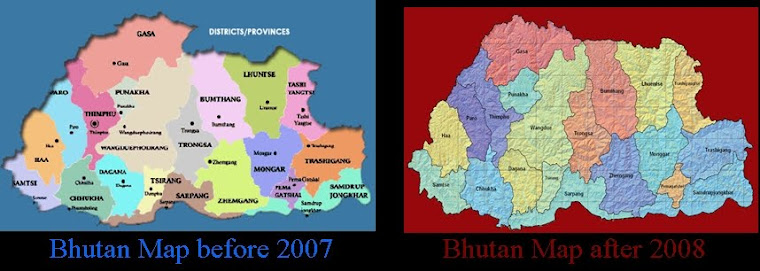
The Sorry Saga of Bhutan's North

The Sorry Saga of Bhutan's North
Click over the map to know the differences
Showing posts with label Good news. Show all posts

Friday, September 10, 2010

First private Dzongkha weekly launched


A brand new newspaper with a reader-friendly language

Druk Neytshuel: The seventh newspaper hit the stand yesterday

30 August, 2010 - At a time when the quality of Dzongkha is being questioned and discussed in every possible medium comes an opportune attempt to apprise Bhutanese of their national language.

Beginners can take a plunge into the language, starting with the alphabets illustrated in elementary pictures and interpretations.

Students can refer their Dzongkha textbook contents in a simplest elucidation. Those who need help with essays and application writing can allude to tutorials. Office-goers can stay abreast about events unfolding around them in most comprehensible Dzongkha.

In short, it is Dzongkha in its highest reader-friendly form, or so the first private Dzongkha newspaper, Druk Neytshuel, promises its readers.

As for the first issue launched and distributed free yesterday, the 24-page paper lived up to their words. With an apt main story questioning the varied spelling use on signboards, the paper carried stories on diverse subjects in an easy-to-read and easy-to-understand Dzongkha.

“This is Zhungkha in its simplest form, with slight inclination towards Wangkha, spoken popularly by people of Thimphu and Punakha,” the paper’s chief editor Chungdru Tshering said. “Everyone can speak the language, but a very few can read and write it. We’re trying to be as colloquial as possible.”

Apart from news updates, a well-organised section on driglam namzha, religion, economy, sports, community news and environment maintained a neat presentation on fresh topics.

The highlight was the section titled “Gup Of The Week”, an attempt to bring communities in the limelight by profiling the leaders and exposing problems prevailing in each gewog.

The free issue, which has taken on well with the readers, will come for Nu 10 starting next week.

“Compared with the Dzongkha issues of other private papers, this paper is on a different level all together,” Sangay Tenzin, a monk with the Thimphu rabdey, said. “It appears more serious than the previous ones, who, at times, give us an impression that they’re functioning just so to adhere to government policy, and not out of a genuine interest.”

One of the Dzongkha newspaper editors said the standard of the language and the news quality was impressive for a starter. “They should maintain it,” he said.

A few, however, felt the need to standardise the spellings of names and places and objects, as it read different in different newspapers.

The weekly paper, comprising a team of five reporters and two editors – graduates from the institute of language and cultural studies and former monks – feeds on 4 pages of advertisements in Dzongkha, and also caters to English ads in its inserts.

“We started off two months ago, with an intention to emulate government’s policy of promoting and preserving the national language,” Chungdu Tshering said.

By Kesang Dema

First private Dzongkha weekly launched


A brand new newspaper with a reader-friendly language

Druk Neytshuel: The seventh newspaper hit the stand yesterday

30 August, 2010 - At a time when the quality of Dzongkha is being questioned and discussed in every possible medium comes an opportune attempt to apprise Bhutanese of their national language.

Beginners can take a plunge into the language, starting with the alphabets illustrated in elementary pictures and interpretations.

Students can refer their Dzongkha textbook contents in a simplest elucidation. Those who need help with essays and application writing can allude to tutorials. Office-goers can stay abreast about events unfolding around them in most comprehensible Dzongkha.

In short, it is Dzongkha in its highest reader-friendly form, or so the first private Dzongkha newspaper, Druk Neytshuel, promises its readers.

As for the first issue launched and distributed free yesterday, the 24-page paper lived up to their words. With an apt main story questioning the varied spelling use on signboards, the paper carried stories on diverse subjects in an easy-to-read and easy-to-understand Dzongkha.

“This is Zhungkha in its simplest form, with slight inclination towards Wangkha, spoken popularly by people of Thimphu and Punakha,” the paper’s chief editor Chungdru Tshering said. “Everyone can speak the language, but a very few can read and write it. We’re trying to be as colloquial as possible.”

Apart from news updates, a well-organised section on driglam namzha, religion, economy, sports, community news and environment maintained a neat presentation on fresh topics.

The highlight was the section titled “Gup Of The Week”, an attempt to bring communities in the limelight by profiling the leaders and exposing problems prevailing in each gewog.

The free issue, which has taken on well with the readers, will come for Nu 10 starting next week.

“Compared with the Dzongkha issues of other private papers, this paper is on a different level all together,” Sangay Tenzin, a monk with the Thimphu rabdey, said. “It appears more serious than the previous ones, who, at times, give us an impression that they’re functioning just so to adhere to government policy, and not out of a genuine interest.”

One of the Dzongkha newspaper editors said the standard of the language and the news quality was impressive for a starter. “They should maintain it,” he said.

A few, however, felt the need to standardise the spellings of names and places and objects, as it read different in different newspapers.

The weekly paper, comprising a team of five reporters and two editors – graduates from the institute of language and cultural studies and former monks – feeds on 4 pages of advertisements in Dzongkha, and also caters to English ads in its inserts.

“We started off two months ago, with an intention to emulate government’s policy of promoting and preserving the national language,” Chungdu Tshering said.

By Kesang Dema
Kuensel

Tuesday, November 17, 2009

Let's talk turkey

Let's talk turkey

By DOROTHY DUFFY
Monday, November 16, 2009
From over the river to Grandma's house to over the hill as Grandma we've had so many Thanksgivings with a lot of stuff in between.

Early Thanksgivings were a challenge. Just where to sit everyone, often in houses without dining rooms, meant some sat on the arms of chairs, boxes with pillows or babies on laps. Our mothers cooked "from scratch" on wood stoves. My mother would chop a huge Hubbard squash into workable pieces on the block outdoors, cook it, squash and season it, yet once en route to the table, it slipped from the fingers to the floor. It was hardly missed with all the other root vegetables but love's labor lost!

My dad's job was to amuse us by having Headless Tom turkey trot on the white enameled tabletop. Diddle, diddle, diddle, . . .

I made my first Thanksgiving dinner at age 12 when my mother was bedridden. She instructed me from the pillows to the pot. I don't remember how I did — guess the others were thankful they didn't have to do it.

My second attempt at turkey was in the 50s when I had my first apartment in Long Beach, Long Island — affordable but so desolate and barren in the winter — me and the gulls. I invited my sister, aunt and uncle to dinner. My face was flushed from fuss and flurry as I remembered my mother's to be. The pride soon drained when my uncle, the carver, pulled out a sack of cooked innards from Tom's cavity.

Just as my marriage introduced more ethnic cultures in the family mix, so did the traditions. My siblings married French-Canadians adding toutierre to the menu. My German mother-in-law's rutabaga with potatoes and creamed onions were included with my family's Harvard beets, mincemeat pie and Grammie Lowell's Indian Pudding. Later when the three Italian in-laws joined the family, antipasto and lasagna might appear.

The first time the big Duffy family sat at our table laden and labored over with luscious food, cornucopias, candles and linens, the men asked the ladies to sit back so they could still watch some overgrown kid kick a pigskin about on the television. In a twit, I shut off the TV, slammed the doors shut and with hands planted firmly on each hip, addressed the old sports with, "I spent all day cooking this meal! You better damned well spend a few minutes enjoying it!"

This actually claimed my role in the family. My mother-in-law was beaming. Thanksgiving dinners take 18 hours to prepare. They are consumed in 12 minutes. Half-times take 12 minutes. This is not coincidence. - Erma Bombeck.

When I was expecting my second child, I couldn't stand the smell of turkey. I bundled the bird up and stuck it in freezer. Yet, even much later and thawed, it still nauseated me, so I sent it flying and stuck to my doughnuts.

Over the years, a French exchange student was our guest with "Tres bien, Madame" and a Fresh Air Fund kid from the ghetto who announced, "I don't like white meat." Now he's a cook on Riker's Island. Recently, I have dined with Turkish and Bhutanese refugees who didn't have a clue what they were eating but were truly thankful of the moment.

Thanksgivings stay traditional for most, invite change for others or arouse emotions for many. The turkey itself has changed. Some now are marinated, boneless, smoked, deep-fried. The range-grown lean and lanky turkeys are now like our young ladies, plump and full-breasted — even the Toms. Oh, oh, another quote: I love Thanksgiving turkey. It's the only time in Los Angeles that you see natural breasts. - Arnold Schwarzenegger.

But the saddest for some may be to dine alone. While you can eat what you want, where you want, when you want and with or without half-time frolics and really pampering the palette, it isn't the same without the family hassle.

Bon appétit, mon amis!

Bhutanese in NH find American Dream elusive

Refugees in NH find American Dream elusive

MICHAEL COUSINEAU
CONCORD
Sunday, Nov. 15, 2009


The American Dream hasn't reached the living rooms of Pema Tamang and Bhakta Dhital. Job rejection letters and public-assistance checks have arrived instead.

"There are no jobs and nothing to do," said Tamang, a Bhutanese refugee who arrived in New Hampshire last December.

The Concord resident worked three months at Walmart before his temporary job ended, and he hasn't received one callback from any of the 150-plus businesses with whom he's left applications. Tamang recently had his electricity turned off briefly after he fell behind on his payments.

"It's not like I don't like to pay for the bill, but I have no money," said the father of two.

"I'm just trying to have a better time and a better life," said Tamang, 27, who attends English classes twice a week. "I hope that this bad time doesn't go like this forever."

Refugees arriving in the United States in the past year have run straight into strong financial headwinds.

In New Hampshire alone, more than 51,000 workers went jobless last month, nearly 23,000 more than a year earlier.

New Hampshire had 561 refugees from nine countries settle here during the fiscal year ending Sept. 30, including 462 from the Asian nation of Bhutan, where thousands fled more than a decade ago and relocated in nearby Nepal resettlement camps. Since the early 1980s, more than 6,500 refugees have made New Hampshire their new home.

Refugees receive a variety of government assistance when they arrive here, including at least four months of rental help, as well as food stamps and medical care.

"Refugees historically would get jobs within three to six months after arrival," said Amy Marchildon, director of new American services for Lutheran Social Services of New England, which settles refugees in the Concord-Laconia area.

"Now, it's probably taking between eight and 12 months. Because there's a higher competition for jobs, the refugees might be at a disadvantage if they don't have the same level of skills," she said.

Public assistance

A half mile from Tamang's apartment, Bhakta Dhital and his wife, Asha, live in another Loudon Road complex. They now rely on city welfare to help pay the rent.

"I'll do any kind of job," said Bhakta Dhital, 28, who arrived here in June. "We want to be independent."

Carol Moore, a Concord psychotherapist who has been helping the Dhital and Tamang families, said she wishes the resettlement groups would do more.

"It drives me nuts," she said.

Marchildon said refugees need to learn to become self-sufficient.

"I think a challenge for resettlement agencies is managing refugees' expectations. Many, but not all, have higher expectations than what the service delivery is," she said. "It's a new system that they have to learn. Refugees have been in situations where other agencies are supporting them and keeping them alive and haven't had to make decisions for them.

"The feeling we should be doing everything for them can be a blow when we're trying to teach them to do things for themselves," Marchildon said.

"With the downturn in the economy, the hope of starting their lives sooner rather than later is exacerbating their feelings of frustration and anger," she said.

Barbara Seebart, the state's refugee coordinator, said the current economic downturn means it's "basically taking longer for refugees to get jobs."

Possible employment

The Dhitals sometimes rely on a Bhutanese friend who lived in their refugee camp. Devi Bhattarai of Concord has a car, a 2000 Nissan, that helps them when searching for work.

Bhattarai and Mr. Dhital believe they have a job lined up for January at a Loudon landscaping business.

"I have to sell my skills," said Dhital, who taught computer science in Nepal.

His wife said she doesn't like being jobless.

"It's makes our body so lazy," she said.


Pema Tamang (left) of Bhutan and his friend Ganga Chimariya have been seeking work to support their families. (THOMAS ROY)

The Dhitals spent 18 years in a refugee camp of 18,000 in Nepal after their families were driven from their Bhutan homeland. They were married in the camp last year.

Sure, their Concord apartment doesn't have cable and they rely on free wireless that fades in and out. But it's a far cry from their Nepal residence, which was made of bamboo and plastic.

Rainy season meant wetness inside and out, Mrs. Dhital said.

"When I was in Nepal, I thought if I get a chance to go to America, I'd make my future bright," Asha Dhital said. "In Nepal, it's very, very hard."

Nepal meant food rations and no driver's license. It also meant no future.

In the United States, they believe in a future, even if it might take longer to brighten. Already, they feel they are ahead in life.

"Compared to Nepal, it's very luxurious here," Mr. Dhital said.


Linked from here: http://www.unionleader.com/article.aspx?headline=Refugees+in+NH+find+American+Dream+elusive&articleId=0967e20d-4a0a-415e-8c3e-f5fb1b68eed4