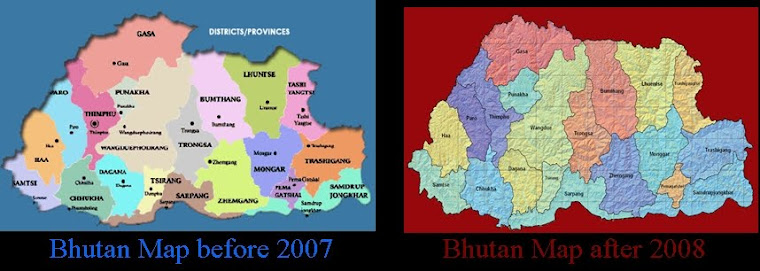
The Sorry Saga of Bhutan's North

The Sorry Saga of Bhutan's North
Click over the map to know the differences
Showing posts with label eviction. Show all posts

Monday, October 7, 2013

Bhutan Prepares for Another Eviction

........Population figure discrepancyThere is a difference of 100,00 between the NSB projection and the census record 

Statistics: Bhutan’s population could be about 100,000 lower than projections of the national statistical bureau (NSB), according to figures maintained by the home ministry’s department of civil registration and census.

Bhutan’s population stood at 633,607 as of September 11 this year, as per the civil registry records. NSB’s projections put the population figure at 733,004 for 2013.

NSB’s projections are based on the population growth rate of 1.9 percent, which is derived from the 2005 population and housing census of Bhutan (PHCB). Accordingly, NSB projected the population for 2012 at 720,679 with 375,554 males and 345,125 females.

Civil registration officials presented the figures last month to district judges, who were in Thimphu attending a training programme.

According to the census figure, 322,020 persons are males and 311,587 are females. By age group, 390,802 fall between age group of 18 to 65 years, which makes up 62 percent of the population. The remaining 206,915 are under 17 years. Six percent or 35,890 persons are above 66 years of age.

According to the Constitution, a person, both of whose parents are citizens of Bhutan, shall be a natural born citizen of Bhutan. A person, domiciled in Bhutan on or before December 31, 1958, and whose name, if registered in the official record of the government of Bhutan, shall be a citizen of Bhutan by registration.

The 2005 population and housing census of Bhutan conducted in May that year, and the principal source of information for the NSB, was enumerated using the de facto and de jure method.

Then the actual resident population enumerated, as of May 30 and 31, 2005, was 634,982 persons, of which 333,595 persons were male and 301,387 were females. The total urban population was 196,111 while 438,871 lived in rural areas.


The population break up as of September 11

Population censuses were undertaken in 1969 and 1980, during which population figures were found to be bloated because of the large influx of migrants from neighbouring countries, particularly labour migrants at the instance of construction coinciding with the large-scale development work on infrastructure expansion.

“In 1996, the total population was found to be around 600,000,” the NSB 2012 statistical yearbook states.

Meanwhile, civil registry records state that, as of September 11 this year, 56,444 non-Bhutanese were in the country with valid permit.

Of this 51,139 were non-Bhutanese construction workers, 56 were student cardholders, 961 were dependent cardholders, 894 with marriage certificate card holders, who married Bhutanese, and 746 were entry permit holders.

There were also 2,648 Tibetans, of which 993 were green card holders, who opted to stay in Bhutan, while 1,655 were stay permit holders, who opted to leave the country as and when they wished.

The number of non-Bhutanese residing in Bhutan is expected to be higher. For instance, immigration officials detected a total of 2,952 illegal immigrants from 2008 to 2012.

The highest numbers were detected in 2010 with 624, followed by 613 in 2009. The total figure detected in 2012 was 496.

The inspection during 2010 included 46 hawkers, 29 sadhus, 106 illegal sweepers and 193 illegal maids.

Immigration officials also collected Nu 36.1M as fines and penalties between 2010 and 2103. The highest collection of Nu 13.73M was recorded in 2012-13, followed by Nu 12.48M in 2011-12.

For the 2013 general elections in July this year, the election commission of Bhutan used the data of the civil registry to finalise the electoral roll. According to the commission, 381,790 were registered to vote in the Assembly elections, which means they feature in the census records and can vote.

Meanwhile, development practitioners point out that certain key economic indicators, such as per capita income could significantly change if the civil registry figures are used in the calculation.

By Rinzin Wangchuk


Saturday, March 12, 2011

Bhutan's Government Officers Ursurp People's Land, Torture the Owner

STATEMENT OF MOTIKHAR ACHRAJA Date:-11/03/2011

1. My Father Mr. Devi Charan Acharja was forced to live Bhutan in June 1992.
2. In 1986 I separated from the joint family and staying with my nine family members. While appropriating the land among five brothers, I got the share of land measuring 10.31 acres under the old thram (land registration number) no.114 and the new 158.However, mean while the Home ministry had suspended the land registration and transfer or transaction of any land deal. While allotting the said land, I was also given the responsibility of education and marriage of four younger brothers and five sisters.
3. I also cleared the loan of Rs.31, 514.00 taken by my father from Bhutan Development Finance Corporation (BDFC) mortgaging the same land in 1994 for fishery development.
4. Since my father and other family members were evicted, I was mending the land until the then Dzongda of Sarbang district Dr.Sonam Tenzing on April 21, 1998 verbally to my shock told me that the land does not belong to me.
5. I could not approach the king immediately for consideration of my case due to financial constraint. I could do only in October 1998.
6. The king had ordered the Royal chamberlain (Zimpon) Dorji Gyeltshen to forward the case to the home ministry for verification .After that there was no any intimation to me pertain the case.
7. I approached the High court in 1999 for redress of my case as I did not get anything from the King. As there was no any response or action even from the High court, again I appealed to the high court in 2002 requesting to review my case .In 2003,the High court forwarded the case to Home Ministry to look into the matter. When I approached the Home ministry and met the then home minister Tinley Gyamtso, he told me that it is the duty of the court to ascertain whether you get the land or not. I was regularly paying land tax and other government liabilities.
8. To my surprise and in my absence, Mr. Nima Khandu came and claimed that the land had been allotted to him by the government under resettlement scheme along with the building. My children defied and sent him away when he came with some monks to lay the foundation.
9. I also appealed to the then Agriculture minister Sangay Nedup on 1-1-2004 and november2004 for transfer of registration of land to my name from my father.
10. On 6 April 2004, Dzongda Sonam Dawa, Dungpa and Gup (block head) Karma and Tshogpa in my absence came to my house and told my children to vacate the land and the house. When my children started crying, the Dzongda pointed the area leaving the house for demarcation. On 7th April 2004, Dzongkhag land surveyor Mr. I.K. Suncheuri, resettlement coordinator district livestock officer, Gup and Tshokpa came in my absence and demarcated the area along with 1.5 acres of betel nut orchard and paddy field totaling 5 acres.

11. When Nima Khandu came and started building house, my son Durga Prasad Acharja rejected and dismantled the poles.
12. On 8th may 2004 my son Durga Prasad Acharja was arrested and taken to Lodrai jail, Galephu and the court in Galephu sentenced him to one year jail on charges of violating section Na 1-4 of Thrimzhung Chenpo (supreme law).

13. Unsatisfied with the unfair decision of the Galephu court, I appealed to the Sarbhang district court for fair judgment and justice. However, the district court too did not give any decision of its own and justified the decision of the Galephu court.
14. On 21-9-2004, the Dzongda Sonam Dawa issued a last warning letter to me written in Dzongkha which I cannot read except the English word “Last Warning” written in bracket.
15. On 2-2-2005 again appealed the Agriculture minister on his visit to our block Chujegang (Danabari) to look into my case and on the spot decision. The minister then and there ordered the surveyor general Mr.Sithar Namgyel who was also with the minister’s entourage to look into the case and resolve the problem. After hearing my story and the facts by the Surveyor general, he told the two judges of sub-division Galephu and the Sarbhang district to transfer the land registration in my name as I posses the agreement from my father.
16. On 8-2-2005 the Surveyor General has written to the judge, Galephu to transfer the land registration in my name. It is more than 5 years, the court has not done anything to transfer the land and has not respected the Surveyor General’s letter too asking to transfer the land in my name.
17. In 2005 the Sarbhang court also justified the verdict of Galephu court of imprisonment of my son.
18. Since I felt injustice and unfair verdict of my son, I appealed to the high court Thimpu in 2005.
19. The High court judge Karma Sherpa also game the verdict that since the land has not been transferred within one year of the agreement, the land thus belongs to the government and the imprisonment of son is right (bench no.3). Further I was sent to the Royal Bhutan Police Central box, Thimpu and kept there for one month and 25 days without any question.
20. Not satisfied with the verdict of bench 3, I appealed to the full bench consisting of judges Passang Topgay, Thinglay weizer, K.B.Ghaley, Sithar Namgyal, Jigme Zangpo and Tshering Wangchuk. The judges instead of giving fair judgment, they alleged me of stealing betel nuts grown in my own land and fined me Rs. 27000.00 saying that the land belonged to the government and allotted to Nima Khandu. Further I was asked to pay fine of Rs 20000 for dry land Rs 35000.oo for wet land per acre totaling Rs 1,57,00.00 and also additional Rs9862 as compensation to Nima Khandu and asked to vacate the land. The decision was passed on 5-7-2006 vide case no.1583.
21. On 19-7-2006 not satisfied with the decision of the High court, again I approached the King. The king ordered the Royal chamberlain office to issue a letter to the Home minister to look into the matter and resolve it. The king also ordered that in case of complication and unable to solve the problem, the matter should be forwarded to Gyelpoi Zimpon’s office.
22. In 2007 the high court summoned and asked me to produce the decision paper. Along with the decision paper, I showed the letter issued by the Gyelpoi Zimpon’s office. Again I went to the Zimpon’s office to inquire the progress. I was told that nothing has come to the office from home ministry. I went to the home ministry and on inquiry, I was told that my letter was forwarded to local government section. At last the letter was found lying in the office without any action. The local government office told me that they would dispatch the letter to the Dzongkhag office. On 1-10-2007 the home ministry had sent the detail report of the plot no.SSD-03 to the Zimpon’s office.
a. On May 18, 2009, I appealed to the prime minister, Thimpu stating that nothing has happened in regard to transfer of my land registration from my father. The case was put up in the cabinet. The cabinet has written to the department of the land record to look into the case. The land record had written to the Dzongkhag citing all the correspondence regarding the said land but there was no any response to the query from the Land record. The office had inquired whether there is new land (Sathram no.158, previous 114).The new thram was also issued in my father’s name Devi Charan Acharja. This is so because he had not taken a pie as compensation.
23. On June 2010 I appealed the 5th king through the Gyelpoi Zimpon office, Thimpu. The Zimpon office; Thimpu had forwarded the appeal to the Zimpon welfare office, Bumthang as Sarbhang Dzongkhag falls under the jurisdiction of welfare office, Bumthang.
24. In 2010 legal officer from the sarbang Dzongkhag investigated and reported to the Gyelpoi Zimpon legal officer Wang Gyeltshen. Mr. Wang Gyeltshen submitted the report to Gyelpoi Zimpon and the Gyelpoi Zimpon according to the order of the King instructed the high Court to respect the verdict of case no.1583 dated 5-7-2006.
25. On 2-12-2010, according to the instruction from Dzongkhag, the Gup of Chujegang Sangay Tshering issued order asking me not to touch anything in the land, either sow or reap any crop.
26. The high court has sent a letter on 31-1-2011 to Dungkhag court Galephu Instructing to respect the old decision of 2006.

27. On 22-2-2011, I plucked 98 sacks of betel nut grown in my land. While plucking the nuts the Gup came to my house and went. Later on sent the Tshogpa to call me to his office with the laborers numbering 10. He handed me a letter written in Dzongkha and asked me immediately to go to Galephu to meet the Dungpa. When I came to Dungkhag to meet the Dungpa who was away and had to stay overnight in Galephu. The laborers packed the betel nuts in 98 sacks and loaded on the truck number BP-2-1326 and were bringing to Galephu, while on the way to Galephu, the truck with the load was intercepted by the Royal Bhutan Police and taken into custody and is kept in the police centre, Galephu.
Mr. Motikhar Acharja is arrested by the royal Bhutan Police, Galephu on 26th February 2011 and is kept in the Galephu jail without any question. The Human Rights organization of Bhutan (HUROB) has appealed to all the concern for Urgent Action on 26th February 2011 and requested to write to the Prime Minister of Bhutan for justice and immediate release of Mr. Acharja. HUROB firmly believes that the respective concern Human Rights Organizations and Diplomatic missions have taken appropriate steps to pressurize the Royal government of Bhutan (RGOB) and hopeful that Mr. Acharja gets justice and be released who is till date kept in the jail, Galephu.
The above statement was taken by HUROB staff on 24th February 2011from Mr. Acharja. He has availed more than 70 letters of correspondence and courts decisions for ready reference. Mr. Acharja statement and his untiring saga of fight for justice and right is one testimony to fathom by all conscientious human being that how much injustice being meted out to southern Bhutanese of Nepali speaking by the Bhutanese regime starting from the King, the supreme authority to the lowest Block head. Even the Court that talk of fair justice without favour and fear is biased when concerning the southern Bhutanese. One should also comprehend that people like Acharja who dares to challenge the government is not reaching any where to get justice that how many innocent Bhutanese especially the Nepali speaking are being suppressed, oppressed and denied justice. Again HUROB requests everyone who receives this statement to promptly take action. Your small gesture is doing to make big difference in the life of Mr. Acharja and thousands of southern Bhutanese who are silently suffering. The HUROB also request the core countries for Bhutanese refugees which are resettling the Bhutanese refugees to form a committee to independently study the unabated suppression of the southern Bhutanese, question of nationality and citizenship of about 80000 relatives of refugees still living in Bhutan and denial of justice.
Thank you for your kind and continuous support and solidarity.

S.B.Subba
Chairman
HUROB
Email: sbyongya@yhaoo.com
hurob1991@gmail.com
Mobile: +91-7602895197.

Sunday, October 31, 2010

NEPAL – BHUTAN Convicted in Bhutan, Christian gets Protestant bishop support

For exiles, the ethnic Nepali Protestant’s conviction is just another example of the government’s policies against minorities and non-Buddhist religions. Protestant bishop says, the government “should at least maintain basic democratic freedoms and human rights”.


Kathmandu – “This is the picture of Bhutanese suppression against religious freedom,” said Rev Narayan Sharma, Protestant bishop of Nepal. “We should condemn such undemocratic practices wherever they are,” he added. He was speaking about the case involving Prem Singh Gurung, an ethnic Bhutanese-Nepali Christian, who was sentenced to three years in prison for screening a movie about Christianity. “Bhutan,” the bishop said, “should at least maintain basic democratic freedoms and human rights.”

In 2006, Bhutan formally began a shift towards a democracy after centuries of absolute monarchy that banned all religions other than Buddhism and rejected all ethnic groups other than the Bhutanese.

The new constitution adopted in 2008 recognises freedom of religion for all Bhutanese, as long as the appropriate authorities are informed. Proselytising is outlawed however. The same is true for publishing Bibles, building Christian schools and allowing men and women religious into the country.

For more than 100,000 ethnic Nepali refugees, including more than 10,000 Christians, the new democratic dispensation has not changed things much. Between 977 and 199, they were subject to a virtual policy of ethnic cleansing.

Gurung’s conviction has outraged many in the refugee camps. For them, the court decision is just another example of government repression against ethnic Nepalis and non-Buddhists.

For Rijen Lama, a Christian Bhutanese refugee, “We should all unite regardless of religion and fight against Bhutanese suppression” of minorities.

Bhutanese authorities are expelling people who want freedom for the country, be they foreigners or Bhutanese nationals, Tek Nath Rijal, a senior Bhutanese refugee leader, said. “This is how many are becoming refugees.” For him, the international community should do something to stop these atrocities.

Linked from

Friday, September 17, 2010

Torture in Bhutan

Tale of Terrible Torture (Exclusive)
17 September 2010
By Pabitra Gautam
It was past midnight, the 22nd of November 1990. I was sleeping with my children at home. Suddenly, I was woken up by the sound of banging on my door. When I opened the door, I was chilled to see my husband, Hom Nath Gautam and step son, Deo Dutta Gautam in handcuffs arrested by Major Chachu, accompanied by a dozen policemen. They were arrested from our own cattle farm, located at a distance from home, where they were sleeping for the night. Major Chachu said that my husband and son were being taken for questioning to the police station and would be sent back home the next day.

They were taken to Goshi High School, which was converted into detention-centre-cum-army-barrack. I was not allowed to see my husband and son while they were in detention. I got the information about my husband, only after Mani Prasad Ghimirey was released from the detention centre, where my husband was kept.

According to Mani Prasad, my husband was interrogated regarding the donation made to the Bhutan People’s Party. Out of extreme fear and weakness, he could not answer promptly to what had been asked. The army began to kick him randomly and mercilessly with their boots. When he denied the allegation of donation, he was made to squat on the floor and was hit on his neck and shoulder. When he continued to deny the allegation, he was further beaten with a wooden baton and whipped until he began to bleed. Then, the police hung him by his legs from the hook in the ceiling. He was hung for the second time – even when he was bleeding from his nose.


Late Gautam. Photo Courtesy/Family (HERE)
Thereafter, beating with wooden batons, whipping, clamping and electrocuting became a routine. He was usually tortured at midnight. The most common practice was to clamp his thighs with wooden poles, while policemen stood at the far ends of the pole and jumped. It often resulted in losing consciousness out of extreme pain and bleeding. Once he regained consciousness, he was beaten again. After 12 days Deo Dutta returned home, but my husband continued to be detained.

After three months of continuous torture, he was taken to Damphu, an adjacent district, where he was kept overnight and tortured again before transferring to Chemgang jail, near the Capital, Thimphu. At Damphu, he had already lost control of his urinary bladder and rectum. He began to vomit blood and pass blood through stool. While in Chemgang, my husband was given very little food to eat and made to do heavy work – like carrying stones and constructing the prison house without any rest. They were whipped and ordered to run down the slope with heavy iron shackles. Due to continuous torture in Chemgang, he began to bleed heavily and completely lost his appetite. Yet, he was not given any medical attention but was compelled to work and was tortured as usual. When his health aggravated further, his friends requested the prison authority and he was admitted in Thimphu hospital. I was never let to know about his deteriorating health condition.

Back in the village, I worked hard to bring up my children all alone. My eldest son Chitra was 10 yrs; daughter Dhan Maya – 8 yrs; son Mohan – 6 yrs; daughter Khaga Maya – 4 yrs and youngest son Khem was 2 yrs old. The story of torture of my husband, narrated by his prison inmates, made me cry all day and night. I often used to hide or hold my tears back, fearing that my children would be distressed.

Few months after my husband’s arrest, the army began to patrol the Emirey village especially at night. Each day became a nightmare for the women and children, for all adult males were either in prison or had fled the village fearing arrest. My children were afraid of the sight of the army in uniform and they used to cry and run away. The village headman, Lok Nath Bajgain, had shifted his office to the army barrack housed in Goshi School. He used to circulate the orders received from Home Ministry to evict people from the village. The army came every day and asked for chickens or goats to take for free. Although I had supplied them with rice and dairy products, I refused to give away my two goats which I had rearing for several years. Despite of my repeated requests, the army ultimately took away the goats without paying for them. The villagers were forced to meet all the expenses of the army in the barrack.

Even after one year of my husband’s arrest, I was still unclear about his whereabouts. One day the district council member, Mukti Nath Chamlagain, came with some army men and asked me to fill up a ‘voluntary migration form’ to leave Bhutan. He said that my husband would be released as soon as the form is filled and deposited in the district office. I signed the form with the hope that I would get my husband back soon. Mukti Nath told me to come to the block office at Emirey the next day to take photograph with my husband. But as I reached the block office, there was Mukti Nath with a squad of army waiting to take my picture. Mukti Nath said that unless I get my photograph taken to complete the process to leave Bhutan, my husband would have to bear continuous torture and would never be released. I insisted that unless he was released, I alone would not be in a position to handle the kids and leave Bhutan. I told them clearly that only my husband would decide what we would do next. They tried all possible ways to get my photograph taken, but I kept on insisting that I would do it only with my husband. At one point, I met the village headman who said that I would not have to fill up the form. If I leave Bhutan, my husband would be released. It was unexpected, but this gave me some hope.

Once again, Mukti Nath came to my house with army men and told me to be ready for the photograph. As I refused again, an army officer pressed a gun on my head and said, ‘If you leave Bhutan, your husband will accompany you at the gate (at Indo-Bhutan border)’. However, I gathered some courage and said, “You called me several times to the block office assuring me that I would see my husband – but he is never there. So now, how can I be sure whether I will find my husband or you (army) at that gate?” The officer got angry and hit me with the butt of his rifle. I collapsed immediately and fell on the ground and hit a big stone with my back, and my head struck against a peeple tree. I became unconscious. When I regained my conscious, the army had left.

One day, we got a notice from block office to report immediately. Accompanied by another woman, whose husband too was in jail, I reached the block office. Again, we were led to the same army squad and were asked to complete the form by letting them to take our photographs. Pestered by continuous mental torture, I shouted at them saying – ‘Bring our children right here and kill us together instead of calling and lying time and again or else, take us to where our husbands are’. Fortunately, the village headman, heard it and told us to go back home.

The village was haunted. In the night, the army heavily patrolled the area. I could never go out even for a nature’s call, while the children used to do it in the house itself. Every minute, we feared of being arrested, beaten or sexually abused. The worst of all, Emirey residents had to send their girls and women, according to a circular sent through the village headman, to the army barrack at night. As far as I can recall, at least eight girls and women, one of whom was only 13 years old, fell prey to such a routine. Most of them were married, whose husbands were either in jail or had left the village. One of them returned only after a week from the barrack. I too narrowly escaped the routine!

As I received a call to attend the army at the barrack, the assistant village headman used his wit to save me. As planned, I carried two of my five children and whisked away to hide in nearby shade, where straw was stored for the cattle, while he slept at the courtyard of my house with his friend. At night, around 10 pm, the army came and inquired why they failed to send me to the barrack. The assistant headman said, “We have been waiting for her to come in, but she hasn’t been around here. We’ll wait for her till morning and when she comes in, we’ll bring her to the barrack’. The army was convinced and went away. As the army would return tomorrow, the assistant village headman said that he would not be able to save me next time risking his own life. The next day, he also read out a letter sent from the district office that if I failed to leave the house the army would set it on fire.

Following this, I had no option than to leave the house where I had spent almost half of my life with my husband and where my children were born and were growing up. That day, I neatly cleaned the house, set the cattle free, lit the evening lamp, and left home before nightfall, leaving all doors open.

I carried my youngest son on my back and kept walking, with other children, until I reached my relative’s house in another village. I stayed there for one month with them. However, my relatives constantly feared that the army would come to know about me and they would have to face severe consequences for sheltering me. So I left that house too and sheltered at the house of another relative at another village. I carried a pair of clothes each for my children and nothing more. While staying in my new shelter, I again received a letter from the district office calling me to complete the voluntary migration form. I ignored three such letters.

Then one day I received a message that my husband was released. I was also told that he was sick and was in the care of Mani Prasad Ghimirey. With my children, I rushed to see him and reached there in the evening. However, when we reached the village and met my husband, he was struggling on his death bed. He could not eat or drink anything. When we lost hope of his survival, we decided to perform Baitarni (a religious ritual performed for one’s easy exit from the physical world). After 13 days, he passed away in his relative’s home. The well wishers and relatives in village gathered for his funeral. While his corpse was being tied to the coffin, a letter was received from the district administrator office which required me to report to his office immediately to complete the voluntary migration form.

Traditionally, a wife would mourn the death of her husband for 13 days, confined in a room, cooking on her own, isolated from the people around, except from underage children. But due to reasons of insecurity, I began to mourn his death, in the courtyard of Mani Prasad Ghimirey, who had already left the house following threats. In the freezing winter, only with a piece of white wrapper on my body, I spent seven days with my children.

When Mani Prasad sent one Adhikari escort, I set out with him for another village called Alekatahare. I carried my youngest son, Khem on my back, tied a white piece of cloth on my waist and walked with my children for the whole day. We had nothing to eat or drink. After walking for few hours, my four years old daughter was exhausted and could walk no more. So I carried her on my shoulder and kept walking without rest. Since I had refused to take photograph to complete the voluntary migration form, there was constant fear of being arrested or shot by the patrolling army. A dark cave, in the middle of the forest became our shelter for that night. It was a dreadful cave and my children were scared of snakes. But, it was safe as we would be hidden from the patrolling army. The escort shared a little of his beaten rice. We had to walk for one more day to reach Alekatahare on foot. The next day too, we carried out the similar journey hiding from security forces and spies. We found a cow shed by the evening where we spent that night amongst the hip of straw. We ate the remaining bitten rice for dinner.

The next day, we reached Alekatahare, where Mani Prasad was preparing to flee to India. He was waiting to rescue me, after I completed the 13 days mourning for my husband. When we reached Alekatahare, I still had two days left to complete the mourning. At Alekatahare, villagers helped me by collecting necessary materials to perform the final ritual of mourning on the 13th day.

After completing the final ritual, we had to flee from the village as soon as possible. I neither had money nor any other resources. And I did not have any knowledge as to where we were heading to. In the next few days we reached Kali Khola, a place near the Indian border. Mani Prasad made all arrangements, including the fare, for his family and mine to flee from Bhutan. We waited in the open lawn for three days before we boarded an Indian Truck at 6 am to flee from Bhutan – eventually reaching the refugee camp in eastern Nepal.


BNS