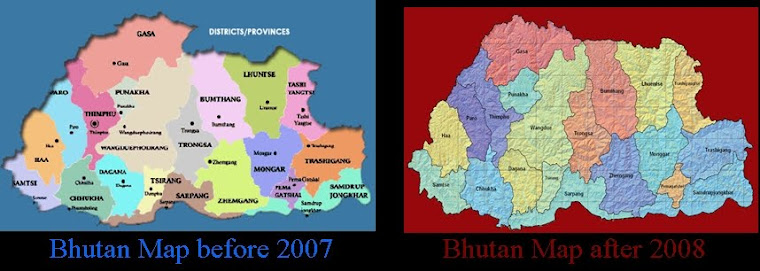
The Sorry Saga of Bhutan's North

The Sorry Saga of Bhutan's North
Click over the map to know the differences
Showing posts with label Host people's reaction. Show all posts

Thursday, February 4, 2010

Visit of great value: Nepal

•First high-level visit since fall of Maoist govt
ANIL GIRI


KATHMANDU, JAN 13 -

India’s External Affairs Minister S.M. Krishna will on Friday start his three-day visit to Nepal. The visit is being seen here as New Delhi’s effort to address Nepal’s call for reciprocity in high-level bilateral visits.

The visit, which begins on Jan. 15, will be his first to Nepal since he assumed office in May. Accompanying him will be senior South Block officials, including Foreign Secretary Nirupama Rao and Joint Secretary Satish Mehta.

“This is one of those rare visits where the Indian foreign minister and secretary are travelling together,” said a senior foreign ministry official. “That gives the visit strong political symbolism. India’s concerns in Nepal are widespread and deep.”


The visit will deal with a range of bilateral issues but is aimed primarily at giving Nepal-India ties a further boost with a message that Nepal remains a very important partner for India, the official said.

The visit will provide the Indian political leadership the opportunity to take first-hand stock of the state of the peace process in Nepal, he said.

To many, the visit will hold special significance to see how New Delhi-Maoist relation shape up after the visit. It is the first high-level visit by seniormost Indian diplomats since the fall of the Maoist government in May. “Especially interesting will be to see how Indian officials treat the Maoists,” said Hari Rokka, a Constituent Assembly member and analyst with close ties with the UCPN (Maoist). “It will be closely followed how the Indian leadership approaches the border issue raised by the opposition and the current state of political stalemate.”

Krishna will also meet Maoist Chairman Pushpa Kamal Dahal at a time when the party is in the midst of its campaign to safeguard “national sovereignty”.

Krishna is likely to hold talks with his counterpart Sujata Koirala on close to a dozen issues. “This is a follow-up visit to the prime minister’s visit to Delhi in August,” said an official. “The two will assess the progress made.”

Issues of Indian compensation for Gandak flood victims and extension of two new cross-border rail links will be taken up.

Delay in construction of the Indian-assisted Naumure hydro project (240mw), early implementation of the Bagmati Civilisation Project and Indian assurance for import of LPG from Haldiya port will be taken up. Koirala will also discuss effective management of Nepal-India border. Nepal will ask for more scholarships for Nepali students in India, construction of Mahendranagar-Tanakpur link road and assistance for two suspension bridges in the Far-Western region.

“Nepal will also request Indian support in persuading Bhutan to repatriate refugees,” said the official.

Thursday, December 10, 2009

Taxpayers bear the burden as refugee resettlement soars

Posted by acorcoran on December 9, 2009

That is the title of an opinion piece that appeared today in the Tennessean. Freelance writer Don Barnett raises many of the same issues we have been raising here for the last 2 and a half years. Unfortunately, reform of the program won’t happen until the media begin to investigate what is hidden behind a ‘presumption of good intentions.’

I’ll have more comments later on this excellent op-ed, but wanted to get it to you right away.

This fiscal year, the U.S. resettled almost three times as many refugees as all the rest of the countries in the industrialized world combined.

Despite the recession, growing poverty, unemployment and homelessness, the U.S. resettled 75,000 refugees, the highest number of admissions since 9/11.

This is possible only because what was once the calling of true sacrificial charity and private sponsors is now the responsibility of the American taxpayer. Traditional sponsor duties have been replaced by access to welfare upon arrival for refugees and an opaque stream of grant money from seemingly every government agency except NASA.

In recent years up to 95 percent of the refugees coming to the U.S. were referred by the U.N. High Commissioner for Refugees (UNHCR) or were the relatives of U.N.-picked refugees. Until the late 1990s, the U.S. picked the large majority of refugees for resettlement in the U.S.

Considering that the refugee influx causes increases in all legal and illegal immigration as family and social networks are established in the U.S., the U.N. is effectively dictating much of U.S. immigration policy.

A nonprofit nation of hundreds of taxpayer-funded organizations has grown up around refugee resettlement in the U.S. A government-funded study finds “U.S. resettlement communities are awash with ECBOs that exist in name only but provide little meaningful assistance.” ECBO stands for Ethnic Community Based Organization, a government-defined category of grant recipients.

The expansion of the fraud-prone refugee program and the transformation of refugee resettlement into a federal contracting business have given birth to a global refugee industry well-adapted to the federal grant and contract environment.

Catholic Charities with its parent the U.S. Conference of Catholic Bishops (USCCB ) is the largest refugee agency both nationally and in Nashville. It is neither a charity nor Catholic, but more an extension of a state welfare agency.

Sixty-five percent of Catholic Charities USA’s $3.6 billion annual budget comes from government sources. Refugee resettlement, a relatively small portion of its services, is covered by the government at closer to 100 percent. For nonprofits, it is profitable to be in refugee resettlement, and the executive directors of some of the 10 major resettlement agencies make almost as much as the president of the United States.

Nashville Catholic Charities devotes about 26 percent of its budget to “immigrants and refugees,” an amazingly high percentage considering most of that aid is going to recent refugee arrivals — a fraction of 1 percent of Nashville’s population. Interestingly, Tennessee recently put Nashville Catholic Charities in charge of distributing and monitoring federal “refugee” grant money to other NGOs in the state.

The possibility of a generous reception in the U.S. has created a “magnet effect” for refugees deciding between resettlement in the U.S. and integration in the region where they reside.

The once-independent faith-based and civic organizations have suffered their own “magnet effect,” causing a shift of efforts away from traditional works toward the more profitable refugee program. USCCB even lobbies for more business — that is, for higher refugee admission quotas.

Incentives built into refugee resettlement are behind much of its growth, especially as refugees themselves enter the federal contracting and lobbying business.

It is long past the time to lift the curtain of myth that protects this program from scrutiny.


From This Blog Refugee Resettlement Watch