The Obama administration’s «Asia Pivot» is playing out in earnest in joint U.S.-Indian-Israeli intelligence operations in the Himalayan region. The actions by the three cooperative nations’ intelligence agencies are aimed at limiting Chinese influence here. The strategy in the mountainous area of the Sino-Indian border complements other U.S. strategies now being played out in the East China Sea, the Yellow Sea, the South China Sea, the South Pacific, and the Indian Ocean to box in China and prevent it from challenging America’s military presence in the Asia-Pacific region…
The most recent covert operation in the encirclement of China played out in the recent election in the Buddhist Himalayan Kingdom of Bhutan. Under its previous government, led by the first democratically-elected Prime Minister, Jigmi Y. Thinley, Bhutan championed the concept of «Gross National Happiness,» which measured the progress of a nation based on the happiness and well-being of its people rather than by cold economic figures and statistics. Thinley traveled to the UN General Assembly in 2012 to urge the world’s nations to adopt Gross National Happiness as a principal in running their economies.
Such a notion of Gross National Happiness is anathema to the globalist economists and bankers that infest the World Bank, International Monetary Fund, and worldwide central banks, and these institutions took note of Thinley’s proposal for a New Bretton Woods system to replace the current domination of the world economy by the World Bank and IMF. However, it was primarily Bhutan’s alteration of its traditional Indian-directed foreign policy that spelled ultimate doom for Thinley.
Thinley committed an unforgivable sin in New Delhi’s eyes by exerting a degree of foreign policy independence from India by opening up direct talks with China and considering establishing diplomatic relations with Russia and other nations. Thinley had already established diplomatic ties with 32 nations, a move that caused distress in New Delhi. Bhutan’s foreign policy independence was a bridge too far for the intelligence alliance of India’s Research and Analysis Wing (RAW), the U.S. Central Intelligence Agency (CIA), and Israel’s Mossad. Plans were put into motion to dump Thinley in the scheduled Bhutanese election and replace him with someone with more pro-India and anti-China credentials.
In 1975, U.S. Secretary of State Henry Kissinger gave India’s Prime Minister Indira Gandhi a «wink and a nod» when RAW staged phony protests against the Chogyal (King) of Sikkim, a semi-independent nation to the west of Bhutan that was attempting to exercise more independence from New Delhi. Sikkim’s Gyalmo (Queen) was American-born Hope Cooke, a New York debutant who married Sikkim’s King. The King of Sikkim, who was related to the Bhutanese royal family, had attempted to follow Bhutan into the United Nations as a member state. India staged anti-royal and anti-Buddhist demonstrations by Hindi Nepali residents of Sikkim and eventually sent in the Indian army to not only «restore order» but overthrow the King and declare Sikkim to be an integral state of India. Ever since the absorption of Sikkim into India, CIA station chiefs in New Delhi have kept track of attempts by Sikkimese, especially Bhutia and Lepcha Buddhists, former royalists, and some anti-India local politicians, to reassert the occupied nation’s independence from India.
Thanks to the revelations of National Security Agency (NSA) whistleblower Edward Snowden, independence-minded political leaders in Bhutan, Sikkim, and Nepal are now aware that a system code-named XKEYSCORE, which operates from a CIA/NSA Special Collection Service operations center at the U.S. embassy in New Delhi, intercepts satellite and Internet traffic transmitted to and from the Indian subcontinent, including the countries and territories of the Himalayan region. The presence of XKEYSCORE in New Delhi is primarily aimed at the strategically-important Himalayan region, as well as China to the north. Based on the close links between the CIA and RAW and NSA’s use of Israeli-developed interception technology, the intelligence services of India, the U.S., and Israel have virtually unimpeded access to all the communications of the Himalayan region. Therefore, Thinley and his government in Bhutan, advocates of Gross National Happiness, were up against Gross International Surveillance.
Undoubtedly, the NSA/CIA XKEYSCORE operation at the U.S. embassy in Brasilia was surged against the delegations of Thinley and Chinese Prime Minster Wen Jiabao before and after they met last year in Rio de Janeiro at the Rio plus 20 Summit. The two leaders agreed to begin negotiations on establishing diplomatic relations between Beijing and Thimphu, agree to demarcate their common border, and to have China push for Bhutan as a non-permanent member of the UN Security Council. All of these notions were non-starters for New Delhi and its American and Israeli allies.
The United States, which has refined the art of interfering with elections to a science, thanks to the global use of agents agitateurs financed by George Soros on behalf of the CIA, and India, which successfully interfered with elections in Sikkim prior to and after the Indian invasion, pooled their resources to guarantee a reversal of course in Bhutan. The pro-Indian candidate for Prime Minister, Tshering Tobgay of the People’s Democratic Party (PDP), trounced Thinley’s Druk Phuensum Tshogpa (DPT) party in the election, winning 32 of 47 parliamentary seats . Tobgay’s first action was to stop Bhutan’s outreach to other countries like China and Russia, and pledge total loyalty to India. That course also pleased Washington, which could devote its resources to other flash points on China’s borders and not worry about Bhutan.
Israel’s interests in the Himalayan region are murky. Several thousands of ethnic Mizo, Kuki, and Chins peoples in India’s northeast claim to be Jews, the Bnei Menashe, descendant from one of the so-called «Lost Tribes» of Old Testament folklore. In fact, Jewish proselytizers appeared in the region in the 1980s and began poaching Christian Mizos, Kukis, and Chins for conversion to Judaism in order to extend Israel’s political influence in the region and recruit new settlers to occupy Israel’s ill-gotten territories in the Middle East.
The claims of the Bnei Menashe are, therefore, specious. However, many thousands have emigrated to Israel after being declared «Jewish» by some rabbinical authorities and they are being moved into West Bank settlements to supplant Palestinians. Other Bnei Menashe remain in northeast India, where they give religious cover to many thousands of Israeli Mossad and Israel Defense Force personnel, most said to be former or reserve lDF members, who have become more and more active in the entire Himalayan region, particularly around the Tibetan government-in-exile community in Dharamsala, India. Kibbutzes and Chabad facilities are springing up all over northeastern India, all run by Israeli nationals, many with ties to Israeli intelligence and military branches. Israel has helped establish in Mizoram a political party, the Ephraim Union, which advocates conversion of all Mizos to Judaism and the establishment of a Jewish independent state in Mizoram. It claims India’s sovereignty over Mizoram was only to continue for ten years after India’s independence from Britain in 1947. In the 2008 election for the Indian Lok Sabha lower house of parliament, the party received a mere 1.87 percent of the vote.
Israel has obvious designs on other parts of the region. A Hindu political party, Panun Kashmir, which demands a separate Hindu state among the majority of Muslims in the Valley of Kashmir, suspiciously uses a white Star of David on its orange flag.
It is also no coincidence that Israel is now India’s second largest supplier of weapons. Mizoram, the location of many Bnei Menashe, is also the location of the Counter Insurgency and Jungle Warfare School (CIJW) in Vairengte where Indian, American, Israeli, Bhutanese, Nepali, and other allied special operations personnel jointly train in military operations.
RAW, the CIA, and Mossad are equally active in increasingly fragmented Nepal, where the priority has been to limit the political power of the Maoist political party. From primarily Buddhist Gilgit-Baltistan in Pakistan’s far north to Buddhist Ladakh in Kashmir, to Sikkim and Bhutan, and further east into Myanmar, there is a grab for influence between various parties that have committed to either side in a forthcoming Asia-wide conflict between the West and China.
Wayne MADSEN is an investigative journalist, author and syndicated columnist. Has some twenty years experience in security issues. As a U.S. Naval Officer, he managed one of the first computer security programs for the U.S. Navy. He has been a frequent political and national security commentator on Fox News and has also appeared on ABC, NBC, CBS, PBS, CNN, BBC, Al Jazeera, and MS-NBC. He has been invited to testify as a witness before the US House of Representatives, the UN Criminal Tribunal for Rwanda, and an terrorism investigation panel of the French government. A member of the Society of Professional Journalists (SPJ) and the National Press Club. Lives in Washington, D.C.
The Sorry Saga of Bhutan's North
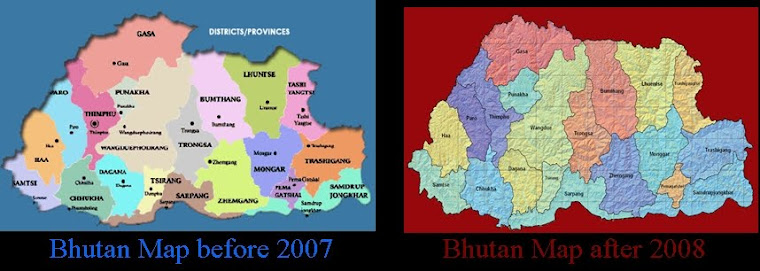
Click over the map to know the differences
Showing posts with label USA. Show all posts
Showing posts with label USA. Show all posts
Thursday, August 8, 2013

Tuesday, November 17, 2009
Bhutanese in NH find American Dream elusive
Refugees in NH find American Dream elusive
MICHAEL COUSINEAU
CONCORD
Sunday, Nov. 15, 2009
The American Dream hasn't reached the living rooms of Pema Tamang and Bhakta Dhital. Job rejection letters and public-assistance checks have arrived instead.
"There are no jobs and nothing to do," said Tamang, a Bhutanese refugee who arrived in New Hampshire last December.
The Concord resident worked three months at Walmart before his temporary job ended, and he hasn't received one callback from any of the 150-plus businesses with whom he's left applications. Tamang recently had his electricity turned off briefly after he fell behind on his payments.
"It's not like I don't like to pay for the bill, but I have no money," said the father of two.
"I'm just trying to have a better time and a better life," said Tamang, 27, who attends English classes twice a week. "I hope that this bad time doesn't go like this forever."
Refugees arriving in the United States in the past year have run straight into strong financial headwinds.
In New Hampshire alone, more than 51,000 workers went jobless last month, nearly 23,000 more than a year earlier.
New Hampshire had 561 refugees from nine countries settle here during the fiscal year ending Sept. 30, including 462 from the Asian nation of Bhutan, where thousands fled more than a decade ago and relocated in nearby Nepal resettlement camps. Since the early 1980s, more than 6,500 refugees have made New Hampshire their new home.
Refugees receive a variety of government assistance when they arrive here, including at least four months of rental help, as well as food stamps and medical care.
"Refugees historically would get jobs within three to six months after arrival," said Amy Marchildon, director of new American services for Lutheran Social Services of New England, which settles refugees in the Concord-Laconia area.
"Now, it's probably taking between eight and 12 months. Because there's a higher competition for jobs, the refugees might be at a disadvantage if they don't have the same level of skills," she said.
Public assistance
A half mile from Tamang's apartment, Bhakta Dhital and his wife, Asha, live in another Loudon Road complex. They now rely on city welfare to help pay the rent.
"I'll do any kind of job," said Bhakta Dhital, 28, who arrived here in June. "We want to be independent."
Carol Moore, a Concord psychotherapist who has been helping the Dhital and Tamang families, said she wishes the resettlement groups would do more.
"It drives me nuts," she said.
Marchildon said refugees need to learn to become self-sufficient.
"I think a challenge for resettlement agencies is managing refugees' expectations. Many, but not all, have higher expectations than what the service delivery is," she said. "It's a new system that they have to learn. Refugees have been in situations where other agencies are supporting them and keeping them alive and haven't had to make decisions for them.
"The feeling we should be doing everything for them can be a blow when we're trying to teach them to do things for themselves," Marchildon said.
"With the downturn in the economy, the hope of starting their lives sooner rather than later is exacerbating their feelings of frustration and anger," she said.
Barbara Seebart, the state's refugee coordinator, said the current economic downturn means it's "basically taking longer for refugees to get jobs."
Possible employment
The Dhitals sometimes rely on a Bhutanese friend who lived in their refugee camp. Devi Bhattarai of Concord has a car, a 2000 Nissan, that helps them when searching for work.
Bhattarai and Mr. Dhital believe they have a job lined up for January at a Loudon landscaping business.
"I have to sell my skills," said Dhital, who taught computer science in Nepal.
His wife said she doesn't like being jobless.
"It's makes our body so lazy," she said.
Pema Tamang (left) of Bhutan and his friend Ganga Chimariya have been seeking work to support their families. (THOMAS ROY)
The Dhitals spent 18 years in a refugee camp of 18,000 in Nepal after their families were driven from their Bhutan homeland. They were married in the camp last year.
Sure, their Concord apartment doesn't have cable and they rely on free wireless that fades in and out. But it's a far cry from their Nepal residence, which was made of bamboo and plastic.
Rainy season meant wetness inside and out, Mrs. Dhital said.
"When I was in Nepal, I thought if I get a chance to go to America, I'd make my future bright," Asha Dhital said. "In Nepal, it's very, very hard."
Nepal meant food rations and no driver's license. It also meant no future.
In the United States, they believe in a future, even if it might take longer to brighten. Already, they feel they are ahead in life.
"Compared to Nepal, it's very luxurious here," Mr. Dhital said.
Linked from here: http://www.unionleader.com/article.aspx?headline=Refugees+in+NH+find+American+Dream+elusive&articleId=0967e20d-4a0a-415e-8c3e-f5fb1b68eed4
MICHAEL COUSINEAU
CONCORD
Sunday, Nov. 15, 2009
The American Dream hasn't reached the living rooms of Pema Tamang and Bhakta Dhital. Job rejection letters and public-assistance checks have arrived instead.
"There are no jobs and nothing to do," said Tamang, a Bhutanese refugee who arrived in New Hampshire last December.
The Concord resident worked three months at Walmart before his temporary job ended, and he hasn't received one callback from any of the 150-plus businesses with whom he's left applications. Tamang recently had his electricity turned off briefly after he fell behind on his payments.
"It's not like I don't like to pay for the bill, but I have no money," said the father of two.
"I'm just trying to have a better time and a better life," said Tamang, 27, who attends English classes twice a week. "I hope that this bad time doesn't go like this forever."
Refugees arriving in the United States in the past year have run straight into strong financial headwinds.
In New Hampshire alone, more than 51,000 workers went jobless last month, nearly 23,000 more than a year earlier.
New Hampshire had 561 refugees from nine countries settle here during the fiscal year ending Sept. 30, including 462 from the Asian nation of Bhutan, where thousands fled more than a decade ago and relocated in nearby Nepal resettlement camps. Since the early 1980s, more than 6,500 refugees have made New Hampshire their new home.
Refugees receive a variety of government assistance when they arrive here, including at least four months of rental help, as well as food stamps and medical care.
"Refugees historically would get jobs within three to six months after arrival," said Amy Marchildon, director of new American services for Lutheran Social Services of New England, which settles refugees in the Concord-Laconia area.
"Now, it's probably taking between eight and 12 months. Because there's a higher competition for jobs, the refugees might be at a disadvantage if they don't have the same level of skills," she said.
Public assistance
A half mile from Tamang's apartment, Bhakta Dhital and his wife, Asha, live in another Loudon Road complex. They now rely on city welfare to help pay the rent.
"I'll do any kind of job," said Bhakta Dhital, 28, who arrived here in June. "We want to be independent."
Carol Moore, a Concord psychotherapist who has been helping the Dhital and Tamang families, said she wishes the resettlement groups would do more.
"It drives me nuts," she said.
Marchildon said refugees need to learn to become self-sufficient.
"I think a challenge for resettlement agencies is managing refugees' expectations. Many, but not all, have higher expectations than what the service delivery is," she said. "It's a new system that they have to learn. Refugees have been in situations where other agencies are supporting them and keeping them alive and haven't had to make decisions for them.
"The feeling we should be doing everything for them can be a blow when we're trying to teach them to do things for themselves," Marchildon said.
"With the downturn in the economy, the hope of starting their lives sooner rather than later is exacerbating their feelings of frustration and anger," she said.
Barbara Seebart, the state's refugee coordinator, said the current economic downturn means it's "basically taking longer for refugees to get jobs."
Possible employment
The Dhitals sometimes rely on a Bhutanese friend who lived in their refugee camp. Devi Bhattarai of Concord has a car, a 2000 Nissan, that helps them when searching for work.
Bhattarai and Mr. Dhital believe they have a job lined up for January at a Loudon landscaping business.
"I have to sell my skills," said Dhital, who taught computer science in Nepal.
His wife said she doesn't like being jobless.
"It's makes our body so lazy," she said.
Pema Tamang (left) of Bhutan and his friend Ganga Chimariya have been seeking work to support their families. (THOMAS ROY)
The Dhitals spent 18 years in a refugee camp of 18,000 in Nepal after their families were driven from their Bhutan homeland. They were married in the camp last year.
Sure, their Concord apartment doesn't have cable and they rely on free wireless that fades in and out. But it's a far cry from their Nepal residence, which was made of bamboo and plastic.
Rainy season meant wetness inside and out, Mrs. Dhital said.
"When I was in Nepal, I thought if I get a chance to go to America, I'd make my future bright," Asha Dhital said. "In Nepal, it's very, very hard."
Nepal meant food rations and no driver's license. It also meant no future.
In the United States, they believe in a future, even if it might take longer to brighten. Already, they feel they are ahead in life.
"Compared to Nepal, it's very luxurious here," Mr. Dhital said.
Linked from here: http://www.unionleader.com/article.aspx?headline=Refugees+in+NH+find+American+Dream+elusive&articleId=0967e20d-4a0a-415e-8c3e-f5fb1b68eed4
Subscribe to:
Posts (Atom)