The Sorry Saga of Bhutan's North

The Sorry Saga of Bhutan's North
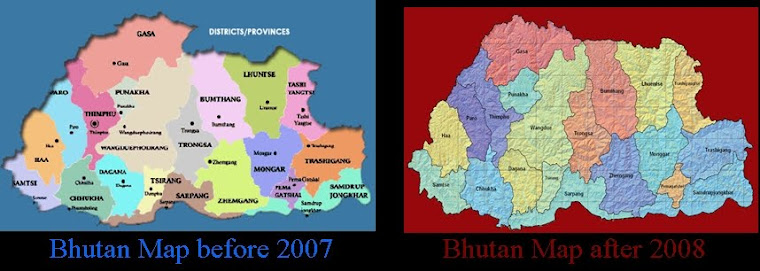
Click over the map to know the differences

Sunday, March 18, 2012

Exiled Citizens Land distributed

Over 5,000 people received lands owned by exiled citizens

March 14th, 2012 by
Altogether 5,088 people from various other districts have been resettled in farms and lands, which were previously owned by Southern Bhutanese in exile, between 1997 and 2008.
District map of Bhutan
Of this, Samtse suffered the largest resettlement as the National Land Commission (NLC) offered lands to 2,194 individuals, offering five acres of land for each resettled.
Likewise, 1,585 people were offered lands in Sarpang followed by 859 persons in Tshirang. Dagana received the least number of 450 resettlers, according to NLC.
The resettlers are mostly Sarchops from the East. However, the Commission has issued lands to landless citizens from other parts of the country as well.
Meanwhile, the Commission last week notified all resettlers that if they failed to occupy or cultivate the allotted land it would not be registered.
It has also warned of nullifying the registration of those who have stopped cultivating the farms offered to them.
Unverified reports have claimed that new settlers in the South have been threatened of physical actions from some underground outfits for agreeing to cultivate the farms and lands abandoned by exiled Bhutanese.


............................

Resettlers notified to occupy or cultivate land

March 10, 2012

Failing which land registration will be cancelled
National Land Commission (NLC) has notified resettlers that if they failed to occupy or cultivate the allotted land it will not be registered.
Section 215 of Land Act 2007 says that a landowner does not occupy or use kidu or rehabilitation land within three years from the date of allotment, it shall be deemed that he or she has the intention to abandon his or her rights on the land.
Many resettlers have been found leaving their land unoccupied or fallow in violation of the provision of the act.
NLC says that the same conditions will be applied to rehabilitation land registered during the ongoing National Cadastral Resurvey.
The dzongkhag administrations have been asked to monitor land use closely and take action according to sections 216, 217 and 218 of the land act.
Sections 216, 217 and 218 of the act say that the local authorities shall be responsible for monitoring and reporting to the land commission cases of non-occupancy and non-use of land. When such cases are known, the local authorities should serve a written notice to landowners concerned.
After 180 days of serving the notice, if the landowners do not occupy or use their land, the commission, upon recommendation from the local authorities, will submit a report to the Office of Gyalpoi Zimpon. If the ownership of the land is annulled, the land will be taken over as government land or government reserved forest land.
The programme director for rehabilitation of the NLC secretariat, Ugyen Tenzin, said many land registration cases in the dzongkhags are pending because they couldn’t be completed between 1997 and 2008 when resettlement programme was undertaken.
The notification, he said, was meant to provide the local authorities a guideline on registering kidu and resettlement land. “These are the terms and conditions based on which they will carry out registration of pending cases,” he said.
There have been cases of land allotments being cancelled because people failed to occupy or cultivate land.
A total of 5,088 people have been resettled in Samtse, Sarpang, Dagana and Tsirang dzongkhags between 1997 and 2008. Each resettler was given five acres of land. Samtse has 2,194 resettlers followed by Sarpang with 1,585, Tsirang with 859 and Dagana, 450.
The land commission doesn’t have detailed dzongkhag-wise statistics on non-occupancy and non-use of resettlement land.
By Gyembo Namgyal

Friday, March 16, 2012

Students die from malnutrition in A GNH school.

Vitamin deficiency confirmed                


«The Orong HSS: A GNH school?
The school had outsourced its mess for a year
Update The Guwahati neurological and research centre confirmed that students of Orong high school were deficient of vitamin B1, thiamine, in its report that the ministry received on Monday.
Four of the 34 students, who were admitted to the Samdrupjongkhar hospital for vitamin deficiency, were sent to Guwahati on December 20 to be further checked by a neurologist.
There had been few cases since July in Orong high school where the lower limbs of students were swollen. It however went unreported to the school authorities because the number of cases was very few.How the school authorities couldn’t know about this condition or the first death remains to be known. Kuensel learnt that the school authorities learnt about it only after they were informed by the students after the second death.It was also learnt that the school mess was outsourced for the last one year, between July 2010 and June 2011 but following complaints, it was taken over by the school.
Health ministry’s director general Dr Dorji Wangchuk said meat, unpolished rice and vegetables are good sources of thiamine.
“Those deficient of this vitamin were found to be physically active and above 10 years,” he said.
That very few girls were affected could be because of the folic acid supplements they get, the DG said.
It was found during investigation that boarding girls were given iron tablets once a week, from where they could be getting some amount of vitamins.
A team led by the nutritionist has also been formed to do a study on nutritional adequacy in school diets. The investigation team, which was in Orong, recommended multivitamin supplements in all schools following a study.
A preliminary report from the investigation team found that the food menu for all meals had below the recommended daily allowance (RDA) for most of the vitamins and micronutrients.
“For instance, the recommended RDA for thiamine is 1.2, but the nutritional assessment showed only 0.7,” the report stated.
Most students, who were admitted were from far flung places such as Gomdar, Shingkhar Lauri, and Samdrup Choling (Bangtar), and had no other alternative food that could possibly provide nutritional supplements.
While most students, who showed no symptoms of peripheral neuropathy like swelling limbs and numbness, are from nearby localities, and day-scholars.
The findings by the investigation team supplemented the findings of a study that was done in July last year, which reviewed the nutrition aspects of food basket in middle and higher secondary schools in Bhutan.The joint study by World Food Program and the education ministry had however remained stacked and no recommendations implemented.It recommended that in order to meet the daily nutritional and kilocalories requirement, the stipend of Nu 700 a student a month should be increased to Nu 1,000. The increase should not increase the cost of firewood, cooks’ salary, utensil costs and electricity.
The review found that the current national education policy does not include school feeding as an integral part of the sector policy. Sanitation and hygiene in the kitchens was a major concern.
“Use of black tea with meals inhibits absorption of iron,” the study stated. “This practice should be discouraged.”
Nutritional guidelines recommend 2,420kcl for 15 – 19 year olds. But it was found that the food basket was low in calcium, iron and vitamin A, Vitamin B1 and B2.
Micronutrients from the current school feeding program had 80 percent carbohydrates, 11 percent fat and nine percent protein.
feeding as an integral part of the sector policy. Sanitation and hygiene in the kitchens was a major concern.
“Use of black tea with meals inhibits absorption of iron,” the study stated. “This practice should be discouraged.”
Nutritional guidelines recommend 2,420kcl for 15 – 19 year olds. But it was found that the food basket was low in calcium, iron and vitamin A, Vitamin B1 and B2.
Micronutrients from the current school feeding program had 80 percent carbohydrates, 11 percent fat and nine percent protein.
“It’s therefore evident that they had access to home food or nutritional supplements, which could have probably prevented them from this condition,” the report stated.
From the information gathered, the investigation team concluded that most likely the students had chronic nutritional deficiencies that eventually led to peripheral neuropathy.
Of the 34 admitted by mid December, eight were kept back for further treatment and the rest discharged. Four were sent to Guwahati for clinical assessment, three were kept in Samdrupjongkhar, and one was referred to Mongar hospital for renal function test and echo test.
By Sonam Pelden

******************

Food for thought
The neurology centre in Guwahati, India has confirmed that vitamin deficiency caused the death of two students in Orong. While this is not a big surprise, the Orong incident has opened a window to look deeper and beyond the school feeding programme.
Most rural schools depend on the programme, and the first question that arises is: why only in Orong? Why only male students and why the deficiency? Bhutanese, who grew up eating school meals, would remember that the food school messes served is not the best. The monotonous diet of rice, potato and dal is still the most common diet even today.
The school feeding programme benefitted thousands of students, especially in rural Bhutan, and it is one reason why many students from disadvantaged families are able to continue their education despite problems at home. But if what is fed to students is causing problems, it may be a good time for decision makers to look closer into the programme. The stipend of Nu 700 for students, who depend on the school mess for all three meals, may be not enough to buy the same basket of food, like when it was decided years ago. Nutritional content can be improved only if the menu is improved. The education ministry is aware that 80 percent of the energy supplied by different macronutrients in school menu is carbohydrate. Protein composes only nine percent.
However, money alone will not solve the problem. Educationists, as they talk about wholesome and GNH education, could re-look into the school agriculture programme. We have some schools in rural Bhutan, where students not only supplement the school mess menu, but also make income for the school from their agriculture programme. Some even have fisheries and poultry, and students are proud of what they do. All schools may not have fertile backyards, but each school, with good leadership, could look into their strengths. A good example schools can learn from is the voluntary feeding programme initiated by the Chubachu school in Thimphu.
A school mess outsourcing to private business people could jeopardise what students consume. Business people are concerned with profits and not the quality of food they supply. The school should have the authority of tendering of food supply, as they know best and not the dzongkhag administration. A review report on nutrition of food basket in middle and higher secondary schools in Bhutan has already recommended what needs to be done in the school feeding programme. For whatever reasons, the report has just remained on paper.
If the programme aims at improving the cognitive capacity of rural students, it is high time to change the menu they consume day in day out for 10 months every year.

***********

Almost a case of involuntary manslaughter: minister
Orong HSS IncidentThe recent incident in Orong higher secondary school, where two students died of complications arising from chronic nutritional deficiencies, was like involuntary manslaughter, education minister Thakur S Powdyel said, during the annual education conference that ended in Gelephu yesterday.
“For students’ safety, and to avoid such embarrassing situations, it’s vital for the ministry, dzongkhag education officials, principals, teachers and parents to work together and ensure to provide better feeding and nutritional foods to every student,” the education minister said.
He urged the of school feeding program division, the agriculture club of schools, the dzongkhag administration and the public health to work cooperatively and find out the availability of food (vegetable) items in the district, based on the nutrition value, and circulate them with immediate effect to schools.
Some principals told Kuensel that to coordinate and take care of fresh feeding items for a huge number of boarding students in the midst of heavy teaching schedule is no easy task. “Managing informal boarders was a huge burden, as parents leave everything up to the school management and never show up for months on end,” another principal said.
Presenting the school feeding and nutrition report, the chief program officer, Chador Wangdi, said that, because of the limited availability of food commodities in remote schools, feeding often lacks essential macronutrients and other nutritional requirements, whereby resulting in monotonous diet.
“Lack of adequate storage is a major concern, especially for perishable items, such as vegetables, meat and eggs, which could further result in health hazards,” he said.
In some case, schools outsource the catering of food commodities, whereby the contractors, for their convenience, supply a month’s stock at one go. In such cases, he said, the food items either get rotten, or become likely to cause food poisoning. “Therefore, if catering is outsourced, contractors should be closely monitored by school authorities,” Chador Wangdi said.
He also said that, despite providing agricultural training to 20 teachers annually, none of the female staff initiate programmes or participate as mess in-charge, except for one female teacher in Sarpang.
“Lack of female staff participants, sanitation and hygiene in kitchen and surrounding areas were some of causes of health problems, education officials said, adding that school feeding should be set as an integral part of education sector policy.
Meanwhile education officials reminded the teachers that “boarding isn’t a choice but a necessity, therefore, the hostel seats should be fixed, based on the number of students who could comfortably fit, and the admission should be given to students, whose parents reside outside an hour’s walking distance from school.
Principals and teachers requested the ministry to revise the monthly stipend rate to Nu 1,000 from Nu 700 a student. They also asked for a separate transportation charge and an additional Nu 300 a student a month to buy vegetables, meat and eggs.
By Dawa Gyelmo, Gelephu

**********
Did the school make a mess of the mess?
Outsourced or not made no difference to the poor food quality, say students
Orong HSS UpdateStudents complained of insufficient food and poor quality, when the Orong high school’s mess was outsourced to a grocery shop in Samdrupjongkhar for a year.
They said meat was served once a month, mixed with potato or radish. Between July 2010 and June this year, the 484 students were eating such meals.
After the midterm exams, the school took over the mess. By then, the 34 students, who were admitted to Samdrupjongkhar hospital earlier this month, had started showing signs of vitamin deficiencies, such as swollen limbs.
Seldon grocery shop, to whom the school mess was outsourced for Nu 338,800 a month, bore the cost of ration, transportation, firewood and the cook’s salary, among others. All seven cooks in the school were recruited by Seldon grocery.
Each student gets a stipend of Nu 700 a month from the government. Orong HSS received Nu 338,800 every month for its 484 boarding students.
The shop had never taken up something like this before, nor had the school outsourced its mess before.
Orong high school principal Nima Wangchuk said the school authority had called a quotation, and then given it to the shop.
He said the school mess was outsourced after they were “encouraged” by the education ministry to implement its policy of outsourcing to reduce workload on schools.
It was also discussed during the 9th annual education conference, and first initiated by Bajothang high school in Wangduephodrang, the principal said.
“When they had to bear all costs, the quality could have been compromised,” he said. “They too requested to quit after it was outsourced, as they were running on loss.”
But the school soon learnt that outsourcing in a remote school like Orong was not easy, especially during summer, when roads are blocked frequently.
The complaints from students on the food quality was another issue.
Yet they continued, because of the one-year agreement the school and the shop had.
Seldon grocery however said they were not aware of having received any complaints with food or its quality. “The money wasn’t enough for us to run the mess, as well as meet the other costs and we had to quit,” the shop people said.
The shop paid Nu 6,000 each to the six cooks, and Nu 7,000 to the head cook a month. It also bore the cost of firewood, about Nu 10,000 every month, and between Nu 3,000 to 5,000 for transportation.
The shop spent about Nu 62,000 on these costs from the total budget of Nu 338,800. This means it was spending Nu 276,800 on food.
The school would not have to bear these costs, if it was managing the school mess.
The shop also said it didn’t serve eggs throughout the time it was catering, because of the bird flu, and the ban on poultry products. Instead it served beef twice.
When the school took over the mess, only three of the seven cooks returned to the school. The rest either resigned or were transferred.
Except for rice, tea leaves, milk powder and sugar, which was supplied by the Orong gup, who also runs a grocery shop near the school, the rest of the mess supplies were still supplied by Seldon grocery.
The school’s vice principal Ugyen Namgyel said the school also has a school agricultural program, where they grow spinach, beans, peas, pumpkin and radish, along with maize, on about 50 decimal land.
“Vegetables, harvested once a year, are supplied to school mess, given to students by mixing with potatos,” he said. “Some are also sold to school staff.”
No teachers or principals eat at the school mess.
Students said not much changed after the school took over the mess. The mess diet comprised dal, polished rice, chick peas, nutrella, potato, amul cheese, all cooked in refined oil. They ate dry fish, beef and an egg once a month.
Vegetables were given when villagers brought them to sell. Dry fish, although on the menu, never made it to the plates.
By Nirmala Pokhrel, Samrupjongkhar
***********
Lack of vitamins in diet likely cause
«A dietician collects samples of rations from Orong school’s storeroom on Sunday
Results of tests in Guwahati on 5 students are awaited
Update: Orong HSS Deaths Five of the 34 boarding students of Orong higher secondary school, being treated at the Samdrupjongkhar district hospital for nutritional deficiencies, leave today for Guwahati, Assam, for further medical tests.
Clinical research, done by a medical specialist from the Mongar regional hospital, and a dietician and a public health lab microbiologist from Thimphu referral hospital, suggests the students could be suffering from peripheral neuropathy, an illness arising out of vitamin deficiency.
“Their nutrition level is below the recommended daily allowance (RDA),” dietician Laigden Dzed said. “It’s 0.7 milligram a decilitre (mg/dl), when they’re required to have 1.5mg/dl a day,” he said. “They are lacking vitamins like B1 and B12.”
Vitamin B12 is available from meat, egg and fish only.
Samples of the ration from the school have been collected and will be sent outside the country to find out its vitamin contents. Some Orong students, who did not fall ill and were in Samdrupjongkhar for the National Day celebrations, were also tested for nutritional levels.
Medical specialist Dr Kezang said the cause of illness will be further verified after the five students do the nerve conduction and the electro mayo graph (EMG) test in Guwahati, 90 kms from Samdrupjongkhar. “It’ll give us a picture of the preliminary cause of illness,” he said. “We’ll then be able to further proceed with the investigation.”
He also said that he could not confidently say at this point that peripheral neuropathy led to the death of the two students on December 3 and 12. “Although they had similar symptoms that the 34 students being treated showed, there could have had other infections, which was never revealed,” he said.
The students at Samdrupjongkhar hospital are likely to be discharged today with vitamin supplements, as they have fully recovered fully, but they are required to visit the hospital once a month.
Meanwhile, the school authorities and health officials cannot explain why only students of classes X and XII fell ill, and not students of classes IX and XI, who were taking the same meals served by the school.
The local community believes the dirtying of a small lake by the hostel’s sewerage water outlet might have something to do with deaths and sickness in the school.
By Nirmala Pokhrel
********
Cause of student deaths not yet known
While 31 students are on treatment
Orong HSS A medical specialist and a nutritionist from Thimphu referral hospital should reach the southeastern border town of Samdrupjongkhar today to investigate the deaths of two students of Orong higher secondary school (HSS), who died on December 3 and 12.
As of now, it’s suspected that chronic multi-vitamin deficiency might be one of the reasons why a 21-year-old class X student and a 19-year old class XII student died at the Samdrupjongkhar district hospital from severe heart failure. Doctors explained that heart failure is different from heart attack. A heart attack is sudden and happens when the heart do not get enough blood. Heart failure happens when the heart is too weak to pump enough blood to meet the body’s needs.
Based on this suspicion, the 31 students of Orong HSS who were admitted to the district hospital on Wednesday and Thursday, with swelling of limbs, face, hands, numbness, irritation of skin and drowsiness, were treated for chronic multi-vitamin deficiency, and are reportedly improving, said the district medical officer Dr Ugyen Wangdi.
Doctors said that if one is suffering from iron deficiency, it would cause anaemia and that chronic anaemia leads to heart failure. These symptoms also occur say doctors when the body lacks vitamin B1 or is deficient of Thiamin.
The 31 students showed the same symptoms as the two students who died, according to hospital doctors.
While 23 cases, of which 14 were severe, were admitted on December 14, another eight students were brought to the hospital last morning. Only one was female. With the 20-bed hospital not able to accommodate all the students, those with less severity have been kept in a classroom of a nearby middle secondary school.
Students at the hospital said they started falling sick and started experiencing slight swollen limbs before the midterm vacation, but started feeling better after taking some doses of vitamin B-complex from the Orong basic health unit.
A class XII student, Chhogyel Rigzin, 20, said the same symptoms started showing again during their trial examinations, and students stopped going to classes and stayed back in the hostel.
“We thought it wasn’t a severe case, so we just took vitamin tablets provided by the BHU and stayed back,” he said. “It was difficult to attend classes and we could not do the trials well.”
The school principal Nima Wangchuk said that, when the second student died, he told the students not to worry, and not to spoil their last board exam paper, so that they did not panic.
Dr Ugyen Wangdi said that, after students were given thiamine injection and multi-vitamin tablets, most showed signs of recovery and the swelling was reduced.
The severely affected students are also being fed with meat, eggs, fish and made to do some exercises. “With lack of facility and medical specialists we aren’t able to diagnose the disease properly,” the DMO said.
By Nirmala Pokhrel, Samdrupjongkhar
*********
A HISTORY OF THE BHUTANESE

Who are the Bhutanese refugees and why are they in Madison?

The refugees who have been arriving in Madison since 2009 from eastern Nepal have a complicated history that involves migration between the small countries of Nepal and Bhutan, both tucked between India and China in the Himalayan mountains.
The refugees trace their ancestry to Nepal. They speak Nepali. They follow the Hindu religion.
Before they became refugees, they lived in Bhutan, Nepal's neighbor to the east. Their ancestors moved from Nepal to the southern lowlands of Bhutan in the late 1800s after being invited by the Bhutanese government to clear the jungles for farming. They remained there for generations and considered themselves Bhutanese. In 1958, they were granted Bhutan citizenship.
However, in the 1980s, Bhutanese authorities representing the majority Buddhist population increasingly cracked down on them, forcing them to verify their citizenship and passing laws banning their dress and removing Nepali language from schools. Thousands of protesters against the policies were put in prison, with reports of torture and other brutal punishment against them.
In the early 1990s, they fled Bhutan, finding themselves without a country. Eventually, the United Nations refugee commission granted them refugee status, setting up seven camps in eastern Nepal in 1991. Life in the camps was meager but offered them some security.
They remained in camps for decades as the Bhutan and Nepal governments negotiated possible resettlement in one or both nations. No agreement has been reached.
The United Nations began to resettle the refugees in third countries early in 2008, with the majority accepted by the United States and others finding new homes in Australia, Canada, Denmark, the Netherlands, New Zealand, Norway and the United Kingdom.
Lutheran Social Services established a branch office in 2009 in Madison largely to help resettle the Bhutanese refugees, and 172 have come here since. The agency can accept about 100 new arrivals a year, said Mary Flynn, who supervises refugee resettlement for Lutheran Social Services in Milwaukee and Madison.


Read more: http://host.madison.com/a-history-of-the-bhutanese/article_4b60709e-5b16-11e1-a8e6-001871e3ce6c.html#ixzz1pLvKQjcc

Govt promises to resolve the issue of the people in the camps (kuensel)

Some thoughts
The government announced that it will try to resolve the case of the people in the camps once the majority have been repatriated to third countries. My question is why? What benefit does Bhutan have in trying to resolve anything to do with those people in the camps? GRRR
**********
How pathetic and unconvetional mode of approach towards one of the most ever-pending issue. How come this DPT govt. is so immature in its administrative functioning. Noyak
************
PM as a head of the govt. must have his answer to the question thrown at him. Morning Glory
*********
The government should take bold decisions and playing politics at the cost of people’s sufferings is very dangerous. Should they come back because they are our true Bhutanese family then take it back without any conditions. newsfu
*********
 People here are almost dying. We are not engaged in any criminal activity which is proved by individual data-wise/record wise in the Home Ministry. tinor
*************
If this prolonged RGOB created human disaster is solved in a justly manner, the govt of Bhutan and the people those who have negative attitude as seen in the above comments will be applauded every where in google. You don't have to worry about these camp people because they are not the people as being portraid by you and the then foolish govt.They were forcefully evicted by the then RGOB looting every thing they had of their sweat.And when you talk about their dress and dance a Nepali-that is true because they are ethnic Nepali as you are an ethnic TIBETAN. So,what? If you say that they should stay in Nepal ,then, why not you silently move to Tibet and stay there.If you don't agree with the later idea,then,why don't you and they coexist in Bhutan? Shiva
********
Are we being this much ignorent this soon, so are we just not paying attention to our history. This country is/was build by those ancestor whose children and relatives are in camps. People who choose to resettle are not prouding choosing it either. They don't have any choice, so it is make or break deal for them. We the people who are inside the country need to grow up and stop whining about unneccessary thing, we need to raise our voice against anarchy and bring our family together, we need to forget about which religion they follow, where they live, which party they belongs too, all we need remember is that we were BHUTANESE yesterday, we are BHUTANESE today and WE WILL BE BHUTANESE in coming days.

And also, Lets not forget our country is not too small, neither big but if we keep kicking people out one day we will be forced to day we are indian, so, support the PM and bring our people home. LETS WELCOME THEM, THEY ARE NOW WELL EDUCATED, AND THEY CAN/WILL SERVE OUR NATION JUST LIKE WE BEEN DOING.CoolSmileSmileSmileSmileSmileSmileSmileSmileSmileSmileCool Bikash
**********

now the govt. has taken right dicission to resolve the refugees issues. but i think its too late to be done becoz over 60 thousand people in the camp has already moved to foriegn countries and resettled there after suffering 20 yrs long in the hut. hey mr. grrrr, tango, noyak and auspicious !!! like your attitude makes everybody voilent. you bloody isolated people have always negative view. you people are still like an animal. we the human being living on the earth has rights to live every where on the earth as per the dharma philosophy. bhutan is still backward country in the world because of the people like your attitude. bhutan has long way to go ahead in the international level. the govt. is doing as per the international law. dont try to interfare.
i want to ask one question; you people are saying bhutanese refugees are voilen and criminal, if they are criminal and voilent, why the foriegn countries has choosed these people? they says one of the best refugees in the world.
hey !!! stay faithful to be grateful,,,,,,,,,,,,,
zingodon
***********
 i would say…Problem solved is better then problem ignored…phoenix
************
we the bhutanese people are very innocent comparing to other countries. in bhutan we have only 2 casts i.e. drukpas and lhotshampas. the population in bhutan is only 6 lakhs. just imagine to other countries? siliguri alone have over 25 lakhs people and uncountable casts. we must be proud to have got to live in such a peaceful country. we must love each other and live happily.zingodon
***********
the content of OL's blog is such a pathetic view of him. Just an instance, few days back there were several cases of stabbings in Thimphu. Does this mean that we all the bhutanese were involved in those stabbing cases? No. Similarly how could OL say that 2.5% of the refugees were involved in the bomb blast? Those could be anyone. So let us not directly get emotional on the baseless aligations of OL.noyak
*******

This is a bold decision of the honourable PM and there is no need to create dummy and proxy discussions on the issue. The problem needs to be solved somehow (only the government knows the root cause of the planned, budgeted and implemented problem and can deal with prudence). So much of negativity circulating in the world against us due to this naughty (made knotty) issue should be brought to rest without infuriating the parties involved. Let the honourable Lyonchen proceed with caution, not against the Bhutanese victims suffering for decades but against the foreign interest (immediate neighbour) to destabilize Bhutan's sovereignty and security in the long run on moral ground.
That means the people that were in Bhutan and had citizenship/census enrolled in family dairy till late 1980s should be brought back and the rest left to make their own decision to return from where they joined the camp.Logical
***********


Passion to serve leads Rice student to help others here, abroad


    Rice University student Melody Tan wants to motivate others to help the less fortunate. Photo: Tommy LaVergne, Rice University / HC
  • Rice University student Melody Tan wants to motivate others to help the less fortunate. Photo: Tommy LaVergne, Rice University / HC

When Rice University student Melody Tan was in junior high, she began to feel a passion to help those who were less fortunate.
"I felt like I hadn't accomplished anything to make my life worthwhile," Tan said. "I hate seeing, hearing of, or even reading about people in pain or need."
At Cinco Ranch High School, Tan began to volunteer helping a group of Bhutanese refugees in the Houston area. She did this by speaking to her friends at Grace Fellowship United Methodist Church in Katy.
"I was passionate about service, and the refugees' story is an important issue because over a 100,000 people were forced to leave their home and go to the United Nations camps in Nepal," Tan said. "They're a part of the Houston community now, and many of their needs aren't those met by money, but by acceptance."
 
Her motivation spread to others, and soon Grace Fellowship youth and classmates began helping collect clothing, shoes, toys and household appliances for the refugees.
When she started college in 2010, Tan joined organizations like the Urban Immersion Program founded through Rice's Community Involvement Center.
In May 2011, after completing her freshman year, Tan and 11 other students traveled to Guatemala for a two-week service project at the mission San Lucas Toliman. When she arrived at the rural village, she saw how devastated the community had been by violence and lack of health care.
"The most moving experience was learning about the history. I heard firsthand the story of a Guatemalan woman who traveled to Santiago to rescue 11 children who had been orphaned by the Guatemala militia," Tan said.
Moved to become involved in human rights advocacy and global health, Tan traveled to the Ecuadorean villages of Planchaloma and Quito in June 2011 after being accepted into an internship with the Rice's Beyond Traditional Borders program, which focuses on addressing health needs in developing countries.
"When I try to push aside my feelings for others less fortunate, I feel like I'm living a lie," Tan said. "As long as I can, and with whatever I have, I will try to make a difference."
A bioengineering major and global health technology minor, Tan wants to do work that combines her interests in medicine and engineering, while improving the quality of life in the developing world.
"I think many people claim to make a difference, help people and save the world, but are ignorant of actual needs and the necessary steps to take them," Tan said. " A good place to start is by reading books, volunteering and praying."
Tan is eager for future projects, including a yearlong commitment to interfaith community service on campus and a trip to Africa. "I don't want people to remember me when they read this, but be challenged to learn about global issues," Tan said.
"I believe everyone should use their abilities in whatever capacity they are given to serve others."

Michelle Reed is a freelancer who can be reached at michellereed89@gmail.com

Indian Hegemony In Nepal – OpEd

March 7, 2012

By Nabin Kumar Chhetri
The Indo-Nepal discourse would be incomplete without reviewing the land encroachment agenda. Some of the crucial issues like Kalapani and the Susta land grab have frozen with time. The impasse is further postponing the issue into oblivion. Is Nepal willing to forget the long stretch of land in Kalapani that has been illegally occupied by the Indian army since 1962?
India is reluctant to retract from Kalapani as it serves as a vantage point to eye over Chinese border activities. The bilateral dialogue; tainted by Indian hegemony and political volatility of Nepal has failed to solve the dispute. As a result, the silence is intimidating Nepal’s sovereignty. Nepal covers a total area of 1, 47,181 Sq km according to the official record. However, owing to the Indian land grab of nearly 59,970 hectares, the overall size of Nepal has been reduced. The encroachment spreads to 54 points covering 21 districts. In kalapani alone, the disputed area is 372 Sq km.
Nepal has a unique relationship with India. Both the countries share a long stretch of open border. The Indo-Nepal friendship has been beneficial for both the countries however there are a few issues where Nepal is at lost. Nepal falls within India’s top watch list due to its exclusive geographic location. It is due to this distinction that it frequently intrudes into Nepal’s domestic affairs.
Analyzing India’s perspective on Nepal; If we look back at the refugee issue, the Bhutanese Refugees were not allowed to settle in India. The first batch of refugees were loaded on trucks and dropped at the Indo-Nepal border near Kakarbhitta. The other refugees followed later. Why did India deny asylum to the Bhutanese Refugees when it had allowed Tibetan and Bangladeshi Refugees? The Bhutanese refugees were later prohibited from going back to Bhutan by the Indian Border Security Force.
In May 2007, The Indian police fired randomly and killed a refugee teenager at the Mechi border. The only fault that he had committed was that he wanted to go back. If India can train the Bhutanese Army, install an Army base in Bhutan, interfere in Bhutan’s foreign policy, why did it remain passive in resolving the refugee issue?
The hardest slap on Nepal’s sovereignty comes from the protracted border encroachments by the Indian force. Throughout history, Nepal has lost lands and rights at different times. Why is Nepal silent in this issue? India has always denied the allegation of any encroachment. Indian officials have threatened numerous times showing security concerns. Rakesh Sood, the former Indian ambassador had once warned of sealing the entire Indo-Nepal border. India’s frequent violation into Nepal’s internal affair seems normal today due to our corrupt political leaders. If they had not relied on India for their political stability, the Indian encroachments would not have been as severe as it is now.
On the contrary, various Indian media like the CNN-IBN had accused Nepal of land grab in Bihar. Another news channel called News X had blamed the Nepali authority for uprooting the demarcation pillar. The Junge pillars that demarcate the borders have disappeared in most places, some are uprooted and some are intentionally shifted by the Indian authorities to claim their possession. At many places where the border between the two countries is the river, the problem seems to get worse as the river changes course every year. This shifting natural tendency has allowed the Indian authority to occupy more Nepali lands. The case of kalapani and Susta shows gross bilateral failure thus it has to be addressed by the UN.
The presence of Indian Air Marshals at the Tribhuwan International airport (TIA) raises a lot of question about India’s intention. If India is reluctant to trust the local security at TIA, why does it allow planes to Nepal? Is it possible for Nepalese officials to operate at the Indira Gandhi International Airport under similar excuse? If not, the Indian officials should immediately retract.
Nepal is passing through a troubled time. New Delhi directly godfathers the political picture of Nepal. Most of the Nepalese political parties are like mosaics that India arranges as per its convenience. Despite the restoration of democracy and the abolition of monarchy, the ongoing political turmoil that has been brewing, poses a great threat for the unity of Nepal. The rift between parties may serve as a harbinger in inviting foreign elements into our political system. There has to be a great focus shift amongst the Nepalese before the country sinks into the quagmire of foreign trap. Petty issues should not act as impediments in uniting the Nepalese for the greater cause of Nepal.

Nabin Kumar Chhetri graduated with a degree of M.Litt in Novel from the University of Aberdeen. His articles have appeared in the International Herald Tribune, The Statesman, Eurasia Review, The Kathmandu Post, Nepal News, Darjeeling Times, etc. He can be reached at nabin11111@yahoo.com.

Researchers try to unravel mystery of immigrants' health woes

 
Tika Devi Gurung, left, and her children Sudesh, Parash, Suk Bahadur and Phul Maya, spent years in a refugee camp in Nepal before they were finally resettled in Ottawa in December.

Tika Devi Gurung, left, and her children Sudesh, Parash, Suk Bahadur and Phul Maya, spent years in a refugee camp in Nepal before they were finally resettled in Ottawa in December.

Photograph by: Bruno Schlumberger, The Ottawa Citizen , Ottawa Citizen

DAMAK, Nepal — It's a late November afternoon in Beldangi II camp, one of half a dozen United Nations refugee camps clustered in the southeastern corner of Nepal. Sixteen-year-old Sudesh Gurung is sitting on a stool outside his bamboo hut, poised for flight.

Nearly 20 years after they escaped ethnic tension in the mountain kingdom of Bhutan, the Gurung family — and almost 5,000 other Bhutanese refugees — are moving to Canada for resettlement, at the invitation and expense of the Canadian government. Within a few weeks, Sudesh, his widowed mother and three siblings will fly to Ottawa, where they will become permanent residents and begin to build new lives.

Lean and eager, Sudesh works hard at school, and does his homework by camp light. He can hardly fathom what comes next, and health is not at the top of his mind. In limited English, he hesitantly asks a visitor: "What school will I go to? Can I play cricket and soccer in Ottawa?"

At the other end of the migration journey, almost 45 years after arriving in Canada, Harminder Magon putters in his white and black Ottawa kitchen. He weighs the health values of every dish he's making, and reminds himself to check his insulin level and take his cholesterol pills.

Magon is a storyteller and bon vivant by nature; a husband, father and immigrant by choice. The restless youngest son in a wealthy Sikh family in Kenya, he came to Canada in 1967, and built a happy, prosperous life. Sudesh Gurung, on the other hand, arrived just two months ago. He hopes Canada will be where he finally can have safety, education and a country to call his own.

They came here assuming that if they worked hard and did their best, they would thrive. If they thought about health at all, it was simply that our medical system would take care of them, just as it takes care of all Canadians.

But a growing number of doctors, nurses, researchers and policy-makers say that's a flawed assumption, and a potentially dangerous one. They argue that — much like employment — health care is emerging as one area of immigration where Canada is failing many of the people we have brought in, whether they are recent arrivals like Sudesh or longtime residents like Magon.

Since the 1990s a growing body of data has suggested that most newcomers arrive in Canada healthier than the native-born population, only to have that advantage erode over time. New immigrants tend to live longer than the Canadian-born population, but within a decade of resettlement, their mortality rates creep up, as do their rates of chronic disease. In looking at almost a decade of data in its biannual National Population Health Survey, Statistics Canada also found immigrants were almost twice as likely as native-born Canadians to report feeling unwell. Recent non-European immigrants — the largest proportion of newcomers we currently admit — were the most likely to report their health declining from good or excellent to fair or poor.

No one has been able to put a price on the "healthy immigrant effect" in terms of lost productivity or health-care costs, but some basic math hints at the potential. Immigration has been a cornerstone of Canada's labour policy for decades. In 2010, we admitted 280,000 permanent residents, including skilled workers, sponsored family members and United Nations refugees, on top of 250,000 temporary visitors, such as foreign workers, international students and asylum-seekers asking for refugee status. Almost 20 per cent of us were born outside the country and immigrants are now responsible for two-thirds of our population growth, yet in many parts of Canada, policy-makers now consider immigrants an under-served population, along with First Nations and seniors.

While researchers and medical professionals are struggling to understand the precise why's and how's of this unhealthy welcome, there's a consensus that Canada's health-care system has been too slow to adapt to our increasingly diverse population. From front-line doctors and nurses to policy-makers, all levels of the medical system have been reluctant to let go of the hidden assumption that we're all pretty much alike, when it's clear that we aren't. Fixing that perception, advocates say, means learning to ask the right questions at every stage of care, from the waiting room to the examining room to the operating table, and from the well-baby clinic to the rehabilitation centre and the cancer survivor's support group.

"We assumed people would come, hook themselves up with a doctor and everything would be fine — after all, we have universal health care," says Morton Beiser, professor of psychology at Ryerson University and an expert on immigrant mental health. "What we didn't realize, and I think we still haven't quite acknowledged, is if you bring large groups of people from all over the world, it enriches your society but it also calls for institutional change. We have institutions that have been very slow to respond to the call for change, including the health care system."

***

It was the newspaper ads that ignited his curiosity. Harminder Magon vividly remembers seeing large notices in Kenyan newspapers in 1967, declaring that Canada needed hard-working immigrants. He knew nothing of this place beyond the cliches of igloos and wheat fields, but it didn't matter.

"I wanted to see the world," Magon says. "I figured if Canada wanted me, they'd find something for me to do."

The visa officer in Nairobi liked what he saw in Magon, a burly, six-foot-two, 21-year-old with an advanced secondary school education, charming and eager to work. But first he had to pass a medical examination to make sure he wasn't bringing tuberculosis or other communicable diseases into the country.

The image of the newcomer as a threat to public health is as old as Canada. The first Europeans to arrive in North America brought with them "white man's diseases," including measles and smallpox, which decimated the Huron, or Wyandot, nation. In New France, doctors boarded newly arrived ships to conduct medical examinations to keep the plague at bay. In 1832, colonial officials rushed to set up a quarantine station at Grosse Ile, Que., to contain the cholera pandemic sweeping Europe. In its early years, the hastily-erected station was an early sign of the unhealthy welcome, as it proved to be an unhygienic death-trap where thousands of previously healthy migrants — primarily Irish — died of cholera or typhus.

In 1928, the Canadian government made pre-departure medical examinations mandatory for all prospective immigrants. The landmark 1976 Immigration Act, which laid the basis for current policy, went further with the introduction of "excessive demand" on Canada's health-care system as grounds for inadmissibility. The act defines excessive demand as anything more than the average annual cost of social services per Canadian. That figure is updated annually and currently stands at $6,141.

Today, if an immigration medical officer believes an economic class immigrant or a sponsored parent or grandparent would put an undue burden on Canada's social services — by needing dialysis to treat kidney failure, for example, or special care for a severely disabled child — the application would most likely be rejected unless the applicant can prove otherwise.

The exceptions are the 25 per cent of permanent residents who are refugees (like Sudesh and his family) or spouses and children sponsored by permanent residents. They are screened and steered toward treatment if needed, but the excessive burden test is not applied to them. When they had their immigration medical in Nepal, Sudesh's 24-year-old sister Phul Maya tested positive for latent tuberculosis. Their departure was delayed nine months so she could receive treatment, and as soon as the family arrived in Canada, Ottawa Public Health began regular monitoring to make sure they are TB-free.

The immigration medical system is designed to catch and treat communicable diseases before they cross our borders, and screen out costly conditions. For the most part, only the healthiest get approved. That may explain, in part, why the emerging data on the healthy immigrant effect turned heads in the 1990s.

At first the effect was thought to suggest that all newcomers faced worsening health after migration to Canada. More recent findings suggest that it matters whether someone is from Warsaw or Kinshasa, whether they arrived 30 years ago or three, and whether they came to Canada as refugees traumatized by war or software developers searching for greener pastures.

With a few exceptions, the healthy immigrant effect appears to apply less to immigrants from Europe and the United States, while it hits other groups hard. Clarifying why, for example, people from the Philippines, China and India — the three biggest source countries for immigration to Canada — are over-represented in prevalence of chronic disease is crucial to finding a solution.

Similar patterns have been found among immigrant populations in other western countries, and researchers believe the problem lies in a combination of factors, starting with the complex interplay between genetics, diet and lifestyle.

"Fundamentally, we are all a product of our experience, our culture, our religious background, where we've lived," says Dr. David Butler-Jones, head of the Public Health Agency of Canada. "Then there's our parents and grandparents, our genetics. How that manifests itself depends on our environment. What we've been exposed to can shape how healthy we are."

Every Canadian carries his or her own risk factors, and ethnicity-specific diseases are nothing new. Canadian practitioners have long known to be alert for sickle cell anemia in patients of African descent, or to screen Jewish patients for Tay-Sachs disease. What's new is that as immigration Canada began to select a broader range of immigrants in the late 1960s, the ethnic composition of our population began to change, from heavily European to increasingly Asian, African, Latin American and Caribbean, while most of our medical research and guidelines for practitioners continued to be based on the risk factors and behaviour of Caucasian populations.

That's slowly changing. Researchers such as Dr. Sonia Anand, professor of medicine and population health expert at McMaster University in Hamilton, Ont., have started mining existing databases and conducting primary studies to explore the link between ethnicity and health. Thus far, the most studied communities have been the two biggest non-European ethnic groups in Canada: people from South Asia (India, Pakistan, Nepal, and others) and, to a lesser extent, from China.

An early database study suggested that Chinese Canadians had higher rates of cancer and lower rates of cardiovascular disease than the general population. Anand later led a team looking at risk factors across four ethnic groups — Caucasian, South Asian, Chinese and Aboriginal.

"What we observed and has been observed in other studies is that, for South Asians who live in Canada, the longer they live here, the more risk factors they accumulate for heart disease and diabetes, and at higher rates than Chinese or Caucasian," says Anand, adding that those risk factors include abdominal obesity, elevated blood sugar and higher amounts of so-called bad cholesterol.

South Asians have significantly more body fat than Caucasians with the same body mass index, so "a South Asian person might not look grossly overweight, but their percentage of body fat is too high," says Anand, putting them at risk of chronic illness at weights lower than people of other ethnic groups.

According to the Heart and Stroke Foundation, all Canadians have a one in three chance of having a heart attack or stroke. But Canadians of South Asian descent have three to five times higher risk than the average simply because of their genetic heritage. And that's for those who watch their weight and exercise — if you are of South Asian descent, overweight and largely sedentary, your risk of heart attack jumps to eight times the average.

Researchers around the world now recognize that South Asians, whether they live in New Delhi, Manchester or Ottawa, have a significantly higher risk of heart disease and diabetes than other ethnic groups. The Diabetes Foundation of India estimates there are 40 million people in India with Type 2 diabetes, and expects that figure to double by 2025. Indian public health authorities are grappling with malnutrition among the poor and obesity among the growing middle and upper classes — another signal that the healthy immigrant effect is about much more than what genes a newcomer brings to Canada.

"The analogy I use is that it's like taking a seed from a certain soil and transplanting it to a different soil, with the seed being genetics," says Anand, herself the Canadian-born daughter of immigrants from India. "If the normal environment or soil for a South Asian seed is rural India, that's where it will flourish. If you move that seed into an urban environment — whether in India or elsewhere — where we don't expend much energy but we consume a lot of energy, the seed grows in a different way. If we all just stayed in places like rural India, doing jobs where we sweat a lot, South Asians would not have an epidemic of Type 2 diabetes and heart disease."

Harminder Magon's grandfather emigrated from India to Kenya, and made a fortune in business. He was also a diabetic who died following complications from a leg injury. Magon's father and three of his uncles all died relatively young, all from heart disease or diabetes.

When he transplanted to Saskatoon almost 45 years ago, Magon quickly got a job as an architectural technician and embraced the Canadian diet with gusto.

"Breakfast would start with Coca-Cola and leftovers from the night before, which I would eat while I was cooking bacon and eggs with cheese, beans and sausages," Magon says of the years he now calls his "indulge and bulge" period. "For my morning break I'd have coffee with a cream-filled doughnut. Lunch would be mostly either pizza or Chinese buffets, or veal cutlet sandwiches with gravy and fries."

Supper with his wife, Surinder Kaur Magon, was usually a nod to their Indian heritage: a rich curry, some chapatis loaded with butter, some rice and a few vegetables, cooked to exhaustion. Dessert would be a store-bought cheesecake or ice cream, often followed by a late-night snack of double-deep-fried egg rolls.

By the time his son Harpreet was born in 1976, Magon weighed more than 300 pounds. "I was a big, fat jolly guy, and it didn't bother me," he says.

What did bother him was getting out of breath after five minutes of playing on the floor once his son started to crawl. He cut back drastically on sugar and fat, started swimming and cycling, and lost 100 pounds in eight months. It wasn't enough. First came back trouble, then his gall bladder. After he moved to Ottawa in 1990 to work for the Canadian Union of Public Employees, Magon began to travel a lot, eating irregular meals, sitting on planes and getting less exercise. Soon he developed circulation problems in his legs and later was diagnosed diabetic. It was the first time a doctor had explained his hereditary risk factors to him, and tied it to family, not ethnicity.

Then, last fall, Magon couldn't make it up the stairs at home without feeling winded. After excellent care at the Montfort Hospital and the University of Ottawa Heart Institute, he was diagnosed with unstable angina, caused by small blockages in his arteries. It was a warning Magon has taken seriously, dropping another 45 pounds, exercising regularly and taking medications for cholesterol, blood pressure and diabetes. He's also an evangelist for healthy eating, spreading the word about healthy international and South Asian food through cooking classes in his home and on his Facebook page, Desi Guys Should Learn How to Cook.

"I indulged and abused my body," he says with a sigh.

Surinder smiles. "You were too stubborn to listen to your body."

"I'm listening now dear, trust me," Magon replies.

***

Sudesh Gurung's father died suddenly while doing manual labour on the black market in Nepal several years ago. "It was blood pressure, maybe," Sudesh shrugs. What does that have to do with him, young, fit and full of the future?

Harminder Magon missed the red flags in his family tree and revelled in high-calorie traditional cuisine while adopting the worst his new environment had to offer. But when his health hit a crisis, Magon had the advantages of speaking fluent English, understanding the Canadian medical system and feeling confident dealing with his caregivers. He also recovered in a comfortable home with healthy food, a strong, supportive network of family and friends, and no worries about how to pay for extra costs or transportation.

Many recent arrivals are not so lucky. Problems in any one of those areas — housing, food security, social exclusion and income, known collectively as social determinants of health — can have a significant impact on their recovery and future health.

Toronto Public Health took a close look at the research on immigrant health in a study released last November, and one finding stood out, says Dr. David McKeown, the city's medical officer of health.

"We documented better than in the past that some of the challenges faced by everyone in maximizing their health potential — acquiring the social determinants of health, such as economic success and integration into the community — are real challenges for newcomers, have an impact on their health and cause them to gradually lose the health they brought with them," says McKeown.

In many ways, the healthy immigrant effect underscores the shortcomings of integration. Increasingly, immigrants who arrived in the last 10 years are underemployed compared to their skills and over-represented among Canada's poor. It's well-documented that poor people are less likely to have secure housing and good diets, and less likely to stay healthy.

The impact of migration on mental health is also key, and another reminder that one-size-fits-all approaches don't work for the newcomer population. How someone arrived here, and what path their settlement took, can make a crucial difference in how their mental health problems manifest themselves. Did they flee conflict only to live in limbo for decades, like the Gurungs, or did they simply trade one comfortable life for another? Did they struggle to find work, or did they slide right into an executive position?

Dr. Joel Ray, an obstetrician at St. Michael's Hospital in Toronto, sees many Filipina, Sri Lankan and Ethiopian women and their babies in his practice, which serves one of the country's most ethnically diverse neighbourhoods. He believes the gaps in health care for newcomers are partly the result of "unintentional, non-malicious insensitivity."

"As Canadians we're just understanding what our current, multi-ethnic generation of immigrants are really like and physicians and nurses are absolutely no better," says Ray. "They rarely understand the cultural health-related aspects of where someone comes from, and how that might have an impact on their health."

That can translate into newcomers having less of a chance of finding a family doctor than the average Canadian, says Dr. Kevin Pottie, a physician at the Bruyere Centre for Family Medicine in Ottawa.

"It's recognized that a big barrier to care is often integrating a newcomer family into community-based primary care," says Pottie, who is also a researcher at the University of Ottawa's Institute for Population Health. "Doctors are very busy and a newcomer family is often not at the top of their list" when it comes to choosing new patients.

And what if a practitioner and patient don't speak the same language, not just figuratively but literally? Sarah Bowen, a public health expert at the University of Alberta, has studied under-served populations and believes language is the single biggest obstacle to effective care for many new Canadians. Although the percentage of newcomers arriving with poor proficiency in either official language is on the decline as the government assigns more weight to language skills, there are still tens of thousands of Canadians who struggle. Bowen says patients who can't communicate with their doctors or nurses are less likely to absorb healthy living messages or seek preventive treatment, and more likely to go to an emergency room instead of a primary care physician.

"If you're not communicating properly, there's more chance you'll be misdiagnosed, more chance you won't understand the treatment or the medications and higher risk you'll take them incorrectly," says Bowen. "There's good evidence in the literature that providers, in the face of a language barrier, are more likely to rely on testing, which ups the costs. They say 'I'm not sure I'm getting the full story here, better to do an X-ray just in case.'"

This applies not just to recent immigrants, says Bowen, but to earlier waves of immigrants — for example, from Germany, Ukraine or Italy. As they reach old age and their cognitive abilities decline, some Canadians are losing their second language skills.

Part of the difficulty in forming a comprehensive policy is that the problem cuts across sectors and responsibilities: immigrants are federal, health is provincial. Immigrant health features prominently in settlement conferences and government policy papers these days, accompanied by calls for more data. Studies on the risk factors for South Asians have captured a lot of attention, but other large and growing ethnic communities await their close-up. In the meantime, practitioners on the front lines are starting to collaborate and compare notes.

"Immigrants today are like pioneers, and pioneers are the most productive, hard-working and often healthiest people," says Pottie. "Lots of different people are working together now, believing that we need better care for newly arriving immigrants and refugees, and we're building a foundation for that."

Sudesh Gurung is settling in at school, cheerfully unaware of risk factors and plenary sessions. As he updates his Facebook status, his friends — also from Bhutan — tease him about his new love for chicken burgers from McDonald's, and laugh at how Canadian clothes are much too big for them.

"Me, I'm very healthy and strong," Sudesh says with a broad grin. "No worries."

ltaylor@ottawacitizen.com

An EMAIL: Plight of Non-Registered Bhutanese refugees in Nepal - an Urgent Call

Bhutanese Refugees Camp
Beldangi
Jhapa, Nepal
Dated : Feb 21, 2012

Dear Sir/ Madam,

The purpose of this email is intended to share and make our concern known to all concerned fellow Bhutanese who have been resettled but certainly not denying to have forgotten the appalling and inhumane sufferings of a significant number of people like us who are languishing in the camps in eastern Nepal without formal registration - deprived of basic right to identity and survival.
Drawing attention of all concerned fellow Bhutanese, particularly those who had been campaigner of Human Rights and defender of civil, political and cultural rights in Bhutan, we sincerely believe it is once again high time to realize each other’s duties and moral responsibility as the situation calls for urgent respond to the plight of some 3000 unrecognized fellow Bhutanese seeking asylum in Nepal.
In general, un-registered bhutanese refugees fall under various levels of registration categories such as:
Census Absentees (CA) – Registered persons, absent during the 2006/07 joint census verification.
Asylum seekers (ASR)- Non-registered persons, those who had attended 2006/07 joint verification census exercise. Photo for Refugee ID Cards not issued.
Prisoner of Conscience – Those detained in jail in Bhutan and have arrived in Nepal after release.
Non-registered (New arrivals) – more recent arrivals from Bhutan and those who have not attended 2006/07 joint verification census.
we (Asylum Seekers from Bhutan) living in the camps in Jhapa and Morang in Eastern Nepal, sincerely wish to draw your urgent and generous attention to one of the most protracted and appalling situation facing some 3000 non-registered Bhutanese - Asylum Seekers.
Many of us who have formally registered asylum claims during Bhutanese Refugees Camp population census exercise jointly carried out by the Government of Nepal and UNHCR in the year 2006 – 2007, and those who have been interviewed during the Re-registration Exercise in 2008, are awaiting the Government’s decision on the ‘refugee’ status claim till date.

Nepal Government’s swift decision on asylum claims would have certainly been beneficial for us – those who are in desperate need of International protection. It is primarily due to the pending Government decision on the long awaited complementary registration process that we are deprived of the much needed humanitarian support and protection of UN-Refugee Agency (UNHCR). Several appeals we have made in the past to the Higher Authorities of the Nepal Government through the local administration (CDO Office) Chandragadi, Jhapa, offered no respite except for the empty rhetoric.
In an effort to draw attention to our concerns, we even resorted to a number of democratic protest programs; one of such events was the Fast Onto Death Hunger strike that we staged in Pathari and Beldangi camps in January 2011 (from 11/01/2011 - 14/01/2011). On the eve of fourth day we called off the strike after CDO Jhapa, convened a meeting with us at Pathibhara (Armed Police Force Barrack) in Damak and assured us that he would resolve the crisis within fifteen days; however, no tangible efforts have been made so far as the crisis still remains intact.
Besides, such protest programs we have organised various delegations to local government authorities (CDO/UNHCR Field Office Damak) and Home Ministry, Kathmandu to no avail.
Our delegation to Home Jt. Secretary and UNHCR Dy. Country Representative on October 10, 2011 and the Home Minister Bijay Kumar Gachhadar on Dec 19, 2011 included representatives of all above cited groups, as given below:
Dhan Kumar Rai – Prisoner of Conscience (18 years in Jail in Bhutan), Khudunabari, Camp. (Kabari/G2/105) (Pakha Gaon, Sibsoo Bhutan)
Deepak Rai – Asylum Seeker, Beldangi – II,(Bel-II/I3/115) (Gola Baazar, Sibsoo Bhutan.
Laxman Gurung – ASR, Bel-I/G2/138 (Gopini, Chirang Bhutan)
Yad Bahadur Gurung – Prisoner of Conscience (7 years in jail in Bhutan), Beldangi-II (Bel/A3/56) (Danabari, Phanfaney, Geylephu Bhutan).
Kishore Kumar Bhandari – ASR, Sanischare pathari (SAN/A4/44) – Ghumauney, Samchi Bhutan.
Tezman Chhetri, Torture Victim (6 years in Jail in Bhutan), Sanischare Camp, SAN/E2/22. Bhur – Geylephu.
Chandra Bahadur Chhetri, ASR – New Arrival, Sanischare camp, (SAN/G1/50).
Bishnu Prasad Sharma, CA, (Kbari/G1/30), Jogimara, Sibsoo Bhutan.
Bhim Tiwari, CA, (Kbari/B1/61), Neoly, Samdrupjongkhar.
Mahendra Nepal, ASR-New Arrival, SAN/A4/09)
Trulku Kezang Tamang Lama – Sanischare camp(SAN/A1/31)
In spite of all these, we are in constant follow-up with the concerned authorities.  Although, there isn’t any tangible progress, but we are still positive and hopeful about it.
So far we believe this is the only democratic means to put our concerns through, but with the passage of time, people are loosing patience and getting more and frustrated and aggresive.
As Asylum Seekers, we are left with only limited options and have no legitimate rights or access to legal procedures. It is widely presumed that one of the biggest problems is that the plight of this segment of Bhutanese refugee population is simply not recognized as being a serious humanitarian issue by the concerned authorities, and apparently there are still some major gaps in the knowledge of concerned authorities about the presence of unrecognized people like us in the camps, living in void - practically deprived of basic right to food and identity which over the period of time rendered us vulnerable, forced into exacerbated poverty, created social tensions, broken families, and destroyed children’s futures.
At this time point of time, we are besieged by uncertainties, rumours, virtually no hope for any kind of support and protection, we regret to express our deep concern on the Nepal Government’s apathetic and virtually reluctant position in giving a decision on the long pending ‘refugee’ status claim we have formally registered, which is eventually dragging us into even more horrendous situation of de jure and defacto statelessness.
As rational humans beings, we sincerely believe that we do deserve recognition as persons before the law with formal rights and obligations, therefore made appeal to Home Minister to look into the plight under humanitarian perspectives and respond to this issue – of long awaited decision sympathetically.
We also would like to mention that there are several ficticious groups within the camps that with ulterior motives staged hunger strike in last November – 2011. It was a futile attempt to protest as both UNHCR and Nepal government authorities pronounced it undemocratic and illegal as the strikers resorted to taking laws in their hands during their sit-in protest. It would be worthwhile and appreciated if our Bhutanese fellowmen abroad do not blindly make moral as well as financial support to such groups without verifying authenticity of their protest programs and mode of their protest.
Although, we do need your moral support and concerns, but we seek your support only in times of genuine needs. We have formed a committee, Asylum Seekers Cordination committee (ASRCC) and it was under this committee we have been launching various activities. It is only widely supported Ad hoc committee functioning with support from all groups.
We are waiting for another few weeks for the Nepal government to address our problems. We are planning for yet another delegation to Home Ministry as well as to the Prime Minister if the problems remain unresolved. Given the sluggish response and visibly reluctant stand on the plight of non-registered refugees, we are afraid if we would be forced to take the matter to the apex court of Nepal and seek apex court's ruling on our legitimacy in seeking asylum in Nepal. If it is beyond refugees right to appeal in the court of law in country of asylum, we would move the International court of Justice.
In this connection, we would like to have your views and opinions. Further, we would like to have your kind support both moral and financial if really we feel the need in the very near future.
Kindly contact us at the following phone numbers:
Deepak Rai (former AMCC representative to Sikkim) – (0977) – 9814988171,
Laxman Guurng : (0977- 9722356396.
We are most eagerly waiting for your prompt response, your valuable comments and suggestions are highly solicited.
Laxman / Deepak
Bhutanese refugees camp in Jhapa, Eastern Nepal

The Enigma of Bhutan

Kai Bird

Dilli Ram Dhimal, 73, sits cross-legged on his bed in a bamboo shack in Goldhap, a camp that once housed some 5,000 Bhutanese refugees in southeastern Nepal. In a month he will arrive in America, a citizen of the New World. He stares at me through eyeglasses thick as a magnifying glass. He must be half-blind. He is dressed in a Nepali-style kurta shirt and baggy pants. His full beard is white and his brown skin is gnarled and wrinkled from decades of laboring in his rice paddy. He once owned six acres of paddy and a wooden house in Lali, a small village in the southeastern lowlands of the Kingdom of Bhutan. Dhimal’s father and grandfather were both born in Bhutan. As a young man he had worked on building the road to Thimphu, the kingdom’s capital in the mountains to the north. “I can remember when the king rode a donkey,” Dhimal says in Nepali, the only language he knows. “Now he rides in a car over the roads we built.”
Kai Bird lived in Nepal from 2007 to 2011.
Dhimal describes the day in June 1992 when Tshring Togbe, the district magistrate, arrived in Lali accompanied by Bhutanese soldiers. Togbe called the villagers to assemble and then announced over a loudspeaker that they had seven days to pack up their belongings and leave the country. He spoke to them in Nepali. When a few of the peasants protested, an army officer shouted, “This is a hunting ground, and we can take you like monkeys.”
Dhimal, his wife and five young children decided to leave. They had heard of people being killed in neighboring villages. He thought he would return in a few weeks, when things settled down. Before trekking toward the Indian border, he released his cattle.
By 1992 an estimated 80,000 Bhutanese of Nepali ancestry had been pushed across the Bhutanese border into Indian territory. There, Indian army trucks immediately transported them to the Mechi River and pushed them across the border into Nepal. These refugees constituted at least 15 percent of Bhutan’s estimated population of 550,000.
Stranded in the open on the Mechi River bank just inside Nepal, the refugees were not exactly welcomed by their ancestral compatriots. The government in Kathmandu deemed the refugees citizens of Bhutan and requested assistance from the United Nations High Commissioner for Refugees (UNHCR). Eventually, seven refugee camps were built in the southeastern districts of Jhapa and Morang, where the UN’s World Food Program fed them a daily ration. But the government of Nepal declined to issue work permits to the refugees. And so there the Bhutanese refugees languished for nearly two decades.
By 2007, because of natural population growth, approximately 108,000 refugees lived in the seven camps. In that year, the US ambassador to Nepal, James Moriarty, brokered an agreement to resettle them in several Western countries. Astonishingly, more than 60,000 Bhutanese—many of them peasants like Dilli Ram Dhimal and his family—have already been resettled abroad. The vast majority, more than 50,000, have gone to the United States, with the rest resettling in Australia, Canada, Denmark, the Netherlands, New Zealand, Norway and Britain.
* * *
By any definition, what happened in Bhutan in the years 1989–93 was ethnic cleansing. The Bhutanese government denies this and has refused to repatriate any of those forcibly expelled.
By all accounts, the problem began when the royal family was startled to learn from a government census in 1988 that the Nepali-speaking Lhotshampas (literally, “southern people”) of southern Bhutan were threatening to become a majority. In response, King Jigme Singye Wangchuck promulgated a series of edicts that he said would preserve Bhutan’s cultural heritage. He defined this national culture, however, as Drukpa—the culture of the descendants of migrants from Tibet who practice Mahayana Buddhism and speak the Dzongkha language. The Drukpas have certainly been the dominant, ruling ethnic group in Bhutan for hundreds of years, but up until the 1980s Bhutan was a multiethnic society that included the Sharchops (also originally from Tibet), the Lhotshampas and more than a dozen other linguistic, ethnic and religious groups.
On January 6, 1989, the 33-year-old king proclaimed a policy of “One Nation, One People.” Henceforth, it seemed that by virtue of a royal edict all Bhutanese would have to dress and speak like Drukpas. The teaching of Nepali to Lhotshampa schoolchildren was banned. They would have to learn Dzongkha. All citizens would also have to wear Drukpa attire, the gho coat for men and the kira for women. A recent citizenship law had required the Lhotshampas to produce pre-1958 tax receipts to prove that they were not illegal immigrants.
Naturally, these royal edicts aroused opposition. A few of the king’s advisers appealed to him to modify his policies toward his Nepali-speaking subjects. One of the king’s physicians, Dr. Bhampa Rai, approached the king’s second maternal uncle and warned him that the situation was going “to earn a bad name for the king.” Rai was told by the uncle, “The king is not listening to his advisers.” Rai is a Lhotshampa himself. “Everyone in Bhutan is an immigrant,” he told me. “The king who first united Bhutan came from Tibet. And when the first Wangchuck king was crowned in 1907, my great-grandfather was already there.”
Initial peaceful protests in southern Bhutan eventually escalated into incidents of vandalism and attacks on policemen. Young Lhotshampas made a public show of burning their Drukpa clothing. The king’s security apparatus responded to these protests with arrests. And then anyone associated with the protests was branded a traitor and expelled. It was a gradual process, but by the summer of 1992 tens of thousands of Lhotshampas were being forcibly expelled. According to a 1995 report commissioned by the UNHCR and published by the human rights group WriteNet:
For approximately eighteen months after the demonstrations ethnic Nepalis were at the greatest risk of gross physical abuse. Experience of such treatment, or the threat or fear of being subjected to it, was commonly cited by refugees who left the country during this period as the primary motivation for doing so. Since then, the level of serious physical abuse has declined significantly, although cases of torture and ill-treatment in police stations and prisons in the south continue to be reported. The arrest of ethnic Nepalis also continues, albeit on a much smaller scale, but refugees state that many of those who are detained are released only after specifically agreeing to leave the country.
At the time, the plight of the Bhutanese refugees garnered little attention. Far more serious ethnic cleansing in Bosnia and Rwanda was grabbing the headlines. There were no massacres in Bhutan, only arbitrary arrests, violent interrogations and some disappearances. Officially, the Bhutanese simply claim that these refugees were recent—by their definition, post-1958—illegal immigrants, squatters if you will, who never had any claim to Bhutanese citizenship. (Last year I interviewed dozens of people in the camps and nearly everyone pulled out a dog-eared copy of their Bhutanese citizenship card, sometimes carefully laminated in plastic.) There’s no doubt that most of these people were forcibly expelled on the express orders of Bhutan’s then-reigning absolute monarch, King Wangchuck. Nor is there any doubt that the Indian government facilitated these expulsions. (Why? is another question, but New Delhi has long valued its close alliance with the Wangchuck dynasty.)
* * *
With the international community preoccupied with other crises, King Wangchuck escaped any real censure from the international community. How did he get so lucky?
Dorji Wangmo Wangchuck, one of his four queens—all sisters—described her husband in her 2006 book, Treasures of the Thunder Dragon: A Portrait of Bhutan. He was, she wrote, a “wise king whose unique philosophy of governance measures the country’s progress and development not by its gross domestic product…but its gross national happiness (GNH)—this is the stuff of which legends, and romantic flights of fancy, are born.” Quite so. And the king’s remarkable public relations machine has indeed used the GNH moniker to garner worldwide praise for Bhutan’s rapid economic development. (No one, of course, knows how to measure happiness, but Bhutan’s GDP is about $4.3 billion and it has a per capita income of around $1,900, making it relatively prosperous compared with its neighbors. And largely because of its efficient exploitation of hydropower resources, Bhutan’s economy has been growing in the double digits for many years.)
On a recent trip to Bhutan I had the good fortune to sit next to Queen Wangchuck at India House, the elegant official residence of Indian Ambassador Pavan Varma. She was so lovely, so charming and so articulate that it would have been rude to inquire about the events of twenty years ago. Neither did I have the courage to query the new king, His Majesty Dasho Jigme Khesar Namgyel Wangchuck, when we were briefly introduced a few minutes later at the same party. Moreover, I thought to myself, it would have seemed as though I was interrogating him for the sins of his father.
At 31, the young king is even more charismatic than the Queen Mother. Educated at Phillips Academy in Andover, Wheaton College and Oxford, Khesar Wangchuck became king in 2006 when his father abruptly decided to abdicate at the age of only 50. Both father and son—colloquially referred to as K4 and K5 because they are respectively the fourth and fifth in the Wangchuck dynasty dating back to 1907—have guided the country toward a quasi-constitutional monarchy. Fair National Assembly elections were held in 2008—the royalist party captured forty-four out of the forty-seven seats, even though the very loyal opposition polled about 33 percent of the popular vote in a first-past-the-post electoral system. The monarchy still wields enormous influence.
On the same day I met Khesar, I watched him give a speech that morning in the National Assembly in which he announced his engagement to Jetsun Pema, 21, a stunningly beautiful daughter of a Druk Air pilot. K5 is down-to-earth and extremely personable. In our brief conversation he told me he loves to work in his vegetable garden, and like his father, he is an avid mountain-bike enthusiast. People talk about the day he walked up and down Thimphu’s main business boulevard, stopping to chat inside each shop with the customers. Recently he spent six days visiting one of Thimphu’s universities, where he sat in on various classes and mingled with students. A professor observed afterward that K5 was “extremely impressive—articulate, warm, smart, responsive and funny.” The king is obviously working hard to become a “people’s king.”
The Wangchuck dynasty thus seems a model of good governance. Over the past half-century the monarchy has implemented methodical and transparently rational steps to develop the kingdom’s economy. It has pragmatically allowed corporations from India, its giant neighbor to the south, to exploit its tremendous hydropower resources. The literacy rate is above 60 percent—nearly everyone in Thimphu seems to speak flawless English. The streets of Thimphu and other towns are clean, and the tap water is potable—a rarity in South Asia. Relatively few tourists visit, but that’s because the Wangchucks decided long ago that they want only the high-spending, boutique tourist trade. To get a tourist visa one must plunk down in advance more than $200 per day. As developing countries go, Bhutan seems to be doing everything smartly.
And yet, there is this little matter of forcibly expelling nearly one-sixth of your population. How could such nice people do this? I spoke with Tenzing Yonten, the director of the Royal Thimphu College, who was once married to one of the daughters of K4. I asked him what he thought most people think today about what happened in the early 1990s. When Yonten hesitated, his American colleague interrupted to say, “Well, that’s a difficult topic.” Yonten then replied, “I think most people have forgotten about it. The issue has faded away.”
I responded, “But do you understand that all these refugees are going to America, where their sons and daughters are going to get educated? And then some of them are going to start speaking out about what happened to their families. Some of them are going to want to come back here on their American passports. And then many of the elderly refugees I interviewed in the camps say they won’t go to America. They are waiting, hoping that someday the Bhutanese government will relent and allow a few of them to come home.” Yonten sat in silence, and then he said, “Yes, but they will find that there is nothing to come back to. Their homes and lands are gone.”
* * *
Bhutanese officials are quick to point out that there are still Nepali-speaking Lhotshampas in their midst. The government won’t specify, but they probably still constitute 20–25 percent of the population. In public, these Lhotshampas conform to the Drukpa attire, and if they are at all educated they speak both Dzongkha and English. A handful of Lhotshampas were elected to the National Assembly in 2008. But the Nepali speakers I talked with indicate that there is a glass ceiling. They feel culturally and politically discriminated against by the ruling Drukpas. “They don’t like us,” one young man told me.
With at least 50,000 Lhotshampas becoming American citizens, it may someday be harder for the Wangchuck dynasty to ignore this difficult history. They have proudly sold themselves in the West as guardians of an idyllic Buddhist culture. The unspoken implication is that it was necessary to purge these people in order to save the last Buddhist kingdom. The Chinese destroyed Tibet, and the Indians absorbed Sikkim. Bhutanese (Drukpa) culture is unique and tough measures were needed to preserve it. Evidently, this was the former king’s cold calculus.
And then again, let’s put this in perspective. A hundred thousand refugees is a paltry number compared with the number of Palestinian, Congolese, Darfuri and Bihari refugees. After all, the modern history of forced expulsions by one ethnic group against another involves millions of victims. And why are these particular refugees coming to America? If the UNHCR had never built the refugee camps, would the government of Nepal have felt compelled to give these ancestral Nepalese work permits or even citizenship? Not very likely. Isn’t this like the Israelis arguing that Lebanon, Jordan, Syria and Egypt should have absorbed the Palestinian refugees of 1948 and ‘56 and ‘67? So maybe America should have offered refuge to the Palestinians sixty years ago? But these are just teasing counter-factuals. Millions of refugees around the world remain refugees for decades or more.
The story of the Bhutanese refugees is thus unusual in that it has an ending. Most of them are going to find a new home in America or elsewhere. This brings some measure of closure for the refugees—but ironically, also for the Wangchucks. They hope the unhappy story of what they did twenty years ago will disappear with the closing down of the refugee camps in southern Nepal. It is as if it didn’t happen. Now they can get on with Gross National Happiness.
But there is another specter haunting the Wangchuck dynasty’s Shangri-La: globalization. Internet, television, Bollywood and rock and roll have invaded the kingdom. Thimphu has a free press. But it is a press that observes two cultural taboos: criticism of the royal family, and discussion of what happened to the Lhotshampas. How long can that last?
Bhutan is a beautiful place. High-end tourists love it. Here is my revealed prejudice: I have lived in Nepal for the past four years. In contrast with Bhutan, nothing works in Kathmandu. The electricity is off as much as eighteen hours a day in the winter months. The streets are jammed with unimaginable traffic. The Bagmati River is clogged with plastic bags and other refuse. The drinking water is sickly. But in 2006 there was a people’s uprising that threw out a truly decadent and inefficient royal family. The royal palace is now a national museum. The newspapers are filled with scurrilous attacks on anything and everybody. Anyone can say anything he or she wants. The politicians dawdle irresponsibly, and the Brahmin elite shamelessly does everything it can to perpetuate a Hindu caste culture that holds the country back. Every month or so one of the twenty-four political parties declares a bandh—a strike—and the city comes to a screeching halt. Chaos reigns in Kathmandu. But I like it. It smells of freedom. And I dare say, someday the Bhutanese will get a whiff of it.