Press Trust of India / Thimphu September 15, 2009, 12:01 IST
If President Nicolas Sarkozy has his way, France may soon follow Bhutan in using happiness as the index to measure the country's development.
Sarkozy yesterday said that measuring well-being would make France's economy, famous for its short work week and generous social benefits, look more rosy.
"A great revolution is waiting for us. For years, people said that finance was a formidable creator of wealth, only to discover one day that it accumulated so many risks that the world almost plunged into chaos," he said.
Bhutan has as its development indicator Gross National Happiness (GNH) with 72 variables considered the pillars. According to Bhutanese Prime Minister Jigme Y Thinley, in the wake of the global meltdown, the GNH development paradigm has become more relevant.
GNH has fascinated many an outsider, the prominent being Canadian-American actor Michael J Fox and Simpsons' co-creator Sam Simon.
The Centre for Bhutan Studies has grouped the 72 indicators under nine principal domains - time use, living standards, good governance, psychological wellbeing, community vitality, culture, health, education and ecology.
Scholars at the centre have even come up with a set of mathematical formulae that can measure jealousy, sexual misconduct and apathy toward reciting prayers among others.
The Sorry Saga of Bhutan's North
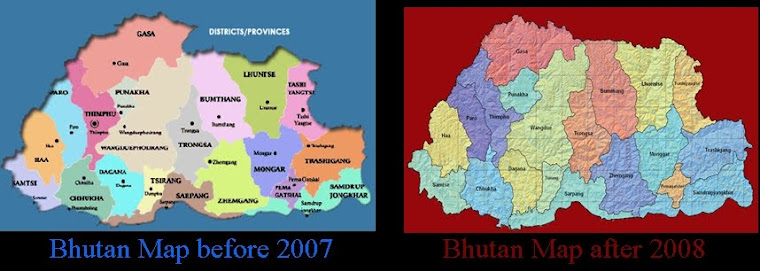
Click over the map to know the differences
Saturday, September 19, 2009

Bhutan for top GNH and no mobiles
Published: September 17 2009 03:00 | Last updated: September 17 2009 03:00
From Mr Laurent Legein.
Sir, If indeed happiness is to supplant gross domestic product as a measure of progress, and if somehow the current French leadership and Joseph Stiglitz, 2001 winner of the Nobel economics prize, get credit for that (“Sarkozy recommends happiness as yardstick of economic progress”, September 15), the world would not be paying King Jigme Singye Wangchuck, the former king of Bhutan (who graciously abdicated in favour of his son in 2006), the tribute he deserves.
For it is he who, in 1972, first coined the term “gross national happiness” and instructed his administration to construct a sophisticated GNH index (based on 72 variables, I was told by an enthusiastic bureaucrat) as a more holistic, and culturally appropriate, alternative to GDP.
GNH growth has since been the guiding objective in Bhutanese socio-economic and environmental policies. With universal healthcare coverage, high literacy rates, pristine landscapes and the purest air on the planet, this small, beautiful Himalayan kingdom certainly has plenty of GNH-improving qualities.
Oh, and did I mention that it has no global system for mobile communications or BlackBerry coverage anywhere in the country? That, for the duration of a short, blissful trip there, sent my own happiness index through the roof.
Laurent Legein,
Brussels, Belgium
Bhutan Hopes Bamboo Boosts National Happiness
September 15, 2009
The mountain kingdom of Bhutan measures its own Gross National Happiness, which is enhanced by its lovely forests. One tradition bringing down the Happiness quotient is the flags that are flown for the departed, for good luck. The more flags, the better. Now Bhutan's government is growing bamboo to spare the trees that are cut down.
The mountain kingdom of Bhutan measures its own Gross National Happiness, which is enhanced by its lovely forests. One tradition bringing down the Happiness quotient is the flags that are flown for the departed, for good luck. The more flags, the better. Now Bhutan's government is growing bamboo to spare the trees that are cut down.
Marinello's Story One of 'Gross National Happiness'
BY DARLIND DAVIS: SPECIAL TO THE PILOT
For years, Carl Marinello, a lifelong PGA golfer, and former Pinehurst resident, has entertained friends and strangers alike with his story of his career, including golf jobs in the Bahamas, St. Maartin, South Florida, New York and Australia.
Now Marinello, and the story of his time as coach of the Bhutan golf team, is the subject of a major motion picture, which is scheduled to begin filming in 2010.
The Bhutan golf team, a group of golfers whose average scores were in the high 80s and low 90s, rallied behind the teaching of Marinello to become good enough to beat the Chinese team at the Asian Games in Seoul in 1986.
Peter Cattaneo (who directed "The Full Monty" and has two Academy Award nominations to his credit) reportedly will direct the new film aptly titled, "Gross National Happiness," which refers to Bhutan's efforts -- launched in the early 1970s -- to officially measure happiness in terms of Buddhist spiritual values.
advertisement
The story began when Marinello answered an innocuous ad in a Florida paper beckoning: "Spend a summer in Bhutan training a team for the Asian Games in Seoul."
Antsy and looking for a challenge at the age of 40, Marinello, who along with his wife Marcia, organized the Moore County Challenged Golfer Program, was soon flying East.
Bhutan is situated in the Himalayan Mountains, landlocked between India and China. The King (Bhutan has since become a democracy in 2008) shared a love of golf and pushed the idea of having a competitive golf team. The king had his cousin enlist the help of Marinello to make that goal a reality.
The story is reminiscent of the rag-tag Jamaican Olympic bobsled team in the movie Cool Runnings.
"Their discipline and self-control was amazing," said Marinello of Bhutanese.
Some credit that ability to concentrate to Buddhist values, other said some of it can be traced to their participation in archery, the national sport. Archers must have keen eyes, a steady hand and extraordinary focus. Skills that can also be beneficial on the golf course.
The team members played their hearts out with pride and natural ability and the outcome surprised all, including the King, as the players stated, "We will win this for our King and coach Carl."
Combine the great underdog story with the serenity and beauty of Bhutan and the story is sure to stir one's imagination.
National Geographic television channel has featured previous programming about this breathtakingly beautiful land.
The hardship of living in rocky terrain is taken in stride and seems to cause little strain on a people who are tranquil, peaceful and beautiful. They continue to wear the traditional dress every day. But in spite of these ancient customs and surroundings, The King often wore his golf shirt and pants underneath traditional garb, ready for a planned tee time, according to Carl.
Cantilever monasteries jut out precariously from stone cliffs and the villages overflow with monks in maroon robes. Colored flags adorn the roofs of houses, as they whip in the wind to stir prayers upward to heaven. Nearby Nepal is perhaps better known (where Katmandu is located); the highest elevation on Earth as Mt Everest is considered the nearest link to heaven.
Amid this pristine setting, the original golf course layout resembled early Pinehurst, with its brown greens made of sand and oil. The course was a far cry from the Arnold Palmer-designed course that the Asia Games were played on in Seoul.
The ability of the players and coach Marinello to adapt to different course conditions is another remarkable achievement, said Marinello's longtime friend and Pinehurst resident Tom Stewart.
"Golf in the Kingdom was a type of fiction, but Carl is the real experience," Stewart said.
Dissident: Democratisation in Bhutan all for show
Religious freedom, an independent judiciary, freedom of the press and human rights remain unsolved questions
Friday, September 18, 2009 By Asia News
Bhutan’s democratisation is all for show; it exists only “on paper” and is of little relevance to the population, this according to Karma Duptho, secretary of the Druk National Congress (DNC), a Bhutanese political movement operating in exile. He has harsh words for the Bhutan government on a number of issues, from Nepali refugees to the free press, from an independent judiciary to respect for human rights and religious freedom, issues that have not yet found a solution in the small mountain kingdom in the Himalayas, caught between China and India.
On the issue of religious freedom, the DNC secretary said that it “was absent until the promulgation of the constitution last year, but” even now “ we can never be certain whether the constitutional provision guaranteeing freedom of religion will be upheld.”
“There are reports of Buddhist culture and religion being imposed on ordinary people,” he said. Members of “other faiths are at risk of attacks, arrests and other forms of persecution including arbitrary detention and arrests from officials,”
Buddhism is Bhutan’s state religion. The authorities have a past of violently cracking down on dissident sects or smaller faith communities. In 1997 for example, some Nyingmapa Buddhists were killed or arrested.
Although constitutional changes made “arbitrary arrest unlawful” last year, proselytising remains illegal” and it is not clear whether “building churches is still restricted or not.”
An “independent judiciary is a fundamental tenet of democracy and this is absent in Bhutan,” Duphto said. “There are at present some 200 and plus political prisoners in various jails throughout Bhutan. Most of them participated in peaceful demonstrations in the early and late 1990s, demanding human rights and democracy.” Some of them have been “imprisoned for more than 17 years;” in 2007 they were joined by “hundreds more” who were arrested for “engaging in political activities contrary to the belief and ideology of the Thimphu regime,” mostly “charged with sedition and treason, and sentenced to 15 years to life imprisonment.”
A tool of democracy elsewhere, in Bhutan the “judiciary is under the control of the king, Jigme Khesar Namgyel Wangchuck, the country’s fifth monarch, who ascended to the throne in 2006 at the age of 26.
Finally yet importantly, freedom of the press remains a contentious issue. Restrictions are still in place and the country’s four radio stations and four newspapers must follow government directives. No newspaper has for instance “written a single article on the Bhutanese refugee issue” since it emerged in 2007, “except for state-owned Kuensel”.
As AsiaNews recently reported, many Bhutanese refugees found asylum in the West, but their problem still remains unresolved.
Wednesday, September 16, 2009
HM grants audiance to the Comptroller and Auditor General of India
15 September 2009
His Majesty the King, today, granted an audience to Comptroller & Auditor General (C&AG) of India Shri Vinod Rai.
The C&AG of India is in the Kingdom from 14 to 17 September leading a four member delegation on a goodwill visit. He also called on the Prime Minister.
Today Morning he visited the RAA complex and delivered a talked on; “Relationship between Public Accounts Committee and Supreme Audit Institutions – an Indian perspective” to the members of the Public Accounts Committee and the RAA Officials.
This is the fourth visit made by the successive C&AG of India and the first since Bhutan adopted Constitutional Democracy. The relationship between the Office of the Comptroller & Auditor General of India and Royal Audit Authority had been strengthened with the signing of Memorandum of Understanding (MOU) in 2001.
The MOU was signed to strengthen the existing friendly relations and bilateral co-operations aimed at improving the work methodologies and exchange of information in the field of public audit. Under the MOU, two Audit Officers are trained every year in the prestigious Academy of Indian Audit and Accounts Services in Shimla, Himachal Pradesh, besides deputing senior resource persons from the Office of the C&AG of India once in a year to train auditors in Bhutan. The MOU was renewed in 2007 for another six years.
The visit made by the C&AG is yet another step to further strengthen the relationship between the two Supreme Audit Institutions.
His Majesty grants audience to India’s new Foreign Secretary
September 12: His Majesty the King granted audience to India’s new Foreign Secretary Nirupama Rao this morning. She is accompanied by Satish C. Mehta, Joint Secretary North, of Ministry of External Affairs. They arrived in the country on a three day official visit this morning.
At the Paro airport, The Indian Foreign Secretary was received by her Bhutanese counterpart Daw Penjor, the Chief of Protocol, the Paro Dzongda and Foreign Ministry officials.
Shortly after her arrival in the capital, His Majesty the King granted audience to the Indian Foreign Secretary.
Nirupama Rao became the Foreign Secretary of India on August 1 this year. Before that she served as the Indian Ambassador to China and High Commissioner of India to Sri Lanka.
From 2001 to 2002, she served as the first woman spokesperson of the Ministry of External Affairs. From 1998 to 1999, she was the Deputy Chief of Mission at the Indian Embassy in Moscow.
She joined the Indian Foreign Service in 1973.
His Majesty also hosted a luncheon at the Dechenchholing palace for the Indian Foreign Secretary.
Later in the afternoon, the Foreign Secretary of India called on the Prime Minister Lyonchhen Jigmi Y. Thinley.
While in the Kingdom, the delegation will also be meeting senior officials and visiting places of historical and cultural interest.
The Foreign Secretary leaves for New Delhi on Monday.
Bhutan on the Seine
Peter Foster, Financial Post
Published: Wednesday, September 16, 2009
Being vertically challenged obviously bothers French President Nicolas Sarkozy. At a visit to a manufacturing plant in Normandy last week, his aides sought out the factory's twenty shortest workers as a backdrop. On the other hand, he wasn't too short to trade in his old wife for dishy model/songstress Carla Bruni. But then she is five inches taller than him. Is that a worry? Should President Sarkozy's anxieties and joys be somehow included in the French Gross Domestic Product?
Seems like a wacky idea, but eighteen months ago, M. Sarkozy established an International Commission on the Measurement of Economic Performance and Social Progress, headed by renowned Keynesian anti-capitalist Joseph Stiglitz. This was allegedly due to "dissatisfaction" with the state of statistical information. I can just imagine the conversations along the Champs: "Zoot alors, I am absolument fromaged off with the state of zee stats. When will they incorporate zee leg over in zee GDP?"
President Sarkozy apparently wants to follow the desperately poor, heavily subsidized Himalayan kingdom of Bhutan in installing the notion of "Gross National Happiness." He claimed at a speech at the Sorbonne on Monday that focusing on GDP was all part of the "overreliance on free market principles" that triggered the global crisis. Fannie Mae and Freddie Macdidn't rate a mention.
"If the market was the solution to all problems and was never wrong," continued M. Sarkozy, "then why are we in such a situation?" But who ever said the market was "the solution to all problems?" And it's not markets that screw up, it's people. Markets just hand out the bouquets and brickbats. However, according to M. Sarkozy, one means of avoiding future crises will be to incorporate measures of such joys/aggravations as vacations (a la M. Hulot?), recycling, doing household chores, and traffic congestion. The contribution to well-being of physical attributes and sex were not mentioned, but presumably will have to be shoved in there somewhere.
Professor Stiglitz laid out his thoughts on the inadequacy of traditional statistics in a piece in last Sunday's Toronto Star. "Are statistics giving us the right signals about what to do?" he pondered. But this question begged more fundamental ones such as: who is this "we" who are seeking signals? And what do "we" plan to do with them?
Professor Stiglitz pointed out that "What we measure affects what we do," but what he really meant was that "what government measures determines what government does." Which gets to the heart of the statistical problem.
In the good old days, GDP provided a rough measure of overall output, but such statistics were always dangerous because they were the raw material of planning. Gradually, as planning failed, planners turned to attacking markets by attacking GDP. Look, they would say, car accidents contribute to GDP! Bombs and tanks contribute to GDP!
Professor Stiglitz claimed that political leaders "are told to maximize [GDP], but citizens also demand that attention be paid to enhancing security, reducing air, water and noise pollution, and so forth -all of which might lower GDP growth." But who exactly is "telling" political leaders to maximize GDP? And are we short of environmental legislation, or the threat of it, in modern democracies?
Professor Stiglitz believes, as President Sarkozy's new statistical Robespierre, that there are opportunities to "improve metrics." His ideology was clearly showing in his eagerness to incorporate inequality. "If a few bankers get much richer," he wrote, "average income can go up, even as most individuals' incomes are declining." He suggested that U.S. growth was held up as a model, but that GDP numbers didn't take account of mounting household debt. But nobody hid the household debt figures. All this establishes is that you have to look at a full range of relevant statistics to come to any conclusions. More important, you tend to pick figures to support your conclusions anyway.
Professor Stiglitz claims that policy wonks are now in a better position to assess well-being and gather the relevant data, employing such insights as that losing a job means more than just loss of income. But who except an ivory tower Martian would not know that? Meanwhile somebody has also apparently just told Professor Stiglitz that "social connectedness" is important. Uh oh. Here come those old anti-capitalist favourites: anomie and alienation!
"It should have been obvious that one couldn't reduce everything to a single number, GDP," claimed Mr. Stiglitz. But it was only ever people like him who thought that such an exercise was possible in the first place.
Now they claim access to more subtle and comprehensive measures so that they can more subtly and comprehensively interfere with our lives. Or, as professor Stiglitz puts it "Such reforms will help us direct our efforts (and resources) in ways that lead to improvement in both."
The trouble is that when he writes "us" he doesn't mean you and me. When he refers to "our" resources, he does. Meanwhile expect a lot of French people to be bothered by nerds with clipboards and happy-ometers.
HM grants audiance to the Comptroller and Auditor General of India
15 September 2009
His Majesty the King, today, granted an audience to Comptroller & Auditor General (C&AG) of India Shri Vinod Rai.
The C&AG of India is in the Kingdom from 14 to 17 September leading a four member delegation on a goodwill visit. He also called on the Prime Minister.
Today Morning he visited the RAA complex and delivered a talked on; “Relationship between Public Accounts Committee and Supreme Audit Institutions – an Indian perspective” to the members of the Public Accounts Committee and the RAA Officials.
This is the fourth visit made by the successive C&AG of India and the first since Bhutan adopted Constitutional Democracy. The relationship between the Office of the Comptroller & Auditor General of India and Royal Audit Authority had been strengthened with the signing of Memorandum of Understanding (MOU) in 2001.
The MOU was signed to strengthen the existing friendly relations and bilateral co-operations aimed at improving the work methodologies and exchange of information in the field of public audit. Under the MOU, two Audit Officers are trained every year in the prestigious Academy of Indian Audit and Accounts Services in Shimla, Himachal Pradesh, besides deputing senior resource persons from the Office of the C&AG of India once in a year to train auditors in Bhutan. The MOU was renewed in 2007 for another six years.
The visit made by the C&AG is yet another step to further strengthen the relationship between the two Supreme Audit Institutions.
His Majesty the King, today, granted an audience to Comptroller & Auditor General (C&AG) of India Shri Vinod Rai.
The C&AG of India is in the Kingdom from 14 to 17 September leading a four member delegation on a goodwill visit. He also called on the Prime Minister.
Today Morning he visited the RAA complex and delivered a talked on; “Relationship between Public Accounts Committee and Supreme Audit Institutions – an Indian perspective” to the members of the Public Accounts Committee and the RAA Officials.
This is the fourth visit made by the successive C&AG of India and the first since Bhutan adopted Constitutional Democracy. The relationship between the Office of the Comptroller & Auditor General of India and Royal Audit Authority had been strengthened with the signing of Memorandum of Understanding (MOU) in 2001.
The MOU was signed to strengthen the existing friendly relations and bilateral co-operations aimed at improving the work methodologies and exchange of information in the field of public audit. Under the MOU, two Audit Officers are trained every year in the prestigious Academy of Indian Audit and Accounts Services in Shimla, Himachal Pradesh, besides deputing senior resource persons from the Office of the C&AG of India once in a year to train auditors in Bhutan. The MOU was renewed in 2007 for another six years.
The visit made by the C&AG is yet another step to further strengthen the relationship between the two Supreme Audit Institutions.
PM’s Japan experience
10 September, 2009 - Returning yesterday from his eight-day visit to Japan, Prime Minister Lyonchhoen Jigmi Y Thinley said the visit confirmed good relations between the two countries that will not be altered by the changing political situation in Japan.
Japan had its general elections in August this year where the opposition Democratic Party of Japan defeated the Liberal Democratic Party that had been in power for almost 52 years.
“Japan is one of the most important developing partners of Bhutan and, with this visit, we were able to strengthen and build linkages with both the parties,” said Lyonchhoen. “I’ve come back with assured support and many opportunities to collaborate in pursuit of various programmes the government is committed to.”
Lyonchhoen said he made it very clear to all Japanese officials he met that it was not his intention to request Japan for additional assistance beyond what Japan had already committed. “We are fully mindful of how Japan has been worst hit by the economic recession. We just wanted to thank the Japanese people for their cooperation and assistance,” he said.
“But I told them that there’s a great need for ambulances and they’ve noted that,” said Lyonchhoen. “There’s a high possibility that several ambulances and fire fighting engines may be forthcoming within this year.”
Lyonchhoen Jigmi Y Thinley said that the most important event was his meeting with the outgoing prime minister of Japan, Taro Aso, during which he thanked the Japanese government for all the contribution and support to Bhutan’s development process.

“One of the outcomes of my visit will be a significant increase in Japanese tourists to Bhutan,” said Lyonchhoen. He said that an agreement would be signed between the government and JALPAK, which will formally recognise Bhutan as a high-end tourism destination. A JALPAK team will visit in October and operations will start by spring next year, said the prime minister.
Lyonchhoen also met with the Tokyo metropolitan governor, who expressed his interest in supporting Bhutan in technological cooperation. “He gave me a list of activities in which we might find interest. But I informed them and many other business people that we’re at present looking at the possibility of upgrading our Paro-Bondey farm machinery workshop into a factory that could manufacture most parts for our farm machinery,” he said. “By upgrading, we’d need to import only the engine and the more sophisticated parts, thereby making our mechanisation of rural farm sustainable.”
During his visit, Lyonchhoen also met with the Japanese vice foreign minister, a very prominent sports personality. “I’ve invited her to visit Bhutan with the view to build relations between our sports organisations and the Japanese sports establishments,” he said.
On foreign direct investment in the area of building health facilities, Lyonchhoen said that he had a discussion with a leading biotechnology company. “This is an area we think we’ve considerable potential for in terms of having abundance of herbal medicine plants. The concerned party will visit Bhutan soon to explore the possibility of establishing a high-tech medical and research centre.”
During his meeting with the vice president of JICA, Kenzo Oshima, Lyonchhoen said he thanked them for the support they have committed. “We hope that, despite the difficulties the Japanese government is facing as a result of recession, there would be no withdrawal of earlier commitments. And this was confirmed,” he said. Lyonchhoen Jigmi Y Thinley said he studied a Japanese farming cooperative to replicate the idea in Bhutan. “The government is committed to promote cooperatives and we explored opportunities to import machinery for grading our food products and installing them in particular places, starting from Thimphu, Phuentsholing, Gelephu and Samdrupjongkhar,” he said.
Lyonchhoen had gone to Japan on the invitation of the junior chamber of commerce in Fukuoka district to speak on Gross National Happiness. He addressed an audience of more than 2,000 people, which comprised of young leaders of the chamber and important politicians.
“Relations between Japan and Bhutan have been diversifying with greater levels of exchange and Japanese people have taken great understanding of Bhutan’s development process. This relation will continue to grow,” he said.
A Buddhist group in Tokyo donated 400 bicycles to Bhutan during the prime minister’s visit to Japan.
“Another group has arranged for its transportation costs,” said Lyonchhoen Jigmi Y Thinley. “We’ll probably, depending on what the cabinet decides, give them to those people, who will pledge sincerely to use the bicycle to go to work instead of cars.”
He said that the government has already taken a step to reduce the use of private vehicles in Thimphu. “We’ve added some 13 buses during the coronation and centenary celebrations to increase public transportation and we’ll continue to add more buses,” he said.
“Through the use of 400 bicycles during working days, we’ll be able to reduce carbon emission. The idea is to make Thimphu a bicycle city,” said Lyonchhoen.
A non-government organisation in Japan, AMDA, also donated a Japanese ambulance to Bhutan.
By Phuntsho Choden
Subscribe to:
Posts (Atom)