The Sorry Saga of Bhutan's North

The Sorry Saga of Bhutan's North
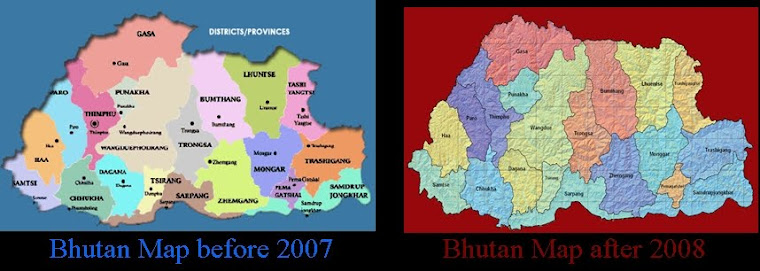
Click over the map to know the differences
Showing posts with label Agriculture. Show all posts

Saturday, July 14, 2012

State of the state

The prognosis is good
 
In all basic developmental indicators, the country has scored highly, as reflected in its 8.1 percent growth rate
«Lyonchhoen presents the 4th State of the Nation report at the Parliament yesterday
State Of The Nation Report: Going by the figures, and what the prime minister presented to the Parliament, brimming with senior civil servants and media personnel apart from the members themselves yesterday, the nation’s state, in general, was good.
After speaking for almost three hours, Lyonchhoen Jigmi Y Thinley, while presenting the fourth annual state of the nation report, said the country’s achievement over last one year was something to applaud.
He started off with a rerun of the good moments last year, a significant one being the royal wedding, an occasion that was “celebrated not only by the jubilant Bhutanese people, but by an enchanted world”.
But, on the flip side, the house was reminded of the tragedy country witnessed last year, the September 18 earthquake, Rupee debt, and the recent fire incident that reduced the age-old Wangduephodrang dzong to rubble.
Moving on to the country’s economy, Lyonchhoen said Bhutan’s 8.1 percent growth rate was ranked second in South Asia, and 11th in the world by real GDP growth rate for last year, in the list prepared by the US central intelligence agency.
It was mainly driven by industry, with hydropower constructions contributing 44.1 percent, followed by service sector at 37.4 percent, and primary sector at 15.1 percent.
In terms of the minimum program for accelerating poverty eradication, about 22 of the 49 gewogs in the country targeted to be connected by motorable road in the 10th plan have been completed.
About 80 percent of the Bhutanese families have received electricity, as of March 2012.
Claiming that all the funds are in place, the remaining 16,462 households will be electrified during the 2012-13 financial year.
Lyonchhoen admitted that their commitment of delivering a minimum of three doctors for every dzongkhag hospital was a challenge.
“While it’s difficult to get doctors from abroad, even if we did, we’re also unable to afford the amount they demand,” he said, adding a number of existing doctors were also undergoing specialisation programs abroad.
As such, although 11 dzongkhags have at least three doctors each, five dzongkhags have two doctors each, while the remaining four have a single doctor at the moment.
In figures
Access to Save drinking water
94% (From 69% in 2008) of the population
Mobile connectivity
68.4% (484,189) as of Dec. 2011 (From 56.4% in 2010)
Number of cooperatives
16 registered cooperatives
64 Farmers Groups (FGs)
Industrial license
2,447 industrial licenses issued in the last year (Total 15,190 licenses operational)
Tourists arrivals
100,833 tourists in 2011
(46% growth from 2010)
Roads
38.80km of national highway constructed in FY 2011-12
146 km of feeder/dzongkhag roads built
108 km roads connecting hydropower projects constructed
104 km of road resurfaced in FY 2011-12
30 Motorable bridges built in FY 2011-12
But Lyonchhoen said they hoped to fulfill this goal by 2013.
There were also places where safe drinking water through “conventional methods” has not reached. Alternative technologies in the form of rainwater harvesting system and pumping water supply were implemented.
All 205 gewog centres now have access to mobile services. Through government subsidy, services were made available in remote and difficult places.
In the agriculture sector, Lyonchhoen said a budget of Nu 32M was allocated for fiscal year 2012-13 to accelerate vegetable production and marketing, one of the moves taken to address ongoing rupee shortage.
He also claimed a substantial improvement in livestock productions, generated through gains in milk production, about Nu 1,280M, followed by egg, about Nu 195M.
Cattle population was also increased by four percent, pig by eight percent and poultry by 69.
Education wise, the number of schools increased to 553 and extended classrooms to 108 to meet government’s objective of providing all children with access to education within an hour’s walking distance.
In the tertiary education sector, five programs – media studies, BA in Bhutan and Himalayan studies, bachelor of sustainable rural development, BS (nursing), and diploma in computer hardware and networking were introduced in the past year under the Royal University of Bhutan.
Claiming that it to be one of the lowest in the world, the unemployment rate is declared at 2.1 percent, with youth unemployment rate falling from 9.2 percent last year to 7.3 percent.
In the health sector, to address the long-standing human resource shortage, the first university of medical sciences of Bhutan will be launched this month.
Introduction of health help centre, Lyonchhoen said, enabled people to access services of health professions within an hour at any time from anywhere through a telephone or mobile network.
In the field of communication, construction of about 100 community centres has been completed. About 22 G2C services were also provided through the centre.
Although temporarily stalled, the launch of domestic air services in Yonphula, Bumthang and soon in Gelephu would supposedly enhance transport connectivity, reduce travel time and also promote regional development.
The highest revenue contributor, trade sector, contributed about Nu 4.8B in the last fiscal year, an increase by about eight percent.
All hydropower projects were “well on track”, with Punatsangchu I and II and Mangdechu projects already employing about 2,853 Bhutanese.
Introduction of 20 percent green tax on vehicles and the pedestrian day were some recent moves to ensure environmental conservation.
In conserving culture and architectural skills, Lyonchhoen highlighted the conservation projects of Paro, Lhuentse and Dagana dzongs, scheduled to be completed by June next year.
Lyonchhoen also applauded Royal Audit and Anti Corruption, who played key roles in ensuring transparency and accountability, for their devotion and professionalism in carrying out the mandates.
Stressing a need for strong media in a democratic setup, he commended the existing media.
He, however, said the number of newspapers appeared more than enough for a small country like Bhutan.
Bhutan has also established diplomatic relations with 14 additional countries between end of 2011 and March 2012.
Introduced for the first time, a three-day visit designed to know Bhutan was extended to ambassadors, based in Dhaka and New Delhi, representing 44 countries.
“In reflecting on the reasons and causes for such accomplishments, I am reminded, once again, that the credit belongs largely to our highly dedicated and competent civil servant,” he said.
“Likewise, the local governments, the corporations and the business sector are deserving of high praise.”
By Kesang Dema
source: Kuensel

Saturday, March 12, 2011

Bhutan's Government Officers Ursurp People's Land, Torture the Owner

STATEMENT OF MOTIKHAR ACHRAJA Date:-11/03/2011

1. My Father Mr. Devi Charan Acharja was forced to live Bhutan in June 1992.
2. In 1986 I separated from the joint family and staying with my nine family members. While appropriating the land among five brothers, I got the share of land measuring 10.31 acres under the old thram (land registration number) no.114 and the new 158.However, mean while the Home ministry had suspended the land registration and transfer or transaction of any land deal. While allotting the said land, I was also given the responsibility of education and marriage of four younger brothers and five sisters.
3. I also cleared the loan of Rs.31, 514.00 taken by my father from Bhutan Development Finance Corporation (BDFC) mortgaging the same land in 1994 for fishery development.
4. Since my father and other family members were evicted, I was mending the land until the then Dzongda of Sarbang district Dr.Sonam Tenzing on April 21, 1998 verbally to my shock told me that the land does not belong to me.
5. I could not approach the king immediately for consideration of my case due to financial constraint. I could do only in October 1998.
6. The king had ordered the Royal chamberlain (Zimpon) Dorji Gyeltshen to forward the case to the home ministry for verification .After that there was no any intimation to me pertain the case.
7. I approached the High court in 1999 for redress of my case as I did not get anything from the King. As there was no any response or action even from the High court, again I appealed to the high court in 2002 requesting to review my case .In 2003,the High court forwarded the case to Home Ministry to look into the matter. When I approached the Home ministry and met the then home minister Tinley Gyamtso, he told me that it is the duty of the court to ascertain whether you get the land or not. I was regularly paying land tax and other government liabilities.
8. To my surprise and in my absence, Mr. Nima Khandu came and claimed that the land had been allotted to him by the government under resettlement scheme along with the building. My children defied and sent him away when he came with some monks to lay the foundation.
9. I also appealed to the then Agriculture minister Sangay Nedup on 1-1-2004 and november2004 for transfer of registration of land to my name from my father.
10. On 6 April 2004, Dzongda Sonam Dawa, Dungpa and Gup (block head) Karma and Tshogpa in my absence came to my house and told my children to vacate the land and the house. When my children started crying, the Dzongda pointed the area leaving the house for demarcation. On 7th April 2004, Dzongkhag land surveyor Mr. I.K. Suncheuri, resettlement coordinator district livestock officer, Gup and Tshokpa came in my absence and demarcated the area along with 1.5 acres of betel nut orchard and paddy field totaling 5 acres.

11. When Nima Khandu came and started building house, my son Durga Prasad Acharja rejected and dismantled the poles.
12. On 8th may 2004 my son Durga Prasad Acharja was arrested and taken to Lodrai jail, Galephu and the court in Galephu sentenced him to one year jail on charges of violating section Na 1-4 of Thrimzhung Chenpo (supreme law).

13. Unsatisfied with the unfair decision of the Galephu court, I appealed to the Sarbhang district court for fair judgment and justice. However, the district court too did not give any decision of its own and justified the decision of the Galephu court.
14. On 21-9-2004, the Dzongda Sonam Dawa issued a last warning letter to me written in Dzongkha which I cannot read except the English word “Last Warning” written in bracket.
15. On 2-2-2005 again appealed the Agriculture minister on his visit to our block Chujegang (Danabari) to look into my case and on the spot decision. The minister then and there ordered the surveyor general Mr.Sithar Namgyel who was also with the minister’s entourage to look into the case and resolve the problem. After hearing my story and the facts by the Surveyor general, he told the two judges of sub-division Galephu and the Sarbhang district to transfer the land registration in my name as I posses the agreement from my father.
16. On 8-2-2005 the Surveyor General has written to the judge, Galephu to transfer the land registration in my name. It is more than 5 years, the court has not done anything to transfer the land and has not respected the Surveyor General’s letter too asking to transfer the land in my name.
17. In 2005 the Sarbhang court also justified the verdict of Galephu court of imprisonment of my son.
18. Since I felt injustice and unfair verdict of my son, I appealed to the high court Thimpu in 2005.
19. The High court judge Karma Sherpa also game the verdict that since the land has not been transferred within one year of the agreement, the land thus belongs to the government and the imprisonment of son is right (bench no.3). Further I was sent to the Royal Bhutan Police Central box, Thimpu and kept there for one month and 25 days without any question.
20. Not satisfied with the verdict of bench 3, I appealed to the full bench consisting of judges Passang Topgay, Thinglay weizer, K.B.Ghaley, Sithar Namgyal, Jigme Zangpo and Tshering Wangchuk. The judges instead of giving fair judgment, they alleged me of stealing betel nuts grown in my own land and fined me Rs. 27000.00 saying that the land belonged to the government and allotted to Nima Khandu. Further I was asked to pay fine of Rs 20000 for dry land Rs 35000.oo for wet land per acre totaling Rs 1,57,00.00 and also additional Rs9862 as compensation to Nima Khandu and asked to vacate the land. The decision was passed on 5-7-2006 vide case no.1583.
21. On 19-7-2006 not satisfied with the decision of the High court, again I approached the King. The king ordered the Royal chamberlain office to issue a letter to the Home minister to look into the matter and resolve it. The king also ordered that in case of complication and unable to solve the problem, the matter should be forwarded to Gyelpoi Zimpon’s office.
22. In 2007 the high court summoned and asked me to produce the decision paper. Along with the decision paper, I showed the letter issued by the Gyelpoi Zimpon’s office. Again I went to the Zimpon’s office to inquire the progress. I was told that nothing has come to the office from home ministry. I went to the home ministry and on inquiry, I was told that my letter was forwarded to local government section. At last the letter was found lying in the office without any action. The local government office told me that they would dispatch the letter to the Dzongkhag office. On 1-10-2007 the home ministry had sent the detail report of the plot no.SSD-03 to the Zimpon’s office.
a. On May 18, 2009, I appealed to the prime minister, Thimpu stating that nothing has happened in regard to transfer of my land registration from my father. The case was put up in the cabinet. The cabinet has written to the department of the land record to look into the case. The land record had written to the Dzongkhag citing all the correspondence regarding the said land but there was no any response to the query from the Land record. The office had inquired whether there is new land (Sathram no.158, previous 114).The new thram was also issued in my father’s name Devi Charan Acharja. This is so because he had not taken a pie as compensation.
23. On June 2010 I appealed the 5th king through the Gyelpoi Zimpon office, Thimpu. The Zimpon office; Thimpu had forwarded the appeal to the Zimpon welfare office, Bumthang as Sarbhang Dzongkhag falls under the jurisdiction of welfare office, Bumthang.
24. In 2010 legal officer from the sarbang Dzongkhag investigated and reported to the Gyelpoi Zimpon legal officer Wang Gyeltshen. Mr. Wang Gyeltshen submitted the report to Gyelpoi Zimpon and the Gyelpoi Zimpon according to the order of the King instructed the high Court to respect the verdict of case no.1583 dated 5-7-2006.
25. On 2-12-2010, according to the instruction from Dzongkhag, the Gup of Chujegang Sangay Tshering issued order asking me not to touch anything in the land, either sow or reap any crop.
26. The high court has sent a letter on 31-1-2011 to Dungkhag court Galephu Instructing to respect the old decision of 2006.

27. On 22-2-2011, I plucked 98 sacks of betel nut grown in my land. While plucking the nuts the Gup came to my house and went. Later on sent the Tshogpa to call me to his office with the laborers numbering 10. He handed me a letter written in Dzongkha and asked me immediately to go to Galephu to meet the Dungpa. When I came to Dungkhag to meet the Dungpa who was away and had to stay overnight in Galephu. The laborers packed the betel nuts in 98 sacks and loaded on the truck number BP-2-1326 and were bringing to Galephu, while on the way to Galephu, the truck with the load was intercepted by the Royal Bhutan Police and taken into custody and is kept in the police centre, Galephu.
Mr. Motikhar Acharja is arrested by the royal Bhutan Police, Galephu on 26th February 2011 and is kept in the Galephu jail without any question. The Human Rights organization of Bhutan (HUROB) has appealed to all the concern for Urgent Action on 26th February 2011 and requested to write to the Prime Minister of Bhutan for justice and immediate release of Mr. Acharja. HUROB firmly believes that the respective concern Human Rights Organizations and Diplomatic missions have taken appropriate steps to pressurize the Royal government of Bhutan (RGOB) and hopeful that Mr. Acharja gets justice and be released who is till date kept in the jail, Galephu.
The above statement was taken by HUROB staff on 24th February 2011from Mr. Acharja. He has availed more than 70 letters of correspondence and courts decisions for ready reference. Mr. Acharja statement and his untiring saga of fight for justice and right is one testimony to fathom by all conscientious human being that how much injustice being meted out to southern Bhutanese of Nepali speaking by the Bhutanese regime starting from the King, the supreme authority to the lowest Block head. Even the Court that talk of fair justice without favour and fear is biased when concerning the southern Bhutanese. One should also comprehend that people like Acharja who dares to challenge the government is not reaching any where to get justice that how many innocent Bhutanese especially the Nepali speaking are being suppressed, oppressed and denied justice. Again HUROB requests everyone who receives this statement to promptly take action. Your small gesture is doing to make big difference in the life of Mr. Acharja and thousands of southern Bhutanese who are silently suffering. The HUROB also request the core countries for Bhutanese refugees which are resettling the Bhutanese refugees to form a committee to independently study the unabated suppression of the southern Bhutanese, question of nationality and citizenship of about 80000 relatives of refugees still living in Bhutan and denial of justice.
Thank you for your kind and continuous support and solidarity.

S.B.Subba
Chairman
HUROB
Email: sbyongya@yhaoo.com
hurob1991@gmail.com
Mobile: +91-7602895197.

Friday, July 23, 2010

1,000 apply for 152 power tillers

Priority will be given to farmers, who form groups to share the machine

Power To The People: In the last 26 years, Bhutan has received about Nu 1.5B grant assistance from Japan

Japanese KR II grant 9 July, 2010 - The agriculture ministry has received more than 1,000 applications from farmers across the country for the 152 power tillers the Japanese government recently gave under its KR II grant.

Unable to decide, the executive agricultural engineer, Karma Thinley, said the criteria for providing the machines would be done by the dzongkhag, after analysing which farmers in what part of the country were in most need of the power tillers.

He said they would consider farmers’ cultivable land, poverty index, demand from the respective dzongkhag, and farm road availability. The ministry would send the information to the agriculture machinery centre in Paro, which would then distribute the power tillers.

Agriculture ministry’s policy states priority would be given to farmers, who form groups to work together and share the machine.

The power tillers come with accessories and spare parts worth 180M yen.

Along with the power tillers, KR-II grant’s Japanese non project grant aid (JNPGA 2008) has provided other agricultural machinery, which include 35 tractors, 77 paddy transplanters, 25 water pumps, 165 sets of plastic for greenhouses and 85,000 seedlings for underprivileged farmers worth 200M yen.

The first secretary, Japanese embassy in New Delhi, Manabu Suzuki, formally handed over the machines to the ministry last evening in Thimphu.

Lyonpo (Dr) Pema Gyamtsho said the KR-II grant was an unusual assistance to Bhutan, supporting the country’s development by strengthening the grassroots.

He said the country’s progress was in being able to mechanise, not just its farming activities, but all other development activities requiring labour.

The KR II came into being, following the Kennedy round table conference in 1967, which required commitment from developed countries to provide food assistance to those struck with epidemic and famine.

Japan was one of the main donor countries to countries with food shortages, which were many.

Japan formulated a new grant scheme in 1977, which, instead of just supplying food, provided assistance to help developing countries increase their food produce. The scheme came to be known as the KR-II grant.

Bhutan qualified the category and reaped its benefits since 1984. Under the grant, only agricultural machines, fertilisers, and chemicals were considered essential to increase food production, but for Bhutan, agricultural machines were more important.

In the last 26 years, Bhutan has received grant assistance from Japan amounting to about Nu 1.5B. It accounted for more than 2,000 power tillers, 300 tractors, rice mills, threshers, harvesters and irrigation pumps.

The relationship between Bhutan and Japan has continued to grow ever since Dasho Keiji Nishioka came to Bhutan in 1964.

By Kuenga Tendar

Organic farming

Organic farming: Let’s cash in on the demand
25 March 2010
The world is going gaga over organic farming. Growing organic, consuming organic and selling organic.

The value of organic vegetables has increased in the past few years. People have increasingly come to understand the ill effects of vegetables grown using chemical pesticides, fertilizers and other allied chemicals.

Because organic vegetables are grown using local organic farm yard manure and traditional farming practices they are sustainable, farmer friendly and helpful to the poor. Organic vegetables have zero residues of pesticides or other chemicals in them and therefore safe for all ages to consume.

Besides the high health value associated with organic vegetables, they are soil friendly. Farm yard manure used to grow organic vegetables help organisms in the soil enhance and rejuvenate its fertility.

However, for vegetables to be organic in its true sense needs to fulfill a set of conditions. Were the seeds used to grow the vegetables organic, was the farm yard manure prepared using excreta from animals fed strictly organic feed, was the land used for cultivation free from fertilizers, was the water used free from chemicals like chlorine and other disinfectants, and was the packing materials used free from chemical contaminants are some of the conditions to be taken into account. If these conditions are fulfilled the vegetables can then be called organic.

In Bhutan, from time immemorial, our farmers have practised traditional farming using farm yard manure for fertilizing soil prior to cultivation of crops and vegetables.

Farmers have always preferred organic farming because of the unavailability of chemical fertilizers, cost factors and transportation problems. But today, these reasons have come as a ‘blessing in disguise’ for Bhutanese farmers.

Having realized the benefits accruing from consumption of organic vegetables and the huge market demand, farmers have taken to growing organic vegetables en masse. The trend of organic farming has indeed picked up momentum in the country.

But there are bottlenecks associated with it. There is no access to ready market for farmers in remote pockets of the country. We have not been able to export our organic vegetables beyond India or Bangladesh. We still have not been able to get our vegetables certified as truly organic.

The government, however, realizing the huge demand for organic vegetables in the neighbouring countries and overseas has plans to cash in on the demand. National Organic Programme under the aegis of MoA has been established to promote, encourage and support organic farming in Bhutan.

The huge demand for organic vegetables, fruits, and cereal crops overseas has partly been fuelled by high scientific literacy. Organic farming can be economical for Bhutanese farmers with small land holdings.

It makes lot of sense for our farmers to grow organic vegetables that will fetch them higher price in the market. Further, the hilly terrain does not permit mechanized farming.

Organic farming is sustainable in the sense that it uses local green wastes which would otherwise be useless, creates no residual harmful effects in the soil, and products. It gives a better value for the products to the farmers who in turn will be motivated to go for it in the long run.

Rural-urban migration can be controlled. The paradox of having fallow land on one hand at the same time the need to rely on imported food stuffs will die down. Regional airports in the future can help mitigate transportation problems for farmers involved in commercial organic farming.

Then will not everyone get a pie from this organic revolution?

By Netra Binod Sharma

From: Bhutan Observer

Keiji Nishioka: A bridge between two nations

Keiji Nishioka: A bridge between two nations
Posted on 09 March 2010 by editor
By Govinda Rizal

Keiji - a bridge for Bhutan-Japan relations
At a time when Japan’s economy was in a bubble stage, when the Japanese people were considering TV, washing machine, refrigerator as necessities at their homes, a Japanese youth, an agriculture expert was writing development plans in a remote village in Bhutan under a lamp-light lit from pine extract. The agricultural development in Bhutan and Japan-Bhutan relationship came out as a one man initiative of this planner, Keiji Nishioka.

In 1962, the then Prime Minister of Bhutan Jigme Palden Dorji made a request to one of his Japanese friends, Nakao Sasuke, for an agriculture expert to plan agricultural development in Bhutan. Sasuke recommended one of his students, Keiji Nishioka. Keiji was familiar with Himalayas through his expeditions.

One fine day in 1962, Keiji and his wife Satoko reached the Prime Minister’s residence, the Bhutan House in Kalimpong. His destiny was penned that day. Two years later, the couple left industrialized Japan for rural Bhutan. They flew to Calcutta airport and then to Hashimara. From there a jeep sent by Bhutanese government took them to Paro where his destiny was waiting for them. Then, he was 31. Initially, Keiji worked as a member of Japan’s Overseas Technical Cooperation Agency (now JICA) under the Colombo Plan. His earlier days were more challenging than imagined. He was in a remote area. He had to work with boss and colleagues from India who were cynical to believe that an expert from an island country has anything to do with the mountainous country than waste the resources. He had to either quit or prove them wrong. He started a small experimental farm, hired young boys as apprentices and began promoting products from his farm. He used seeds from Japan and the products attracted the farmers. Year by year, he increased the size of the farm, and amount and varieties of products. He experimented Japanese rice, large cabbage and long radish; grew asparagus, onion, potato, tomato, melon, watermelon, apple, cherry, grapes, persimmon, peach, pear, strawberry and everything the climate permitted. He grew improved varieties of vegetables, cereals, fruits and trees, and distributed seeds. The farmers were attracted; he worked with them and initiated selling of vegetable in the market. Before this, farmers had no idea if they had any products that would fetch them money. He took the farmers to markets, as far as to Thimphu and Phuntsholing, to sell their products.

After four years, upon his request, Japanese government started sending farm machineries. He taught improved cultivation methods and management techniques. In June 1974, during the coronation ceremony of the fourth monarch of Bhutan, the fresh fruits and vegetables from his farm were on the table for the royal guests. He walked around the country observing people’s works, listening to their stories, giving them advices and distributing seeds. He trained youths in farming techniques and sent students to Japan for trainings. He was entrusted the entire development of Zhemgang, one of the rural districts, where shifting cultivation was practiced and no rice fields existed. The district was not connected by roads and his two children were nearing school going age. So, he sent his wife and children to Japan and continued his development exercises in the remote Himalayan Mountains. He coordinated Zhemgang Integrated Area Development Project; introduced agar wood from neighboring Assam in India, cardamom from neighboring district Gelephu; and started their plantation as cash crops. He groomed apprentices, constructed rice fields, and introduced high yielding varieties of cereals, fruits and vegetables. Besides agricultural development, he mobilized people’s participation to construct suspension bridges, irrigation canals, farm roads, health clinics, sanitation and disseminated concept of healthy cooking and safe meat preservation methods. By now he was a national hero known as Japan “sahib” or the Lord.

Bhutan and Japan are distinct in many ways, yet Keiji Nishioka chose to seek uniformities. Born on St. Valentine’s Day of 1933, educated in Sakuragaoka Primary School in Seoul, Korea, Yao Junior High School in Osaka and Osaka Prefecture University, Keiji spent his life serving the farmers of Bhutan. In 1980, the monarch conferred to him a red scarf and a title of ‘Dasho’ equivalent to ‘Sir’, for his selfless service, making him the first foreigner to earn the title. In 1983, an international airport was built near to his farm, in Paro. Three years later, Japan and Bhutan signed a formal diplomatic tie and a year later in 1987, Japanese Prince Naruhito visited Bhutan. In all these mega events, Dasho Keiji Nishioka was the center of talks and the farm established by him was a ‘must-visit’ venue. He spent twenty eight restless years in Bhutan. On March 21, 1992, a toothache stole away his soul from his body in Thimphu hospital. On March 26 a state funeral in his name drenched Paro valley with the tears of the farmers and officers alike and the whole nation was soaked in grief. In 1999, he was awarded meritorious ‘Druk Thugsey Award’ posthumously, for his contributions to the development of agriculture productions in the country.

Today, Nishioka bridge in Zhemgang, Bonday farm in Paro, Agriculture Machinery Centre, National Seed and Plant Protection Program, roads, hospitals, thousand of fruit trees, hundreds of agriculture veterans, high yielding varieties of rice, vegetables, fruits and trees, made-in-Japan farm machineries and automobiles all over the nation are the results of his vision and dedicated service to the Bhutanese people. The name of Dasho Keiji Nishioka ties the people and governments of Japan and Bhutan with hearty spiritual knot initiated by him. …………..

Original here

KO Copies this way

The dasho lives on
24 March 2010
At the approach of his 18th death anniversary on March 21, Dasho Keiji Nishioka is still remembered with gratitude by Panbang farmers. Rabi C Dahal reports
Dasho Keiji Nishioka, known throughout Bhutan as Dasho Nish­ioka, died 18 years ago.

His house in Panbang is falling into ruins but memo­ries of 28 years of his selfless dedication for his adopted country are still fresh in the minds of the people of Pan­bang.

Elderly people like to talk about his whims and fancies, his natural sense of humour and numerous possibilities that he brought to bear on the far-flung, isolated land.

Although few farmers from Dasho Nishioka’s time live today, everybody has a story to tell about how he trans­formed the poverty-ridden countryside into an agricul­tural hub.

Tobgay, 73, a former forest ranger of Royal Manas Park, said there had been no place called Panbang until the late 1970s. The present-day Pan­bang, Sonamthang and Thin­leygang had been covered by thick forests inhabited by wild animals like elephants.

Tobgay worked with Dasho Nishioka to clear the for­ests. He said, “Clearing the thick forests was a daunt­ing task but he was deter­mined, and within two years, Sonamthang was born.”

Landless farmers from the region were then resettled on the newly-created farmland. Soon, Dasho Nishioka’s farm­ing methods were shared with the farmers from other places.

Between 1976 and 1980, Dasho Nishioka, with his 10 staff and villagers, cre­ated over 50 hectares of rice fields, constructed 17 suspen­sion bridges, many irrigation channels, farm roads, schools and clinics.

Besides, he introduced new varieties of rice, pota­toes, maize, mandarin, and agar wood to the place.

The lives of the people of Panbang improved dramati­cally.

According to Sangay Kiba, a businessman, Dasho Nish­ioka also introduced new fruits, crops and vegetables in the region. At the time, a few people grew mandarin but they did not know its eco­nomic value. Dasho Nishioka introduced commercial cash crops to the farmers.

Cheki Tshering from Sonamthang said, before Nishioka project, many people of the region hardly owned any rice fields. They depended on shifting cultiva­tion, which barely produced enough to feed themselves.

Therefore, many farmers depended on wild tubers.

Cheki said, “Today, the farmers of Pangbang revere the late agriculturist as a god.”

“Had the government not entrusted him to carry out its plan, many of us would have remained as starving farm­ers,” said Rinchen, a dungpa, who holds a master’s degree in science from a European university.

“I can proudly say that I am a product of Dasho Nishioka,” he said.

Back Drop


■Keiji Nishioka, a Japanese agriculturist, was dispatched as an agriculture expert to Bhutan in 1964. He introduced rice culture techniques from Japan and worked with local counterparts and farmers. He continued to stay in Bhutan after his two-year assignment period was over. He worked in the country for 28 years.
■In 1980, in recognition of his dedication to development of Bhutan’s agriculture, His Majesty the fourth Druk Gyalpo conferred the title of Dasho on him.
■In 1999, Dasho Nishioka was granted Druk Thuksey.
■Dasho Nishioka is the only foreigner to receive the title of Dasho. He was honoured with a state funeral.


Source: http://www.bhutanobserver.bt/2010/featured-stories/03/the-dasho-lives-on.html

Thursday, October 29, 2009

The rise and fall of cardamom

Attacked by viral and fungal infections, Tendu plantations bear crops for only 3 years

WEALTHY AND VULNERABLE : A cash crop that is especially susceptible to disease

29 October, 2009 - When former soldier Dawa Tshering moved from Trashiyangtse in eastern Bhutan to Tendu, Samtse, he pinned his future on cardamom plantations.

It has been four decades among cardamom plantations for the 62-year-old and in that time he has seen the crop flourish and then give in to diseases, crushing the hopes of many Tendu farmers.

“Cardamom had become the main cash crop in this area since 1977. Plantations began to increase from 1985 onwards,” he said. “But that same year, deadly diseases began affecting the plantation.”

Tendu farmers explained that foorkey (bushy dwarf) and another wilt and blight disease caused by an insect took all the hopes of cardamom planters. “Foorkey is a bush of small weeds that appears within the root of the cardamom plant, while the wilt is seen with lots of insect eggs along the leaf of the plant,” according to Dawa Tshering.

A study on cardamom diseases has classified the foorkey as a viral disease and the wilt cum blight as a fungal disease.

According to Dawa’s observations, the plants die the next year after the appearance of foorkey and, within three years, it spreads to the whole plantation.

The blight disease spreads within a year and also takes around three years to kill the whole plantation. “The blight kills the leaf in the first year and gradually reaches the root, killing whole plantations within three years, but any plant that has the foorkey bears no produce and does not survive the next year,” he said.

From his 90 decimal plantation area, Dawa harvested about 560 kg of cardamom last year and sold it for Nu 7,000 a mon (40 kg).

This year the price has reached Nu 11,000 a mon and Dawa is hoping it touches Nu 12,000. “I’ve about 10 mons left and my son wants me to wait and sell it when it touches Nu 12,000,” he said.

Nar Bahadur, 65, also said that every year about half the production gets lost to diseases. “We’ve informed the agriculture officers and they did their best, but the plants couldn’t be protected from this diseases,” he said.

According to Dawa, the plant takes two years to bear fruit. That is when foorkey also starts to appear in one or two plants. “We get just three years to harvest in decreasing yields and, by sixth and seventh years, the plantation has to be cleaned and re-planted,” he said.

By Samten Yeshi, Kuensel

Monday, September 21, 2009

Bhutanese refugees get fresh start in Ohio

By ROBERT L. SMITH, The Associated Press 1:06 PM Monday, September 21, 2009


CLEVELAND — The families from the edge of the Himalayan Mountains arrived in Cleveland last winter as other refugees have — poor, cold and bewildered.
They had once been farmers in the tropical lowlands of Bhutan in southern Asia. Suddenly, they faced an economy based on medicine and advanced manufacturing. A brutal recession ensured there were few jobs to train for.
Their Old World skills could not help them anymore. Or could they?
On a recent morning, Nandu Poudel, 18, and O.K. Basnet, 25, stood behind a table laden with fresh vegetables in the thick of a farmers market on the campus of the Cleveland Clinic.
Men and women in hospital scrubs and lab coats streamed by. Some stopped to buy the sweet tomatoes and the seedless, Asian cucumbers offered by the two young men in fez-like Nepalese caps.
Handing over vegetables for cash, Basnet beamed like an artist selling his work.
"Farming, it's what I do," he explained in labored English, pressing a palm to his chest. "And what my father did. And his father."
The harvest of 2009 is doing more than stocking urban farmers markets in a city with a growing appetite for local agriculture. It's introducing a new class of farmers.
Seven thousand miles from their ancestral home, Bhutanese refugees are tilling the good earth outside of Cleveland and making it bloom. To the astonishment of many, they are using the old ways to gain a fresh start in their new home.
Some see a model that could employ future waves of refugees — or at least other Bhutanese. By getting back to the land, a challenged immigrant group may be getting ahead.
"We needed to put these guys to work," said Hira Fotedar, a retired Eaton Corp. executive and a friend to the local Bhutanese community. "They don't know English. They don't read. Boy, they know farming."
The farming venture sprang from a partnership between the Bhutanese families, who are mostly Hindu, and the established Hindu community of Greater Cleveland, much of it from India.
A religious minority in the Buddhist kingdom of Bhutan, the Hindu Bhutanese were driven from their villages in pogroms in the late 1980s. More than 100,000 ended up in refugee camps in nearby Nepal.
America has pledged to accept about 60,000 of the refugees by 2012. Some 400 have arrived in Akron, Cleveland and Lakewood as part of the initial wave.
Soon after the first Bhutanese families arrived in Greater Cleveland in November 2008, Parma's Shiva Vishnu Temple befriended them. Temple members bought shoes for children, who were seen walking barefoot in snow, and began job training for their parents.
Sewa International, a Hindu charity with a local chapter, joined the effort.
Volunteers for Sewa, which means "service" in Sanskrit, helped train some of the men as landscapers and some of the women as seamstresses. But a bigger job source was needed.
"They kept saying, 'You know, we're farmers. We'd like to farm,'" said Sree Sreenath, a professor of mechanical engineering at Case Western Reserve University and the president of Sewa International USA.
Sreenath knew a horticulturist at the University of Akron, who steered him to Mark Mackovjak, a Lake County farmer with land to lease.
It's at the Mackovjak farm, in Madison Township, that a new trade is taking root.
On a recent morning, a warm fall sun beamed down upon three men from Bhutan as they stooped among long rows of rutabaga, onions and turnips. With gestures, Mackovjak showed them how to thin the leafy crops, and the Bhutanese fell quietly to work.
Indra Pyakurel, a father of six, once owned his own farm in Bhutan. He grew rice and pumpkins and oranges. Now he's tending tomatoes and other exotic vegetables. He's not getting paid yet. But at night, he leaves with bags of fresh produce for his family.
Pyakurel and his co-workers — Lal Bhujel, 57, and Rohit Basnet, 30 — represent three of nine Bhutanese families learning to plant, tend, harvest and sell Midwest crops. They take turns vanpooling in from Lakewood, 50 miles away, work the fields and sleep overnight in a trailer.
There's a learning curve. Back in Bhutan, the men plowed with an ox.
But the education goes both ways, Mackovjak said. When they first arrived at his farm in April, the Bhutanese asked if they could pick wild greens he considered weeds. A Google search on "lambsquarter" revealed a nutritious salad green consumed in much of the world.
Unfamiliar with pesticides, the Bhutanese farm without them. What they can't eat or sell, they pickle or jar.
Mackovjak, the grandson of immigrants from Slovakia, said he sees his grandparents in the Bhutanese — hardworking people seeking a better life. He also sees a needed expertise.
"There's a need for farmers," he said. "Most Americans don't want to do agricultural work. That's the truth. These guys, they love the work."
The region's Hindu community envisions a business strategy: an organic farm supported by its customers. They are pulling the refugees into the Community Supported Agriculture movement, where people buy shares of a farm in exchange for a slice of the harvest.
Already, about 70 local Hindu families have purchased shares of the Bhutanese farm, Sreenath said. The investment will buy seeds and supplies for next year, when the Bhutanese intend to extend their handshake deal with Mackovjak, and maybe pay themselves for their labors.
The long-term goal is to own and farm their own land, as they did in Bhutan.
Tom Mrosko, the refugee coordinator for Cleveland Catholic Charities, which initially resettled the Bhutanese in northeast Ohio, said the strategy shows promise.
For lifelong farmers likePyakurel, 58, it offers a priceless measure of peace.
Knee-deep in ripening cucumbers, a cool wind in his face, Pyakurel smiled as if he wanted to be nowhere else.
"Life good," he said, as he plunged his hands into the earth.
___
September 21, 2009 05:04 PM EDT
Copyright 2009, The Associated Press. All rights reserved. This material may not be published, broadcast, rewritten or redistributed.

Wednesday, April 8, 2009

Who is afraid of WTO?: Achyut Bhandari

Check Prime Minister's View here: HERE


Part I

Sir,

When a Bhutanese delegation was in Geneva in June for negotiations on accession to the World Trade Organization, a debate went on in the Bhutanese media about the benefits of joining WTO. The timing of the debate could not have come at the worst time for the delegation which could not have negotiated from a position of strength. An uncertainty on the government position on accession not only undermines our delegation’s credibility to negotiate but more importantly it destroys the morale of the negotiating team some of whom have been engaged in the process for almost ten years. It is not easy to complete all the needed documentations and conduct negotiations with global trade experts. The job is more difficult when we have only a handful of officers conversant with WTO and its technicalities. Moreover, the government has spent a lot of time and resources in undertaking the preparatory work. The new Government must take a firm decision soon on the membership taking into account the long-term interests of the Bhutanese people.

It is good to know that in a recent press conference, the prime minister said that he was not against Bhutan joining the WTO as such; but he saw the need for more debate and better understanding on its full implications before taking the final decision. He particularly mentioned his apprehension on WTO’s impact on the policy of GNH and on lives of our farmers. I agree that there has not been enough public discussion on the effects of WTO. We need to do more on this front.

The fear of WTO arises from general misunderstanding of its role and impact on a small developing country like Bhutan. Put simply, WTO’s mandate is to promote free and fair trade amongst its members who themselves are responsible for devising the trade rules. Free trade however does not mean a complete absence of tariffs; it implies that trade creates optimum benefits when tariffs are low. Regional Free Trade Agreements (FTA) within SAARC and BIMSTEC are aimed at progressive reduction or elimination of tariffs within an agreed time frame. In contrast, the bilateral Trade Agreement with India is truly free as no tariffs are levied on trade between the two countries. Fair trade on the other hand means that trade is conducted within a framework of globally agreed rules so that no country is discriminated or unfairly treated by its trading partners except provided for in bilateral or regional FTAs that are allowed under WTO.

There are five main areas of concern for those who question the benefit of WTO for Bhutan. These are WTO’s perceived incompatibility with the concept of GNH, opening of Bhutanese economy to foreign participation, our small volume of trade, circumspection in policy flexibility and exogenous factors.

GNH is an evolving philosophy. Even as efforts are being made to define it more objectively, it still remains an ephemeral concept. If economic growth measured by GDP is a reflection on the quest of excessive materialism, then how can we justify that a poor Bhutanese family living in a remote village is contend with their bare income and material possession? Would Bhutan’s GDP per capita be around US$1,400 today without economic growth generated by domestic investments and foreign aid? Without a certain level of personal comfort that can only arise from economic growth, there can be no happiness and peace of mind unless one denounces everything from this world and chooses to live a hermit’s life. On the other hand, it is accepted and known that materialism does not give personal happiness. Within Bhutan’s small and predominantly Buddhist society that is supposed to shun greed, the drive for material gains is only too apparent. So, we have to find a middle path in the true Buddhist sense between a holistic approach to development which takes into account our socio-cultural values and needs on the one hand and traditional approach to development based on sheer economic growth.

GNH is generally explained in Bhutan through four pillars – sustainable and equitable development, environmental protection, cultural preservation and promotion and good governance. How does WTO interface with each of these pillars? WTO per se has no authority to impose any trade and investment policy or rule unless a member country is a party to the relevant WTO Agreements. Hence, it is entirely up to us as to the type and extent of dispensation that we want to seek during the accession negotiations.

Sustainable and equitable development is being promoted universally today. The only difference is that some countries have been more successful than others. There is a complete national consensus in Bhutan for the judicious exploitation and use of its natural resources (forests, minerals and water). It will be difficult for any future government to alter this policy substantively. WTO will have hardly any impact on this matter.

The same is true for environmental protection. In fact, there is a Committee in WTO addressing trade and environmental issues to which Bhutan as a member could make meaningful contributions to its work. Our membership will also enable us to produce, manufacture and trade in environmental and other niche products without compromising our policies. Bhutan is best placed to take an active and leading part in all global fora on the environmental front. Our membership in WTO will equip us better to assume this role.

WTO has no direct bearing on culture except through commitments that Bhutan will have to make in opening some service sectors such as media and broadcasting and the notion that WTO members will push for excessive exports to Bhutan. Again, culture is not static; it evolves as a nation makes socio-economic progress. It is inevitable that in this process the good aspects of culture will remain or transform while the not so good parts get discarded. What is important for us is to protect and preserve the real essence of the Bhutanese culture. As for our fear of the market being flooded with imports, the small size of the market will be the limiting factor combined with the rates at which Bhutan will bind its tariffs on agricultural and manufactured products. Here too, it is still in our hands to negotiate the necessary safeguards.

For promoting good governance, WTO will have a positive impact as we have to make our policies consistent and transparent and introduce the needed legislations.

Given our historically cautious approach in dealing with the outside world, one can understand some apprehension on the consequences of our membership. This fear is about foreign participation in and ownership of business and commerce with its ramifications on Bhutanese entrepreneurship, infant industries and employment. The fear also arises out of the “small country syndrome” whereby we sometime become over sensitive and emotional about our sovereignty. While national sovereignty is indivisible, we must also accept the fact that we live in a highly inter-dependent world characterized by globalization, liberalization and competition. Our productive capacity is limited; the domestic market is not only weak and small but there is very little purchasing power amongst the Bhutanese. The traditional objective of economic self-sufficiency is unattainable. Whether we like it or not, our dependence on imports is inevitable. Within the limit set by our small domestic market, strong competition will reduce prices of imports and benefit the Bhutanese consumer in many ways. Bhutanese export products will become more competitive in the long run as the producers will be forced to improve the standard and quality to conform to WTO rules, though they have to adjust and adapt to the new situation in the short run. Many other countries have gone through this phase but they have eventually gained by way of higher incomes and wealth.

To reduce our heavy dependence on foreign aid, we have to mobilize investments from abroad. The DPT’s Manifesto also talks on FDI that has to be made attractive through a stable and transparent FDI policy. Otherwise, with our small market and high transportation and labor costs, foreign investment may not flow in except in hydropower, tourism and a few service sectors. The parliament has already laid down the rules on foreign ownership of assets in Bhutan that can only be registered through a Bhutanese partner. Foreign investment has to be regulated through a well defined FDI Act that protects our vital national interests. We should select the economic sectors for foreign participation carefully during the negotiations and should not exceed the commitments made by other new least developed members like Nepal, Cambodia and Cape Verde.

Part II

What about WTO’s impact on national entrepreneurship, infant industries and employment? Here, it is the Bhutanese business community that fears from outside competition. Their fear is misplaced. Membership in WTO would mean that the government has to accord the same treatment to a foreign participant as given to a Bhutanese entrepreneur though some temporary concessions can be negotiated to encourage the growth of infant industries. We can also control the number of expatriates to be employed in Bhutan. We all know that the Bhutanese private sector is stagnating for a long time. It is only in the recent past that some new industries have come up, a few with foreign collaboration (hotels, for example). A number of them are no longer viable as they were set up purely on duty and tax differentials between India and Bhutan. If the processes in production, products quality and standard, managerial and labor skills and marketing are to improve and become more competitive in the region and the world at large, and if we want to induct new technology for economic efficiency, WTO will bring about a positive change in the private sector.

As Bhutan’s share in world trade is negligible, it is said that Bhutan will not gain from joining WTO. It is indeed our sovereign right to decide whether to join or not, and we do not necessarily have to join the waiting line for membership. The point is that we are already required to apply WTO rules even in honoring our bilateral (India and Bangladesh) and regional (SAARC and BIMSTEC) commitments as these trading partners are all WTO members except Afghanistan. Five years back, our exports to India and Bangladesh were disrupted temporarily as we did not have a proper mechanism for export certification on health and quality standards. We had to negotiate bridging arrangements with them till such measures are developed in Bhutan. This was possible only because of our close relations with the two countries. In regard to regional trade agreements, the principles and rules are the same as those of WTO. So we have no alternative but to follow them. Further, even smaller and economically more vulnerable countries such as the Maldives, Solomon Islands, Tonga, and Tuvalu have joined WTO. Others like Afghanistan, Seychelles, and Samoa are negotiating for accession. I do not know of any major problem that new members like Nepal, Cambodia, and Vietnam have faced. Bhutan can learn from their experiences if desired before joining.

The main obligation of membership is that we have to arrange a WTO review of our trade policy once in two years, an exercise that would itself provide an opportunity for us to articulate and clarify the policy. In addition, there are some costs associated with instituting a legislative framework and attending major meetings in Geneva where we already have an official presence. The cost would partly be offset by the technical and financial assistance that we can get as an LDC. The required national measures and focal points some of which are already in place or are being developed (intellectual property rights, sanitary and phyto-sanitary measures, technical barriers to trade and customs valuation) would rather help us to build our internal capacity on trade which is required in any case in meeting our bilateral and regional commitments.

Perhaps the biggest fear among the decision-makers today is that they would no longer be able to exercise flexibility in taking policy decisions on economic and trade issues because these have to conform to WTO rules. But in reality, this has most often been the case after we became a member of the United Nations, International Monetary Fund, World Bank, Asian Development Bank and other international and regional organizations. We have never compromised our vital interests and it would be the same with WTO. Further, with the introduction of parliamentary democracy, the government will be required to make its policies clear, consistent and transparent for the benefit of the electorate. This is what WTO requires and so our membership will be consistent with the new system of government.

The last concern may arise from the negative publicity and image of WTO projected by civil societies registered mostly in developed countries. They see WTO as being synonymous with globalization. Though there is a close relation between globalization and world trade, the former is a far broader phenomenon involving, among others, cross border location and movement of factors of production for economic efficiency. Their main complaint is on losses of jobs and impact of trade on agriculture and environment. Anti-WTO lobbies in developing countries on the other hand are concerned about the stiff competition from imports from developed countries on the price of their agricultural and manufacturing products due to market liberalization, high production incentives and tariffs maintained by industrialized countries on their agricultural products, and increase in the cost of medicines and its effect on public health due to patent protection by multinational pharmaceutical companies. As Bhutan’s share in world trade is negligible, these issues will not affect us adversely. Rather, these should alert and sensitize us for taking proactive action where needed.

Addressing specifically the prime minister’s concern on the impact of WTO on our farmers, I see no reason for us to worry. Yes, agriculture has been by far the most controversial and sensitive issue in WTO. This has to do with major agricultural producing and exporting countries. Most industrialized countries have high tariffs against agricultural imports; for example, Japan on rice as it wants to protect its rice farmers. A major agricultural exporter like Australia is fighting for greater market access to both developed and developing countries. Cotton and banana producing developing countries on the other hand are worried at the low prices of and export barriers to their products, and have received special considerations at different times. So, if the WTO Doha Development Agenda has stalled once again as seen last week, it is due to the difficulty in finding a common position on major issues affecting the members on global agricultural trade.

Bhutan is neither a significant agricultural exporting country nor it is likely to be so due to limited available land for commercial agriculture and our commitment to protect the forests. It can export only a few niche agricultural products (fruits, vegetables and spices), the bulk of it to the neighboring countries with which we have preferential trading arrangements. The only point that we remember is monitor the volume of agricultural imports that compete directly with our niche agricultural exports. We should not however forget that our agricultural exports and imports are seasonal in nature with imports completely outweighing the exports. With the proposed binding of tariff on agricultural products at about 49% and the principle of differential treatment for developing countries as a cushion for Bhutan, there is no room for us to be alarmed.

We have completed about 90% of the work for accession during the last five years. The work so painstakingly done for a decade will go in vain if we were to abort the plan to accede. If a future government were to reconsider the decision, the whole preparatory process has to start again. The longer the wait, the more costly and onerous the accession process will become, especially as Bhutan may graduate from the LDC status in the near future.

In sum, apart from trade and economic reasons that I have given, the accession will be yet another step in our gradual steps to strengthen our sovereignty and play a constructive role in international relations. The WTO is by no means perfect; it is young and evolving. The developing countries today have a stronger position in promoting their national interests in WTO compared to the period of its predecessor, the GATT. An observer does not have any weight in the corridors of power in WTO. Bhutan’s voice will be heard only if it becomes a member. The prime minister and three senior ministers have sufficient knowledge on WTO. I am sure that they and their colleagues in the cabinet will have the vision and wisdom in taking the right decision for the benefit of the Bhutanese people.


Achyut Bhandari:was the Director-General of Trade from 2000 to 2004

Check the Prime Minister's View: HERE