The Sorry Saga of Bhutan's North

The Sorry Saga of Bhutan's North
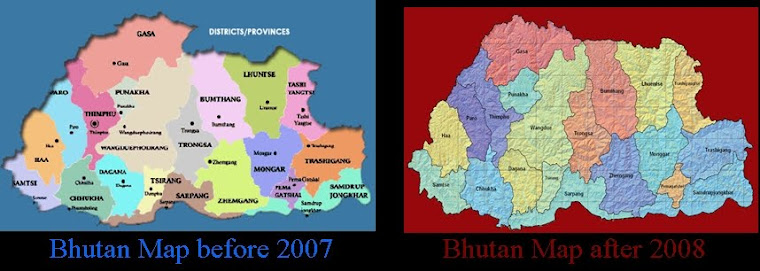
Click over the map to know the differences
Showing posts with label Rural development. Show all posts

Friday, September 10, 2010

Where tradition discounts education

Empty schools in two villages speak of separate priorities

Old Habits Die Hard: A family on route to its summer residence

Merak-Sakteng 23 May, 2010 - It’s different in the highlands of remote Sakteng in northern Trashigang. Walking to the dungkhag, visitors encounter droves of cattle herded by young school-aged children.

Rarely are these children in the company of their parents while herding cattle, which is just one of their responsibilities. They even carry material for developmental projects in the gewog from the nearest road in Phongmey, which is a day’s journey by foot. Their latest task was to carry material for the erection of a mobile tower and its barbed wire for fencing.

With so many children out and about, the community schools in the gewog are in want of students.

Community schools in Thrakthri and Joenkhar villages have only five and nine students each in class PP. “We’ve gone into the villages and talked the parents into sending their children, mostly the over-aged ones to school,” said principal Yeshi Dorji of Joenkhar community primary school.

The community school did not have any enrolment in 2007 and currently does not have a class two section. Teachers are worried about next year. “We’ve carried out a survey and found out there are none for enrollment next year,” he said, adding that the children that are in the villages are just two or three years old.

Other teachers in Sakteng said that many parents were withdrawing their children from school. According to the teachers, some parents were not allowing their children to continue studies after they complete primary education.

The elders of the villages, however, think differently. Parents do not send all their children to school and, even if they do, they usually withdraw them after they reach a certain age. Only the young ones are sent, while the older ones stay at home to assist them.

“If we send all our children to school, who’ll take our place and carry forth the traditions and culture we’ve long cherished and lived by?” questioned Sonam Tshomo from Tholong, Sakteng.

Sonam Tshomo is in her early fifties and has seven children, of whom only two attend school in Joenkhar. Her 13-year old daughter follows her with a herd of oxen and horses to collect ration and other essential commodities from Phongmey, a tradition that has been followed for a long time.

Meymey Karchung, 53, from Merak, lives with two of his sons in Thrakthri. Both dropped out of school after Class VII. The elder is only 18 years old and is married with a daughter.

“It’s difficult to handle more than 40 cattle, so I had to keep my sons out of school to help me,” said Karchung. “Moreover, we can earn if we rear the cattle, whereas sending them to school incurs expenses and I can’t afford that because I have nine children.”

Though the number of children in a family has relatively declined, most brokpa families still have more than six children, according to village representatives.

Another villager had a different opinion. “Our government said tourism would greatly benefit the Sakteng brokpas. Now, if all our children go to school and are employed elsewhere, then there would be none left to continue our culture,” said Norbu, another brokpa. “Tell me then, why would tourists want to come to our villages?”

Moreover, Norbu said that there is an increasing need of manpower, because each year the livestock increases. “There are at least five new calves born each year, so the need increases,” he said, adding that a brokpa’s son is the best brokpa.

Tashi Phuntsho, a teenager, had to give up school, as he was the eldest in the family, and remain home to shoulder bigger responsibilities. His two younger siblings go to school.

Sangay Tshering, 15, from Thrakthri village, likes attending school. But attending to his family’s need comes first. Sangay’s village is about a six-hour walk away from Phongmey. The villagers depend on livestock and crops. He frequently walks to Phongmey to get rice and other essentials.

But Sangay is not bothered by not being able to attend school. He said that he will soon marry and have a family. When his children grow up, he would want his children to listen and obey him like he obeyed his parents. “I know my parents want me to become like them,” he said. “I’m happy as a brokpa.”

By Tshering Palden
Feature: Kuensel

Where tradition discounts education

Empty schools in two villages speak of separate priorities

Old Habits Die Hard: A family on route to its summer residence

Merak-Sakteng 23 May, 2010 - It’s different in the highlands of remote Sakteng in northern Trashigang. Walking to the dungkhag, visitors encounter droves of cattle herded by young school-aged children.

Rarely are these children in the company of their parents while herding cattle, which is just one of their responsibilities. They even carry material for developmental projects in the gewog from the nearest road in Phongmey, which is a day’s journey by foot. Their latest task was to carry material for the erection of a mobile tower and its barbed wire for fencing.

With so many children out and about, the community schools in the gewog are in want of students.

Community schools in Thrakthri and Joenkhar villages have only five and nine students each in class PP. “We’ve gone into the villages and talked the parents into sending their children, mostly the over-aged ones to school,” said principal Yeshi Dorji of Joenkhar community primary school.

The community school did not have any enrolment in 2007 and currently does not have a class two section. Teachers are worried about next year. “We’ve carried out a survey and found out there are none for enrollment next year,” he said, adding that the children that are in the villages are just two or three years old.

Other teachers in Sakteng said that many parents were withdrawing their children from school. According to the teachers, some parents were not allowing their children to continue studies after they complete primary education.

The elders of the villages, however, think differently. Parents do not send all their children to school and, even if they do, they usually withdraw them after they reach a certain age. Only the young ones are sent, while the older ones stay at home to assist them.

“If we send all our children to school, who’ll take our place and carry forth the traditions and culture we’ve long cherished and lived by?” questioned Sonam Tshomo from Tholong, Sakteng.

Sonam Tshomo is in her early fifties and has seven children, of whom only two attend school in Joenkhar. Her 13-year old daughter follows her with a herd of oxen and horses to collect ration and other essential commodities from Phongmey, a tradition that has been followed for a long time.

Meymey Karchung, 53, from Merak, lives with two of his sons in Thrakthri. Both dropped out of school after Class VII. The elder is only 18 years old and is married with a daughter.

“It’s difficult to handle more than 40 cattle, so I had to keep my sons out of school to help me,” said Karchung. “Moreover, we can earn if we rear the cattle, whereas sending them to school incurs expenses and I can’t afford that because I have nine children.”

Though the number of children in a family has relatively declined, most brokpa families still have more than six children, according to village representatives.

Another villager had a different opinion. “Our government said tourism would greatly benefit the Sakteng brokpas. Now, if all our children go to school and are employed elsewhere, then there would be none left to continue our culture,” said Norbu, another brokpa. “Tell me then, why would tourists want to come to our villages?”

Moreover, Norbu said that there is an increasing need of manpower, because each year the livestock increases. “There are at least five new calves born each year, so the need increases,” he said, adding that a brokpa’s son is the best brokpa.

Tashi Phuntsho, a teenager, had to give up school, as he was the eldest in the family, and remain home to shoulder bigger responsibilities. His two younger siblings go to school.

Sangay Tshering, 15, from Thrakthri village, likes attending school. But attending to his family’s need comes first. Sangay’s village is about a six-hour walk away from Phongmey. The villagers depend on livestock and crops. He frequently walks to Phongmey to get rice and other essentials.

But Sangay is not bothered by not being able to attend school. He said that he will soon marry and have a family. When his children grow up, he would want his children to listen and obey him like he obeyed his parents. “I know my parents want me to become like them,” he said. “I’m happy as a brokpa.”

By Tshering Palden
Feature: Kuensel

Friday, July 23, 2010

A slew of recommendations

Among others, to include rural development within EDP’s ambit
Economic Development Policy 24 June, 2010 - Having delved into the economic development policy, the national council’s (NC) economic affairs committee had reviewed, members yesterday discussed a list of recommendation to be submitted to the government.

From the basics of defining the purpose of the policy to some salient ones, like reviewing the fiscal incentives, the recommendations touched on most aspects.

Based on the policy review, council members felt the need for clarification, as to whether the policy was to be considered an apex policy document for the nation’s development, or merely for private sector development.

Thimphu NC member Sangay Zam said that, if the private sector was developed, it automatically fulfilled the objectives of the policy, which were to close the gap between the rich and the poor, creating employment and revenue generation.

She raised concerns about government plans to increase the power tariff, which she said was the only advantage Bhutanese industrialists enjoyed of having a natural resource at its disposal.

Most members expressed the need to make the policy more inclusive, by bringing rural enterprise development into the ambit of the policy.

The council’s deputy chairman Sonam Kinga recommended extending more and better micro credit facilities to small and cottage industries, which at the moment Bhutan development finance corporation alone provided; while the rest were focused on financing big businesses and projects.

Lhuentse council member Rinzin Rinzin proposed the need to understand why, despite the government’s support to the existing industries in the country, their growth and contribution to the country’s economy was negligible.

It was necessary to understand, he said, whether it was the industries, which failed to perform, or if it was the failure on the government’s part to take much interest in supporting them.

A few members also said the goals and objectives of the policy should look beyond statistics and emphasise on qualitative measures, on how the policy’s implementation would contribute to human development and happiness.

Council member Kuenlay Tshering said the policy, being an important document, they were under the pressure to make a choice, which would have a far-reaching impact in future. Caught between economic development and preserving the country’s culture and tradition, he said, it was imperative that they draw a path which, while it propelled economic development, did not cause cultural dilution.

Members also explained that it was useful to have short-term goals the government wished to attain by 2013, within the time frame of the first democratically elected government, rather than push it until 2020.

Reading out the list of recommendations, Pemagatshel council member Jigmi Rinzi felt the necessity for drawing up a monitoring mechanism to keep record of how much was achieved in terms of development.

He said people often criticised the government of framing grand policies and plans, but faltering when it came to implementation.

He also said they needed a model country or a vision of what the country should look like in 15-20 years.

Haa council member Tshering Dorji added that, as a developing country, one of the advantages was to be able to draw lessons from global experiences, adopting or adapting the good policies and examples, and avoiding the bad ones.

A few members explained that, as a measure to improve and engender an enabling environment for business, the economic development policy should focus on improving Bhutan’s rank on “Ease of Doing Business” survey the World Bank conducted. In addition, they proposed the government reconsider establishing offshore financial centres, deemed detrimental to the country.

The Gasa council member, Sangay Khandu, expressed his reservations on one of the provisions in the framework for private participation in infrastructure that undermined transparency and good governance.

He said clause 11 of the framework, allowing the government to accept project proposals unique in nature, innovative, ecologically sound, socially responsible and one that was mindful of the country’s development philosophy, without having to undergo bidding process, was contradictory to the system many Bhutanese were bound by.

By Samten Wangchuk
Kuensel