22 September, 2010 - With Dzongkha Braille now at par with Unicode in all its symbols and signs, visually impaired students in the country would now be able to read and write words that were not possible before.
Learning Dzongkha for the visually impaired first started orally at the national institute of visually impaired (NIVI) in Khaling.
Officials from the curriculum and professional support division (CAPSD) said that Dzongkha Braille code saw several “developments” since it was first developed in 1984. The development of a software that could translate any Dzongkha letters into Unicode first and then into Braille helped to a large extent.
“But the Dzongkha Braille lacked some signs that are in Unicode and we needed to bring the Braille code at par with Unicode,” CAPSD’s assistant program officer, Kuenga Dorji said.
A recent workshop in Bumthang has now brought the Braille code at par with the Unicode, said officials. They developed new Dzongkha Braille codes for all signs and symbols of Dzongkha Unicode, and made sure that the new code development would enable the visually impaired to read and write tantric words of religious texts, that sometimes have more than two words on one another.
Based on the Braille that consists of patterns of raised dots, of up to six, arranged in two lines of three dots each, the Dzongkha Braille code was also developed in the same format within the six dots.
“While the codes for Dzongkha alphabets are developed according to the phonetics such as ‘k’ for Dzongkha ‘ka’ and ‘g’ for Dzongkha ‘ga’, we developed an indicator for those Dzongkha characters that have more than one letter and for the letters those are written opposite, such as opposite ta and da,” Kuenga Dorji explained.
The workshop also finalised a Dzongkha Braille code guidebook for standard usage of the code.
“This will not only enable all Dzongkha Braille learners and teachers to use systematically, but will also enable the visually impaired people to have better access to Buddhist literature and philosophy,” said Kuenga Dorji.
Braille was first introduced for Bhutan in 1973 when the national institute for the visually impaired (NIVI) was established.
By Samten Yeshey
Kuensel
The Sorry Saga of Bhutan's North
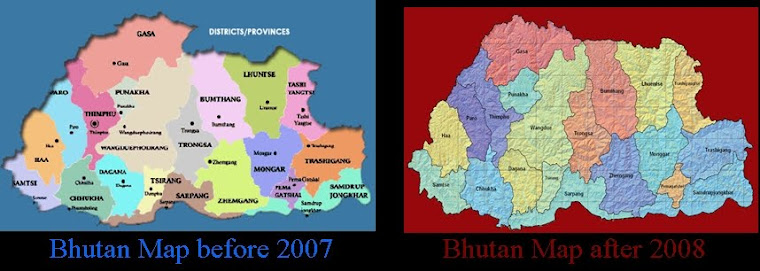
Click over the map to know the differences
Showing posts with label Dzongkha. Show all posts
Showing posts with label Dzongkha. Show all posts
Thursday, September 23, 2010

Friday, September 10, 2010
First private Dzongkha weekly launched
A brand new newspaper with a reader-friendly language
Druk Neytshuel: The seventh newspaper hit the stand yesterday
30 August, 2010 - At a time when the quality of Dzongkha is being questioned and discussed in every possible medium comes an opportune attempt to apprise Bhutanese of their national language.
Beginners can take a plunge into the language, starting with the alphabets illustrated in elementary pictures and interpretations.
Students can refer their Dzongkha textbook contents in a simplest elucidation. Those who need help with essays and application writing can allude to tutorials. Office-goers can stay abreast about events unfolding around them in most comprehensible Dzongkha.
In short, it is Dzongkha in its highest reader-friendly form, or so the first private Dzongkha newspaper, Druk Neytshuel, promises its readers.
As for the first issue launched and distributed free yesterday, the 24-page paper lived up to their words. With an apt main story questioning the varied spelling use on signboards, the paper carried stories on diverse subjects in an easy-to-read and easy-to-understand Dzongkha.
“This is Zhungkha in its simplest form, with slight inclination towards Wangkha, spoken popularly by people of Thimphu and Punakha,” the paper’s chief editor Chungdru Tshering said. “Everyone can speak the language, but a very few can read and write it. We’re trying to be as colloquial as possible.”
Apart from news updates, a well-organised section on driglam namzha, religion, economy, sports, community news and environment maintained a neat presentation on fresh topics.
The highlight was the section titled “Gup Of The Week”, an attempt to bring communities in the limelight by profiling the leaders and exposing problems prevailing in each gewog.
The free issue, which has taken on well with the readers, will come for Nu 10 starting next week.
“Compared with the Dzongkha issues of other private papers, this paper is on a different level all together,” Sangay Tenzin, a monk with the Thimphu rabdey, said. “It appears more serious than the previous ones, who, at times, give us an impression that they’re functioning just so to adhere to government policy, and not out of a genuine interest.”
One of the Dzongkha newspaper editors said the standard of the language and the news quality was impressive for a starter. “They should maintain it,” he said.
A few, however, felt the need to standardise the spellings of names and places and objects, as it read different in different newspapers.
The weekly paper, comprising a team of five reporters and two editors – graduates from the institute of language and cultural studies and former monks – feeds on 4 pages of advertisements in Dzongkha, and also caters to English ads in its inserts.
“We started off two months ago, with an intention to emulate government’s policy of promoting and preserving the national language,” Chungdu Tshering said.
By Kesang Dema
Kuensel
Subscribe to:
Posts (Atom)