Bhutan Urban Development Project II14 July, 2010 - Bhutan will receive USD 12 million for the Bhutan urban development project II (BUDP) from the World Bank (WB), according to an agreement signed between the World Bank and Bhutan yesterday.
The agreement for the international development association (IDA) credit was signed between the WB country director, Nicholas Kraft, and the finance secretary, Lam Dorji, in Thimphu.
IDA is the part of the World Bank that helps the world’s poorest countries. IDA lends money (known as credit) on concessional terms. This means that IDA credit has no interest charge, and repayments should be made within 20 years, including a 10-year grace period.
Secretary Lam Dorji said that once the loan is received, USD 8 million will be released to Thimphu city corporation (TCC), and the rest to the works and human settlement for capacity building.
The whole amount will be used to support urban infrastructure development in two local area plans, Langjophakha and Dechencholing, under the BUDP. It will be also used to strengthen the institutional capacity of the city corporations in Thimphu and Phuentsholing.
Of the total, USD 9.3M will be used for improving infrastructure development, such as road, storm water drainage, water supply, proper sewerage system and street lighting; USD 1.5M for municipal reform and USD 1.2M for capacity building.
An official from TCC said that municipal reform includes improving the system of finance, accounting, create revenue section offices, provide infrastructure and management trainings. “Development would also include cable services, sanitation facilities and river protection work.”
The project will kick off from Dechencholing with USD 4.56M and for Langjophakha with USD 4.89M, said TCC officials. “The affected families will be compensated by the government.”
Besides the USD 12M, the government has already received USD 20M as budgetary support under the development policy financing during the last fiscal year. The balance of USD 20M, said officials, is still being processed. The project is scheduled to be completed by December 2015.
By Yangchen C Rinzin
Kuensel
The Sorry Saga of Bhutan's North
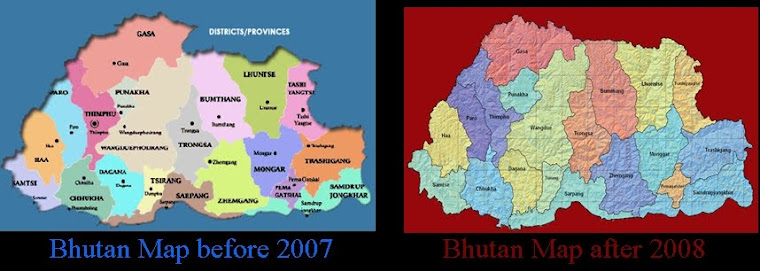
Click over the map to know the differences
Showing posts with label Budget. Show all posts
Showing posts with label Budget. Show all posts
Friday, July 23, 2010

NU 393.9 MN TO IMPROVE LIVING STANDARD IN 205 GEOGS
February 4, 2010 · Filed Under Top Articals, Topstories, archive · Comment
Of the Nu 34 billion support committed by the government of India (GOI) for the 10th plan, Nu seven billion has been earmarked for sustainable development projects
The ambassador of India to Bhutan, Pavan K Varma, handed over a cheque for Nu 393.9 million to Prime Minister Lyonchhen Jigmi Y Thinley yesterday.
The amount comprises 30 per cent mobilization advance for the implementation of the first lot of 441 small development projects (SDPs).
The Prime Minister said that this was a reflection of India’s special sensitivity and concern for the problem of poverty in Bhutan.
“It is very important form of support and the money will directly go for improving the living standards at 205 geogs in the country,” Lyonchhen said.
Lyonchhen added that Bhutanese people particularly in rural are eagerly waiting for the money and they will be happy to know that the money has been released.
The Ambassador Pavan K Varma said that this 30 per cent of money is very important and pivotal as it is structured to prevent any delay in the implementation of projects as all projects are identified in a credible manner.
The Ambassador said: “I hardly have to say that the well being of the people of Bhutan is also the well being of India.”
He said: “The projects, jointly cleared and approved by the two governments, were structured to prevent any delay and reflected the “nature and content of our collaboration.”
The ambassador also ensured that India will try to expedite the clearance of further projects as the working modality is already in place and it is going on vigilantly to complete them in a time bound manner.
The ambassador also said that all these projects are close to our hearts in terms of contains and the nature of collaboration and SDP is a fruition of the common interest of Bhutan and India.
According to the Secretary of Gross National Happiness Commission (GNH), Karma Tshiteem, the SDP is a new financing window introduced between Bhutan and India in the 10th plan and all these 441 projects are included in this plan.
“Out of Nu 34 billion support committed by India in the 10th plan, Nu 20 billion is provided as project-tied assistance, Nu 7.00 billion as programmme grant and Nu 7.0 billion as SDP for the key socio-economic areas, which are short gestation, community-oriented and impact lives of a wider cross section of the society,” said GNHC Secretary.
Karma Tshiteem said that all these 441 projects are community oriented and all projects are originated from local government from geogs and dzongkhags, and reflect local priorities.
The GNH Secretary said: “Money released is significant for the implementation of local government projects and all 441 projects will get 30 percent of money for the project.”
The 441 projects of SDP will cover in the areas of drinking water supply, health, education, construction of administrative offices and community hall, roads, bridges, culture, irrigation channels and Renewable Natural Resource (RNR) centres.
The 441 projects covering all the 205 geogs of Bhutan were identified in the first meeting of the Small Project Development Committee in Thimphu in November last year.
The committee comprises members from the royal government and the Embassy of India.
By Kezang Dorji in THIMPHU
Bhutan Today
2011 Budget
2010 - 11 budget highlights
Social services get the lion’s share, as usual
27 June, 2010 - In keeping with past trends, the social service sector, health and education, has the highest allocation, with an outlay of Nu 8.21B, which is 23 percent of the 2010-11 budget.
Under health, the budget includes provision to construct a regional hospital in Gelephu, and the Bhutan institute of medical sciences, reconstruction of the Samtse and Dagana hospitals, and construction and relocation of 17 basic health units (BHU).
Budget has also been kept for 10 more ambulances, apart from the 10 that the government of Japan is expected to provide in the next fiscal year.
16,200 rural households to receive power
10 new PS, LSS, MSS, HSS schools to be built
13 new bailey and motorable bridges
Nu 805.5 M for HRD
218 KMs of National highways
17 new BHUs
242 new rural water schemes
A total of 242 new water supply schemes is to built at a cost of Nu 83.6M, and 170 rehabilitated with a budget of Nu 40.26M. The new fiscal year also has a budget of Nu 64.081M for ongoing and new scholarships for doctors, nurses and technicians.
The major capital works in the education sector are building three lower secondary schools, five new middle secondary schools, two higher secondary schools and a primary school in nine dzongkhags. Other work includes building hostels, labs, multipurpose halls, libraries and dining halls in institutes across the country.
The renewable natural resources sector has an outlay of Nu 3.54B, or 10 percent of the budget; of which a sizeable portion is the construction of farm roads. According to the budget report, funding for farm roads has largely been mobilised, with a large part of the resources coming from the government of India, and other development partners providing substantial support.
About Nu 740M has been set aside for the construction of farm roads that is expected to connect 73 percent of all gewog centres by the next financial year. There is a budget of Nu 26.940M for maintenance, and Nu 200M as a pool fund that will be allocated, as when gewogs are ready to start the building the roads that are in the plans. A total of 62 RNR centres, including those under construction, will be built in the coming fiscal year.
The total budget for the roads sector is Nu 3.4B, about 10 percent of the budget; of which Nu 648M is for resurfacing, Nu 2.2B for road constructions and Nu 647M for building bridges.
The target for this financial year is to complete 218 km of highways in Dagana, Chukha, Samdrupjongkhar Panbang, Zhemgang and Mongar; and includes spillover work like the Gyalpoizhing-Nganglam and Samtse-Phuentsholing highways.
The budget will also go into completing mainly spillover work of dzongkhag roads, of a total length of 182 km, in Chukha, Dagana, Lhuentse, Mongar, Pemagatshel, Trashigang and Wangduephodrang.
On the major bridges to be built or completed in the coming year are the Nishioka 1,500 ft bridge in Zhemgang, the Amochu bridge on the Samtse-Phuentsholing highway and the Mangdechu bridge in Trongsa. All are spillover works. A Nu 10M budget has also been set aside for a cable stayed single lane motorable bridge over the Maokhola in Gelephu.
Urban development, housing and public amenities have a budget of Nu 1.6B, much of which will go into local area plans and water supply projects for Thimphu city. Trashigang will get a sewerage treatment plant and solid waste management plan.
Under communications and transport, the major projects are the implementation of the total solutions project, the broadband master plan, the SASEC information highway project and the IT park in Wangchutaba, besides the building of the three airports.
Law and order has quite a substantial budget, as in the past, with Nu 2.6B earmarked for the relevant agencies, which includes the judiciary and the royal Bhutan police (RBP). RBP has a budget of Nu 1.1B, mainly for construction of family quarters all across the country and for transport.
The judiciary’s total budget is around Nu 383M, mainly for building dungkhag and district courts in several dzongkhags, and continuing work on building the Supreme Court.
By Phuntsho Wangdi
From Kuensel
Subscribe to:
Posts (Atom)