Over 20 injured in clash between Nepali police, Bhutanese refugees
More than 20 persons have been injured in a clash between Nepali police and Bhutanese refugees in eastern Nepal, local newspaper The Himalayan Times reported on Wednesday.
The clash occurred Tuesday in Goldhaop of Jhapa district, some 400 kilometers east of Kathmandu.
It started after two police constables of Mechi Zonal Police Office were captured by refugees living in the camp on charge of misbehaving with refugee women on Monday night.
According to Camp Secretary Ram Chandra Banstola, the policemen have been taken back to the Zonal Police Office.
Source: Xinhua
The Sorry Saga of Bhutan's North
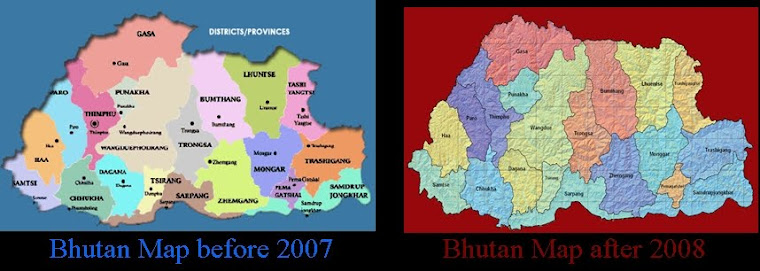
Click over the map to know the differences
Tuesday, January 2, 2007

Sunday, December 31, 2006
implement all solutions put forward by the UNHCR- Hari Adikari
Bhutanese refugees submit memorandum to PM
Kantipur Report
KATHMANDU, Dec 30 - The Bhutanese refugees on Saturday submitted a memorandum to Prime Minister Girija Prasad Koirala, urging the latter to resolve the refugee crisis as soon as possible to prevent the situation from worsening into a state of permanent displacement.
Stating that the efforts made by the Government in the past to solve their problems have not been successful, the refugees today urged the government to find a permanent and long-term solution to refugee crisis.
In the memorandum submitted today, the refugees have said that the annual budget cuts by the United Nation’s High Commission for Refugees (UNHCR) has further worsened their plight.
Likewise, the refugees also urged the PM to implement one or all of the solutions put forward by the UNHCR including repatriation, resettlement in a third country and settlement here in Nepal itself to seek a sustainable solution to the long-standing refugee crisis.
The memorandum was submitted today to PM Koirala by acting Director of the coordinating committee formed to resolve the Bhutanese refugee crisis Hari Adhikari and other camp secretaries.
More than 106,000 Bhunatese refugees have been living in the seven refugee camps in eastern Nepal for the past 15 years.
Posted on: 2006-12-30 02:03:15 (Server Time)
Kantipur Report
KATHMANDU, Dec 30 - The Bhutanese refugees on Saturday submitted a memorandum to Prime Minister Girija Prasad Koirala, urging the latter to resolve the refugee crisis as soon as possible to prevent the situation from worsening into a state of permanent displacement.
Stating that the efforts made by the Government in the past to solve their problems have not been successful, the refugees today urged the government to find a permanent and long-term solution to refugee crisis.
In the memorandum submitted today, the refugees have said that the annual budget cuts by the United Nation’s High Commission for Refugees (UNHCR) has further worsened their plight.
Likewise, the refugees also urged the PM to implement one or all of the solutions put forward by the UNHCR including repatriation, resettlement in a third country and settlement here in Nepal itself to seek a sustainable solution to the long-standing refugee crisis.
The memorandum was submitted today to PM Koirala by acting Director of the coordinating committee formed to resolve the Bhutanese refugee crisis Hari Adhikari and other camp secretaries.
More than 106,000 Bhunatese refugees have been living in the seven refugee camps in eastern Nepal for the past 15 years.
Posted on: 2006-12-30 02:03:15 (Server Time)
Wangchuck was the 'terrorist' involved in evicting the refugees- Rizal
Oli raises strong objection against Bhutan PM's remarks
Terming the remarks made by Bhutanese Prime Minister about refugees in Nepal as "serious and negative," Nepalese deputy Prime Minister and foreign minister KP Oli has raised strong objections.
Talking to Kantipur daily, Oli said, "Serious attention of Nepal government has been drawn by these remarks." He was referring to the remarks made by Bhutanese PM Khandu Wangchuk that repatriating Bhutanese refugees from Nepal would be like importing readymade terrorists.
Totally rejecting the remarks made by the Bhutanese PM, Oli said they were disrespectful of the whole issue and also of the bilateral relations. The Bhutanese PM had accused that majority of refugees languishing in camps in Nepal were engaged in Maoist activities. He had added that there could not be any dialogue with any refugee representative. Speaking in the Bhutanese parliament, Wangchuk also rejected Nepal government's assertion that the refugee issue was primarily an issue between Bhutanese government and its people.
Meanwhile, the Ministry of Foreign Affairs has issued a statement expressing surprise over the remarks. It has said that the Nepal government was regularly monitoring the refugee camps and that there is no intrusion by any untoward elements there.
Likewise, refugee leader Tek Nath Rijal, reacting to Wangchuk's remarks, said the latter, in fact, was the 'terrorist' involved in evicting the refugees. nepalnews.com sd Dec 29 06
Friday, December 29, 2006
National Assembly strict yet positive on repatriation
Assembly discusses status of bilateral talks with Nepal
NATIONAL ASSEMBLY 27 December, 2006 - Members of the National Assembly yesterday asked the government to strictly enforce the Citizenship Act after the foreign minister, Lyonpo Khandu Wangchuk, briefed the assembly on the status of the Bhutan - Nepal bilateral talks on the problem of the people in the camps in eastern Nepal.
The Citizenship Act should not be diluted: Lyonpo Khandu Wangchuk
After several chimis pointed out that the people in the camps were a threat to the security of Bhutan despite repeated efforts to solve the problems mutually the Speaker, Dasho Ugen Dorje, asked the foreign minister to brief the house on the progress of the talks.
Lyonpo Khandu Wangchuk informed the Assembly that the two governments had been meeting and maintaining contact regularly at the ministerial level to discuss the issue since the stalemate in the talks after Bhutanese officials were violently assaulted on December 22, 2003, in Nepal.
He said that he had met the Nepalese counterpart in September 2005 on the sidelines of the UN General Assembly in New York to break the stalemate.
“Bhutan offered to take back those people in category 1 (C1) and category 4 (C4) from Khudanabari camp who choose to return to Bhutan,” said Lyonpo Khandu Wangchuk.
The positions of the two governments on the people in the camps had been harmonised during the 14th meeting of the Nepal-Bhutan Ministerial Joint Committee (MJC) in Kathmandu in 2003. The MJC had categorised people found to be forcefully evicted from Bhutan under C1 and Bhutanese who have committed criminal acts under C4 category.
Lyonpo Khandu Wangchuk said that in November 2005, on the sidelines of the 13th SAARC Summit in Dhaka, Bhutan had proposed for the Joint Verification Team (JVT) members of the two countries to visit the camps to explain the terms and procedures to the people and to collect applications of those opting to return.
“To have a clear understanding, I proposed incorporation of clauses in a joint communiquè reaffirming the agreements reached in the joint ministerial committee on the terms and procedures, and on the visit of members of the JVT to the camp,” said the foreign minister. “The foreign minister of Nepal would not agree to the incorporation of such clauses in a joint communiquè or in any other written form. In subsequent written and telephonic contacts, the foreign minister of Nepal maintained this position and we could not reactivate the bilateral process.”
The foreign minister also informed the Assembly that the political changes in Nepal had also been an impediment to the smooth process of the bilateral talks.
In September 2006, Lyonpo Khandu Wangchuk met the present deputy prime minister and foreign minister of Nepal on three occasions in Kuala Lumpur, Dhaka, and in New York.
Lyonpo Khandu Wangchuk informed the Assembly that in these meetings, the government of Nepal had introduced a new element stating that the problem was between Bhutan and the camp people and not between Nepal and Bhutan, and that Bhutan should talk directly to the people in the camps.
“The government of Nepal has even stated in the press that it would not abide by the past agreements reached between the two governments,” he said, adding that their latest position was that all the people in the camps have to be repatriated.
The Nepalese government also stated that they could only facilitate to resolve the problem, that they had only given asylum to the people on humanitarian grounds, and that the prime onus to resolve the stalemate was with Bhutan.
“The government of Nepal wants to make a fresh start, doing away with past agreements,” said Lyonpo Khandu Wangchuk.
The minister said that Bhutan could not accept the Nepalese government’s new position. “The two governments had agreed from the beginning of the talks in 1993 that they were in the best position to find a solution to the problem through bilateral process,” he said. “The government of Bhutan and past successive government of Nepal had always reiterated their commitment to the bilateral process.”
Lyonpo Khandu Wangchuk said that it was not practical for the government to talk to the people in the camps because most of them were not Bhutanese.
“The camps have been infiltrated by Maoist elements and several radical parties like the Bhutan Communist Party, Bhutan Gorkha National Liberation Front and the Bhutan Revolutionary Students Union have been formed with the declared objective of carrying out armed struggle to overthrow the government of Bhutan,” said the minister.
He added that it was the Nepalese government that established the camps and sought UNHCR assistance in 1991 when there were only 304 people claiming to be Bhutanese refugees. “Until mid 1993 all ethnic Nepalese claiming to be Bhutanese refugees were admitted into the camps without proper screening,” said the foreign minister.
The minister said that the involvement of the Nepalese government in the process was necessary as there was clear agreement on Category 2 (C2) where it says that people under C2 who do not wish to return to Bhutan would be given the option to apply for Nepalese citizenship. “Nepal has both moral and legal responsibility over the problem,” he said.
The new proposal, Lyonpo Khandu Wangchuk said, was a step backward and could derail the bilateral process and would mean going back on all agreements reached between the two governments and undoing all that has been achieved in the past 13 years.
“Last October, a letter from the deputy prime minister and foreign minister of Nepal reiterated their government’s stand,” said Lyonpo Khandu Wangchuk. “But I made it clear that the issue must be resolved through a bilateral process and in accordance with the agreements reached between the two governments.”
Lyonpo Khandu Wangchuk also informed the Assembly that the two governments had agreed to meet in Thimphu from November 20 to 23 this year, but the talks had to be postponed on the request of the Nepalese government.
The minister also expressed his concern on the infiltration into the camps by the Maoist elements and the formation of radical parties in Nepal. “A large number of people in the camps are supporting and joining the Maoist movement in Nepal. They are listed as both refugees and Maoist members,” he said. “Allowing the highly politicised camp people into Bhutan would mean importing ready made radical political parties and terrorists to duplicate the violence, terror, and instability the Maoists have unleashed in Nepal.”
The minister also expressed concern on the growing nexus between the militant elements in the camps and the Indian Maoists and Naxalities and insurgent groups who where flushed out of Bhutan in 2003.
“With the culmination of political reforms initiated by His Majesty the fourth King, it is critical for Bhutan at this delicate juncture to maintain its peace and stability to ensure a smooth new political system,” said Lyonpo Khandu Wangchuk.
He said that it was wise for the Bhutanese government and people to uphold and enforce the Citizenship Act. “I agree with the chimis that the Citizenship Act of Bhutan should not be diluted as it is the only protection for the security and sovereignty of Bhutan.”
Alarmed and expressing their apprehension, several chimis said that the problems of the people in the camps should be solved based on the agreements and the resolutions of the past Assembly sessions.
The Samtse chimi said that even if people falling under C1 are ever repatriated, they should be punished according to the Citizenship Act of Bhutan. “The decision for awarding citizenship should be left with His Majesty the King,” he said.
The Bumthang chimi said that Bhutan had no business with the people in the camps. “We will follow the agreements signed between the two governments and the National Assembly resolutions,” he said.
Others submitted that the people should not be allowed to return at all.
The Punakha chimi said that there were rumors that these people would be allowed to return to Bhutan after 2008. “There is widespread talks that the people in the camps would be returning as if the Citizenship Act has been amended,” he said. “The government should strictly enforce the Citizenship Act of Bhutan.”
The foreign minister reassured the members that the talks would be carried out based on the agreements signed between the two countries, the Citizenship Act of Bhutan, Immigration laws, and the resolutions passed by the National Assembly of Bhutan.
“If the people are repatriated, they would have to deal with the Citizenship Act,” he said. “The two governments had agreed to respect each other’s laws.”
The National Assembly resolved that the issue be resolved bilaterally based on the agreements signed between the two governments, the Citizenship Act of Bhutan, and the resolutions of the National Assembly of Bhutan.
By Ugyen Penjore
ugyenpen@kuensel.com.bt
NATIONAL ASSEMBLY 27 December, 2006 - Members of the National Assembly yesterday asked the government to strictly enforce the Citizenship Act after the foreign minister, Lyonpo Khandu Wangchuk, briefed the assembly on the status of the Bhutan - Nepal bilateral talks on the problem of the people in the camps in eastern Nepal.
The Citizenship Act should not be diluted: Lyonpo Khandu Wangchuk
After several chimis pointed out that the people in the camps were a threat to the security of Bhutan despite repeated efforts to solve the problems mutually the Speaker, Dasho Ugen Dorje, asked the foreign minister to brief the house on the progress of the talks.
Lyonpo Khandu Wangchuk informed the Assembly that the two governments had been meeting and maintaining contact regularly at the ministerial level to discuss the issue since the stalemate in the talks after Bhutanese officials were violently assaulted on December 22, 2003, in Nepal.
He said that he had met the Nepalese counterpart in September 2005 on the sidelines of the UN General Assembly in New York to break the stalemate.
“Bhutan offered to take back those people in category 1 (C1) and category 4 (C4) from Khudanabari camp who choose to return to Bhutan,” said Lyonpo Khandu Wangchuk.
The positions of the two governments on the people in the camps had been harmonised during the 14th meeting of the Nepal-Bhutan Ministerial Joint Committee (MJC) in Kathmandu in 2003. The MJC had categorised people found to be forcefully evicted from Bhutan under C1 and Bhutanese who have committed criminal acts under C4 category.
Lyonpo Khandu Wangchuk said that in November 2005, on the sidelines of the 13th SAARC Summit in Dhaka, Bhutan had proposed for the Joint Verification Team (JVT) members of the two countries to visit the camps to explain the terms and procedures to the people and to collect applications of those opting to return.
“To have a clear understanding, I proposed incorporation of clauses in a joint communiquè reaffirming the agreements reached in the joint ministerial committee on the terms and procedures, and on the visit of members of the JVT to the camp,” said the foreign minister. “The foreign minister of Nepal would not agree to the incorporation of such clauses in a joint communiquè or in any other written form. In subsequent written and telephonic contacts, the foreign minister of Nepal maintained this position and we could not reactivate the bilateral process.”
The foreign minister also informed the Assembly that the political changes in Nepal had also been an impediment to the smooth process of the bilateral talks.
In September 2006, Lyonpo Khandu Wangchuk met the present deputy prime minister and foreign minister of Nepal on three occasions in Kuala Lumpur, Dhaka, and in New York.
Lyonpo Khandu Wangchuk informed the Assembly that in these meetings, the government of Nepal had introduced a new element stating that the problem was between Bhutan and the camp people and not between Nepal and Bhutan, and that Bhutan should talk directly to the people in the camps.
“The government of Nepal has even stated in the press that it would not abide by the past agreements reached between the two governments,” he said, adding that their latest position was that all the people in the camps have to be repatriated.
The Nepalese government also stated that they could only facilitate to resolve the problem, that they had only given asylum to the people on humanitarian grounds, and that the prime onus to resolve the stalemate was with Bhutan.
“The government of Nepal wants to make a fresh start, doing away with past agreements,” said Lyonpo Khandu Wangchuk.
The minister said that Bhutan could not accept the Nepalese government’s new position. “The two governments had agreed from the beginning of the talks in 1993 that they were in the best position to find a solution to the problem through bilateral process,” he said. “The government of Bhutan and past successive government of Nepal had always reiterated their commitment to the bilateral process.”
Lyonpo Khandu Wangchuk said that it was not practical for the government to talk to the people in the camps because most of them were not Bhutanese.
“The camps have been infiltrated by Maoist elements and several radical parties like the Bhutan Communist Party, Bhutan Gorkha National Liberation Front and the Bhutan Revolutionary Students Union have been formed with the declared objective of carrying out armed struggle to overthrow the government of Bhutan,” said the minister.
He added that it was the Nepalese government that established the camps and sought UNHCR assistance in 1991 when there were only 304 people claiming to be Bhutanese refugees. “Until mid 1993 all ethnic Nepalese claiming to be Bhutanese refugees were admitted into the camps without proper screening,” said the foreign minister.
The minister said that the involvement of the Nepalese government in the process was necessary as there was clear agreement on Category 2 (C2) where it says that people under C2 who do not wish to return to Bhutan would be given the option to apply for Nepalese citizenship. “Nepal has both moral and legal responsibility over the problem,” he said.
The new proposal, Lyonpo Khandu Wangchuk said, was a step backward and could derail the bilateral process and would mean going back on all agreements reached between the two governments and undoing all that has been achieved in the past 13 years.
“Last October, a letter from the deputy prime minister and foreign minister of Nepal reiterated their government’s stand,” said Lyonpo Khandu Wangchuk. “But I made it clear that the issue must be resolved through a bilateral process and in accordance with the agreements reached between the two governments.”
Lyonpo Khandu Wangchuk also informed the Assembly that the two governments had agreed to meet in Thimphu from November 20 to 23 this year, but the talks had to be postponed on the request of the Nepalese government.
The minister also expressed his concern on the infiltration into the camps by the Maoist elements and the formation of radical parties in Nepal. “A large number of people in the camps are supporting and joining the Maoist movement in Nepal. They are listed as both refugees and Maoist members,” he said. “Allowing the highly politicised camp people into Bhutan would mean importing ready made radical political parties and terrorists to duplicate the violence, terror, and instability the Maoists have unleashed in Nepal.”
The minister also expressed concern on the growing nexus between the militant elements in the camps and the Indian Maoists and Naxalities and insurgent groups who where flushed out of Bhutan in 2003.
“With the culmination of political reforms initiated by His Majesty the fourth King, it is critical for Bhutan at this delicate juncture to maintain its peace and stability to ensure a smooth new political system,” said Lyonpo Khandu Wangchuk.
He said that it was wise for the Bhutanese government and people to uphold and enforce the Citizenship Act. “I agree with the chimis that the Citizenship Act of Bhutan should not be diluted as it is the only protection for the security and sovereignty of Bhutan.”
Alarmed and expressing their apprehension, several chimis said that the problems of the people in the camps should be solved based on the agreements and the resolutions of the past Assembly sessions.
The Samtse chimi said that even if people falling under C1 are ever repatriated, they should be punished according to the Citizenship Act of Bhutan. “The decision for awarding citizenship should be left with His Majesty the King,” he said.
The Bumthang chimi said that Bhutan had no business with the people in the camps. “We will follow the agreements signed between the two governments and the National Assembly resolutions,” he said.
Others submitted that the people should not be allowed to return at all.
The Punakha chimi said that there were rumors that these people would be allowed to return to Bhutan after 2008. “There is widespread talks that the people in the camps would be returning as if the Citizenship Act has been amended,” he said. “The government should strictly enforce the Citizenship Act of Bhutan.”
The foreign minister reassured the members that the talks would be carried out based on the agreements signed between the two countries, the Citizenship Act of Bhutan, Immigration laws, and the resolutions passed by the National Assembly of Bhutan.
“If the people are repatriated, they would have to deal with the Citizenship Act,” he said. “The two governments had agreed to respect each other’s laws.”
The National Assembly resolved that the issue be resolved bilaterally based on the agreements signed between the two governments, the Citizenship Act of Bhutan, and the resolutions of the National Assembly of Bhutan.
By Ugyen Penjore
ugyenpen@kuensel.com.bt
Thursday, December 28, 2006
Adopt Multi-track Approach- Siwakoti
US - Last Stop for Bhutanese Refugees?
This is "an opportunity for the refugees who had been living a sub-human life for the last 16 years", U.S. Ambassador to Nepal James Moriarty said on a visit to one of the seven camps in southeastern Nepal in November. He reaffirmed the position set out by Assistant Secretary of State for Refugee Affairs Ellen Sauerbrey on Oct. 2 -- the offer to take in up to 60,000 refugees is a humanitarian one and not meant to absolve Bhutan for evicting the ethnic Nepalis, known as Lhotsampas.
But that will be the result, exiled leaders of opposition Bhutanese political parties and human rights groups have argued. The U.S. "on one hand is aware that (Bhutan's government) is a terrorist regime," says prominent Nepal-based leader Tek Nath Rizal. "But instead of pressuring Bhutan through (South Asia's superpower) India, they say 'we want to take you to America'...Knowingly or unknowingly the U.S. is helping the terrorist government in Bhutan", he added in an interview with IPS.
Some of the extremely influential exiled leaders have damned the U.S. proposal outright. Others like Rizal say they will accept "third-country resettlement" only as a last resort. First priority must be given to "repatriation" to Bhutan followed by settlement in Nepal or India, where another 15,000-20,000 refugees live.
But in the tidy camps with their dirt roads and long lines of tiny bamboo huts, it is hard to find anyone in favour of going to the U.S. or to the other countries that have reportedly also offered safe haven -- Canada, New Zealand and Australia.
"It's better to go back to Bhutan than to stay here," says one former farmer, 78, in Sanischare, the western-most camp, home to 21,000 people. "If I can't go to Bhutan I leave it up to the agencies (that support the camps) to decide," adds the man.
As he talks to visiting journalists, other residents -- men, women and children -- crowd around. Most identify themselves as the old man's relatives; all of them say they want to return to their homeland, even those hardly old enough to remember it.
Local media has reported that some refugees who publicly welcomed the resettlement offer have been threatened, and leaders of the camp management committees who backed the idea were "fired" by the exiled leaders. But later, as the reporters walk through the dusty camp, a United Nations employee suggests that if given the chance to vote confidentially, about 70 percent of residents would choose third-country resettlement.
In an interview in Kathmandu, human rights activist Gopal Siwakoti agrees that 70 percent is a good estimate. A supporter of a "comprehensive solution" to the refugee problem, Siwakoti has joined hands with activists in India and Bhutan to press the three governments to focus on the humanitarian issue and resolve the stalemate -- Nepal and Bhutan have held 15 rounds of talks and failed, while India has refused to participate.
Bhutan and Nepal do not share a border. They are separated by Sikkim, a former independent state that is now part of India. When Bhutan's royal government expelled the Lhotsampas in 1990, the refugees first entered India before most returned to Nepal, their ancestral home.
In the 1980s, the northern-based Drukpa elite (ethnic Tibetans) who rule Bhutan as an autocracy accused the Lhotsampas of anti-nationalist activities and began to impose strict conditions. They changed citizenship rules, forced ethnic Nepalis to wear Drukpa dress, to speak their language (Dzongkha) and to stop practising Hinduism; eventually they were chased across the border.
The international community failed to address the issue, Siwakoti told IPS. "It has a moral obligation, but India has an official obligation, for two reasons: it has security and external affairs treaties with Bhutan, and because the refugees transited through India."
According to Rizal, a former senior civil servant in Bhutan who was jailed for 10 years, "Unless India gets involved in the talks, nothing will happen...Nepal should initiate India's involvement in the talks."
But while the South Asian giant's media, civil society and some politicians are starting to show interest, the government position has not changed. "India encourages the governments of Nepal and Bhutan to find the solution of the problem on their own," Indian Foreign Secretary Shiv Shankar Menon said on a visit to Kathmandu on Nov. 30.
Still, momentum seems to be growing toward a fundamental step that could break the deadlock -- refugee leaders and their backers accepting to detach repatriation from the resettlement option.
Siwakoti describes it as adopting a "multi-track approach": untie the human rights and humanitarian issues and pursue all options simultaneously instead of waiting for repatriation. "You can't make this whole population responsible for restoring democracy in Bhutan: they are refugees," he said.
But, added the activist, the refugees must be declared Bhutanese citizens before being resettled, so they can retain the option to return to the country.
The head of the UN Refugee Agency (UNHCR) in Nepal, Abraham Abraham, has a similar view. "The key (to an agreement) lies in understanding that you can't keep human beings in a camp situation for 16 years. In my opinion, the humanitarian considerations should prevail over political ones."
A first step is to "de-link" the options, added the UNHCR chief in an interview. "As things stand, it appears as if repatriation is holding hostage the other two possible solutions...You don't need to keep all the 100,000 people for the next 10 years (until repatriation is settled). You already have prospects for at least reducing the numbers in the camps now."
Rizal says he will not block refugees who truly want to resettle. "For the last 17 years my people have been fighting.If they are fed up I'll help them to go. But those whose family members are in Bhutan's jails or living there without citizenship rights and those who are in India separated from their families -- if they want to go back, the international community should not stop them."
The U.S. offer coincided with other significant events in 2006: April's 'people's movement' in Nepal, the popular uprising that united Maoist rebels and seven main opposition parties to oust the autocrat King Gyanendra; and the peace agreement signed between the Maoists and the new government.
That administration scheduled talks with the Bhutan government in November and December but both times they were postponed because of peace negotiations. "In my four years here, this is the first time I'm seeing such a genuine attempt (from Nepal's government) to try and resolve this problem," says Abraham. "What we need now is a clear policy decision from the Nepali government that includes resettlement as an alternative, with repatriation being the preferred solution," he told IPS.
A more urgent problem is feeding the refugees. The UN World Food Programme said Friday it will run out of food in January without donations for the two-year, 24-million-dollar programme that starts Jan. 1.
Source: IPS NewsMore
This is "an opportunity for the refugees who had been living a sub-human life for the last 16 years", U.S. Ambassador to Nepal James Moriarty said on a visit to one of the seven camps in southeastern Nepal in November. He reaffirmed the position set out by Assistant Secretary of State for Refugee Affairs Ellen Sauerbrey on Oct. 2 -- the offer to take in up to 60,000 refugees is a humanitarian one and not meant to absolve Bhutan for evicting the ethnic Nepalis, known as Lhotsampas.
But that will be the result, exiled leaders of opposition Bhutanese political parties and human rights groups have argued. The U.S. "on one hand is aware that (Bhutan's government) is a terrorist regime," says prominent Nepal-based leader Tek Nath Rizal. "But instead of pressuring Bhutan through (South Asia's superpower) India, they say 'we want to take you to America'...Knowingly or unknowingly the U.S. is helping the terrorist government in Bhutan", he added in an interview with IPS.
Some of the extremely influential exiled leaders have damned the U.S. proposal outright. Others like Rizal say they will accept "third-country resettlement" only as a last resort. First priority must be given to "repatriation" to Bhutan followed by settlement in Nepal or India, where another 15,000-20,000 refugees live.
But in the tidy camps with their dirt roads and long lines of tiny bamboo huts, it is hard to find anyone in favour of going to the U.S. or to the other countries that have reportedly also offered safe haven -- Canada, New Zealand and Australia.
"It's better to go back to Bhutan than to stay here," says one former farmer, 78, in Sanischare, the western-most camp, home to 21,000 people. "If I can't go to Bhutan I leave it up to the agencies (that support the camps) to decide," adds the man.
As he talks to visiting journalists, other residents -- men, women and children -- crowd around. Most identify themselves as the old man's relatives; all of them say they want to return to their homeland, even those hardly old enough to remember it.
Local media has reported that some refugees who publicly welcomed the resettlement offer have been threatened, and leaders of the camp management committees who backed the idea were "fired" by the exiled leaders. But later, as the reporters walk through the dusty camp, a United Nations employee suggests that if given the chance to vote confidentially, about 70 percent of residents would choose third-country resettlement.
In an interview in Kathmandu, human rights activist Gopal Siwakoti agrees that 70 percent is a good estimate. A supporter of a "comprehensive solution" to the refugee problem, Siwakoti has joined hands with activists in India and Bhutan to press the three governments to focus on the humanitarian issue and resolve the stalemate -- Nepal and Bhutan have held 15 rounds of talks and failed, while India has refused to participate.
Bhutan and Nepal do not share a border. They are separated by Sikkim, a former independent state that is now part of India. When Bhutan's royal government expelled the Lhotsampas in 1990, the refugees first entered India before most returned to Nepal, their ancestral home.
In the 1980s, the northern-based Drukpa elite (ethnic Tibetans) who rule Bhutan as an autocracy accused the Lhotsampas of anti-nationalist activities and began to impose strict conditions. They changed citizenship rules, forced ethnic Nepalis to wear Drukpa dress, to speak their language (Dzongkha) and to stop practising Hinduism; eventually they were chased across the border.
The international community failed to address the issue, Siwakoti told IPS. "It has a moral obligation, but India has an official obligation, for two reasons: it has security and external affairs treaties with Bhutan, and because the refugees transited through India."
According to Rizal, a former senior civil servant in Bhutan who was jailed for 10 years, "Unless India gets involved in the talks, nothing will happen...Nepal should initiate India's involvement in the talks."
But while the South Asian giant's media, civil society and some politicians are starting to show interest, the government position has not changed. "India encourages the governments of Nepal and Bhutan to find the solution of the problem on their own," Indian Foreign Secretary Shiv Shankar Menon said on a visit to Kathmandu on Nov. 30.
Still, momentum seems to be growing toward a fundamental step that could break the deadlock -- refugee leaders and their backers accepting to detach repatriation from the resettlement option.
Siwakoti describes it as adopting a "multi-track approach": untie the human rights and humanitarian issues and pursue all options simultaneously instead of waiting for repatriation. "You can't make this whole population responsible for restoring democracy in Bhutan: they are refugees," he said.
But, added the activist, the refugees must be declared Bhutanese citizens before being resettled, so they can retain the option to return to the country.
The head of the UN Refugee Agency (UNHCR) in Nepal, Abraham Abraham, has a similar view. "The key (to an agreement) lies in understanding that you can't keep human beings in a camp situation for 16 years. In my opinion, the humanitarian considerations should prevail over political ones."
A first step is to "de-link" the options, added the UNHCR chief in an interview. "As things stand, it appears as if repatriation is holding hostage the other two possible solutions...You don't need to keep all the 100,000 people for the next 10 years (until repatriation is settled). You already have prospects for at least reducing the numbers in the camps now."
Rizal says he will not block refugees who truly want to resettle. "For the last 17 years my people have been fighting.If they are fed up I'll help them to go. But those whose family members are in Bhutan's jails or living there without citizenship rights and those who are in India separated from their families -- if they want to go back, the international community should not stop them."
The U.S. offer coincided with other significant events in 2006: April's 'people's movement' in Nepal, the popular uprising that united Maoist rebels and seven main opposition parties to oust the autocrat King Gyanendra; and the peace agreement signed between the Maoists and the new government.
That administration scheduled talks with the Bhutan government in November and December but both times they were postponed because of peace negotiations. "In my four years here, this is the first time I'm seeing such a genuine attempt (from Nepal's government) to try and resolve this problem," says Abraham. "What we need now is a clear policy decision from the Nepali government that includes resettlement as an alternative, with repatriation being the preferred solution," he told IPS.
A more urgent problem is feeding the refugees. The UN World Food Programme said Friday it will run out of food in January without donations for the two-year, 24-million-dollar programme that starts Jan. 1.
Source: IPS NewsMore
Camps have elements and radicals to overthrow the government of Bhutan- Khandu Wangchuk
No talks with refugees: Bhutan minister
A Bhutanese minister has told the National Assembly of the Bhutan that the government would not hold talks with the refugees since all of them are not Bhutanese.
During his address to the 86th session of the national legislature on Tuesday, foreign minister Lyonpo Khandu Wangchuk, who also holds the portfolio of prime minister, said, "it was not practical for the government to talk to the people in the camps because most of them are not Bhutanese," the online version of the government mouthpiece Kuensel quoted.
Refugee leaders have been demanding that the bilateral Nepal-Bhutan talks must end and the Bhutanese government must start negotiations with the refugees.
Wangchuk alleged Nepal of introducing a new element stating that the problem was between Bhutan and the refugees and not between Nepal and Bhutan, and that Bhutan should talk directly to refugees.
He also claimed that most people in the camps in eastern Nepal are members of the Maoist rebellion force.
"The camps have been infiltrated by Maoist elements and several radical parties like the Bhutan Communist Party, Bhutan Gorkha National Liberation Front and the Bhutan Revolutionary Students Union with the declared objective of carrying out armed struggle to overthrow the government of Bhutan," said the minister.
During the sideline talks with the Nepali counterpart at UN general assembly session, "Bhutan offered to take back those people in category 1 (C1) and category 4 (C4) from Khudanabari camp who choose to return to Bhutan," the minister added.
As per the agreement reached during the 14th bilateral meeting in Kathmandu in 2003, people forcefully evicted from Bhutan are categorized C1 and those who committed crimes C4.
nepalnews.com ia Dec 28 06
A Bhutanese minister has told the National Assembly of the Bhutan that the government would not hold talks with the refugees since all of them are not Bhutanese.
During his address to the 86th session of the national legislature on Tuesday, foreign minister Lyonpo Khandu Wangchuk, who also holds the portfolio of prime minister, said, "it was not practical for the government to talk to the people in the camps because most of them are not Bhutanese," the online version of the government mouthpiece Kuensel quoted.
Refugee leaders have been demanding that the bilateral Nepal-Bhutan talks must end and the Bhutanese government must start negotiations with the refugees.
Wangchuk alleged Nepal of introducing a new element stating that the problem was between Bhutan and the refugees and not between Nepal and Bhutan, and that Bhutan should talk directly to refugees.
He also claimed that most people in the camps in eastern Nepal are members of the Maoist rebellion force.
"The camps have been infiltrated by Maoist elements and several radical parties like the Bhutan Communist Party, Bhutan Gorkha National Liberation Front and the Bhutan Revolutionary Students Union with the declared objective of carrying out armed struggle to overthrow the government of Bhutan," said the minister.
During the sideline talks with the Nepali counterpart at UN general assembly session, "Bhutan offered to take back those people in category 1 (C1) and category 4 (C4) from Khudanabari camp who choose to return to Bhutan," the minister added.
As per the agreement reached during the 14th bilateral meeting in Kathmandu in 2003, people forcefully evicted from Bhutan are categorized C1 and those who committed crimes C4.
nepalnews.com ia Dec 28 06
WB faces reappearance of militant camps in Bhutan
Duggal for Jan visit to Bhutan
Express News Service
Kolkata, December 26: Union home secretary VK Duggal will be visiting Bhutan next month to discuss issues related to Indian militant groups setting up camps in the country.
Chief minister Buddhadeb Bhattacharjee had urged prime minister Manmohan Singh to resume joint operations with Bhutan afresh to force militants out of the country.
Addressing a press conference here, Duggal said: “A joint assessment will be made to take stock of the situation. Though we do not have confirmed inputs about militant camps in the country, we have come across some reports in that regard”.
Recently, the state, facing challenges from militant groups, began to suspect the reappearance of their camps in Bhutan.
Express News Service
Kolkata, December 26: Union home secretary VK Duggal will be visiting Bhutan next month to discuss issues related to Indian militant groups setting up camps in the country.
Chief minister Buddhadeb Bhattacharjee had urged prime minister Manmohan Singh to resume joint operations with Bhutan afresh to force militants out of the country.
Addressing a press conference here, Duggal said: “A joint assessment will be made to take stock of the situation. Though we do not have confirmed inputs about militant camps in the country, we have come across some reports in that regard”.
Recently, the state, facing challenges from militant groups, began to suspect the reappearance of their camps in Bhutan.
Saturday, December 23, 2006
WFP needs money to feed Bhutanese exilees -Richard Ragan
‘WFP can no longer feed Druk refugees’
Kantipur Report
KATHMANDU, Dec 23 - The UN World Food Program (WFP) on Friday said it won't be able to feed Bhutanese refugees languishing in seven camps in eastern Nepal from the coming New Year because of lack of funding.
"WFP will no longer be able to provide full food rations to more than 106,000 Bhunatese refugees living in camps in eastern Nepal from January 2007, unless there is an immediate infusion of fund from the international donor community," WFP's Kathmandu office said in a statement.
"The donor community has always come through and provided critical assistance to the Bhutanese refugees since 1992 but no funds at all have been forthcoming for the next two-year program, which starts on 1 January 2007," the WFP office stated.
WFP is solely responsible for feeding all the refugees.
WFP's Country Representative in Nepal, Richard Ragan, said there has been no commitment made so far to support feeding of the refugees for the coming years. Ragan also said lack of financial support has put the health and safety of the refugees at serious risk. He appealed to the international community to respond quickly.
"Despite recent international media and donor attention on the Bhutanese refugee issue, it has not yet translated into the kind of financial support that WFP has received in previous years," Ragan said.
The lack of donor funds for this two-year, US$23.6 million dollar program means the WFP would not only have to cut food rations to the refugees, but at this critical time in Nepal's history, the threat of over 100,000 refugees losing access to food could have serious implications on the overall security situation in the country, Ragan said.
In this situation humanitarian assistance, like the food aid provided by WFP, is critical to fulfilling their basic needs, the WFP Kathmandu office said.
"As the international community lines up to support the peace process in Nepal, it is important that the donor community does not forget the needs of existing humanitarian crises like the Bhutanese refugees," said Ragan.
In addition to providing essential food items, WFP provides vitamin-fortified food to 3,000 pregnant and lactating women and young children, according to the WFP office. It has also been supporting income-generating activities aimed at improving the livelihoods of refugees as well as vocational training programs that help refugees become self-sufficient once durable solutions are found.
For the current year that ends on 31 December, support for the program has come from the European Commission (US$2.7 million), the United States (US$1.9 million), Nepal (US$150,000), Japan (US$20,000) and the private sector (US$8,000).
A further US$3.7 million was received in multilateral contributions. According to a WFP source, WFP spent about 9.3 million dollars in 2006 to feed the refugees.
Kantipur Report
KATHMANDU, Dec 23 - The UN World Food Program (WFP) on Friday said it won't be able to feed Bhutanese refugees languishing in seven camps in eastern Nepal from the coming New Year because of lack of funding.
"WFP will no longer be able to provide full food rations to more than 106,000 Bhunatese refugees living in camps in eastern Nepal from January 2007, unless there is an immediate infusion of fund from the international donor community," WFP's Kathmandu office said in a statement.
"The donor community has always come through and provided critical assistance to the Bhutanese refugees since 1992 but no funds at all have been forthcoming for the next two-year program, which starts on 1 January 2007," the WFP office stated.
WFP is solely responsible for feeding all the refugees.
WFP's Country Representative in Nepal, Richard Ragan, said there has been no commitment made so far to support feeding of the refugees for the coming years. Ragan also said lack of financial support has put the health and safety of the refugees at serious risk. He appealed to the international community to respond quickly.
"Despite recent international media and donor attention on the Bhutanese refugee issue, it has not yet translated into the kind of financial support that WFP has received in previous years," Ragan said.
The lack of donor funds for this two-year, US$23.6 million dollar program means the WFP would not only have to cut food rations to the refugees, but at this critical time in Nepal's history, the threat of over 100,000 refugees losing access to food could have serious implications on the overall security situation in the country, Ragan said.
In this situation humanitarian assistance, like the food aid provided by WFP, is critical to fulfilling their basic needs, the WFP Kathmandu office said.
"As the international community lines up to support the peace process in Nepal, it is important that the donor community does not forget the needs of existing humanitarian crises like the Bhutanese refugees," said Ragan.
In addition to providing essential food items, WFP provides vitamin-fortified food to 3,000 pregnant and lactating women and young children, according to the WFP office. It has also been supporting income-generating activities aimed at improving the livelihoods of refugees as well as vocational training programs that help refugees become self-sufficient once durable solutions are found.
For the current year that ends on 31 December, support for the program has come from the European Commission (US$2.7 million), the United States (US$1.9 million), Nepal (US$150,000), Japan (US$20,000) and the private sector (US$8,000).
A further US$3.7 million was received in multilateral contributions. According to a WFP source, WFP spent about 9.3 million dollars in 2006 to feed the refugees.
Friday, December 22, 2006
National Assembly to talk on refugees.
86th National Assembly commences
22 December, 2006 - His Majesty Jigme Khesar Namgyel Wangchuck, the fifth Druk Gyalpo, graced the opening ceremony of the 86th session of the National Assembly, which began this morning in Thimphu.
In keeping with tradition His Majesty was received by the members and escorted to the Assembly Hall in a chipdrel procession for the marching and zhugdrel ceremonies.
The formal inauguration was attended by members of the royal family, senior representatives of all three arms of the government, members of the international community, and the public.
The event was broadcast LIVE on TV and radio.
Members of the Assembly welcomed the fifth Druk Gyalpo and paid tribute to the fourth Druk Gyalpo His Majesty Jigme Singye Wangchuck.
The Zhung Kalyon, Dasho Rinzin Gyeltshen, submitted the report on the implementation status of the resolutions of the 85th session in the morning session after the tea break. The report of the Public Accounts Committee will be presented in the afternoon.
Besides development issues the two week session which will also discuss on the Bhutan-China border talks and on the people living in the camps in Nepal.
The Judicial Service Bill of Bhutan 2007, the Immigration Bill of Bhutan 2007 and the Draft Labor and Employment Bill 2007 have been submitted for endorsement in this session. The session will end on January 8, 2007.
22 December, 2006 - His Majesty Jigme Khesar Namgyel Wangchuck, the fifth Druk Gyalpo, graced the opening ceremony of the 86th session of the National Assembly, which began this morning in Thimphu.
In keeping with tradition His Majesty was received by the members and escorted to the Assembly Hall in a chipdrel procession for the marching and zhugdrel ceremonies.
The formal inauguration was attended by members of the royal family, senior representatives of all three arms of the government, members of the international community, and the public.
The event was broadcast LIVE on TV and radio.
Members of the Assembly welcomed the fifth Druk Gyalpo and paid tribute to the fourth Druk Gyalpo His Majesty Jigme Singye Wangchuck.
The Zhung Kalyon, Dasho Rinzin Gyeltshen, submitted the report on the implementation status of the resolutions of the 85th session in the morning session after the tea break. The report of the Public Accounts Committee will be presented in the afternoon.
Besides development issues the two week session which will also discuss on the Bhutan-China border talks and on the people living in the camps in Nepal.
The Judicial Service Bill of Bhutan 2007, the Immigration Bill of Bhutan 2007 and the Draft Labor and Employment Bill 2007 have been submitted for endorsement in this session. The session will end on January 8, 2007.
Wednesday, December 20, 2006
Nothing compelled the King to give up his throne- The statesman
Bhutan abdication
The most arresting development in present day South Asia is King Jigme Singye Wangchuck of Bhutan’s abdication from the throne in favour of his son. Suddenly, the region’s longest serving ruler, a popular and respected statesman, has quit the scene.
It has been an orderly transition, meticulously orchestrated, long anticipated but yet a shock and a surprise, for the King had been there for so long that the idea of someone else now taking over is not easily absorbed. Moreover, though the decision had been made known some time ago, the actual abdication took place rather earlier than anticipated. Typically of the former King, this extraordinary step was taken without pomp or self-congratulation: just a swift action when nobody was looking for it, leaving behind a slightly stunned populace.
Nothing compelled the King to give up his throne. He had reigned for thirty-four years, was fit and active, his people’s cynosure. Bhutan developed steadily under his leadership, transforming itself from a simple, remote society shrinking from the world into a more complex, self-confident realm capable of handling the external challenges it must face.
A Buddhist kingdom
While doing so, it has maintained its distinctiveness as a Buddhist kingdom ~ the last of its type anywhere ~ and strengthened its national identity. It has opened up peacefully, at its own pace and in its own manner, choosing a form of development that has made it a byword for environmental sensitivity.
Traditional forms of governance have been modernized, the old order giving way to a new cadre of well-educated senior officials who can hold their own internationally. There have been some dark moments, notably the expulsion of persons of Nepalese origin from southern Bhutan, now refugees whose fate is yet to be resolved.
Nevertheless, overall this has been a period of sustained progress. Life has become better for the average person, who now has access to facilities and opportunities that were undreamed of only a generation ago. There is thus good reason for Bhutan’s people to laud their former monarch’s rule.
His abdication was no impulsive act. For a quarter of a century or more, the King had been shedding the absolute authority of his high position, devolving more and more power to the state structures set up for the purpose, pushing his officials to take more responsibility. He progressively gave up the prerogative of making appointments, entrusting the task to a state commission. District officials were invested with an authority they had never enjoyed in earlier years, initially with mixed results, as poorly trained and sometimes corrupt officials took advantage of the situation.
But things settled down. The National Assembly was strengthened and encouraged to keep an eye on the administration. The Ministers and their supporting officials became more prominent and were organised in a cabinet under a rotating Prime Minister. The law was codified and a proper Supreme Court established.
And when all these and other basic attributes of a modern state were put in place, a Constitution was drafted under which the monarchy itself would become a constitutional structure. This sweeping transition has been widely explained to the people of Bhutan, whose acceptance of the projected arrangements is crucial to their success.
After initial skepticism, for the King was the symbol and fount of authority of the state, it seems that there is now general acceptance of the radical changes proposed. The new Constitution is to come into force in 2008. It was believed that the abdication would take place around that time but the King obviously felt that there was no advantage in delay and that his son should have the exposure to the exercise of power that will make him a more confident monarch under the new constitution, while the former King removes himself from the political scene.
This systematic yielding of authority proceeds from a clear-eyed assessment of global trends. The twentieth century was not a vintage era for crowned heads, the 21st less so. The demands of democracy and peoples’ participation became irresistible, and at Bhutan’s border was democratic India to drive in the point.
The monarch, and his late father before him, realized early that Bhutan’s security and future prosperity lay in going with the democratic tide rather than resisting it. Few ruling monarchs worldwide showed comparable acumen. Yet Bhutan’s people were not yet politically aware, were attached to the monarchy with which they were familiar, so had to be led and persuaded to accept something different. It has taken many years but now, despite some uneasiness at moving out of the shadow of the only ruler most of them have ever known, everything suggests that the people of Bhutan are ready for the next phase in the transformation of their country.
Bhutan is held up as a model among India’s neighbours, a country with which India has an exemplary relationship. India has done much to develop and sustain this relationship. Jawaharlal Nehru himself went to Bhutan, at a time when the journey required days of travel on horseback. In Bhutan, he underwrote that country’s entire development plan and helped launch its modernization. Following Nehru’s lead, India has always tried to be generous and supportive, and has acquiesced in the gradual emergence of Bhutan from under its shadow.
Ties with India
The great disproportion in size and capacity between the two countries has not prevented the growth of close and harmonious relations. They have been able to collaborate on large hydro-electric projects that have transformed the relationship and given vast benefit to each, though initially some Bhutanese officials felt the projects were too big and would subordinate Bhutan’s interest to India’s.
Another critical development was the successful strike at armed camps set up in Bhutan by insurgent Indian groups. Such major actions were the hallmark of the King’s dealings with India, acting boldly and independently when the time was ripe, working with his large neighbour where common interests prevailed.
Bhutan’s new monarch is now on the throne, H.M. King Jigme Khesar Namgyal Wangchuck. He is very familiar with India, with a wide range of friends in this country and the benefit of a year at the National Defence College in New Delhi. He will preside over the transition to popular rule in 2008 under the new constitution.
At that time, a more clamorous Assembly may well emerge, more inclined to take a critical look at government policy, including relations with India. New Delhi can view the prospect with equanimity, for the India-Bhutan relationship has been well launched and remains in good hands.
The most arresting development in present day South Asia is King Jigme Singye Wangchuck of Bhutan’s abdication from the throne in favour of his son. Suddenly, the region’s longest serving ruler, a popular and respected statesman, has quit the scene.
It has been an orderly transition, meticulously orchestrated, long anticipated but yet a shock and a surprise, for the King had been there for so long that the idea of someone else now taking over is not easily absorbed. Moreover, though the decision had been made known some time ago, the actual abdication took place rather earlier than anticipated. Typically of the former King, this extraordinary step was taken without pomp or self-congratulation: just a swift action when nobody was looking for it, leaving behind a slightly stunned populace.
Nothing compelled the King to give up his throne. He had reigned for thirty-four years, was fit and active, his people’s cynosure. Bhutan developed steadily under his leadership, transforming itself from a simple, remote society shrinking from the world into a more complex, self-confident realm capable of handling the external challenges it must face.
A Buddhist kingdom
While doing so, it has maintained its distinctiveness as a Buddhist kingdom ~ the last of its type anywhere ~ and strengthened its national identity. It has opened up peacefully, at its own pace and in its own manner, choosing a form of development that has made it a byword for environmental sensitivity.
Traditional forms of governance have been modernized, the old order giving way to a new cadre of well-educated senior officials who can hold their own internationally. There have been some dark moments, notably the expulsion of persons of Nepalese origin from southern Bhutan, now refugees whose fate is yet to be resolved.
Nevertheless, overall this has been a period of sustained progress. Life has become better for the average person, who now has access to facilities and opportunities that were undreamed of only a generation ago. There is thus good reason for Bhutan’s people to laud their former monarch’s rule.
His abdication was no impulsive act. For a quarter of a century or more, the King had been shedding the absolute authority of his high position, devolving more and more power to the state structures set up for the purpose, pushing his officials to take more responsibility. He progressively gave up the prerogative of making appointments, entrusting the task to a state commission. District officials were invested with an authority they had never enjoyed in earlier years, initially with mixed results, as poorly trained and sometimes corrupt officials took advantage of the situation.
But things settled down. The National Assembly was strengthened and encouraged to keep an eye on the administration. The Ministers and their supporting officials became more prominent and were organised in a cabinet under a rotating Prime Minister. The law was codified and a proper Supreme Court established.
And when all these and other basic attributes of a modern state were put in place, a Constitution was drafted under which the monarchy itself would become a constitutional structure. This sweeping transition has been widely explained to the people of Bhutan, whose acceptance of the projected arrangements is crucial to their success.
After initial skepticism, for the King was the symbol and fount of authority of the state, it seems that there is now general acceptance of the radical changes proposed. The new Constitution is to come into force in 2008. It was believed that the abdication would take place around that time but the King obviously felt that there was no advantage in delay and that his son should have the exposure to the exercise of power that will make him a more confident monarch under the new constitution, while the former King removes himself from the political scene.
This systematic yielding of authority proceeds from a clear-eyed assessment of global trends. The twentieth century was not a vintage era for crowned heads, the 21st less so. The demands of democracy and peoples’ participation became irresistible, and at Bhutan’s border was democratic India to drive in the point.
The monarch, and his late father before him, realized early that Bhutan’s security and future prosperity lay in going with the democratic tide rather than resisting it. Few ruling monarchs worldwide showed comparable acumen. Yet Bhutan’s people were not yet politically aware, were attached to the monarchy with which they were familiar, so had to be led and persuaded to accept something different. It has taken many years but now, despite some uneasiness at moving out of the shadow of the only ruler most of them have ever known, everything suggests that the people of Bhutan are ready for the next phase in the transformation of their country.
Bhutan is held up as a model among India’s neighbours, a country with which India has an exemplary relationship. India has done much to develop and sustain this relationship. Jawaharlal Nehru himself went to Bhutan, at a time when the journey required days of travel on horseback. In Bhutan, he underwrote that country’s entire development plan and helped launch its modernization. Following Nehru’s lead, India has always tried to be generous and supportive, and has acquiesced in the gradual emergence of Bhutan from under its shadow.
Ties with India
The great disproportion in size and capacity between the two countries has not prevented the growth of close and harmonious relations. They have been able to collaborate on large hydro-electric projects that have transformed the relationship and given vast benefit to each, though initially some Bhutanese officials felt the projects were too big and would subordinate Bhutan’s interest to India’s.
Another critical development was the successful strike at armed camps set up in Bhutan by insurgent Indian groups. Such major actions were the hallmark of the King’s dealings with India, acting boldly and independently when the time was ripe, working with his large neighbour where common interests prevailed.
Bhutan’s new monarch is now on the throne, H.M. King Jigme Khesar Namgyal Wangchuck. He is very familiar with India, with a wide range of friends in this country and the benefit of a year at the National Defence College in New Delhi. He will preside over the transition to popular rule in 2008 under the new constitution.
At that time, a more clamorous Assembly may well emerge, more inclined to take a critical look at government policy, including relations with India. New Delhi can view the prospect with equanimity, for the India-Bhutan relationship has been well launched and remains in good hands.
Subscribe to:
Posts (Atom)