Darjeeling, June 7: The Bengal government today admitted that it is worried about the threat posed by Bhutanese refugees from Nepal who have been trying to return to Bhutan through India.
“We are definitely concerned about the organised efforts being made by (the refugees) to enter Indian territory,” said Amit Kiran Deb, the chief secretary of the state, after a meeting held at the Darjeeling district magistrate’s office here today.
Deb met representatives of the district administration, police and the Sashastra Seema Bal (SSB) to review security arrangements on the India-Nepal border, keeping in mind the June-15 deadline set by the refugees, who want to go back to Bhutan to take part in the hill kingdom’s first general elections.
Indian security agencies had clashed with the refugees on Mechi Bridge connecting India to Nepal at the end of last month. After two days of skirmishes, the refugees had agreed to suspend their movement till June 15.
“We have informed the Centre of the developments,” said Deb.
The chief secretary was non-committal when asked about the Indian government’s stand on the status of the Nepalese of Bhutan origin living in the refugee camps of the Jhapa district of Nepal. While Nepal calls them refugees, they are termed “infiltrators” by Bhutan.
Deb was also asked why the Indian forces were stopping the refuges from entering India when Clause VIII of the 1950 Indo-Nepal Treaty of Peace and Friendship allows the citizens of the two countries to move about freely in each other’s territory. There is also no restriction on Bhutanese people entering India.
Deb, however, clarified that the Indian forces had pushed back the people (refugees) into Nepal because “it was an organised mob”. “Peace and tranquillity was at stake and the assembly was unlawful,” the chief secretary said in defence of Darjeeling police and the SSB.
The Sorry Saga of Bhutan's North
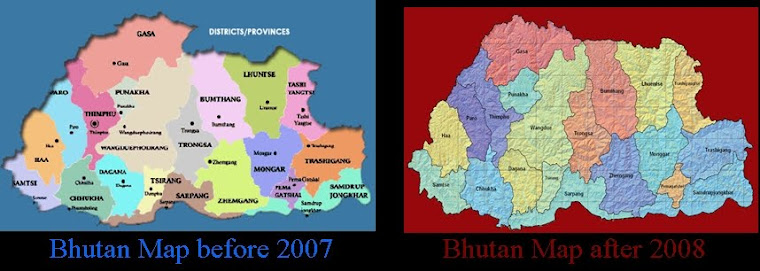
Click over the map to know the differences
Thursday, June 7, 2007

Underground outfit warns against third country refugee resettlement
At a time when the alternative of resettling the Bhutanese refugees to third countries is being seriously considered, an outfit named Bhutan Tigers Force (BTF), a group said to be active in Bhutan in an underground manner, has warned the refugees against going for that option.
Posters and pamphlets said to be pasted by the outfit on the walls, trees and makeshift shacks in the refugee camps of Jhapa and Morang yesterday night warned that if the refugees opted for third country resettlement strong action would be taken against the agencies facilitating the resettlement.
However, the group didn’t explain why it was against the idea.
Resettling the refugees in a third country would only make the respectful return of refugees more difficult, hinder the movement waged for refugee repatriation and would be considered a conspiracy to wipe the identity of the refugees, it has been stated in the pamphlet.
An estimated 106,000 refugees have been living in Nepal since 1990 after being forcefully evicted from their homes by the Bhutanese government. U.S, Canada, Australia including few Nordic countries had proposed to take certain number of the Bhutanese refugees to their countries as part of the third country resettlement option after 15 rounds of bilateral negotiations between Nepalese and Bhutanese governments failed to resolve the refugee stalemate.
Refugees as well as their leaders remain divided over the third country option. nepalnews.com ag June 07 07
Posters and pamphlets said to be pasted by the outfit on the walls, trees and makeshift shacks in the refugee camps of Jhapa and Morang yesterday night warned that if the refugees opted for third country resettlement strong action would be taken against the agencies facilitating the resettlement.
However, the group didn’t explain why it was against the idea.
Resettling the refugees in a third country would only make the respectful return of refugees more difficult, hinder the movement waged for refugee repatriation and would be considered a conspiracy to wipe the identity of the refugees, it has been stated in the pamphlet.
An estimated 106,000 refugees have been living in Nepal since 1990 after being forcefully evicted from their homes by the Bhutanese government. U.S, Canada, Australia including few Nordic countries had proposed to take certain number of the Bhutanese refugees to their countries as part of the third country resettlement option after 15 rounds of bilateral negotiations between Nepalese and Bhutanese governments failed to resolve the refugee stalemate.
Refugees as well as their leaders remain divided over the third country option. nepalnews.com ag June 07 07
Wednesday, June 6, 2007
ALL PEOPLE'S PARTY: THE FOURTH PARTY
Bhutan gets fourth political party
Bhutan's transition from an absolute monarchy to democracy has taken yet another leap forward with a fourth political party being formed to fight the general elections next year.
With mostly retired civil servants, businessmen and former local leaders as members, the All People's Party also has 17 retired royal advisory councilors in its ranks.
DC Sharma, a former principal of Deothang Polytechnic and one of the founding members of the party said the groundwork has already been done. "We have a party manifesto, charter and structure in place and are confident of winning the 2008 election and forming the first democratically elected government," he said.
Three parties -- People's Democratic Party, Bhutan People United Party and the Bhutan National Party -- have been already been formed.
A senior functionary of All People's Party said the main reason for its formation is to provide "an alternative and additional platform so that every Bhutanese can voice their opinion in the formation of the nation's first constitutional and democratic government".
"We are encouraged by the commitment made by many senior civil servants," he said.
Meanwhile, with just about a month left for the political parties to register themselves with the Election Commission of Bhutan, the news of the formation of All Peoples Party has come as an relief to many people who had said that they were looking for more options.
"It is good news. There should be many options for the people to have a free and fair election," said a senior civil servant.
Bhutan's transition from an absolute monarchy to democracy has taken yet another leap forward with a fourth political party being formed to fight the general elections next year.
With mostly retired civil servants, businessmen and former local leaders as members, the All People's Party also has 17 retired royal advisory councilors in its ranks.
DC Sharma, a former principal of Deothang Polytechnic and one of the founding members of the party said the groundwork has already been done. "We have a party manifesto, charter and structure in place and are confident of winning the 2008 election and forming the first democratically elected government," he said.
Three parties -- People's Democratic Party, Bhutan People United Party and the Bhutan National Party -- have been already been formed.
A senior functionary of All People's Party said the main reason for its formation is to provide "an alternative and additional platform so that every Bhutanese can voice their opinion in the formation of the nation's first constitutional and democratic government".
"We are encouraged by the commitment made by many senior civil servants," he said.
Meanwhile, with just about a month left for the political parties to register themselves with the Election Commission of Bhutan, the news of the formation of All Peoples Party has come as an relief to many people who had said that they were looking for more options.
"It is good news. There should be many options for the people to have a free and fair election," said a senior civil servant.
Repatriation or resettlement
RASSEGNA STAMPA SUD/ASIA 6/6/07
a cura di
Alessandra Consolaro
Mercoledi' 6 Giugno 2007
Dall'ultimo numero di Himalmag un articolo sulla situazione dei Lhotshampa, i profughi bhutanesi in Nepal, che rappresentano una delle - purtroppo molte - tragedie dimenticate di questo mondo. La recente promessa statunitense di dare asilo a 60000 rifugiati ha sollevato speranze e timori: dopo quasi due decenni di vita nei campi profughi ci si interroga se sia meglio rinunciare definitivamente al rimpatrio per stabilirsi all'estero, oppure lottare per un'effettiva intergrazione nel territorio nepalese, o ancora perseverare nella difficilimete realizzabile richiesta di rimpatrio.
Oltre al problema umanitario, la soluzione della questione dei profughi comporta anche conseguenze politiche, perché implica scelte che riguardano anche il regime di Thimphu ee eventuali cambiamenti politici in Bhutan.
------------ --------- ---------
Repatriation or resettlement
Resolving the Lhotshampa dilemma
The stagnating Lhotshampa refugee issue has suddenly seen movement in the form of the American government's promise to resettle more than half of the refugees. But what does this mean for the goal of repatriation to Bhutan? And is Thimphu being given an easy exit after the cruelty it has shown to the Lhotshampa? After initial bewilderment, most refugees seem to be opting for resettlement, hoping to keep the fight for repatriation alive in the diaspora.
By : Himali Dixit

All photographs by himali dixit
It is eight o'clock on a tepid mid-April morning in Khundunabari, one of the seven refugee camps in the southeastern Nepal districts of Jhapa and Morang that are home to an estimated 106,000 Bhutani refugees. A few hundred people are gathered in the open grounds near the camp's settlement of thatched-roof huts (see photo). The atmosphere is festive. A handful of large tents have been set up in the commons. Soon, the people here will begin to form long lines, waiting to enter these tents to identify themselves and be counted as refugees. Despite their presence in the camps for a full decade and a half, these people have never been granted that crucial identity marker.
This is the second day of the refugee census exercise in Khundunabari camp. The undertaking is being jointly overseen by Nepal's Home Ministry and the United Nations High Commissioner for Refugees (UNHCR); Khundunabari was the last camp to be surveyed. Among other things, the completion of the census will allow UNHCR, at long last, to issue each refugee an identity card declaring his or her status.
The census is not all that has not taken place in these camps over the past 17 years. During that time, refugee families living here have seen no progress in their efforts to return to their homeland. They have suffered from the instability of the Nepali state, and have seen the Bhutani government run circles around team after negotiating team from Kathmandu. For 17 years, these refugees have lived on aid-agency rations in crowded camps in the hot Nepali plains; one, sometimes two families per hut; their children educated for free until high school but unable to work legally thereafter. For 17 years, frustration has been mounting.
October 2006 saw the first real movement in response to the refugee crisis – along humanitarian if not political lines. At a UNHCR conference in Geneva, US Assistant Secretary of State for Refugee Affairs Ellen Sauerbrey announced that her government was willing to resettle up to 60,000 Bhutani refugees. Since then, the other member countries of the Core Group on Bhutanese Refugees in Nepal – Australia, Canada, Denmark, the Netherlands, New Zealand and Norway – have expressed willingness to take in some refugees, and Nepal's new foreign minister announced in late May that she had commitments for a total of 85,000. In April, a US State Department team visiting Nepal announced that 60,000 – a number that the US hopes to resettle over the coming five to six years – should not be considered a ceiling on the number of Bhutani refugees the country would be willing to accept.
17 long years
Between 1990 and 1992, 75,000 Bhutani citizens, most of them Lhotshampa (Nepali-speakers from south Bhutan), were forced out of the country. Bhutan's minorities had suffered state-led persecution in the form of Bhutan's 'One Nation, One People' policy of Ngalung cultural hegemony and exclusion under the country's 1985 Citizenship Act. This policy, implemented under the command of King Jigme Singye Wangchuk, prompted Lhotshampa resistance before culminating in 1991 in wide-scale evictions, confiscation of citizenship cards, closure of schools in southern Bhutan, dismissal of Lhotshampa government employees, and the razing of homes.
As close to a thousand refugees a month began to enter Assam and West Bengal, seeking to set up camps in border towns, Indian authorities, seemingly unwilling to permit anything that would cause King Jigme discomfort, herded them into trucks and drove them to the Nepali border town of Kakarbhitta. In Nepal, in February 1992, the influx of refugees to the original camp on the floodplains of the Mai River reached 10,000 per month. Reprieve came in the form of UNHCR, which began assistance to the refugees at the request of the Kathmandu government. The refugee population was eventually moved to camps built in Beldangi, Khundunabari, Timai, Goldhap and Sanischare in Jhapa and Morang districts. According to Human Rights Watch, in addition to the 106,000 or so refugees currently in the camps, there are up to 15,000 more in Nepal who are not registered with the Nepal government, as well as up to 30,000 unregistered refugees in India.
Since 1993, Kathmandu and Thimphu have engaged in 15 rounds of ministerial- level talks (a 16th round, slated for late last year, never took place). While negotiations have been unsuccessful in addressing the concerns of the refugee population, even these have been halted since 2003, when a team from Thimphu confronted an angry crowd in Khundunabari camp. This incident seems to have provided an excuse for not returning. The Bhutani side has been continuously successful in stonewalling and duping Nepali delegations. One Nepali team was even convinced to agree to a nonsensical categorisation scheme, in which refugees would be classified according to whether they were 'genuine' Bhutani citizens forcefully evicted; Bhutanis who had left Bhutan voluntarily (which, under Bhutani law, results in loss of citizenship) ; non-Bhutani; or Bhutani criminals.
India, the only obvious lever of diplomatic pressure on its small, introverted neighbour, has been doggedly unwilling to interfere. While some cite New Delhi's need for quid pro quo from Thimphu with regards to insurgent groups in Assam that seek to use Bhutan's borderlands as safe havens, others point to its economic interests in Bhutani hydropower, or to an unwillingness to rock the boat in what is regarded as a sensitive Himalayan frontier. Whatever the reason, the Indian position has been unequivocal, and New Delhi continues to insist that the refugee issue is a bilateral one of concern only to Nepal and Bhutan. Indian authorities also continue to arrest Bhutani refugees trying to return to their country. What has been lacking in this position is a level of humanitarian sympathy for the second-largest group of refugees in the Subcontinent, barring the Afghans in Pakistan.
Until recently, the refugee leadership had not expressed a desire for any 'durable solution' except repatriation to Bhutan. Beginning in the early 2000s, however, some began to speak of the need to "open all options" to the refugees – ie, to give the population in the camps a choice between the three 'durable solutions' of repatriation to Bhutan, local integration in Nepal, or resettlement to a third country.
Since the Core Group's creation in 2006, talks sought with Thimphu by representatives of those countries convinced many diplomats that Bhutan was not inclined to accept back any section of the refugee population in the near future. In Kathmandu, senior Community Party of Nepal (Unified Marxist-Leninist) leader K P Oli had come to a similar conclusion. After a new government made him foreign minister in the spring of 2006, Oli sought to bring 16 years of fruitless negotiations with Bhutan to a definitive conclusion.
It was with the backing of the Core Group countries that the Kathmandu government finally opened up to the idea of third-country resettlement, abandoning its 'repatriation only' stand. There is now a general agreement among all working on Lhotshampa refugee affairs that the refugees cannot be held hostage to the uncertain outcome of bilateral talks. Bhutan, meanwhile, has welcomed the offers of resettlement to a population it continues to deny is its own. Following the visit to Thimphu of the US ambassador to India this April, Bhutani Prime Minister Khandu Wangchuk told the press, "I expressed [to Ambassador David Mulford] our deep appreciation of their decision to resettle the people."
Who wants to go?
Despite being energised by the fact that some movement is finally taking place with regards to the refugee issue – indeed, the month of May saw a sudden flurry of activity in Kathmandu, including the arrival of UNHCR chief António Guterres – the refugees are divided on how to approach the resettlement offers. While a majority would want to accept the promised evacuation to a Western country, some maintain that all they want is to return home. Some of the ambivalence among refugees with regards to resettlement is due to an apprehension with regard to the unknown among the elderly. But there also seems to be a fair degree of political intimidation going on, which keeps many refugees from being open about their choice of resettlement. Indeed, a small segment opposes resettlement not only for itself, but also for others. A lack of information on the modalities and extent of resettlement has caused a fair amount of confusion, and this has been stoked by those vehemently opposed to the option. UNHCR was only just beginning its first official information campaign on resettlement as Himal went to press.
Karna Bahadur Saukar, an elderly man of Beldangi I, says that he is not prepared to resettle in the West. "We don't know the soil of that place. We don't know the water, the air. We want to go back to Bhutan. If we can't do that, we would rather stay here in Nepal." Phurba Tamang, in his early 20s, says, "We are not Nepali. We are Bhutanese." According to this view, it is either Bhutan or nothing: resettlement is out of the question.
Others worry how they will be treated in the countries offering resettlement. Teenager Buddhiman Rang Rai says he has heard that many Vietnamese refugees resettled to the United States have not received the all-important 'green card'. Some suspect that Western countries want them only as cheap labour, while others feel that only the most capable should resettle, and then send money back to their families in the camps. D B Khawaas, a Beldangi resident in his late 20s, worries that he would not be able to care for his old parents and young children if everyone were to move. Clearly, information is lacking on the human-security aspects that would have to be guaranteed in any resettlement exercise. Arjun Pradhan, a journalist with the camp-published Bhutan Jagaran newspaper, says that some refugees are worried that Western countries may house them in conditions worse than they know here – perhaps even in other refugee camps.
" 'Down with America's agents' – The Committee Against Third Country Resettlement"
Muna Giri, a young woman from Beldangi II who organises a women's discussion group in a children's library in the camp, laughs as she recounts some of the rumours that are circulating among the camp population: "They say that in America, if you get very sick they give you an injection and put you to sleep for good." Krishna Maya Basnet, a feisty 79-year-old, chimes in: "They say that we'll be made into fish feed. Well, let us be fish feed rather than stay here, where we don't have firewood to feed ourselves!" In late May, it was heard that fake emails were circulating in the camps in which some of the refugees already resettled in the US and Canada (an initial 'test group' of 18 refugees were resettled last autumn) were said to be complaining of conditions in the resettlement countries and opposing resettlement.
Manoj Kumar Rai, the young and energetic camp secretary of Khundunabari camp, says that those currently opting not to resettle generally fall into three categories: the elderly; those who have already taken Nepali citizenship and so are out of the running; and young "school dropouts", whom anti-resettlement die-hards have convinced that they do not have the skills required to survive abroad.
Humanitarian v political
Some of the most prominent refugee leaders say they do not consider third-country resettlement to be a solution to what they see as the most pressing issue facing the refugee community. Thinley Penjore, head of the Druk National Congress, a party functioning in exile, says that the refugee situation is "first and foremost a political problem. Our expulsion is not and must not be painted as merely an ethnic, cultural or racial problem. And our troubles today cannot be seen as a humanitarian problem alone." As such, the solution to the refugee problem is political change in Bhutan – and that is a fight that must be fought within Bhutan itself. Penjore is positive about the current democratisation process in Bhutan and feels that, though it is taking place on the terms of the Druk monarchy, it is bound to open up space for greater political activity.
While Penjore says he believes that refugees who want to resettle to third countries should do so, he worries that resettlement, as a humanitarian solution, does not address the political problem. He and others fear that resettlement could sap energy from activism for repatriation, and also reduce the numbers fighting for democratisation should the door back to Bhutan be opened.
Frustrated with the prioritisation of the humanitarian cause, Tek Nath Rizal, chairman of the Bhutanese Movement Steering Committee and long the public face of the Bhutani movement for repatriation, retorts: "Don't tell me about human rights. Is not the protection of your property a human right? Is not return to the land of your birth, the country of which you are a citizen, a human right?" Though Rizal, like others, had rejected resettlement in the wake of the offers last autumn, he too no longer publicly opposes it.
For many of those living in the camps, however, the most critical issue is indeed the humanitarian rather than the political. Rupa Monger, a mother of three from Khundunabari, says that life in the camps has been getting more and more difficult. Referring to the so-called bio-briquettes provided by UNHCR since last year, she says: "They cut our kerosene rations and have given us coal instead. To start a fire you need more firewood than coal, but we are not allowed to collect firewood. The funds for higher education have been cut. We were being told to stand on our own feet, but we are not allowed to work. We were worried sick. Now, with the resettlement offers, we have hope."
That hope has not come cheaply, however. While Rupa had long hoped to return to her country, she now says, "Bhutan won; I have lost to Bhutan." Similarly, Pingala Dhital says she feels as though her life has been "put on hold", and that she can no longer live in hope of a political settlement. "I must think about my child, who doesn't know Bhutan, and who mustn't remain stateless," she says.
UNHCR representative in Nepal Abraham Abraham feels strongly that the refugees should be given the option of ending their camp stay as soon as possible. "Repatriation will happen when the time and the situation are conducive to it," he says. "Until that time, refugees need not be subjected to the harsh conditions in the camps. This is a freedom they have – a choice, an option." Abraham also warns that resettlement must be taken up while it is still being held out. "Resettlement is not something that is on offer for everyone forever. It is not an easy thing to get countries to agree to. And if the resettlement option does not remain, what other viable option do we have?"
The seeming impossibility of repatriation to Bhutan is what is getting many refugees to fall on the side of resettlement. Ever since the conclusion of the first survey of the infamous Nepal-Bhutan Joint Verification Team – which divided the refugee population into the four categories of Thimphu's creation – in Khundunabari camp in 2003, the Thimphu regime's attitude has consistently been one of evasion or prevarication on matters of repatriation. Only 2.6 percent of the total 12,000 surveyed in Khundunabari were identified as "genuine Bhutanese", and even these were offered return to Bhutan under denigrating and exploitative conditions. Even so, no repatriation has taken place to date.
Long-time refugee leader Ratan Gazmere says that though most refugees would like to return to Bhutan, next to nobody would opt to do so under current circumstances. "The situation does not exist in Bhutan for a safe and dignified return," he says. "We must work towards the creation of such a situation, and this is where the international community must help us."
Donor fatigue
If many Bhutani refugees seem to be in favour of third-country resettlement today, that change in mindset only came about recently. Father Varkey Perekkatt, head of both the Jesuit Refugee Services in Nepal and the INGO Caritas's Bhutanese Refugee Education Programme, says: "Until two years ago, I'd say 80 percent of the population would have opted to wait for repatriation. " Now, he says, many of those people will opt to leave. A major reason for the shift, explains Perekkatt, is the fact that there has been no progress on the repatriation front since 22 December 2003, when the Khundunabari findings of the Nepal-Bhutan Joint Verification Team were announced and the Bhutani delegates departed, never to return.
In the intervening three years, a number of significant developments have taken place. Most important has been a shift in UNHCR policy, brought about by the organisation' s increasing lack of resources. "Given this," Perekkatt says, "there has been much depression, disappointment and hopelessness over the past few years." Against this backdrop, suddenly and unexpectedly came the resettlement offer from the US.
Outside JVT House in Damak, Jhapa: A sign from another age
Graeme Lade, the Australian ambassador to Nepal and current chair of the Core Group in Kathmandu, cites two reasons why the resettlement offers were made at this time. "First, the offers have been made on humanitarian grounds," he explains. "These refugees have spent a long period of time living in a camp situation, and this gives rise to various concerns. The second reason is basic donor fatigue." UNHCR representative Abraham corroborates this: "Between 15 and 18 million dollars is spent on the camps annually. It's just not sustainable. "
Indeed, over the past few years the refugees have seen cuts in the provision of, among other things, cooking fuel, food and medical services. In December 2006, the World Food Programme (WFP), which provides most of the food rations for the camps, warned that it had not yet received any contributions towards the next two years of its Bhutani-refugee operations. Though aid activities in the camps have been under increasing financial stress over the past decade and a half, the lack of funding has been increasingly palpable over the last few years. All of the major donors to the camps are also members of the Core Group on Bhutanese Refugees, with the exception of Japan. These are also the countries that are currently offering to resettle the refugees, indicating a strong correlation between resettlement and 'donor fatigue'.
Camp breakdown
If the refugee population has been made desperate by cuts and uncertainty in support, an increase in threats and intimidation has made life in the camps that much worse. This makes camp residents all the more willing to relocate, at which point they are once again targeted by radicalised youth who claim to oppose resettlement. Laxmi Adhikari, mother of Hari Om Adhikari, was surrounded and attacked near her home in Khundunabari on 10 November last year by a gang of young camp residents accusing her of wanting to "go to America". Similarly, Hari Adhikari 'Bangaley', camp secretary at Beldangi II and head of the new NGO Bhutanese Refugee Durable Solutions Coordination Committee, no longer lives in the camps after an attack made on him in August 2006. He now commutes to work from the town of Damak. "We have no technical support here to maintain security," he says. "Sometimes, the police don't arrive to help us. What should be small incidents quickly become big incidents."
Adhikari says that intimidation has been on the rise since 2005. "These young people have seen the trajectory of Nepal's Maoists, and how nothing seemed to stop them after they took up the gun." Indeed, at various times during the ten-year conflict between the Communist Party of Nepal (Maoist) and the Nepali state, Maoist cadre treated the refugee camps in Jhapa and Morang as safe havens, forcing camp residents to feed and house them, and making use of camp medical facilities. Before the Comprehensive Peace Agreement was signed between the CPN (Maoist) and the Seven Party Alliance in Kathmandu last autumn, groups of camp youth had also been taken by the Maoists for indoctrination and arms training. The Bhutan Communist Party (Marxist-Leninist- Maoist), founded in early 2003, is believed to have grown out of this socialisation.
Sexual and gender-based violence has been a particular problem in these crowded and mostly unguarded settlements. UNHCR itself woke up to the issue when, in 2002, 18 cases of sexual abuse were discovered to have been perpetrated by people paid by the aid agency and its partner organisations.
Tension has also been increasing between the camp populations and the surrounding communities. The most commonly cited example of this souring is the fight that broke out between refugees and locals in Morang District on 22 February this year. The refugees, reportedly frustrated by using the UNHCR-supplied bio-briquettes, had gone to the community forest near Sanischare camp in search of firewood. The ensuing fight resulted in the death of Gopal Khadka, a refugee from Sanischare.
"The conditions in the camps are worsening, and militancy is so much on the rise that it would be a crime to ask anyone to remain there even a year longer," says Hari Adhikari 'Bangaley'. Meanwhile, Ratan Gazmere, who is chief coordinator of the Association of Human Rights Activists (AHURA), Bhutan, worries that an increase in violence in the camps may affect chances of resettlement, as the refugees gain an image as a violent bunch, something they have thus far avoided. The increase in "violence and militancy" has been gradual, says Abraham Abraham, and is not showing any signs of abating. "The longer the refugees stay in the camps," he notes, "the more frustration will build – the greater the social ills, the greater the animosity. As numbers start leaving, hopefully the social problems will decline."
Many also hope that, with the start of mass information campaigns, intimidation that has found fuel in the confusion surrounding resettlement will decrease. At the end of May, UNHCR began distributing a pamphlet in the camps that seeks to answer questions refugees may have about the choice they face. It explains, among other things, that UNHCR will chose countries to which to refer individual refugees interested in resettlement on the basis of its assessment of their needs; that families will be resettled together; that resettlement avails refugees of permanent residency of the host country and eventually, if the refugees choose, its citizenship; and that refugees will be given assistance until assimilated in the country of resettlement. The US will also soon step up its own information campaign (a fact sheet on resettlement has already been distributed in the camps). Washington, DC will soon set up an Overseas Processing Entity, which will begin processing cases referred to it by UNHCR in September. On a recent visit to Kathmandu, Janice Belz, a high-level official with the US State Department's refugee office, said that the first group of refugees opting for resettlement should be able to leave for the US by the beginning of 2008.
A global movement
At this point, 'opening all options' for the Bhutani refugees – the rhetoric used by refugee leaders and foreign diplomats alike – ultimately boils down to little more than the opening of the option of resettlement. After 17 years, any pressure that has been applied to Thimphu has come to nought. Even as the international community prepares the groundwork to wipe its hands clean of the Bhutani refugee issue, there is the lingering sense that 'justice' has not been delivered to this group of people.
With Bhutan less than a hundred miles from the camps, across Indian territory, some refugee leaders are saddened by the prospect of refugees leaving a place from which Bhutan is physically so close. "From where we are now, we can sneak into Bhutan if need be, and speak to people there," says Thinley Penjore. "From afar, we will only be able to contact those people with access to online media. Not many people have this access, and many have been kept uneducated."
Others point out that, in a few year's time, there will no longer be a 100,000-strong population in the camps, functioning as a prod to the international conscience. At that time, whatever conviction there has been among the international community to resolve the refugee issue will disappear. As such, an injustice carried out by the Thimphu regime on a massive scale will have been excused.
But there are others who say that resettlement will in fact energise a refugee movement that has long stagnated. "We can do nothing sitting here in the camps," complains camp secretary Manoj Rai. "We must give our movement a global scale." A younger generation of refugees, he says, understands the power of information technology and the ways in which it is possible for an educated population across the globe to coordinate and mobilise effectively. Concurs one former Nepal foreign-ministry official: "Why do they not want to leave the camps? Because Jhapa is close to Bhutan? But they have been unable to reach Bhutan in 16 years. Maybe they will find Thimphu closer from elsewhere."
Whether or not the Bhutani refugees can hope to galvanise as much support, the Tibetan movement stands as an example of the kind of solidarity that can be found in the West for the cause of an unjustly displaced people. "The world doesn't know about the Bhutanese refugees. Outreach to the populace of a powerful democratic country could be very useful," says Kimberly Robertson, who looks after durable solutions for UNHCR's Nepal operation. Hari Adhikari 'Bangaley' says that experience has shown that a return to Bhutan cannot be achieved through reliance on the Nepal government alone. "If we have our people in Geneva, New York, London, we can lobby there," he says. "Mechanisms unused until now can be utilised."
If the refugees have been disadvantaged due to their geographical placement, they have been even more so for lack of funds. "Let them go. Let them be educated, earn and live well, and let them spend on their movement," says the former Nepal foreign-ministry official, "Right now, refugees who seek to be heard often can't scrape together enough money for a trip to Kathmandu." Manoj Rai echoes these sentiments. "Our main problem in our efforts to pressure Thimphu is financial," he says. "If our people resettle, they will be able to work. For ten years, they may struggle themselves. But after that, they will fund a movement in Bhutan."
Will the Bhutani identity remain strong enough among the refugees to maintain a movement after a second displacement? D N S Dhakal, general-secretary of the Bhutan National Democratic Party, insists that the refugees will not disappear into a wider Nepali-speaking diaspora. Not only is the Bhutani identity distinct, he says, but, as has been seen with other groups, "Feelings for nationality become stronger when people become economically strong."
The Bhutani refugees have held out hope for long enough that the international community – and, most importantly, India – would pressure Bhutan to allow their peaceful repatriation. With resettlement, perhaps they will be able to finally take the fate of their movement into their own hands. Perhaps it will end not only their dependency on international aid, but also their reliance on others for a movement for change back home.
There are refugees who will remain in the camps, choosing not to leave until they can do so for their own country. The success of a Bhutani movement overseas notwithstanding, the desires of this group of refugees must not be forgotten. It seems, however, that a large number will indeed opt to leave the camps in Jhapa and Morang for overseas resettlement. They will leave looking forward to opportunities and freedoms they have lived without for a decade and a half – seeking employment, and hoping for better futures for their children. The actions of this new diaspora, created out of a humanitarian response in the face of a grave injustice, will be worth watching in the decades to come.
Back in Bhutan
As one group of southern Bhutanis contemplate whether or not to move out of the refugee camps in Nepal, by all accounts those who remain in Bhutan continue to suffer constant discrimination and threats to their status as citizens. The plight of Bhutan's minorities indicates that much needs to change in the country before a safe and dignified return is possible for the exiled Lhotshampa. But perhaps more importantly, ongoing discrimination within Bhutan demands that whatever leverage possible be used in order to ensure the safety of an increasingly insecure population within the country. The international community must be on high alert: it must work to make Bhutan recognise its obligations towards its minorities, and it must be quick to recognise a second eviction if and as it begins to occur.
Following the mass evictions of the early 1990s, the Thimphu government required Bhutani citizens to obtain No Objection Certificates (NOCs) from the police, to confirm that they are not involved in any 'anti-national activity'. NOCs are required for admission in schools, employment in the civil service, the right to sell cash crops, the right to buy and sell land, to obtain business licenses, and for the issuance of passports. According to a report released by Human Rights Watch in mid-May, "Being denied an NOC deprives a person of almost all means of earning a living." Accusations of being 'anti-nationals' fall easily on the Lhotshampa, in particular those with even distant relatives in the refugee camps in Nepal. NOCs are accordingly difficult to obtain.
Bhutan's Nepali-speakers continue to be discriminated against under the 1985 Citizenship Act. That discrimination has recently become more acute, as many Lhotshampa who had previously held citizenship cards have been denied new ones following the 2005 census, which classified 13 percent of those who reside in Bhutan as non-nationals – a total of 80,000 people. It is commonly believed that this figure includes many Lhotshampa. In mid-May, it was reported on a refugee-run news portal that 70,000 Lhotshampa were denied their adult franchise in the 'mock elections' that took place in Bhutan this past April as a part of the new King Jigme Khesar's inherited democratisation project.
"All the root causes of the mass eviction of the early 1990s remain," says a former Nepal foreign-ministry official. Bill Frelick, director of the Refugee Policy Program at Human Rights Watch, concurs: "Things have not changed. Furthermore, there are disturbing parallels between the census of 1988 and the census of 2005." At the same time, refugee leader Ratan Gazmere cautions that any future eviction will undoubtedly be so cleverly conducted that the world may not even notice. Indeed, Human Rights Watch's recent report quotes one Lhotshampa living in Bhutan as saying, "They don't ask me to leave, but they make me so miserable, I will be forced to leave. I have no identification, so I cannot do anything, go anywhere, get any job."
UNHCR-Nepal head Abraham Abraham says he believes a second eviction to be unlikely, given that "Bhutan is receiving messages from all directions that this must not take place." His boss, UNHCR High Commissioner António Guterres, said in Kathmandu in late May, "I have deep conviction, and am sincerely hopeful, that such a tragedy will not occur."
Discrimination and denational-isation should not need to amount to expulsion, however, for the international community to be on the alert. Pressure must be maintained on Bhutan – by recalcitrant India in particular – to amend its citizenship laws, abolish the NOCs, and discontinue all discrimination against Nepali-speakers. In order to make sure that the suffering of the refugees has not been entirely in vain, it is imperative that Thimphu be made to realise that it must respect the political, social, economic and cultural rights of all of its people.
http://www.himalmag .com/2007/ june/special_ report_bhutanese _refugees. htm
a cura di
Alessandra Consolaro
Mercoledi' 6 Giugno 2007
Dall'ultimo numero di Himalmag un articolo sulla situazione dei Lhotshampa, i profughi bhutanesi in Nepal, che rappresentano una delle - purtroppo molte - tragedie dimenticate di questo mondo. La recente promessa statunitense di dare asilo a 60000 rifugiati ha sollevato speranze e timori: dopo quasi due decenni di vita nei campi profughi ci si interroga se sia meglio rinunciare definitivamente al rimpatrio per stabilirsi all'estero, oppure lottare per un'effettiva intergrazione nel territorio nepalese, o ancora perseverare nella difficilimete realizzabile richiesta di rimpatrio.
Oltre al problema umanitario, la soluzione della questione dei profughi comporta anche conseguenze politiche, perché implica scelte che riguardano anche il regime di Thimphu ee eventuali cambiamenti politici in Bhutan.
------------ --------- ---------
Repatriation or resettlement
Resolving the Lhotshampa dilemma
The stagnating Lhotshampa refugee issue has suddenly seen movement in the form of the American government's promise to resettle more than half of the refugees. But what does this mean for the goal of repatriation to Bhutan? And is Thimphu being given an easy exit after the cruelty it has shown to the Lhotshampa? After initial bewilderment, most refugees seem to be opting for resettlement, hoping to keep the fight for repatriation alive in the diaspora.
By : Himali Dixit
All photographs by himali dixit
It is eight o'clock on a tepid mid-April morning in Khundunabari, one of the seven refugee camps in the southeastern Nepal districts of Jhapa and Morang that are home to an estimated 106,000 Bhutani refugees. A few hundred people are gathered in the open grounds near the camp's settlement of thatched-roof huts (see photo). The atmosphere is festive. A handful of large tents have been set up in the commons. Soon, the people here will begin to form long lines, waiting to enter these tents to identify themselves and be counted as refugees. Despite their presence in the camps for a full decade and a half, these people have never been granted that crucial identity marker.
This is the second day of the refugee census exercise in Khundunabari camp. The undertaking is being jointly overseen by Nepal's Home Ministry and the United Nations High Commissioner for Refugees (UNHCR); Khundunabari was the last camp to be surveyed. Among other things, the completion of the census will allow UNHCR, at long last, to issue each refugee an identity card declaring his or her status.
The census is not all that has not taken place in these camps over the past 17 years. During that time, refugee families living here have seen no progress in their efforts to return to their homeland. They have suffered from the instability of the Nepali state, and have seen the Bhutani government run circles around team after negotiating team from Kathmandu. For 17 years, these refugees have lived on aid-agency rations in crowded camps in the hot Nepali plains; one, sometimes two families per hut; their children educated for free until high school but unable to work legally thereafter. For 17 years, frustration has been mounting.
October 2006 saw the first real movement in response to the refugee crisis – along humanitarian if not political lines. At a UNHCR conference in Geneva, US Assistant Secretary of State for Refugee Affairs Ellen Sauerbrey announced that her government was willing to resettle up to 60,000 Bhutani refugees. Since then, the other member countries of the Core Group on Bhutanese Refugees in Nepal – Australia, Canada, Denmark, the Netherlands, New Zealand and Norway – have expressed willingness to take in some refugees, and Nepal's new foreign minister announced in late May that she had commitments for a total of 85,000. In April, a US State Department team visiting Nepal announced that 60,000 – a number that the US hopes to resettle over the coming five to six years – should not be considered a ceiling on the number of Bhutani refugees the country would be willing to accept.
17 long years
Between 1990 and 1992, 75,000 Bhutani citizens, most of them Lhotshampa (Nepali-speakers from south Bhutan), were forced out of the country. Bhutan's minorities had suffered state-led persecution in the form of Bhutan's 'One Nation, One People' policy of Ngalung cultural hegemony and exclusion under the country's 1985 Citizenship Act. This policy, implemented under the command of King Jigme Singye Wangchuk, prompted Lhotshampa resistance before culminating in 1991 in wide-scale evictions, confiscation of citizenship cards, closure of schools in southern Bhutan, dismissal of Lhotshampa government employees, and the razing of homes.
As close to a thousand refugees a month began to enter Assam and West Bengal, seeking to set up camps in border towns, Indian authorities, seemingly unwilling to permit anything that would cause King Jigme discomfort, herded them into trucks and drove them to the Nepali border town of Kakarbhitta. In Nepal, in February 1992, the influx of refugees to the original camp on the floodplains of the Mai River reached 10,000 per month. Reprieve came in the form of UNHCR, which began assistance to the refugees at the request of the Kathmandu government. The refugee population was eventually moved to camps built in Beldangi, Khundunabari, Timai, Goldhap and Sanischare in Jhapa and Morang districts. According to Human Rights Watch, in addition to the 106,000 or so refugees currently in the camps, there are up to 15,000 more in Nepal who are not registered with the Nepal government, as well as up to 30,000 unregistered refugees in India.
Since 1993, Kathmandu and Thimphu have engaged in 15 rounds of ministerial- level talks (a 16th round, slated for late last year, never took place). While negotiations have been unsuccessful in addressing the concerns of the refugee population, even these have been halted since 2003, when a team from Thimphu confronted an angry crowd in Khundunabari camp. This incident seems to have provided an excuse for not returning. The Bhutani side has been continuously successful in stonewalling and duping Nepali delegations. One Nepali team was even convinced to agree to a nonsensical categorisation scheme, in which refugees would be classified according to whether they were 'genuine' Bhutani citizens forcefully evicted; Bhutanis who had left Bhutan voluntarily (which, under Bhutani law, results in loss of citizenship) ; non-Bhutani; or Bhutani criminals.
India, the only obvious lever of diplomatic pressure on its small, introverted neighbour, has been doggedly unwilling to interfere. While some cite New Delhi's need for quid pro quo from Thimphu with regards to insurgent groups in Assam that seek to use Bhutan's borderlands as safe havens, others point to its economic interests in Bhutani hydropower, or to an unwillingness to rock the boat in what is regarded as a sensitive Himalayan frontier. Whatever the reason, the Indian position has been unequivocal, and New Delhi continues to insist that the refugee issue is a bilateral one of concern only to Nepal and Bhutan. Indian authorities also continue to arrest Bhutani refugees trying to return to their country. What has been lacking in this position is a level of humanitarian sympathy for the second-largest group of refugees in the Subcontinent, barring the Afghans in Pakistan.
Until recently, the refugee leadership had not expressed a desire for any 'durable solution' except repatriation to Bhutan. Beginning in the early 2000s, however, some began to speak of the need to "open all options" to the refugees – ie, to give the population in the camps a choice between the three 'durable solutions' of repatriation to Bhutan, local integration in Nepal, or resettlement to a third country.
Since the Core Group's creation in 2006, talks sought with Thimphu by representatives of those countries convinced many diplomats that Bhutan was not inclined to accept back any section of the refugee population in the near future. In Kathmandu, senior Community Party of Nepal (Unified Marxist-Leninist) leader K P Oli had come to a similar conclusion. After a new government made him foreign minister in the spring of 2006, Oli sought to bring 16 years of fruitless negotiations with Bhutan to a definitive conclusion.
It was with the backing of the Core Group countries that the Kathmandu government finally opened up to the idea of third-country resettlement, abandoning its 'repatriation only' stand. There is now a general agreement among all working on Lhotshampa refugee affairs that the refugees cannot be held hostage to the uncertain outcome of bilateral talks. Bhutan, meanwhile, has welcomed the offers of resettlement to a population it continues to deny is its own. Following the visit to Thimphu of the US ambassador to India this April, Bhutani Prime Minister Khandu Wangchuk told the press, "I expressed [to Ambassador David Mulford] our deep appreciation of their decision to resettle the people."
Who wants to go?
Despite being energised by the fact that some movement is finally taking place with regards to the refugee issue – indeed, the month of May saw a sudden flurry of activity in Kathmandu, including the arrival of UNHCR chief António Guterres – the refugees are divided on how to approach the resettlement offers. While a majority would want to accept the promised evacuation to a Western country, some maintain that all they want is to return home. Some of the ambivalence among refugees with regards to resettlement is due to an apprehension with regard to the unknown among the elderly. But there also seems to be a fair degree of political intimidation going on, which keeps many refugees from being open about their choice of resettlement. Indeed, a small segment opposes resettlement not only for itself, but also for others. A lack of information on the modalities and extent of resettlement has caused a fair amount of confusion, and this has been stoked by those vehemently opposed to the option. UNHCR was only just beginning its first official information campaign on resettlement as Himal went to press.
Karna Bahadur Saukar, an elderly man of Beldangi I, says that he is not prepared to resettle in the West. "We don't know the soil of that place. We don't know the water, the air. We want to go back to Bhutan. If we can't do that, we would rather stay here in Nepal." Phurba Tamang, in his early 20s, says, "We are not Nepali. We are Bhutanese." According to this view, it is either Bhutan or nothing: resettlement is out of the question.
Others worry how they will be treated in the countries offering resettlement. Teenager Buddhiman Rang Rai says he has heard that many Vietnamese refugees resettled to the United States have not received the all-important 'green card'. Some suspect that Western countries want them only as cheap labour, while others feel that only the most capable should resettle, and then send money back to their families in the camps. D B Khawaas, a Beldangi resident in his late 20s, worries that he would not be able to care for his old parents and young children if everyone were to move. Clearly, information is lacking on the human-security aspects that would have to be guaranteed in any resettlement exercise. Arjun Pradhan, a journalist with the camp-published Bhutan Jagaran newspaper, says that some refugees are worried that Western countries may house them in conditions worse than they know here – perhaps even in other refugee camps.
" 'Down with America's agents' – The Committee Against Third Country Resettlement"
Muna Giri, a young woman from Beldangi II who organises a women's discussion group in a children's library in the camp, laughs as she recounts some of the rumours that are circulating among the camp population: "They say that in America, if you get very sick they give you an injection and put you to sleep for good." Krishna Maya Basnet, a feisty 79-year-old, chimes in: "They say that we'll be made into fish feed. Well, let us be fish feed rather than stay here, where we don't have firewood to feed ourselves!" In late May, it was heard that fake emails were circulating in the camps in which some of the refugees already resettled in the US and Canada (an initial 'test group' of 18 refugees were resettled last autumn) were said to be complaining of conditions in the resettlement countries and opposing resettlement.
Manoj Kumar Rai, the young and energetic camp secretary of Khundunabari camp, says that those currently opting not to resettle generally fall into three categories: the elderly; those who have already taken Nepali citizenship and so are out of the running; and young "school dropouts", whom anti-resettlement die-hards have convinced that they do not have the skills required to survive abroad.
Humanitarian v political
Some of the most prominent refugee leaders say they do not consider third-country resettlement to be a solution to what they see as the most pressing issue facing the refugee community. Thinley Penjore, head of the Druk National Congress, a party functioning in exile, says that the refugee situation is "first and foremost a political problem. Our expulsion is not and must not be painted as merely an ethnic, cultural or racial problem. And our troubles today cannot be seen as a humanitarian problem alone." As such, the solution to the refugee problem is political change in Bhutan – and that is a fight that must be fought within Bhutan itself. Penjore is positive about the current democratisation process in Bhutan and feels that, though it is taking place on the terms of the Druk monarchy, it is bound to open up space for greater political activity.
While Penjore says he believes that refugees who want to resettle to third countries should do so, he worries that resettlement, as a humanitarian solution, does not address the political problem. He and others fear that resettlement could sap energy from activism for repatriation, and also reduce the numbers fighting for democratisation should the door back to Bhutan be opened.
Frustrated with the prioritisation of the humanitarian cause, Tek Nath Rizal, chairman of the Bhutanese Movement Steering Committee and long the public face of the Bhutani movement for repatriation, retorts: "Don't tell me about human rights. Is not the protection of your property a human right? Is not return to the land of your birth, the country of which you are a citizen, a human right?" Though Rizal, like others, had rejected resettlement in the wake of the offers last autumn, he too no longer publicly opposes it.
For many of those living in the camps, however, the most critical issue is indeed the humanitarian rather than the political. Rupa Monger, a mother of three from Khundunabari, says that life in the camps has been getting more and more difficult. Referring to the so-called bio-briquettes provided by UNHCR since last year, she says: "They cut our kerosene rations and have given us coal instead. To start a fire you need more firewood than coal, but we are not allowed to collect firewood. The funds for higher education have been cut. We were being told to stand on our own feet, but we are not allowed to work. We were worried sick. Now, with the resettlement offers, we have hope."
That hope has not come cheaply, however. While Rupa had long hoped to return to her country, she now says, "Bhutan won; I have lost to Bhutan." Similarly, Pingala Dhital says she feels as though her life has been "put on hold", and that she can no longer live in hope of a political settlement. "I must think about my child, who doesn't know Bhutan, and who mustn't remain stateless," she says.
UNHCR representative in Nepal Abraham Abraham feels strongly that the refugees should be given the option of ending their camp stay as soon as possible. "Repatriation will happen when the time and the situation are conducive to it," he says. "Until that time, refugees need not be subjected to the harsh conditions in the camps. This is a freedom they have – a choice, an option." Abraham also warns that resettlement must be taken up while it is still being held out. "Resettlement is not something that is on offer for everyone forever. It is not an easy thing to get countries to agree to. And if the resettlement option does not remain, what other viable option do we have?"
The seeming impossibility of repatriation to Bhutan is what is getting many refugees to fall on the side of resettlement. Ever since the conclusion of the first survey of the infamous Nepal-Bhutan Joint Verification Team – which divided the refugee population into the four categories of Thimphu's creation – in Khundunabari camp in 2003, the Thimphu regime's attitude has consistently been one of evasion or prevarication on matters of repatriation. Only 2.6 percent of the total 12,000 surveyed in Khundunabari were identified as "genuine Bhutanese", and even these were offered return to Bhutan under denigrating and exploitative conditions. Even so, no repatriation has taken place to date.
Long-time refugee leader Ratan Gazmere says that though most refugees would like to return to Bhutan, next to nobody would opt to do so under current circumstances. "The situation does not exist in Bhutan for a safe and dignified return," he says. "We must work towards the creation of such a situation, and this is where the international community must help us."
Donor fatigue
If many Bhutani refugees seem to be in favour of third-country resettlement today, that change in mindset only came about recently. Father Varkey Perekkatt, head of both the Jesuit Refugee Services in Nepal and the INGO Caritas's Bhutanese Refugee Education Programme, says: "Until two years ago, I'd say 80 percent of the population would have opted to wait for repatriation. " Now, he says, many of those people will opt to leave. A major reason for the shift, explains Perekkatt, is the fact that there has been no progress on the repatriation front since 22 December 2003, when the Khundunabari findings of the Nepal-Bhutan Joint Verification Team were announced and the Bhutani delegates departed, never to return.
In the intervening three years, a number of significant developments have taken place. Most important has been a shift in UNHCR policy, brought about by the organisation' s increasing lack of resources. "Given this," Perekkatt says, "there has been much depression, disappointment and hopelessness over the past few years." Against this backdrop, suddenly and unexpectedly came the resettlement offer from the US.
Outside JVT House in Damak, Jhapa: A sign from another age
Graeme Lade, the Australian ambassador to Nepal and current chair of the Core Group in Kathmandu, cites two reasons why the resettlement offers were made at this time. "First, the offers have been made on humanitarian grounds," he explains. "These refugees have spent a long period of time living in a camp situation, and this gives rise to various concerns. The second reason is basic donor fatigue." UNHCR representative Abraham corroborates this: "Between 15 and 18 million dollars is spent on the camps annually. It's just not sustainable. "
Indeed, over the past few years the refugees have seen cuts in the provision of, among other things, cooking fuel, food and medical services. In December 2006, the World Food Programme (WFP), which provides most of the food rations for the camps, warned that it had not yet received any contributions towards the next two years of its Bhutani-refugee operations. Though aid activities in the camps have been under increasing financial stress over the past decade and a half, the lack of funding has been increasingly palpable over the last few years. All of the major donors to the camps are also members of the Core Group on Bhutanese Refugees, with the exception of Japan. These are also the countries that are currently offering to resettle the refugees, indicating a strong correlation between resettlement and 'donor fatigue'.
Camp breakdown
If the refugee population has been made desperate by cuts and uncertainty in support, an increase in threats and intimidation has made life in the camps that much worse. This makes camp residents all the more willing to relocate, at which point they are once again targeted by radicalised youth who claim to oppose resettlement. Laxmi Adhikari, mother of Hari Om Adhikari, was surrounded and attacked near her home in Khundunabari on 10 November last year by a gang of young camp residents accusing her of wanting to "go to America". Similarly, Hari Adhikari 'Bangaley', camp secretary at Beldangi II and head of the new NGO Bhutanese Refugee Durable Solutions Coordination Committee, no longer lives in the camps after an attack made on him in August 2006. He now commutes to work from the town of Damak. "We have no technical support here to maintain security," he says. "Sometimes, the police don't arrive to help us. What should be small incidents quickly become big incidents."
Adhikari says that intimidation has been on the rise since 2005. "These young people have seen the trajectory of Nepal's Maoists, and how nothing seemed to stop them after they took up the gun." Indeed, at various times during the ten-year conflict between the Communist Party of Nepal (Maoist) and the Nepali state, Maoist cadre treated the refugee camps in Jhapa and Morang as safe havens, forcing camp residents to feed and house them, and making use of camp medical facilities. Before the Comprehensive Peace Agreement was signed between the CPN (Maoist) and the Seven Party Alliance in Kathmandu last autumn, groups of camp youth had also been taken by the Maoists for indoctrination and arms training. The Bhutan Communist Party (Marxist-Leninist- Maoist), founded in early 2003, is believed to have grown out of this socialisation.
Sexual and gender-based violence has been a particular problem in these crowded and mostly unguarded settlements. UNHCR itself woke up to the issue when, in 2002, 18 cases of sexual abuse were discovered to have been perpetrated by people paid by the aid agency and its partner organisations.
Tension has also been increasing between the camp populations and the surrounding communities. The most commonly cited example of this souring is the fight that broke out between refugees and locals in Morang District on 22 February this year. The refugees, reportedly frustrated by using the UNHCR-supplied bio-briquettes, had gone to the community forest near Sanischare camp in search of firewood. The ensuing fight resulted in the death of Gopal Khadka, a refugee from Sanischare.
"The conditions in the camps are worsening, and militancy is so much on the rise that it would be a crime to ask anyone to remain there even a year longer," says Hari Adhikari 'Bangaley'. Meanwhile, Ratan Gazmere, who is chief coordinator of the Association of Human Rights Activists (AHURA), Bhutan, worries that an increase in violence in the camps may affect chances of resettlement, as the refugees gain an image as a violent bunch, something they have thus far avoided. The increase in "violence and militancy" has been gradual, says Abraham Abraham, and is not showing any signs of abating. "The longer the refugees stay in the camps," he notes, "the more frustration will build – the greater the social ills, the greater the animosity. As numbers start leaving, hopefully the social problems will decline."
Many also hope that, with the start of mass information campaigns, intimidation that has found fuel in the confusion surrounding resettlement will decrease. At the end of May, UNHCR began distributing a pamphlet in the camps that seeks to answer questions refugees may have about the choice they face. It explains, among other things, that UNHCR will chose countries to which to refer individual refugees interested in resettlement on the basis of its assessment of their needs; that families will be resettled together; that resettlement avails refugees of permanent residency of the host country and eventually, if the refugees choose, its citizenship; and that refugees will be given assistance until assimilated in the country of resettlement. The US will also soon step up its own information campaign (a fact sheet on resettlement has already been distributed in the camps). Washington, DC will soon set up an Overseas Processing Entity, which will begin processing cases referred to it by UNHCR in September. On a recent visit to Kathmandu, Janice Belz, a high-level official with the US State Department's refugee office, said that the first group of refugees opting for resettlement should be able to leave for the US by the beginning of 2008.
A global movement
At this point, 'opening all options' for the Bhutani refugees – the rhetoric used by refugee leaders and foreign diplomats alike – ultimately boils down to little more than the opening of the option of resettlement. After 17 years, any pressure that has been applied to Thimphu has come to nought. Even as the international community prepares the groundwork to wipe its hands clean of the Bhutani refugee issue, there is the lingering sense that 'justice' has not been delivered to this group of people.
With Bhutan less than a hundred miles from the camps, across Indian territory, some refugee leaders are saddened by the prospect of refugees leaving a place from which Bhutan is physically so close. "From where we are now, we can sneak into Bhutan if need be, and speak to people there," says Thinley Penjore. "From afar, we will only be able to contact those people with access to online media. Not many people have this access, and many have been kept uneducated."
Others point out that, in a few year's time, there will no longer be a 100,000-strong population in the camps, functioning as a prod to the international conscience. At that time, whatever conviction there has been among the international community to resolve the refugee issue will disappear. As such, an injustice carried out by the Thimphu regime on a massive scale will have been excused.
But there are others who say that resettlement will in fact energise a refugee movement that has long stagnated. "We can do nothing sitting here in the camps," complains camp secretary Manoj Rai. "We must give our movement a global scale." A younger generation of refugees, he says, understands the power of information technology and the ways in which it is possible for an educated population across the globe to coordinate and mobilise effectively. Concurs one former Nepal foreign-ministry official: "Why do they not want to leave the camps? Because Jhapa is close to Bhutan? But they have been unable to reach Bhutan in 16 years. Maybe they will find Thimphu closer from elsewhere."
Whether or not the Bhutani refugees can hope to galvanise as much support, the Tibetan movement stands as an example of the kind of solidarity that can be found in the West for the cause of an unjustly displaced people. "The world doesn't know about the Bhutanese refugees. Outreach to the populace of a powerful democratic country could be very useful," says Kimberly Robertson, who looks after durable solutions for UNHCR's Nepal operation. Hari Adhikari 'Bangaley' says that experience has shown that a return to Bhutan cannot be achieved through reliance on the Nepal government alone. "If we have our people in Geneva, New York, London, we can lobby there," he says. "Mechanisms unused until now can be utilised."
If the refugees have been disadvantaged due to their geographical placement, they have been even more so for lack of funds. "Let them go. Let them be educated, earn and live well, and let them spend on their movement," says the former Nepal foreign-ministry official, "Right now, refugees who seek to be heard often can't scrape together enough money for a trip to Kathmandu." Manoj Rai echoes these sentiments. "Our main problem in our efforts to pressure Thimphu is financial," he says. "If our people resettle, they will be able to work. For ten years, they may struggle themselves. But after that, they will fund a movement in Bhutan."
Will the Bhutani identity remain strong enough among the refugees to maintain a movement after a second displacement? D N S Dhakal, general-secretary of the Bhutan National Democratic Party, insists that the refugees will not disappear into a wider Nepali-speaking diaspora. Not only is the Bhutani identity distinct, he says, but, as has been seen with other groups, "Feelings for nationality become stronger when people become economically strong."
The Bhutani refugees have held out hope for long enough that the international community – and, most importantly, India – would pressure Bhutan to allow their peaceful repatriation. With resettlement, perhaps they will be able to finally take the fate of their movement into their own hands. Perhaps it will end not only their dependency on international aid, but also their reliance on others for a movement for change back home.
There are refugees who will remain in the camps, choosing not to leave until they can do so for their own country. The success of a Bhutani movement overseas notwithstanding, the desires of this group of refugees must not be forgotten. It seems, however, that a large number will indeed opt to leave the camps in Jhapa and Morang for overseas resettlement. They will leave looking forward to opportunities and freedoms they have lived without for a decade and a half – seeking employment, and hoping for better futures for their children. The actions of this new diaspora, created out of a humanitarian response in the face of a grave injustice, will be worth watching in the decades to come.
Back in Bhutan
As one group of southern Bhutanis contemplate whether or not to move out of the refugee camps in Nepal, by all accounts those who remain in Bhutan continue to suffer constant discrimination and threats to their status as citizens. The plight of Bhutan's minorities indicates that much needs to change in the country before a safe and dignified return is possible for the exiled Lhotshampa. But perhaps more importantly, ongoing discrimination within Bhutan demands that whatever leverage possible be used in order to ensure the safety of an increasingly insecure population within the country. The international community must be on high alert: it must work to make Bhutan recognise its obligations towards its minorities, and it must be quick to recognise a second eviction if and as it begins to occur.
Following the mass evictions of the early 1990s, the Thimphu government required Bhutani citizens to obtain No Objection Certificates (NOCs) from the police, to confirm that they are not involved in any 'anti-national activity'. NOCs are required for admission in schools, employment in the civil service, the right to sell cash crops, the right to buy and sell land, to obtain business licenses, and for the issuance of passports. According to a report released by Human Rights Watch in mid-May, "Being denied an NOC deprives a person of almost all means of earning a living." Accusations of being 'anti-nationals' fall easily on the Lhotshampa, in particular those with even distant relatives in the refugee camps in Nepal. NOCs are accordingly difficult to obtain.
Bhutan's Nepali-speakers continue to be discriminated against under the 1985 Citizenship Act. That discrimination has recently become more acute, as many Lhotshampa who had previously held citizenship cards have been denied new ones following the 2005 census, which classified 13 percent of those who reside in Bhutan as non-nationals – a total of 80,000 people. It is commonly believed that this figure includes many Lhotshampa. In mid-May, it was reported on a refugee-run news portal that 70,000 Lhotshampa were denied their adult franchise in the 'mock elections' that took place in Bhutan this past April as a part of the new King Jigme Khesar's inherited democratisation project.
"All the root causes of the mass eviction of the early 1990s remain," says a former Nepal foreign-ministry official. Bill Frelick, director of the Refugee Policy Program at Human Rights Watch, concurs: "Things have not changed. Furthermore, there are disturbing parallels between the census of 1988 and the census of 2005." At the same time, refugee leader Ratan Gazmere cautions that any future eviction will undoubtedly be so cleverly conducted that the world may not even notice. Indeed, Human Rights Watch's recent report quotes one Lhotshampa living in Bhutan as saying, "They don't ask me to leave, but they make me so miserable, I will be forced to leave. I have no identification, so I cannot do anything, go anywhere, get any job."
UNHCR-Nepal head Abraham Abraham says he believes a second eviction to be unlikely, given that "Bhutan is receiving messages from all directions that this must not take place." His boss, UNHCR High Commissioner António Guterres, said in Kathmandu in late May, "I have deep conviction, and am sincerely hopeful, that such a tragedy will not occur."
Discrimination and denational-isation should not need to amount to expulsion, however, for the international community to be on the alert. Pressure must be maintained on Bhutan – by recalcitrant India in particular – to amend its citizenship laws, abolish the NOCs, and discontinue all discrimination against Nepali-speakers. In order to make sure that the suffering of the refugees has not been entirely in vain, it is imperative that Thimphu be made to realise that it must respect the political, social, economic and cultural rights of all of its people.
http://www.himalmag .com/2007/ june/special_ report_bhutanese _refugees. htm
Monday, June 4, 2007
Colour ban in Bhutan polls

SUBHASH CHANDRA BOSE
Bhutan mock polls. (File picture)
Jaigaon, June 4: The Election Commission of Bhutan has banned the use of the four primary colours — red, blue, yellow and green — in the country’s first general elections scheduled for 2008.
“None of the registered parties that will take part in the polls will be allowed to use these colours in their election symbols, party flags and banners,” said Kunzang Wangdi, the chief election commissioner of Bhutan. “The four colours have been used by mock political parties in the electoral trial run held recently. The Druk Red Party and the Druk Yellow Party contested in the final phase of mock polling on May 28. Both hues have affected the voters, especially those in the rural areas. Through this directive we wish to do away with any unfair advantage.”
The yellow party, which fought the elections on the agenda of protecting tradition and culture, beat the red party 46-1 in the second phase. The latter was espousing industry-based development.
Wangdi explained that there was apparently a misconception among the electorate regarding the yellow colour, which represents the monarchy, and red, which represents the lamaseries. “The yellow party drew most of the votes as the people believed that it was their duty to vote for the king’s colour,” the chief election commissioner said.
The two parties that have been formed and are awaiting registration — Bhutan People United Party and the People’s Democratic Party — are in a fix as both had used the yellow colour in their symbols.
“I am yet to see the symbols. We will look into these matters when the registration of parties begins in the first week of July,” Wangdi said.
Lam Kesang, the general secretary of the People’s Democratic Party, said they had included yellow in the background of their party symbol and now, after the ban, they would have to do a rethink.
“The most important thing is to adhere to the rules governing the elections,” said Singey Dorji, the spokesman for the Bhutan People United Party.
Koirala discusses Bhutanese refugee issue with Indian envoy
South East Asia News.Net
Monday 4th June, 2007 (ANI)
Kathmandu, June 4 : Nepal Prime Minister Girija Prasad Koirala held a meeting with Indian Ambassador Shiv Shankar Mukherjee on Monday morning on the Bhutanese refugees' agitation at the India-Nepal border.
The two also discussed the current political situation in Nepal.
Last week, thousands of Bhutanese refugees gathered at the Nepal-Indian border wanting to cross over into Bhutan to participate in the second mock elections, but were stopped by Indian border security personnel at the Mechi Bridge.
One Bhutanese refugee was killed in police firing at Mechi while trying to cross over.
Meanwhile, Unified Marxist Leninist (UML) Standing Committee member Bharat Mohan Adhikary has left for New Delhi to join party members -- General Secretary Madhav Kumar Nepal and Standing Committee member KP Oli -- to hold talks with Indian leaders on the Mechi unrest.
In New Delhi, the UML leaders are expected to meet Prime Minister Manmohan Singh, Congress President Sonia Gandhi and External Affairs Minister Pranab Mukherjee.
Over 100,000 Bhutanese refugees have been living in south-eastern Nepal since the early 1990s, when they were forced out by the Bhutanese authorities.
The Bhutanese refugees are demanding their right to return to their places of origin.
They want to be allowed to cross into India to reach Bhutan from Nepal. The Indian authorities have objected to this.
Monday 4th June, 2007 (ANI)
Kathmandu, June 4 : Nepal Prime Minister Girija Prasad Koirala held a meeting with Indian Ambassador Shiv Shankar Mukherjee on Monday morning on the Bhutanese refugees' agitation at the India-Nepal border.
The two also discussed the current political situation in Nepal.
Last week, thousands of Bhutanese refugees gathered at the Nepal-Indian border wanting to cross over into Bhutan to participate in the second mock elections, but were stopped by Indian border security personnel at the Mechi Bridge.
One Bhutanese refugee was killed in police firing at Mechi while trying to cross over.
Meanwhile, Unified Marxist Leninist (UML) Standing Committee member Bharat Mohan Adhikary has left for New Delhi to join party members -- General Secretary Madhav Kumar Nepal and Standing Committee member KP Oli -- to hold talks with Indian leaders on the Mechi unrest.
In New Delhi, the UML leaders are expected to meet Prime Minister Manmohan Singh, Congress President Sonia Gandhi and External Affairs Minister Pranab Mukherjee.
Over 100,000 Bhutanese refugees have been living in south-eastern Nepal since the early 1990s, when they were forced out by the Bhutanese authorities.
The Bhutanese refugees are demanding their right to return to their places of origin.
They want to be allowed to cross into India to reach Bhutan from Nepal. The Indian authorities have objected to this.
“Huge tragedy” looms as Bhutanese refugees stage “long march home”

Photo: Naresh Newar/IRIN
Bhutanese refugees are determined in their struggle to return home
KATHMANDU, 30 May 2007 (IRIN) - Two Bhutanese refugees have been killed and hundreds injured in the past three days by India's border security force, which tried to prevent them reaching Indian territory, said local human rights activists.
The two killed were among tens of thousands of refugees who headed for Kakaribhitta, 700 km east of Kathmandu on the Nepal-India border, in what they called "The Long March Home". They have been trying to reach Bhutan via India since Sunday.
"The situation is getting worrisome as more refugees have vowed to enter India to reach Bhutan," local human rights activist Arjun Basnet told IRIN. He said on Wednesday, nearly 50,000 refugees from Beldangi refugee camps were planning to join the demonstration near Mechi Bridge in Kakaribhitta.
Leading the demonstration were about 15,000 refugees from five camps in the Goldhap area, human rights activist said.
To control the refugees, around 7,000 armed Indian police of the Sashastra Seema Bal (SSB) are on high alert and standing guard around the bridge and throughout the border area.
Nepal’s plea
Nepal's Home Ministry asked the refugees on Wednesday to return to their respective camps, but in vain.
There will be a huge tragedy if the refugees continue their demonstration and force their way to India.
"Considering the sensitivity of the border areas, the government of Nepal requests the Bhutanese refugees not to do anything that will raise tension and chaos, and maintain peace and order by returning to their camps and to show respect for refugee norms," said Home Minister Krishna Prasad Sitaula.
The government has also sent a team led by Jhapa's chief district officer, Jaya Mukunda Khanal, to India for talks to settle the unrest. Nepal's political party leaders as well as Bhutanese refugee leaders have joined the team.
“Huge tragedy” warning
"There will be a huge tragedy if the refugees continue their demonstration and force their way to India," said Basnet, adding that most of the demonstrators are young refugees between 15 and 18.
According to the Nepal Red Cross Society (NRCS), which is providing medical treatment to the refugees, many have been seriously injured and hospitalised in various medical centres in major towns in eastern Nepal.
Meanwhile, local communities have been providing food to the thousands of demonstrators.
Border “sealed”
More on Bhutanese refugees in Nepal
UNHCR in new move on Bhutanese refugees
Bhutanese refugee census nears completion
Bilateral talks on refugees postponed till December
Bhutanese refugees refuse to give up strike
"But the problem is that the border has now been sealed and even Nepalese and Indian citizens are prevented from travelling," said Basnet. To make matters worse, he added, Nepalese citizens are being victimized, as some were beaten up on Wednesday by Indian police near the border.
"We are very frustrated as the Nepalese and Bhutan governments have failed to find any solution. Even the UN has failed to resolve our problems," a local refugee, Ramesh Lama, said.
Known as Lhotsampas in Bhutan, the refugees were forcibly evicted from their homes in 1990 by the Bhutanese government, which introduced a new law stripping them of citizenship and civil rights because of their Nepalese ancestry.
Since then, the refugees have been living in seven camps in the Morang and Jhapa districts of eastern Nepal. The Bhutanese and Nepalese governments have had more than 15 rounds of unsuccessful bilateral negotiations to resolve the problem.
nn/at/ar/cb
Long march to a just solution to Bhutan refugee crisis
New Delhi News.Net
Sunday 3rd June, 2007 (IANS)
The Bhutanese refugee issue is in the news for all the wrong reasons. While there appears to be a glimmer of light at the end of the tunnel for some refugees with announcements of third-country resettlement, recent incidents in the camps and on the India-Nepal border only reiterate the need for careful and sensitive handling.
The violent clashes between the refugees on their 'long march' and the Indian security forces on the Meichi bridge as well as the death of two youths in firing by the Nepal Police in the refugee camps to disperse a mob attacking those supporting resettlement earlier highlight the instability and insecurity in the community.
Since the early 90s, over 100,000 Bhutanese of Nepali origin have been living in UNHCR camps in southeastern Nepal after being evicted from southern Bhutan for supporting a pro-democracy movement. Fifteen rounds of bilateral talks later, Bhutan and Nepal have little to show as far as a resolution is concerned.
Bhutan has remained adamant in its stand that the refugees are in fact illegal immigrants from Nepal and India even though a majority of them possess citizenship documents. Nepal's own internal political crisis has also weakened the country's negotiating position in the bilateral talks.
Meanwhile, life in the refugee camps has been extremely tough with hope of a resolution diminishing with every passing year. The refugees' optimism of early return to Bhutan has given way to fears that that their children too will live as refugees. Severe budget cuts for UNHCR have also meant serious cut backs in food, clothing, fuel, health care and housing.
The denial of access to jobs has led to frustration and restlessness in the community. In these circumstances, the UN High Commissioner for Refugees Antonio Guterres' recent visit to the camps reiterating UNHCR's commitment towards a 'durable solution' of the crisis is a welcome development. This was followed closely by the visit of US Ambassador James Moriarty regarding his country's offer to resettle up to 60,000 Bhutanese refugees.
The refugees, however, are deeply divided on the issue of resettlement. Many fear that resettlement of more than half of the community will dilute their larger struggle for democracy, justice and recognition as legitimate citizens of Bhutan. Others are concerned that pursuing resettlement and not repatriation, would allow Bhutan to abdicate from its role and responsibility in the crisis.
Further, they fear that encouraged by this 'appeasement', Bhutan will begin a second wave of evictions before the much awaited 2008 elections. Bhutan's 2005 census recorded 13 percent 'foreigners' and there is legitimate concern that these 'foreigners' are in fact an oblique reference to ethnic Nepalis still living in Bhutan.
A 'durable solution' involves the simultaneous pursuit of voluntary repatriation, third country resettlement and local integration. While the UN High Commissioner for Refugees' commitment to 'continue to knock on Bhutan's doors on behalf of all those who want to return to their country' is encouraging, there need to be visible and concrete steps towards this end. It is time that UNHCR along with donor countries also begins exploring issues of reparations and property restitution and compensation.
In international law, refugees have the right to choose from the three options that are a part of the 'durable solution' process. This choice is meaningless in the absence of complete information on the terms and conditions of resettlement as well as of negotiations on voluntary repatriation and local integration. As highlighted in 'Last Hope' the recently released Human Rights Watch report on the Bhutanese refugee situation, access to information is key for enabling refugees to decide the course of their future. In fact, one of the main reasons for the deep divide in the refugee camps between resettlement and repatriation, and the resultant instability, is the absence of clear accurate and reliable information.
The refugee camps are abuzz with questions, doubts and rumours about each of the options. Many refugees wonder if resettlement involves simply being relocated to refugee camps in America; others are concerned about the status and rights of children born in the camps in the context of repatriation and some want to know if the refugee camps will be shut down if a large section opts for resettlement and what will become of those who have chosen not to go.
UNHCR and the international community need to do go much beyond lip service. Apart from giving credible information that the most marginalised can comprehend, it needs to hold India to its promise of engaging Bhutan in a dialogue for just and voluntary repatriation. More importantly, leaders among the refugee community need to ensure that no person is stopped from accessing information or from making a free and informed choice. Only then can a 'durable solution' can be achieved, one that is just, allowing each refugee to choose his or her own destiny.
(Malavika Vartak is a WISCOMP fellow researching refugee issues. She can be contacted at malavikav@gmail.com)
Sunday 3rd June, 2007 (IANS)
The Bhutanese refugee issue is in the news for all the wrong reasons. While there appears to be a glimmer of light at the end of the tunnel for some refugees with announcements of third-country resettlement, recent incidents in the camps and on the India-Nepal border only reiterate the need for careful and sensitive handling.
The violent clashes between the refugees on their 'long march' and the Indian security forces on the Meichi bridge as well as the death of two youths in firing by the Nepal Police in the refugee camps to disperse a mob attacking those supporting resettlement earlier highlight the instability and insecurity in the community.
Since the early 90s, over 100,000 Bhutanese of Nepali origin have been living in UNHCR camps in southeastern Nepal after being evicted from southern Bhutan for supporting a pro-democracy movement. Fifteen rounds of bilateral talks later, Bhutan and Nepal have little to show as far as a resolution is concerned.
Bhutan has remained adamant in its stand that the refugees are in fact illegal immigrants from Nepal and India even though a majority of them possess citizenship documents. Nepal's own internal political crisis has also weakened the country's negotiating position in the bilateral talks.
Meanwhile, life in the refugee camps has been extremely tough with hope of a resolution diminishing with every passing year. The refugees' optimism of early return to Bhutan has given way to fears that that their children too will live as refugees. Severe budget cuts for UNHCR have also meant serious cut backs in food, clothing, fuel, health care and housing.
The denial of access to jobs has led to frustration and restlessness in the community. In these circumstances, the UN High Commissioner for Refugees Antonio Guterres' recent visit to the camps reiterating UNHCR's commitment towards a 'durable solution' of the crisis is a welcome development. This was followed closely by the visit of US Ambassador James Moriarty regarding his country's offer to resettle up to 60,000 Bhutanese refugees.
The refugees, however, are deeply divided on the issue of resettlement. Many fear that resettlement of more than half of the community will dilute their larger struggle for democracy, justice and recognition as legitimate citizens of Bhutan. Others are concerned that pursuing resettlement and not repatriation, would allow Bhutan to abdicate from its role and responsibility in the crisis.
Further, they fear that encouraged by this 'appeasement', Bhutan will begin a second wave of evictions before the much awaited 2008 elections. Bhutan's 2005 census recorded 13 percent 'foreigners' and there is legitimate concern that these 'foreigners' are in fact an oblique reference to ethnic Nepalis still living in Bhutan.
A 'durable solution' involves the simultaneous pursuit of voluntary repatriation, third country resettlement and local integration. While the UN High Commissioner for Refugees' commitment to 'continue to knock on Bhutan's doors on behalf of all those who want to return to their country' is encouraging, there need to be visible and concrete steps towards this end. It is time that UNHCR along with donor countries also begins exploring issues of reparations and property restitution and compensation.
In international law, refugees have the right to choose from the three options that are a part of the 'durable solution' process. This choice is meaningless in the absence of complete information on the terms and conditions of resettlement as well as of negotiations on voluntary repatriation and local integration. As highlighted in 'Last Hope' the recently released Human Rights Watch report on the Bhutanese refugee situation, access to information is key for enabling refugees to decide the course of their future. In fact, one of the main reasons for the deep divide in the refugee camps between resettlement and repatriation, and the resultant instability, is the absence of clear accurate and reliable information.
The refugee camps are abuzz with questions, doubts and rumours about each of the options. Many refugees wonder if resettlement involves simply being relocated to refugee camps in America; others are concerned about the status and rights of children born in the camps in the context of repatriation and some want to know if the refugee camps will be shut down if a large section opts for resettlement and what will become of those who have chosen not to go.
UNHCR and the international community need to do go much beyond lip service. Apart from giving credible information that the most marginalised can comprehend, it needs to hold India to its promise of engaging Bhutan in a dialogue for just and voluntary repatriation. More importantly, leaders among the refugee community need to ensure that no person is stopped from accessing information or from making a free and informed choice. Only then can a 'durable solution' can be achieved, one that is just, allowing each refugee to choose his or her own destiny.
(Malavika Vartak is a WISCOMP fellow researching refugee issues. She can be contacted at malavikav@gmail.com)
Bhutan’s plans exclude Hindu refugees
Sunday, June 03,2007
THIMPHU: It’s democracy for some as Bhutan refuses to allow more than 100,000 Bhutanese Hindu refugees to return home. While the tiny Himalayan kingdom of Bhutan has been winning strokes across the world for its abdicating king’s voluntary decision to bequeath democracy to his subjects, the dark side is the 100,000 Bhutanese refugees, in neighboring Nepal who were kicked out of Bhutan in 1991.
The refugees are Nepali-speaking Bhutanese who were driven out after they protested the passage of a law in the 1980s that arbitrarily cancelled their citizenship. As many as a sixth of the Bhutanese population, most of them living in the south of the country, fled Bhutan in 1990. They have been living in refugee camps in Nepal since that time, seeking to get back home.
Bhutan, also known as Druk Yul or the Dragon Kingdom, is surrounded by Nepal, India and Tibet. The country is the midst of a unique transition from absolute monarchy to multiparty democracy, bequeathed by the Dragon King, Jigme Singye Wangchuk, and not because of any popular uprising. Previously, his main accomplishment visible to the outside world was his Gross National Happiness standard-of-living index but in December last year, having set democracy in motion, he abdicated the throne in favor of his eldest son, the Oxford- educated Crown, he Prince Jigme Khesar Namgyal Wangchuk.
The benefits of happiness, however, do not seem to be available to Hindu Bhutanese.
“Some 108,000 Bhutanese refugees have been registered by the United Nations High Commissioner for Refugees," says Suhas Chakma, the director of the Asian Centre for Human Rights (ACHR), a New Delhi based rights body. Following a visit to the refugee camps in Nepal last month, Chakma reiterated his demand that Bhutan be held accountable for settlement of the exiles.
Bhutan is finding this an annoying distraction from Jigme’s plans for democracy, which is getting a series of dry runs prior to the election of a prime minister and council of ministers next year, diminishing the monarchy to a ceremonial role. A second round of mock polls was completed Monday, with school children under the supervision of the Election Commission of Bhutan participating as dummy candidates. Four mock parties the Druk Red Party, Druk Blue Party, Druk Green Party and Druk Yellow Party, each with different symbols and colors participated. Electronic Voting Machines were in place, with assistance and support from India.
Meanwhile, two political parties, the People's Democratic Party (PDP) and the Bhutan People United Party (BPUP) have registered with the government. A third political party is in the offing, an alliance of retired civil servants, defense officials and businessmen called the Bhutan National Party (BNP).
"We definitely need at least three credible political parties, a local journalist told Asia Sentinel. “Otherwise it may turn into a situation where the voters would have to select one from two worst candidates," he said. "We expect for a smooth transition, though I cannot deny that many Bhutanese people are still apprehensive about democracy."
The mock polls are for everybody but the exiled Bhutanese, who repeatedly demanded to be included in the first round but were refused. Nepal-based separatists in the camps as well as the Bhutan Communist Party, a group formed by refugees, threatened to carry out bomb attacks in Bhutan during Monday's mock voting but the situation remained calm.
The Nepal government raised the issue with Bhutanese authorities in 15 rounds of talks, though it failed to convince Thimphu to allow the refugees to go home. Not a single refugee has returned to Bhutan. India, though recognized as Bhutan’s friendliest neighbor and biggest aid donor, has kept out of the dispute, arguing that 'it was a bilateral matter between Nepal and Bhutan.
It is difficult to see any immediate solution. United Nations High Commissioner for Refugees (UNHCR) Antonio Guterres visited some of the Nepal-based refugees recently, the first visit by a high-ranking UNHCR official to the camps since they were established 16 years ago. Speaking in Kathmandu, Guterres reiterated UNHCR's continuing effort to resolve the issue
"We will go on knocking at the door of Bhutan for the amicable repatriation of thousands of Bhutanese refugees living in Nepal," he asserted. "Amazingly, the refugees have a great will to go back."
It appears that a lot of the Bhutanese will give up and migrate overseas. On May 26, US Ambassador to Nepal James F. Moriarty and announced that the US would offer permanent resident status to at least 60,000 of them, adding that the US would provide an additional US$2 million in food aid to the camps. Australia, Canada, Denmark, the Netherlands, New Zealand and Norway have also volunteered to take a share of refugees for resettlement. However, the Asian Center for Human Rights has asked all the countries not to undertake any hasty resettlements.
Speaking to Asia Sentinel from New Delhi, Suhas Chakma, the Asian Human Rights Center director, stressed: "The international community must be mindful of the implications of any resettlement process without any written commitment from Bhutan. It would be tantamount to supporting ethnic cleansing policies by the Royal Government of Bhutan."
He warned that if Bhutan can get away with 108,000 refugees, the situation of the remaining ethnic Nepalis in Bhutan could be untenable as they might also be forced to renounce their citizenship or leave Bhutan.”
“Bhutan, which has perfected the art of repression, need not expel the ethnic Nepalis en masse but it can somehow force them to leave,” he said.
THIMPHU: It’s democracy for some as Bhutan refuses to allow more than 100,000 Bhutanese Hindu refugees to return home. While the tiny Himalayan kingdom of Bhutan has been winning strokes across the world for its abdicating king’s voluntary decision to bequeath democracy to his subjects, the dark side is the 100,000 Bhutanese refugees, in neighboring Nepal who were kicked out of Bhutan in 1991.
The refugees are Nepali-speaking Bhutanese who were driven out after they protested the passage of a law in the 1980s that arbitrarily cancelled their citizenship. As many as a sixth of the Bhutanese population, most of them living in the south of the country, fled Bhutan in 1990. They have been living in refugee camps in Nepal since that time, seeking to get back home.
Bhutan, also known as Druk Yul or the Dragon Kingdom, is surrounded by Nepal, India and Tibet. The country is the midst of a unique transition from absolute monarchy to multiparty democracy, bequeathed by the Dragon King, Jigme Singye Wangchuk, and not because of any popular uprising. Previously, his main accomplishment visible to the outside world was his Gross National Happiness standard-of-living index but in December last year, having set democracy in motion, he abdicated the throne in favor of his eldest son, the Oxford- educated Crown, he Prince Jigme Khesar Namgyal Wangchuk.
The benefits of happiness, however, do not seem to be available to Hindu Bhutanese.
“Some 108,000 Bhutanese refugees have been registered by the United Nations High Commissioner for Refugees," says Suhas Chakma, the director of the Asian Centre for Human Rights (ACHR), a New Delhi based rights body. Following a visit to the refugee camps in Nepal last month, Chakma reiterated his demand that Bhutan be held accountable for settlement of the exiles.
Bhutan is finding this an annoying distraction from Jigme’s plans for democracy, which is getting a series of dry runs prior to the election of a prime minister and council of ministers next year, diminishing the monarchy to a ceremonial role. A second round of mock polls was completed Monday, with school children under the supervision of the Election Commission of Bhutan participating as dummy candidates. Four mock parties the Druk Red Party, Druk Blue Party, Druk Green Party and Druk Yellow Party, each with different symbols and colors participated. Electronic Voting Machines were in place, with assistance and support from India.
Meanwhile, two political parties, the People's Democratic Party (PDP) and the Bhutan People United Party (BPUP) have registered with the government. A third political party is in the offing, an alliance of retired civil servants, defense officials and businessmen called the Bhutan National Party (BNP).
"We definitely need at least three credible political parties, a local journalist told Asia Sentinel. “Otherwise it may turn into a situation where the voters would have to select one from two worst candidates," he said. "We expect for a smooth transition, though I cannot deny that many Bhutanese people are still apprehensive about democracy."
The mock polls are for everybody but the exiled Bhutanese, who repeatedly demanded to be included in the first round but were refused. Nepal-based separatists in the camps as well as the Bhutan Communist Party, a group formed by refugees, threatened to carry out bomb attacks in Bhutan during Monday's mock voting but the situation remained calm.
The Nepal government raised the issue with Bhutanese authorities in 15 rounds of talks, though it failed to convince Thimphu to allow the refugees to go home. Not a single refugee has returned to Bhutan. India, though recognized as Bhutan’s friendliest neighbor and biggest aid donor, has kept out of the dispute, arguing that 'it was a bilateral matter between Nepal and Bhutan.
It is difficult to see any immediate solution. United Nations High Commissioner for Refugees (UNHCR) Antonio Guterres visited some of the Nepal-based refugees recently, the first visit by a high-ranking UNHCR official to the camps since they were established 16 years ago. Speaking in Kathmandu, Guterres reiterated UNHCR's continuing effort to resolve the issue
"We will go on knocking at the door of Bhutan for the amicable repatriation of thousands of Bhutanese refugees living in Nepal," he asserted. "Amazingly, the refugees have a great will to go back."
It appears that a lot of the Bhutanese will give up and migrate overseas. On May 26, US Ambassador to Nepal James F. Moriarty and announced that the US would offer permanent resident status to at least 60,000 of them, adding that the US would provide an additional US$2 million in food aid to the camps. Australia, Canada, Denmark, the Netherlands, New Zealand and Norway have also volunteered to take a share of refugees for resettlement. However, the Asian Center for Human Rights has asked all the countries not to undertake any hasty resettlements.
Speaking to Asia Sentinel from New Delhi, Suhas Chakma, the Asian Human Rights Center director, stressed: "The international community must be mindful of the implications of any resettlement process without any written commitment from Bhutan. It would be tantamount to supporting ethnic cleansing policies by the Royal Government of Bhutan."
He warned that if Bhutan can get away with 108,000 refugees, the situation of the remaining ethnic Nepalis in Bhutan could be untenable as they might also be forced to renounce their citizenship or leave Bhutan.”
“Bhutan, which has perfected the art of repression, need not expel the ethnic Nepalis en masse but it can somehow force them to leave,” he said.
Health of the wounded protestors
The condition of three refugee youths injured by the firing of Indian police at Mechi Bridge during the Long March has worsened further.
Rana Bahadur Bhandari of Khudunabari camp, Laxmi Narayan Dhungana and Nagannath Neupane of Goldhap camp has been undergoing treatment at the BP Koirala Institute of Health and Sciences in Dharan. No one, including the organisers National Front for Democracy (NFD) has helped for their treatment.
Bhandari has been shot on the waist, thigh and hand and a bullet is lodged in the rib of Neupane. Dhungana's case is more serious because the bullet pierced his back and injured his liver as well.
Meanwhile, AMDA, which is contract agency with UNHCR to provide health facilities to the refugees, has also refused to admit the injured refugees for treatment. nepalnews.com ia June 03 07
Rana Bahadur Bhandari of Khudunabari camp, Laxmi Narayan Dhungana and Nagannath Neupane of Goldhap camp has been undergoing treatment at the BP Koirala Institute of Health and Sciences in Dharan. No one, including the organisers National Front for Democracy (NFD) has helped for their treatment.
Bhandari has been shot on the waist, thigh and hand and a bullet is lodged in the rib of Neupane. Dhungana's case is more serious because the bullet pierced his back and injured his liver as well.
Meanwhile, AMDA, which is contract agency with UNHCR to provide health facilities to the refugees, has also refused to admit the injured refugees for treatment. nepalnews.com ia June 03 07
Subscribe to:
Posts (Atom)