By Hari Prasad Adhikari
Dr Manmohan Singh is the second prime minister of India who visited Bhutan after the latter adopted a policy of ethnic cleansing. King Jigme Singye Wangchuk (KJSW) evicted over one hundred thousand people from southern Bhutan in the late 1980s. Since then, the king has denied the right of the refugees to return to their country because the KJSW still holds the power. He doesn't want to destroy his model.
Jigme Kheshar Namgyal Wangchuk is the incumbent king of Bhutan but his official coronation is yet to take place. In this regard, international recognition and India's support is very crucial. Perhaps, Dr Singh's visit may be taken as novel conscience for official recognition until the apology and promise for repatriation of the refugees does not come from the KJSW or his son -- Jigme Kheshar Namgyal Wangchuk.
Some 16 years ago, the late PV Narasimha Rao, the then prime minister of India, visited Bhutan to sign both phases of the memorandum of understanding (MOU) for the Tala Hydroelectric project ignoring the bitter truth of ongoing ethnic cleansing. This is the biggest ever project in Bhutan. It was constructed and completed during the period of ethnic cleansing. Both the visiting prime ministers are members of India's National Congress, which has always been vociferous against any sort of racial discrimination in the past elsewhere in the world.
Between 1992 and 2008, King Jigme Singe Wangchuk made several political dramas to conceal the current ethnic cleansing and despotism. He declared no confident motion against him without removing the provision of Tsa Wa Sum (the three main elements of Bhutan -- king, the country and people) in which no one was/ is allowed to act and speak against these elements where king's place was/ is on top priority. Failing at the first attempt, he then inducted a team of confidents into the Council of Ministers and ordered to vote in their favor in the National Assembly.
Amidst all such political drama, he appointed 11 prime ministers in less than ten years. Fortunately, Delhi neither invited them to visit India nor Indian premier visited Bhutan during this period which in turn exerted significant pressure on the Bhutanese monarch though several foreign ministers of India and army generals visited Thimphu to show India's keen interest of working with the king.
In this regard, statement of former minister of external affairs Kunwar Natwar Singh and present foreign minister Pranav Mukharjee's comments were remarkable. The former said the purpose of his visit to Bhutan was to strengthen the system of monarchy while the latter said, "when the size of Bhutanese refugees in the camps in Nepal will be reduced by resettling in Europe and America, then India will come forward to defuse the refugee crisis." Aren't these comments too awkward from the foreign ministers of the largest democracy?
Keeping Kunwar Natwar Singh's comment at the top, KJSW and his son's government are preparing to promulgate the constitution of Bhutan where the king and his family will be the supreme and their legitimacy will be unquestionable and stronger.
Furthermore, the constitution safeguards the interests of the king and his royal family. No citizen of Bhutan is free to speak his or her language, preserve culture, worship, and own property. In fact, an ethnic Nepali speaker cannot send his or her children to government schools without the consent of a local government official. Nor can an ethnic Nepali speaker run any sort of business in any part of Bhutan, let alone practice of religion or preservation of culture.
It creates different tiers of people through the provision of yellow, red, green and white Kabney (shawl) holders. And the ones at the top hardly come under the court and seek justice. Members of parliament are compelled to bow before the king and high ranking officials according to their rank of Kabney. The prime minister, chief justice, Chief Election Commissioner and speakers of both the houses are the channels who obey the order of the king and are mere devices to legalize the illegal work of their masters.
Analyzing the above fact, it is very sad to say that India's Chief Election Commissioner, including several officials who were invited to give feedback on the draft constitution of Bhutan, were not successful to remove such discriminatory provisions where the king and his stooges are above the constitution.
However, it is worth mentioning that the political document was presented officially to Dr Manmohan Singh and Dr APJ Abdul Kalam by the king of Bhutan before bringing to its present shape. Unfortunately, feedback of these two novel personalities is yet to be known. Can Dr Singh come forward openly in favor of real democracy? Did he advise the king to correct the document so that it becomes acceptable to all ethnic groups? Is Dr Singh bold enough to speak out the truth so that the Druk dictator removes the discriminatory provisions in the constitution?
If not, the same constitution will be enforced under the leadership of new King Jigme Kheshar Namgyal Wangchuk in the upper house without addressing the root-cause of Bhutanese political crises such as absence of real democracy and human rights along with the restitution of properties of political victims and the repatriation of Bhutanese refugees and release of prisoners of conscience.
In addition, prohibition of 150 thousand Bhutanese to return their country is the subject of international concern.
Although Dr Singh spoke nothing about the plight of the refugees, let us hope Dr Singh understands the stark reality and corrects the past mistake of not supporting the demand of democratic reform in Bhutan. Last but not the least, if the Indian prime minister fails to notice the racial discriminatory against the ethnic minority in Bhutan, then India's prestige of regional power also needs to be questioned.
Obviously, it fits every conscience to think that American and European parliaments from overseas have already taken decisive steps. The third country settlement plan suggests that Europe and America are keen to resolve the regional problems as democratic India has failed to act.
(The writer is former National Assembly member of Bhutan)
The Sorry Saga of Bhutan's North
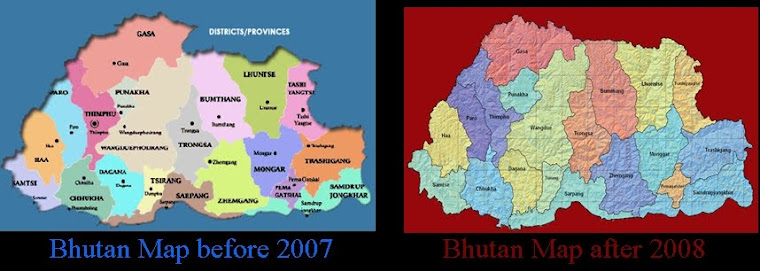
Click over the map to know the differences
Tuesday, November 4, 2008

Dr Singh's visit to Bhutan
By Hari Prasad Adhikari
Dr Manmohan Singh is the second prime minister of India who visited Bhutan after the latter adopted a policy of ethnic cleansing. King Jigme Singye Wangchuk (KJSW) evicted over one hundred thousand people from southern Bhutan in the late 1980s. Since then, the king has denied the right of the refugees to return to their country because the KJSW still holds the power. He doesn't want to destroy his model.
Jigme Kheshar Namgyal Wangchuk is the incumbent king of Bhutan but his official coronation is yet to take place. In this regard, international recognition and India's support is very crucial. Perhaps, Dr Singh's visit may be taken as novel conscience for official recognition until the apology and promise for repatriation of the refugees does not come from the KJSW or his son -- Jigme Kheshar Namgyal Wangchuk.
Some 16 years ago, the late PV Narasimha Rao, the then prime minister of India, visited Bhutan to sign both phases of the memorandum of understanding (MOU) for the Tala Hydroelectric project ignoring the bitter truth of ongoing ethnic cleansing. This is the biggest ever project in Bhutan. It was constructed and completed during the period of ethnic cleansing. Both the visiting prime ministers are members of India's National Congress, which has always been vociferous against any sort of racial discrimination in the past elsewhere in the world.
Between 1992 and 2008, King Jigme Singe Wangchuk made several political dramas to conceal the current ethnic cleansing and despotism. He declared no confident motion against him without removing the provision of Tsa Wa Sum (the three main elements of Bhutan -- king, the country and people) in which no one was/ is allowed to act and speak against these elements where king's place was/ is on top priority. Failing at the first attempt, he then inducted a team of confidents into the Council of Ministers and ordered to vote in their favor in the National Assembly.
Amidst all such political drama, he appointed 11 prime ministers in less than ten years. Fortunately, Delhi neither invited them to visit India nor Indian premier visited Bhutan during this period which in turn exerted significant pressure on the Bhutanese monarch though several foreign ministers of India and army generals visited Thimphu to show India's keen interest of working with the king.
In this regard, statement of former minister of external affairs Kunwar Natwar Singh and present foreign minister Pranav Mukharjee's comments were remarkable. The former said the purpose of his visit to Bhutan was to strengthen the system of monarchy while the latter said, "when the size of Bhutanese refugees in the camps in Nepal will be reduced by resettling in Europe and America, then India will come forward to defuse the refugee crisis." Aren't these comments too awkward from the foreign ministers of the largest democracy?
Keeping Kunwar Natwar Singh's comment at the top, KJSW and his son's government are preparing to promulgate the constitution of Bhutan where the king and his family will be the supreme and their legitimacy will be unquestionable and stronger.
Furthermore, the constitution safeguards the interests of the king and his royal family. No citizen of Bhutan is free to speak his or her language, preserve culture, worship, and own property. In fact, an ethnic Nepali speaker cannot send his or her children to government schools without the consent of a local government official. Nor can an ethnic Nepali speaker run any sort of business in any part of Bhutan, let alone practice of religion or preservation of culture.
It creates different tiers of people through the provision of yellow, red, green and white Kabney (shawl) holders. And the ones at the top hardly come under the court and seek justice. Members of parliament are compelled to bow before the king and high ranking officials according to their rank of Kabney. The prime minister, chief justice, Chief Election Commissioner and speakers of both the houses are the channels who obey the order of the king and are mere devices to legalize the illegal work of their masters.
Analyzing the above fact, it is very sad to say that India's Chief Election Commissioner, including several officials who were invited to give feedback on the draft constitution of Bhutan, were not successful to remove such discriminatory provisions where the king and his stooges are above the constitution.
However, it is worth mentioning that the political document was presented officially to Dr Manmohan Singh and Dr APJ Abdul Kalam by the king of Bhutan before bringing to its present shape. Unfortunately, feedback of these two novel personalities is yet to be known. Can Dr Singh come forward openly in favor of real democracy? Did he advise the king to correct the document so that it becomes acceptable to all ethnic groups? Is Dr Singh bold enough to speak out the truth so that the Druk dictator removes the discriminatory provisions in the constitution?
If not, the same constitution will be enforced under the leadership of new King Jigme Kheshar Namgyal Wangchuk in the upper house without addressing the root-cause of Bhutanese political crises such as absence of real democracy and human rights along with the restitution of properties of political victims and the repatriation of Bhutanese refugees and release of prisoners of conscience.
In addition, prohibition of 150 thousand Bhutanese to return their country is the subject of international concern.
Although Dr Singh spoke nothing about the plight of the refugees, let us hope Dr Singh understands the stark reality and corrects the past mistake of not supporting the demand of democratic reform in Bhutan. Last but not the least, if the Indian prime minister fails to notice the racial discriminatory against the ethnic minority in Bhutan, then India's prestige of regional power also needs to be questioned.
Obviously, it fits every conscience to think that American and European parliaments from overseas have already taken decisive steps. The third country settlement plan suggests that Europe and America are keen to resolve the regional problems as democratic India has failed to act.
(The writer is former National Assembly member of Bhutan)
Nepalese Minority Skeptical of Bhutan’s Democracy
Monday, 26 May 2008, 11:31 am
Column: Adam C Castillo
Bhutan’s Nepalese Minority Skeptical of Country’s Democracy
By Adam C. Castillo
21 May 2008: Bhutan, the last Shangri-La, and until recently a bastion of monarchical fidelity, to everyone’s surprise held the nations first elections earlier this year ushering in a new era of democracy. This development comes as a shock because it was not the will of the people that agitated such a change but a royal edict made by the King himself. The Bhutanese, who hold their royalty in enlightened esteem, have in fact been skeptical of this whole process of democratization. The election’s 80% turnout may be attributed not to the people’s enthusiasm for change but rather to their filial obedience to royal dictates, which ironically in this case has effectually, if only superficially, limited the power of the crown in which they trust so much.
It was in 2005 that then King, Jigme Singye Wangchuck, announced that he would abdicate the throne to his son, the crown prince Jigme Khesar Namgyal Wangchuck, and that popular elections to select members of a new bicameral legislative body would take place in 2008. The elections for the National Council (upper house) and National Assembly (lower house) were held on December 31-January 1 and March 24, 2008 respectively. Despite the region’s bloody struggles for democracy as seen in Pakistan, Nepal, and Myanmar, Bhutan’s transition went quite smoothly, however not without incident.
On January 20, bomb blasts went off in the capital city of Thimphu and three other locations around the country. The United Revolutionary Front of Bhutan, a Maoist guerilla group based in southern Bhutan with ties to similar groups in Nepal claimed responsibility for the bombings. Though no lives were lost in any of the four incidents, the URFB hoped to send a clear message that the new democratic process in Bhutan is in fact tainted and anything but inclusionary.
An estimated 82,000 people, or around 12% of the population, most of whom ethnic Nepalis, were excluded from the 2008 elections due to their status as “non-nationals” according a 2005 national census. An even greater number, over 100,000 Lhotshampas, the Nepalese minority living mainly in Bhutan’s south, were physically expelled or forced to flee the country in the early 1990’s and live today as stateless refugees in seven UNHCR-sponsored camps in eastern Nepal. These factors along with the barring of a third party from participating in the recent elections have brought into question the viability of Bhutan’s commitment to pluralism, an integral part of any inclusionary democratic system.
Bhutan is split into two distinct regions both geographically and culturally. The north is the traditional Buddhist kingdom of our imaginations tucked into the glacial wilderness of the Himalayas. In the south are subtropical lowlands once thought to be uninhabitable due to the region’s vulnerability to choleric and malarial outbreaks. Eventually migrants from neighboring, largely Hindu countries, including a large number from Nepal, came to populate this southern portion of Bhutan.
For hundreds of years the country’s Lhotshampa population coexisted in relative peace with Bhutan’s dominant Drukpa population and remained largely autonomous. The Lhotshampas managed to retain their strikingly different Nepalese culture, language, and religious traditions.
Despite being in a region clamoring for democracy in the wake of India’s political evolution, Bhutan’s monarchy remained intact and unthreatened by outside influences. It was not until the 1970’s that the growing Lhotshampa population became an immediate concern to Bhutan’s ruling elite. They hoped to avoid the fate of neighboring Sikkim, whose monarch was ousted in 1975 by a Nepalese majority in a plebiscite, which made Sikkim an Indian state. By 1980, the number of Lhotshampa in Bhutan was estimated at near 30% of the country’s total population. Revolutionary rhetoric was rife in the region at the time and the Bhutanese government feared an influx of dissonant ideals pertaining to political restructuring, ideals gaining popularity amongst Nepalese populations in the region.
This outside influence began to show itself in the form of demonstrations organized by Lhotshampas calling for democracy in Bhutan. To counter this threat and to bolster Bhutanese cultural solidarity, legislation was passed in 1985 that called for a “one nation, one people” campaign which aimed to standardize the structure of society and cleanse it of any foreign interference. Mandates were made enforcing a strict national dress code of traditional Drukpa garb. Nepali language was banned in schools and public areas and Lhotshampas, traditionally Hindu, were ordered to adopt the official state religion of Vajrayana Buddhism. Television was banned, internal travel was regulated and the little foreign trade that existed at the time was curtailed.
In 1989, new criteria for citizenship was enforced which excluded anyone who could not prove their being a resident of Bhutan prior to 1958, a stipulation made almost impossible considering the pervasive illiteracy among Lhotshampa populations and that few had thought to register their residency with government agencies. The new laws stripped nearly one-sixth of Bhutan’s population of its citizenship. Massive protests and violent clashes between Lhotshampas and Drukpas ensued.
The government’s crackdown was swift and severe. Bhutanese security forces began the process of expelling non-citizens, making them first renounce their homes and homeland and systematically escorting them across Bhutan’s borders. Those who were not forcibly expelled were pressured to flee under threats of arrest and further harassment. The exodus into Nepal continued until the mid nineties.
Per-capita, it remains the world’s largest refugee displacement. After 16 years and 15 rounds of bilateral talks between Bhutan and Nepal not one refugee has had their citizenship reinstated or been let to reenter the country. The United States has recently offered to resettle 60,000 of the refugees in the coming years. Those willing to accept such a compromise face harassment and intimidation from other refugees in the camps who demand nothing less than a plan for comprehensive repatriation back to their homes in Bhutan. The recent elections, having propelled the country into a new era of democracy without the participation of a, what once was, sizable portion of the population speaks volumes about the state of limbo in which these refugees exist and to the bleakness of their prospects to ever get back to their homes where so much has changed without them.
*************
www.bhootan.org attemps to reach out to as many people as possible and provide information on Bhutan.
Refugees adjusting to new life in US
By DEEPAK ADHIKARI
PITTSBURGH, USA, April 30 - For 17 years, the Odari family was among more than 107,000 Bhutanese refugees in camps scattered over the southeastern plains of Nepal, hoping to return to their rightful place: Bhutan.
The nine-member family shared a small hut with thatched roof and dirt floor with no electricity, running water, toilet or kitchen. They lived on sparse rations of rice, lentils, vegetables, salt, sugar and oil distributed twice a month by United Nations agencies, but the food was never enough to fill their hungry bellies.
Then on April 9, three members of the Odari family arrived in Pittsburgh to start a new life.
"We were having a tough time in the refugee camp. We're happy to be here," said a beaming Man Maya, 25, who is living with her younger sister, Yani Maya, 22, and brother, Dilli Prasad, 20, in an apartment at Prospect Park in Whitehall.
Last night, their elderly parents, two more brothers -- one 24 and disabled and another 17, and two other sisters, 21 and 25, were expected to arrive here to join them.
The family's relocation is being assisted by Catholic Charities of the Diocese of Pittsburgh.
Man Maya was only 9 when she was forced to leave Bhutan with her parents and other family members. They were among the 120,000 Nepali-speaking Bhutanese -- mostly Hindu and Buddhist -- who were evicted from Bhutan in the late 1980s and early '90s when the Bhutanese rulers forced them to wear traditional dress, required that they speak the Dzongkha language and deprived many of citizenship. Protests against the stringent rules resulted in the mass exodus of tens of thousands to neighboring India.
India, in turn, forced most of them to enter Nepal, which does not share a border with Bhutan.
The Odaris lived in a Beldangi refugee camp -- one of seven camps run by the United Nations High Commissioner for Refugees (UNHCR). In some camps, many children died from the lack of health care and the scorching climate in the plains.
"At times, there were 14 funerals a day," said Kishor Pradhan, a board member at Association of Bhutanese in America. Mr. Pradhan, who has been living north of Pittsburgh in New Castle for nine months, sought refugee status in the United States three years ago.
The United States has offered to resettle 60,000 of the 107,000 of the refugees. Six other countries -- Australia, Canada, Norway, the Netherlands, New Zealand and Denmark -- have offered to resettle the rest.
"After 17 years of suffering, the day has come for the Bhutanese to start fresh," said Mr. Pradhan, a senior quality analyst at Coventry Healthcare in Cranberry. "There is now a ray of hope for the refugees because numerous attempts to repatriate to Bhutan have failed."
The International Organization for Migration is screening and transporting the refugees. The United States plans to resettle 10,000 by the end of 2008, many going to New York, Maryland, Arizona, Missouri, Illinois and other places.
Dilli Prasad Odari said all of his family decided to resettle in the United States. "In camps we had to rely on UNHCR for our daily needs. But here we can live on our own, and it's also good for future generation," he said. Some of his other relatives have been resettled in Texas.
The family is gradually becoming accustomed to their new surroundings in the Whitehall area in the South Hills.
They are taking English classes in the mornings. They received health screenings shortly after their arrival. They also received food assistance to shop at Wal-Mart.
Even though he's 20, Mr. Odari last attended 10th grade in the refugee camp and hopes to further his education here. He likes to compare Pittsburgh with Ilam, a city in the eastern highland of Nepal that has similar topography. A lover of Nepali music, he has brought a collection of the Nepali lyrics. "But I'm dying to listen Nepali songs," he said.
Man Maya, a high school graduate, said it's hard to keep connected with her loved ones across the ocean. "It's hard to make phone calls to Nepal," she said.
Yani Maya is a little worried about finding work. "I hope we'll be able to work after four months," she said.
"They seem happy and are feeling good about being here," said John Miller, director of refugee services for Catholic Charities. His organization is resettling a total of 170 refugees in 2008.
Catholic Charities also provides core services such as applying for Social Security cards, medical screening, enrollment in English language training, employment counseling and orientation to the refugees. According to Mr. Miller, Catholic Charities provides its services for five years after they arrive. Catholic Charities in Pittsburgh also has helped resettle Vietnamese, Burmese, Sudanese, Somalian, Burundian, Iraqi, Meskhetian Turks (from the former Soviet Union) and Haitian refugees.
"Each refugee group has a different set of challenges," Mr. Miller said. "They have struggles but they also have emotional and psychological issues."
Mr. Odari hopes more Bhutanese will be resettled in Pittsburgh. "It feels good to be here but I'm also missing my friends in Nepal," he said, adding that he is developing friendships with young Burmese refugees in the neighborhood.
He's learning the bus routes of the city and has learned how to follow maps to visit places.
On a recent afternoon, when he saw a deer in the nearby woods, he was thrilled.
Eventually he hopes to return for a visit to Nepal to see the place where he said he has spent "some of the hardest times of my life."
Courtesy : Pittsburgh Post-Gazette
Refugees are in a state of flux
By Narayan Sharma
The Bhutanese refugees, stranded in one of the most protracted-refugee situations, have finally opted for the Third-Country Settlement (TCS) in large numbers. The fight for repatriation for the last 17 years has been inconsequential insofar as that has borne them no return whatsoever.
A three-dimensional approach involving a sincere commitment on the part of the Druk regime, a cogent and a coherent refugee policy on the part of Nepal and an active participatory role of the international community, including India, would have been a way out towards locating a comprehensive durable solution. With none in track, refugees have opted for the third country resettlement plan.
The 17 years of ordeal have witnessed a phenomenal change: The refugees have been classified into 4 categories by Nepal and Bhutan, in their perusal of bilateralism. Bhutan had its goal defined: to preempt the possible return of refugees. And politics of classification was actually a strategic move towards that end. What coerced the then democratic Nepal to grant legitimacy to Bhutan’s ploy is unknown. It has benefited Nepal in no way. One of the bizarre outcomes of classification has been to brand thousands of innocent refugees terrorists. They include many children below 10 years of age!
Back in Bhutan, a constitution was drafted and subsequently “endorsed” by the citizenry. While Bhutan observers were busy lauding the commitment to democracy of the fourth king, over 1/6 citizens were losing their right to return. The international community ignored the clandestine agenda of the king perpetrated through the constitution in the garb of democratizing the Bhutanese polity.
Bhutan’s constitution remains a bizarre exclusionary document, framed with criminal intent of de-Bhutanizing the refugees in particular and excluding the southern Bhutanese from the mainstream political process in general. How could one explain the exclusion of a third political party formed in Bhutan, the exclusion of over 80,000 southern Bhutanese from the electoral roll in the recently concluded elections, let alone excluding the refugees and the political parties in exile?
A new “democratic” government is in place in Bhutan, led by staunch royalist Jigme Y Thinley, an infamous refugee bully. Refugees’ hope of return has been lessened presently as the Druk regime has now the possibility to further procrastinate the issue with the new-found alibi of people’s representatives needing to decide the issue.
The host Nepal has witnessed the most phenomenal changes, with the Maoists inching towards making the next government. They have, inter alia, the challenge of defining the Bhutan policy vis-à-vis the refugee issue. Their ideological tilt might warrant them forestall the process of TCS, but will that be a politically expedient course for them to adopt, when the United States and other core countries, including a number of international organizations, have invested quite heavily in the process? It is time the Maoists defined their refugee policy.
A solution to any refugee problem involves certain essentialities. It needs to balance the right of people to return on the one hand and respect their informed decision on the other. A voluntary and informed decision is possible only when all the options available are availed of. The TCS offer presently underway is being exercised sans other options, namely local integration and repatriation. This is explanatory of the possibility that refugees might be opting for TCS owing more to push factors like, augmenting frustration in the protracted refugee situation, insecurity of life, depleting assistance, amongst others, than available pull factors.
It is to be remembered that 2007 was a tumultuous year in the life of the refugees. They lost quite a few lives to the bullets of Indian security forces during the course of their peace march to Bhutan. The year also witnessed an increased animosity between the refugees wishing to opt for TCS and those championing for repatriation, especially under the aegis of the newly formed leftist forces in exile.
The credit of all stakeholders that the security situation in the camps have been efficiently taken care of and one ardently hopes that the Maoist government ensures the wellbeing and security of all the refugees in and outside the camps.
The impacts of emergence of a new government in Nepal are yet to be felt vis-à-vis the Bhutanese refugees. Some issues of critical concern emerge. And it is on the new dispensation in Nepal to appropriately address them.
Will the Maoists reverse the refugee policy adopted by the outgoing government? If so, that would mean forestalling the TCS process underway which however is fraught with the propensity of generating greater catastrophe and in turn discrediting the Maoists. Together with the agenda of New Nepal, the new government has an important role to play in taking the Bhutanese refugee situation to an acceptable, logical conclusion. Will not the change in host Nepal embolden their ideological Bhutanese brethren who might push through their own agenda more vociferously against the wishes of many who would wish to settle abroad? What policy would the Maoists adopt in case of such an eventuality?
A comprehensive solution package for the refugees should break the refugee deadlock. While continuing with the TCR process, efforts towards enabling a dignified repatriation of all the willing refugees should be initiated. That tests the diplomatic skills of the new dispensation as the process entails dealing with an escapist New Delhi and a hawkish Bhutanese prime minister whose refugee approach has been outrageous all through.
ruleoflaws@gmail.com
Refugees warn of Bhutan's new tide of ethnic expulsions

Refugees warn of Bhutan's new tide of ethnic expulsionsHimalayan kingdom's Shangri-la image is a myth, says tortured activistEd Douglas in Katmandu The Observer, Sunday April 20 2008 Article history
A Bhutanese refugee looks from a bamboo hut in the Ti Mai camp, Nepal. Photograph: Desmond Boylan/Reuters
The small Himalayan kingdom of Bhutan is hailed as the last Shangri-la in a region plagued by conflict and poverty. Attracted by its policy of Gross National Happiness, Western media have held up the country's apparently peaceful transition to democracy as a model of wise governance by a Buddhist regime protecting its culture from the ravages of consumerism.
But behind its facade of otherworldly charm, Bhutan holds a secret. Twenty years ago, its monarchy, threatened by an increase in Bhutan's ethnic Nepalese population, hit on a simple solution: ethnic cleansing. Families who had been living in Bhutan for generations were stripped of their citizenship. One hundred thousand Hindu Bhutanese - around one sixth of the country's entire population - were driven into exile and their land redistributed among the Drukpas, Bhutan's Buddhist elite.
Now a combination of divisions among the refugees, renewed tension inside Bhutan and the surprise election victory by Maoists in Nepal, is threatening a plan that finally gives hope to 107,000 refugees who have been languishing in camps in eastern Nepal for the last 17 years. Tens of thousands of unregistered refugees are living stateless and in abject poverty in Nepal and India.
There are also fears among exiled Bhutanese leaders that a new wave of expulsions from the remaining ethnic Nepalese population, called Lhotshampas, is imminent. 'The process is happening already,' said Ratan Gazmere, a leading human rights activist and a refugee himself. 'But I cannot convince the international community of that.'
Gazmere, who was tortured and jailed for two years in the capital Thimpu, said widespread discrimination continues inside the country.
Lhotshampas are denied education and in the last census, held in 2005, around 13 per cent of the whole population of Bhutan, most of them Nepalese, were classified as 'non-nationals'. As a result, 82,000 Bhutanese were denied a vote in last month's first-ever general election. Non-nationals, lacking an identity card, are not allowed freedom of movement or to start a business.
Paradoxically, it is a potential solution to the crisis that seems to have tipped the Lhotshampa community into fresh uncertainty. In 2006, with the international community facing an apparently endless bill for maintaining the refugee camps, an agreement was reached whereby some refugees would be resettled in the West while others would stay in Nepal and pressure would be brought on the Bhutanese government to allow others to return.
The US assistant secretary of state Ellen Sauerbrey said her country would offer citizenship to 60,000 of the refugees. Other countries, including Canada, have stepped in with similar offers.
With the prospect of around half of the refugees leaving the camps, leaders fear pressure on Bhutan to allow the rest home will evaporate. Put simply, they say, the government of Bhutan will be rewarded for its ethnic cleansing.
Extremists in the camps, including a new Maoist organisation, have allegedly threatened refugees not to apply to leave for the US. Gazmere echoes human rights groups who say refugees must be allowed to make up their own minds. 'My concern is that the refugees should not suffer more than they already have,' he said.
Disaffected young Lhotshampas who have grown up in the camps or suffered discrimination in southern Bhutan are turning to violence. Several bombs exploded in Bhutan in January, including one in Thimpu. Although no one was killed, the escalation resulted in Bhutanese security forces shooting dead five men they described as Maoists.
Now Bhutanese leaders in exile are adjusting to the prospect of a Maoist government in Katmandu that may not welcome what it regards as American interference in the region. The US still classifies the Maoists as a terrorist organisation.
'The Maoists will try to destabilise the resettlement process,' said Gazmere, 'because Americans are involved.' Other Bhutanese leaders disagreed, arguing that Maoist leaders in Nepal have warned them not to expect support.
The question remains how Bhutan got away with such a large-scale expulsion of its own citizens. A recent report by the Norwegian Refugee Council blames the world's media for helping 'perpetuate the myth of an exotic land of happiness. However, what we have before us is a silent tragedy occurring in a media-created Shangri-la.'
Ratan Gazmere said Bhutan's close relationship with India was critical. India had shielded Bhutan in return for access to hydro-power and timber.The Bhutanese had shut down camps in the south hat were used by the United Liberation Front of Assam to launch attacks across the border. 'India doesn't want to push Bhutan too hard,' Gazmere said.
Bhutani refugees
Editorial in Samaya, 30 June
World Refugee Day came and went this week, and it was just a formality. For the 100,000 plus Bhutani refugees who have been living in camps for the past 14 years in Jhapa and Morang there is no hope of any positive developments this year.
The UNHCR which has been trying to get the refugees repatriated to Bhutan or assimilated in the host country Nepal is now also working on third country resettlement. For the refugees, this can be a good option but not the best one. The UNHCR blames mainly Nepal for opposing resettlement in third countries. Nepal's position is that Bhutan needs to take back some of its people as per the bilateral agreement. The Bhutani refugee leadership agrees with this.
Obviously, the issue of refugees is closely linked to the protection of human rights and democracy in Bhutan. A royal dictatorship can perhaps heap injustices on a minority for some time. But ultimately the people will be victorious, and this has been proven by the recent events in the refugees' host country. Unfortunately, the lack of an organised pro-democracy movement has bolstered the harsh crackdowns by the Bhutani regime. Neighbouring democratic country India and the UN have been indirectly helping the anti-human rights and anti-democratic crackdowns by the Bhutani king against his own minority peoples.
It may appear to be in the short-term interest of some of the refugees, especially women and children, to be resettled in third countries. But to be forever torn apart from their country, community, culture and families can only be a last resort. It is important to restart the bilateral ministerial-level talks between Nepal and Bhutan to resolve the issue. Nepal must also remind New Delhi that its neutrality has helped the Bhutan king to continue with his activities against the refugees. Such repressive behaviour will be a challenge in efforts to fight terrorism in South Asia. It is also a test for King Jigme who seems to want to devolve his power and usher in democracy. He must remember that democracy isn't possible by violating the basic human rights of his minority population. That will just set back democracy.
Bhutan, Sikkim journos sign accord
BY UPENDRA POKHREL
GANTOK, SIKKIM (India), June 22 - With a view to exerting pressures for the repatriation of Bhutanese refugees, Bhutan Press Union (BPU) and Press Club of Sikkim signed an agreement, Thursday.
As per the four-point agreement, they would also raise issues for establishing democracy and press freedom in Bhutan. According to Hari Khanal, advisor of BPU, journalists in both the countries would carry news reports on the Bhutanese refugees on a regular basis.
"As we felt that cooperation of the people of north-east India for the solution of Bhutanese refugees' problems was necessary, we have reached this agreement to publicize the refugee-related issues in these areas," said he.
The Press Club of Sikkim also agreed to invite BPU reporters and send representatives for exchanging information. The tabloids in Sikkim would also cover news
and opinion on refugee issues. A team of reporters is also scheduled to visit the refugee camps.
Repatriate refugees
Bhutan holding India's hand has flatly refused to take back the verified refugees of Khudunabari camp. Thimpu still claims that the evicted refugees are not bonafide Bhutanese nationals despite being the victims of ethnic cleansing. This, obviously, is a slap on the face of the international community, especially the United Nations High Commissioner for Refugees (UNHCR) which should have taken strong stand on the repatriation of the verified refugees. It, instead, is advocating the third country settlement. In fact India and some European countries, which are advocating pluralism, democracy and human rights in third world countries, have backed the development projects in Bhutan, overlooking the refugee impasse. India says it is a bilateral matter though the refugees entered Nepal via India's chicken neck corridor. No matter how it deems the refugee impasse, India cannot ignore its responsibility citing it a bilateral matter. The international community knows it well that India has sided with Bhutan on the repatriation process.
The double stand adopted by India and some Western countries on the refugee right to return to their country illustrates that the so-called democratic countries are protecting the tinpot dictator. Such stand apparently encourages Bhutan to evict more people. Bhutan would have taken back all the refugees had Delhi asked the tinpot dictator to do so. Similarly, Switzerland, Denmark and other Nordic countries should have exerted pressure on the dictator to take back the refugees. But these countries continue to back the development projects in that country. The Bhutanese dictator has drafted the constitution without seeking any refugee consent. Has there been any dictator who has drafted a democratic constitution that met the people's aspirations? If Jigme Singye Wangchuck is a benevolent dictator, then why does he hesitate to take back his people?
The royal fossil Nagendra Bikram Shah handpicked by the royal regime as foreign minister committed another blunder. He deceived the one hundred thousand refugees instead of helping them repatriate to their homeland. The royal fossil agreed on the Bhutanese proposal --- the host country would initiate a process of assimilation. The 14 rounds of ministerial level bilateral talks produced no tangible result on the repartition process. What it did was that it stalled the bilateral talks and the verification team proved what the tinpot dictator was lying to the international community. Until the verification of Khudunabari camp, the dictator had claimed the people languishing at UNHCR-sponsored camps were not bona-fide refugees. The December 22 incident that led to pelting of stones at Bhutan's Joint Verification Team took place after the team used abusive language and strict conditions for the refugees. Such incident should not have delayed the refugee repatriation. Now India must understand this and help the refugees return to their homeland. The UNHCR should also respect what the refugees wish, and not what it wants.
Subscribe to:
Posts (Atom)