How does it sound when we hear that political prisoners inside jails are mentally tortured with the help of mind control devices? But this is a fact-based saga in the tiny Himalayan kingdom of Bhutan. Senior human rights leader Tek Nath Rizal is one among the many unknown political prisoners who have suffered brutal torture inflicted by this banned device. From a medical point of view, mind control devices have a direct and bad impact on the brain. Rizal says that one who has been subjected to this gadget will at once become nervous. Other kinds of physical torture will not be felt until consciousness is regained.
The book entitled Bhutan: Hijo Ra Aaja by Balaram Poudel, president of the Bhutan People's Party (BPP), also provides a good illustration of how cruel Bhutanese jails are. It is stated in Poudel's book that before 1992, the Bhutanese authorities stressed inflicting physical punishment on prisoners. According to this book, Dharma Raj Gurung and Padam Dhakal from Dagana district died in jail due to excessive physical torture in 1991. It adds that the whereabouts of Dhakal’s dead body is still unknown.
Not only this, the accurate figure of those who died in jail due to extreme physical torture before and after 1991 has never been made public. In comparison to the early 1990s, the Bhutanese authorities now opt for giving mental instead of physical punishment to political prisoners. This is an attention-grabbing concern as mental punishment has a long-term impact on the sufferer.
We can take yet another example of the saga of a political prisoner in a Bhutanese jail. On Nov. 1, the Druk authorities released Dhan Kumar Rai, 45, founding general secretary of the BPP and an outstanding Bhutanese personality, after 17 years of rigorous imprisonment. Rai says he was kept in solitary confinement for one year.
Rai, generally referred to as the Bhutanese Mandela, is now in Kathmandu for medical treatment for the excessive mental torture he suffered. Rai claims he was mentally tortured in jail for more than a decade. Arrested at Todey in Darjeeling, India on Nov. 17, 1991, he was later handed over to Bhutanese police on the fake charge of being involved in anti-national campaigns. He now suffers from a psychiatric problem due to extreme mental torture.
Many Druk prisoners who have been released say that the most painful physical punishment they faced was having the tips of the fingers pricked with needles.
They also had stones suspended by strings to their private parts. This kind of physical torture is very common in Bhutanese jails.
Hundreds of political prisoners are still believed to be languishing in Bhutanese jails, and their latest status has never been made public. Here arise some significant questions. Where are the international human rights bodies? What is the international community doing to protect the rights of prisoners in Bhutanese jails? Where are the so-called international advocacy groups? How long will India, the world's biggest democracy, remain a mute spectator to the ongoing atrocities in Bhutan? What are those countries that hailed the so-called democratic practice in Bhutan doing? Have the jails in Bhutan ever been visited by any international rights group? These questions still remain unanswered.
However, the role of the International Red Cross Society (ICRC) is worth mentioning here. The ICRC has been actively campaigning for the release of political prisoners in Bhutanese jails. Rai admits that he was released thanks to the heavy and constant pressure the ICRC put on the Druk authorities. But the endeavours of the ICRC alone is not enough to discourage the atrocities being committed in Bhutanese jails.
Bhutan's repeated claims that it has already embarked on a democratic path are nothing but a ploy to hoodwink the international community. There is no independent judiciary in the country, and a fair trial is always doubtful. The fact that Rai was imprisoned for almost 17 years without any justifiable reason serves as a good example.
“Silent state terrorism” still prevails in this tiny kingdom. Freedom of speech is completely restricted. People cannot speak against the government or the monarchy, the so-called supreme institution. The international community should not be duped by Bhutan's illogical concept of having Gross National Happiness in the country. It should always read between the lines of Bhutan's tricky statements.
(The author is editor of the Bhutan News Service and head of the Bhutan Chapter of Dhaka-based Third World Media Network.)
mishratp@gmail.com
The Sorry Saga of Bhutan's North
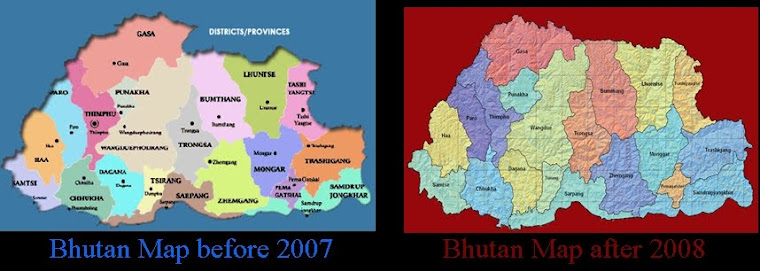
Click over the map to know the differences
Monday, December 22, 2008

All In The Family P. Kharel
in the eve of King Jigme Kheshar Namgyal’s coronation earlier this month, the French news agency, AFP, put out a story datelined Thimpu: "The isolated Himalayan kingdom of Bhutan is to crown its new ruler, with an Oxford-educated bachelor ascending as head of state of the world’s newest democracy." Home to 600,000 people and wedged in remote hills between India and China, Bhutan held its first "democratic" elections for a new parliament and prime minister in March.
Jigme Singhe Wangchuck abdicated two years ago to pave the way for the crowning of the eldest of his five sons and five daughters born to the four sisters he had married over the years. In 1989, he announced his nine-year old son, Keshar, as crown prince, much to the surprise of the rest of the world, including the international media that had been describing the absolute monarch as a bachelor. Such background of Thimpu’s royalty causes some sections to exercise caution in mentioning the marital status of the 28-year-old Keshar.
Systematic suppression
The Bhutanese people were aware of Jigme’s wives and children but so terrified were they of incurring the royal wrath that they maintained an absolute silence. Eventually, the palace, through its embassy in New Delhi, announced to the world that Jigme, till then projected as a highly eligible bachelor, had declared Keshar as his crown prince. The media quoted official sources that the much-married monarch and father of several children had only followed "Bhutan’s way" of announcing marriage and crown prince.
Jigme wielded absolute power. So does his son, except for cosmetic changes in the political structure. The country did not have a formal constitution till recently. Some in the media are dubbing the mere drafting of a constitution and the subsequent elections for parliament democratic exercises. In reality, power is concentrated in the Wangchuck family. Tens of thousands of ethnic Nepalese were delisted or not included at all in the voters’ list for the so-called democratic exercise in March. The majority of members in the legislature have direct ties to the Wangchuck family and its relatives.
Nepalese till the 1980s constituted the largest ethnic grouping representing more than 40 per cent of the country’s population. Nepali language was the lingua franca for Bhutanese in general. But Bhutan’s royals threw out 100,000 Nepalese in the early 1990s during a state-sponsored campaign to impose compulsory national dress and ban the Nepalese language.
The remaining members of this community have been relentless victims of systematic suppression ever since. They are held in high suspicion and deprived of opportunities in government service and other positions of power or lucrative salaries. Obtaining licences for setting up an industry or a major business establishment is an extremely uphill task. Palace nod is required for anything involving financial transaction. Little wonder that the BPP leader Rizal recently described governance in his country as "a family affair".
Driglam Namzha, a royal edict, makes it mandatory for all residents in Bhutan to wear the Druk dress for both men and women. Those not complying are fined, arrested and even tortured. Dashain and Tihar, the two major festivals of Hindus, are not allowed to be celebrated openly. Tens of thousands of ethnic Nepalese have been systematically denied citizenship certificates. Human rights leader Dhan Bahadur Rai, founding general secretary of Bhutan People’s Party (BPP), has been in jail since the last 17 years.
Tek Nath Rizal, now in exile in Nepal, was abducted from Nepal in 1989 and jailed in Bhutan. On November 16, 1989, a Druk aircraft landed at Kathmandu’s Tribhuvan International Airport. The next day Rizal was abducted from Biratnagar and brought to Kathmandu to be dumped into the awaiting Druk aircraft. He was immediately kicked and thrashed by Bhutan’s three senior officials - Vechho Namgey, ADC to King Jigme; Khando Wangcu, a deputy director and son-in-law of the then Bhutanese Tourism Minister; and Gop Wangchhe, royal advisor. The three who abused Rizal were all promoted for the "fine job" they rendered. In a judicial farce, the Bhutanese court declared him guilty of sedition. So absurd was the verdict that the resultant embarrassment compelled the royal regime to eventually give an early release.
Nothing can be said or written against the absolute monarch and his family. The very international media that expressed great concern over the reported killings of a couple of hundred Chinese in Beijing during the Tiananmen Square crisis chose to ignore the fact that the Druk regime killed over 500 people in the autumn of 1990. The ferocity with which Bhutan’s main thoroughfares were turned into killing fields and the manner in which the media largely ignored the gruesome act became conspicuous when they gave wide coverage to Bangladesh as President H.M. Ershad was compelled to pull back the army after 70 persons participating in demonstration against his rule were killed, and he resigned not long after in 1990.
Secretive
The secretive nature of the Druk regime is underscored by its earlier stand that the country’s population stood at 1.3 million. The opposition claimed it to be less than half of that. The cat was out during the protest campaign in 1990, and today the population is placed officially at 600,000. But there are fears that at least 100,000 ethnic Nepalese are not included as Bhutanese nationals. Another 100,000 in the refugee camps in Nepal are also delisted.
In a country where only the state-run newspaper is in circulation, the royal regime arrests people for reading foreign newspapers, especially those originating in Nepal. Ethnic Nepalese are frequently termed "foreigners", "anti-nationals", "terrorists" or "economic refugees". Nepalese began settling in the area in the seventh century and in large numbers since the 17th century as against the fact that the Wangchuk dynasty was established only five generations ago.
The Oxford-educated Keshar would do well to realise before it is too late that serious trouble might be brewing against his regime, what with reports of rebel groups in India training some Bhutanese youths for an armed movement in Bhutan.
To crown it all HARI PRASAD ADHIKARI
Jigme Kheshar Namgyal Wangchuk (JKNW) was declared king of Bhutan on Dec. 14, 2007. Although an official coronation has not been held, he has taken full charge of the kingship, and begun taking action like revising the so-called Indo-Bhutan friendship treaty of February 2007. He then approved Bhutan's constitution written by his father and company that discriminates against Bhutanese on the basis of ethnicity, language, class, political beliefs and loyalty to the king. He also constituted a government under the leadership of Jigme Y. Thinley who became president of the DPT through a controlled election. The present government is only a mouthpiece of the king that legitimizes autocracy in the name of democracy.
Interestingly, he also succeeded in constituting an “opposition party”, which, to quote an idiom, is like a monkey's tail which is neither useful as a stick nor as a weapon. The president of this party, Sange Nidup, and 44 other candidates were scapegoats who were sent to lose in the so-called impartial election to the parliament. After accomplishing the above groundwork to ruin democracy, JKNW is all set for his official coronation scheduled to be celebrated in the Bhutanese capital from Dec. 6-12, 2008.
Representing the Government of India, President Prativa Patil, along with Foreign Minister Pranav Mukharjee, will be present to witness the crowning. All the ambassadors of countries with which Bhutan has diplomatic relations have been invited to attend the ceremony. They include the U.S. ambassador who resides in New Delhi, envoys of the European Parliament and the representative of the United Nations Development Program.
This lavish coronation of the fifth king rests on a pile of government atrocities and looted properties of the citizens. The preceding government carried out the heinous act of evicting about 150,000 Bhutanese citizens between 1988 and 1992, mainly from southern and eastern Bhutan. The government of JKNW is trying to feign ignorance of the expulsion of such a large number of people. And it has not made any attempts to express remorse by giving an assurance of guaranteeing justice to the exiles. Neither is it showing any signs of vacating the properties of evicted Bhutanese which have been given to the king's supporters to occupy.
The ambassadors who are attending the coronation are obviously aware of the above facts, as their governments have been donating money to the U.N. High Commissioner for Refugee to feed the refugees who have been living in camps in Nepal. They have also been helping to relocate these refugees to the U.S.A. and other countries. These foreign envoys who will be attending the coronation to observe the pomp and pageantry could have insisted that they will attend on the condition that the Bhutanese government agree to take back the refugees and establish real democracy and human rights in Bhutan.
Trillions of ngultrums (equivalent to Indian rupees) have been expended for the great success of the coronation and recognition of the fifth monarch of the Wangchuk dynasty. Most people in Bhutan, except for the selected clans close to Wangchuk, are not happy with this expensive fanfare.
In conclusion, the people of Bhutan are under constant surveillance by commandos. Their movement is controlled by regulations that require people to possess a travel document and a new citizenship identity card. This has made travel almost impossible for children below the age of 16 years because they are not eligible to get a citizenship identity card according to the government's existing laws. The upcoming coronation, therefore, will not be a happy occasion for a majority of the Bhutanese people and the world at large as it makes a mockery of the agony of the population that has been forced out of the country.
(The writer is a former National Assembly member of Bhutan.)
Dealing With The Dragon Hari Prasad Adhikari
Today King Jigme Singye Wangchuk and his son’s government are busy concealing the despotic regime under the veil of professed democracy in Bhutan. King Jigme and his son’s government have triumphed in the first step by constituting a so-called democratic government of Bhutan with a 95% majority, backed fully by the Chief Election Commissioner Kunzang Wangdi. Along with this, it has constituted a National Council (upper house) and National Assembly (lower house). Surprisingly, Sangye Nidup’s political party, the People’s Democratic Party of Bhutan (PDP), has been made a scapegoat in this election drama.
Ethnic cleansing
In the upper house, King Jigme and his son’s government appointed so-called neutral persons for contesting the election individually from the respective districts, although it is clear that there received abundant blessing from the government to become winners in the Parliament by an absolute majority. All were erstwhile portfolio holders who were also instrumental in implementing the "Drukpa" (sub sect of the Kayukpa, a branch of Mahayana Buddhism) nationalism from 1985-2008, paving the way for ethnic cleansing in Bhutan.
The king and the government are tirelessly working to mask the ethnic cleansing in Bhutan. And in this endeavour, Home Minister and Prime Minister Jigme Y. Thinley has been elected for a second term to lead the newly elected government. Thinley has a history of serving the king’s government as zonal administrator of eastern Bhutan in 1990, Home Secretary, Foreign Minister and Ambassador to the UN. Other ministers in his team all were then ministers and bureaucrats who implemented the official ethnic cleansing policy. Among them, one was responsible for masterminding the kidnap of Tek Nath Rizal from his residence in exile at Birtamode, Nepal.
According to the present work division, Thinley’s team succeeded in getting the king’s written constitution approved and eye washed the people of Bhutan and the international community. This way, the king’s right has been restored all in all in the constitution as the three main elements of the kingdom, i.e., King, Constitution and Parliament (KCP). Interestingly, the life of this document and its legislative body is extremely vulnerable since the king can make it null and void by a simple letter. Therefore, the king and his coterie of relatives can easily obstruct issues of national interest whenever they feel like it.
Thinley’s team has accomplished the first phase of introducing veiled democracy and is now carrying out the second phase by campaigning it as a unique and the purest form of democracy. Thinley chose the Colombo SAARC summit as the first platform to disseminate this propaganda. Thereafter, he attended the 63rd session of the United Nations General Assembly to misguide the world. In the general assembly, he shamelessly said, "There was no voice for democracy from the public side in Bhutan, rather the king himself voluntarily surrendered his power in favour of his subjects." As if the UN is unaware of the Bhutanese’s refugee crisis!
Also, he contradicted the reports of the sub office of the United Nations High Commissioner for Human Rights in Geneva, the International Red Cross Society (ICRC), Amnesty International, State Department of the United States of America and many other human rights groups that have a record of the violation of democratic rights, citizen rights, ethnic rights and religious right.
Thinley is having a hard time proving his claim though, as recommendation of third country settlement of Bhutanese refugees is a strong evidence. Another one is the restriction of the UNHCR to enter Bhutan for monitoring the settlement programme (in case of repatriation after joint verification by a team of Bhutan and Nepal).
Thanks to the UN and American laws, both were unable to punish Thinley at the forum of this apex world assembly. Actually, Thinley was representing the government of Bhutan that evicted 100,000 people who are now compelled to relocate to places in the USA, Europe, Canada and Australia under the arrangement of the UNHCR. The recorded speech given by Thinley as head of the government of Bhutan to the 63rd general assembly of the UN is available. This evidence must be made the basis for enquiry of real democracy in Bhutan and for verification of the looted properties of its own citizens and the existence of racial discriminatory laws in the country. An enquiry must be made into the claim of the so-called democracy of Bhutan, and the king and his government must be held accountable if there have been violation of human and other rights in Bhutan.
Restrictions
It is now particularly easy for the governments of the United States, Australia and Canada to collect proof of the crimes committed by the government of Bhutan from the more than 4,000 victims who have already been relocated in these countries from the Bhutanese refugee camps in Nepal. Officials of the Bhutanese government must, therefore, be restricted from visiting the United States and other Western nations for private and official purposes.
(The author is a former National Assembly member of Bhutan)
We shall return to Bhutan BY HARI PRASAD ADHIKARI
The Bhutanese of Nepali and Sarchop origins did not come to Nepal to savour camp cuisine or to ask the international community to donate clothes and huts as the royal government of Bhutan has been accusing them of doing. They would not have been forced to live on handouts had they been permitted to live in peace in Bhutan. They had houses to reside in and enough land to till. They had jobs. They were making a good living in Bhutan. But they were evicted from their own houses and their jobs taken away by the royal government at the behest of King Jigme Singye Wangchuk (KJSW). The royal government confiscated everything they possessed including their Bhutanese citizenship. The harsh and racially discriminatory laws of 1985 superseded the 1958 citizenship law. The reason for such punishment being meted out to the Bhutanese of Nepali and Sarchop origins was their call for democracy in Bhutan.
Initially, the evicted Bhutanese obtained refuge in Assam and West Bengal for about two years. From there, the Bhutan People's Party (BPP) organized peaceful demonstrations in various sub-divisions and district headquarters. Between 1990 and 1992, tens of thousands of Bhutanese participated in the demonstrations to demand their political rights.
The BPP guided and provided logistic support for the demonstrations from Garganda, its headquarters in exile. The office was kept under constant surveillance by the West Bengal Police and intelligence agents of both the state and the central governments. On several occasions, the superintendent of police and the deputy commissioner of the district met the top leadership of the BPP and submitted its political demands to the king through the central government. The deputy commissioner of Jalpaiguri often participated in the meetings called by Bhutan's Home Ministry regarding the Bhutanese refugee crisis.
After having received asylum in India for two years, the Bhutanese were rounded up by the same Indian police force, packed into trucks and transported to the Nepal border where they were dumped at the Mechi Bridge in Jhapa. Suddenly finding itself confronted by thousands of Bhutanese refugees who were dying daily of diarrhoea and starvation at its doorstep, Nepal had no choice but to act to save them. Finally, Nepal invited the United Nations High Commissioner for Refugees (UNHCR) to intervene.
Since then, the Bhutanese refugees have been fighting for democracy in Bhutan. They have been trying to reach a political solution as the humanitarian assistance being provided in the UNHCR-administered camps cannot be taken as a permanent solution. The refugees held a bicycle rally to Phuentsoling Gate which marks the entry point into Bhutan. They also marched to Thimphu and staged a satyagraha. During these peaceful movements, thousands of refugees were jailed and many injured. A number of them died on the way to Bhutan. One was shot dead by West Bengal police at the Mechi Bridge.
Along with the public demonstrations, bilateral talks were held to allow the refugees to be repatriated with dignity and honour, but they got nowhere. Bhutan did not budge an inch. One of the reasons for not permitting the refugees to return to Bhutan was India's opposition to the process of repatriation and its tacit support of Bhutan's policy of ethnic cleansing.
The root cause of the Bhutanese refugee crisis was the plan crafted by King Jigme Singe Wangchuk and his henchmen to completely rid Bhutan of Nepali Bhutanese. Accordingly, the king imposed Drukpa dress and language code on the Nepali-speaking people. (Drukpa is a sub-sect of Kargyukpa of Mahayana Buddhism.) Subsequently, he asked them to produce documents to prove their nationality. Land tax receipts of 1958 were one of the documents demanded. Many could not produce this paperwork because they were born after 1958. A newly recruited militia under the direct command of the king was detailed to detain the disqualified people. The militia tortured them and raped the women. Men were murdered and their property looted. Many Bhutanese left for safer places to escape the terror. The leaders sought asylum in India and Nepal.
We had hoped that the Nepal government would mobilise support to speed up the repatriation process. But our hopes were shattered when Nepal accepted Bhutan's proposal to categorize the refugees. This was the original concept of KJSW. We thought there was a fresh chance when Nepal and Bhutan signed an agreement at the time Dr. Bhesh Bahadur Thapa was foreign minister. It was agreed that the refugees categorised as one, two and four were eligible for repatriation. Unfortunately, this plan too fell apart when the third country settlement plan was brought forward to crush the two-decade-long democratic movement. This brought disunity among the refugees who were divided into those supporting third country settlement and those advocating repatriation
Whatever be the situation now, we still hope that the Maoist-led government will push for the repatriation of Bhutanese refugees. Prime Minister Pushpa Kamal Dahal should meet Jigme Y. Thinley and press the case for repatriation. If Bhutan continues to insist on third country resettlement, Nepal should hold frank talks with India, China and the United States. India cannot side with the dictator and prevent thousands of people from returning to their country. The tyrant who has committed crimes should be tried in court. The fast changing political situations in Nepal and North Bengal, where Nepalis are demanding a separate state to be called Gorkhaland, have given some hope for the refugees. The Maoist-led government should make itself clear that it backs repatriation. Let India and Bhutan know that they cannot block the process of repatriation. Nepal must guarantee the right of return of every Bhutanese.
(The writer is a former National Assembly member of Bhutan.)
Not Thrilled By New Treaty Hari Prasad Adhikari
The fifth king of Bhutan, Jigme Kheshar Namgyal Wangchuk (KJKNW), is at the threshold of getting an official coronation. In all probability, on November 6 this year, he will be crowned, though he has been king of Bhutan since December 14, 2007. Before taking up the king’s charge, he clandestinely visited New Delhi to get the blessing from Delhi Durbar. He was accompanied by his maternal uncle Sangye Nidup, the then Agriculture Minister of Bhutan.
Self-reliance
Within a span of a few months, he again visited India officially to sign the so-called revised India-Bhutan Friendship Treaty of 2007. The Bhutanese people had been waiting since the third king’s tenure to replace the old treaty. In order to put pressure on the Indian government to revise the treaty of 1949, the Bhutanese people adopted a self-reliance policy to reduce Bhutan’s dependence on India.
On the other hand, they suggested mobilising international aid, in place of major Indian aid, in key development projects. But King Jigme Singye Wangchuk could not keep this policy for long. He slipped and got trapped into the marsh of Indian diplomacy. Prematurely, he signed several hydro projects at lesser market cost. He sold about half a dozen power projects to India at dirt cheap rates, the brunt of this loss being born by the innocent population of Bhutan. On top of this, he adopted the Drukpa (sub sect of Kayukpa of Mahayana Buddhism) nationalism, ignoring the majority Nyigmapa (other section of Mahayana Buddhism) and Hinduism.
Hydro electrical projects became the influential instrument to keep the absolute monarchy intact and a means to review the friendship treaty with India. Unfortunately it failed to achieve the goal as desired by the people of Bhutan. To elaborate on this point, the following key paragraphs of the 1949 treaty are reproduced along with the new treaty.
(1) "The government of India undertakes to exercise no interference in the internal administration of Bhutan. On its part, the government of Bhutan agrees to be guided by the advice of the government of India in regard to external relations." ( 6) "The government of India agrees that the government of Bhutan shall be free to import, with the assistance and approval of the government of India from or through India into Bhutan, whatever arms, ammunition, machinery, warlike materials or store may be require or desired for the strength and welfare of Bhutan, and that this arrangement shall hold good for all time as long as the government of India is satisfied that the intentions of the government of Bhutan are friendly and that there is no danger to India from such importation." (This article has remained almost as it is in the new one, too).
(7) "The government of India and government of Bhutan agree that the Bhutanese subjects residing in Indian territories shall have equal justice with Indian subjects and the Indian subjects residing in Bhutan shall have equal justice with the subjects of the government of Bhutan." (9) "Any differences and disputes arising in the application or interpretation of this treaty shall in the first instance be settled by negotiation. If within three months of the start of the negotiation no settlement is arrived at, then the matter shall be referred to arbitration of three arbitrators, who shall be nationals of either India or Bhutan chosen in the following manner: (1) One person nominated by government of India; (2) one person nominated by government of Bhutan; (3) A judge of the federal court, or of a high court in India to be chosen by the government of Bhutan, who shall be chairman. The judgment of this tribunal shall be final and executed without delay by either party.
All the above objectionable clauses, sentences and paragraphs are veiled and have been made even stronger than before by the new treaty. The new treaty has added and replaced the following key paragraphs in the so-called Indo-Bhutan Treaty of 2007 signed by King Jigme Kheshar Namgyal Wangchuk himself for his coronation in which he needed India’s support.
For instance, (from paragraph 3-6 in the Preamble of the 2007 treaty) "Recalling the historical relations that have existed between the two countries; Recognising with deep satisfaction the manner in which these relations have evolved, matured over the years into a model of good neighbourly relation; Being fully committed to further strengthening this enduring and mutually beneficial relationship based on genuine good will and friendship, shared interest, and close understanding and cooperation; Desiring to clearly reflect this exemplary relationship as it stands today; and having decided, through mutual consent, to update the 1949 treaty relating to the promotion of, fostering the relation of friendship and neighbourliness between India and Bhutan; Have agreed as follows ( Article 1) There shall be perpetual peace and friendship between India and Bhutan . (2) In keeping with the abiding ties, the close friendship and cooperation between Bhutan and India, the government of the Kingdom of Bhutan and Republican India shall cooperate closely with each other on issues relating to their national interest. Neither government shall allow the use of territory for activities harmful to the national security and interest of the other.
(9)Any difference and dispute arising in the interpretation and application of this treaty shall be settled bilaterally by negotiation in a spirit of trust and understanding in consonance with the historically close ties of friendship and mutually beneficial cooperation from the bedrock of Bhutan-India relation."
People’s confidence
If all these tactics were not for the reward, the people of Bhutan would have been taken into confidence, instead of the kings, while signing the treaties.
(Adhikari is a former National Assembly member of Bhutan)
Nepal-Bhutan talks By Narayan Sharma
Bhutanese prime minister Jigme Y Thinlay has reportedly expressed Bhutan's desire to resume the derailed bilateral consultation with Nepal over the refugee issue. Bhutan has over the years, strategically, procrastinated the solution-seeking process and shifted the onus on Nepal. It has floated the propaganda that its seriousness over the refugee issue notwithstanding, Nepal's political instability and vacillation in its refugee diplomacy pre-empted a solution. With a new government in place in Kathmandu with a secure numerical strength, Thimphu will have no immediate alibi to further forestall bilateralism. Should Nepal opt to evade the alleged culpability, it must resume bilateral exercise at the earliest.
Here are a few significant issues for Nepal to be cognizant of while engaging Bhutan in the future bilateral exercise.
Human classification: A series of Nepal-Bhutan bilateral talks held over a number of years were based on a wrong premise of human classification. This was in turn based on Bhutan's maneuvering that there were non-Bhutanese in the camps. Bhutan's intention has been loud and clear: To minimize the southern Bhutanese population to fit its sectarian nationalist agenda that warrants minimizing the southern Bhutanese strength. Refugee classification is an effort to preempt return of as many Bhutanese as possible. Classification as malafide per se is unambiguous, given its result that criminalizes scores of infants classifying them in the criminal category!
Any future engagement needs to undo these wrongs perpetrated previously.
Conditions imposed upon possible returnees: The post-classification Agreed Position on the Four Categories (APFC) unnerved the refugees as never before. The APFC required the perpetrator government to repatriate just the first category accounting to a paltry 2.5 percent of the total verified. Having thus diminished its responsibility through diplomatic haggling, the Bhutanese government imposed a series of conditions upon possible returnees to be considered worthy of citizenship, a status that was robbed of them years ago. The process lacked transparency.
While the Bhutanese government claims that the conditions were integral to bilateral diplomatic process, the Nepali side maintains that Bhutan imposed them without its acquiescence and contrary to the terms and conditions as agreed in the Ministerial Joint Committee.
The conditions include a compulsory probation period of two years wherein the repatriates' "patriotism" would be tested. Other tenets of this weird examination are that one "must not be engaged in activities that contravene Bhutan's laws, should be able to speak Dzongkha, must have good knowledge of the culture, customs, traditions and history of Bhutan, shall not be associated with activities of any anti-national organization/individuals, must have no record of having spoken or acted against the king, country and people of Bhutan in any manner whatsoever".
Finally, the government reserves the prerogative of whether or not awarding citizenship status to the repatriates upon its subjective satisfaction of having fulfilled the criteria imposed. Any enquiring mind can fathom the mala-fide intention inherent in these set of conditions. Acquiescence to return under such constraints would leave the returnees at the virtual mercy of a very hostile government which precisely was the author of their misery.
And therefore, Bhutanese refugees cannot return under the terms of such draconian conditions. Any future engagement of Nepal with Bhutan must obviate such and other contingencies aimed to defeat the core reason and sanctity of the exercise. Repatriation must be undertaken with honor and dignity, not obviously under the government's whims and fancies.
Simultaneous repatriation: Upon voluntary determination by refugees to return, the two governments must undertake instantaneous repatriation without delaying for the completion of their diplomatic vagrancies. That was one of fallibilities of the past bilateral exercise. Despite determination of their status, refugees' return was delayed to eventually abort the process upon discovering a frail excuse. Bhutan is expected to continue its ingenious tactics of prevaricating the bilateral exercise and repatriation.
Reintegration in the original homesteads: The Bhutanese refugee situation is an expression of Bhutan's homogenizing agenda in perusal of its meta-objective of cultural nationalism. It has not only excluded southern Bhutanese by physical eviction, but has simultaneously unleashed a cultural onslaught on their distinct culture, tradition, customs, religion and language. Even if it were to agree to repatriation, its design is to assimilate them within the Drukpa ethos and to obliterate their distinct identity. This remains a clarion call of the Bhutanese brand of "unique nationalism" propagated in the name of "One Nation, One People." Nepal must raise this concern in any future engagement with Bhutan in right earnest.
Nepal's stake: Nepal must remain cognizant of its stake in the Bhutanese refugee situation. If a durable solution is not found for all the refugees, the responsibility lies with Nepal as the host country. That does not, however, justify any action in haste. Nepal needs to approach cautiously and consistently until the last human being in the camp is integrated either by repatriation or third country settlement. Reintegration is considered the anchor of repatriation, which entails the inclusion of the repatriates in all fronts of the country's mainstream. If that is not achieved, repatriation fails ensuring a holistic solution and remains a shift of venue.
Concerning Bhutanese refugees, repatriation sans Bhutan's serious commitment might usher another influx given Bhutan's ethno-politicking and India's approach. In that event, Nepal may need to face a second brunt. That calls for a conscious approach in its refugee diplomacy. It should work to forge a composite agreement with Bhutan and the core countries that have begun resettling refugees in their national territories. That would bind Bhutan to honor its commitment and also address Nepal's concerns for all the times to come.
(The writer is Assistant Professor, Kathmandu School of Law)
Posted on: 2008-08-27 20:35:48 (Server Time)
Tuesday, November 4, 2008
Stop 3rd country resettlement plan’
BY CHETAN ADHIKARI
DAMAK, Aug 11 - Following positive development on resolving the long-standing Bhutanese refugee problem during a meeting of Prime Ministers of Nepal and Bhutan during the SAARC summit, Bhutan Gorkha National Liberation Front (BGNLF) has called on various donor countries and International Organization for Migration (IOM) to stop third country resettlement process for the time being.
"We request IOM to stop the resettlement process at the moment as there are signs that the refugees' longing to return to their motherland can be fulfilled," said a press statement, signed by D R Kattel, acting chairman of BGNLF. It has also urged for simultaneous processes of repatriation and resettlement once the governments sit for dialogues.
The Front also quoted the Bhutan government's official online portal as saying that the Bhutanese government was ready to hold dialogues with the Nepal government after formation of new government.
"As the Bhutanese government showed readiness to solve the refugee crisis as soon as possible, we believe that the government of Nepal too will first act to solve the crisis before zeroing on in its own developmental works," the statement read.
The repatriation process was halted reportedly due to some "misunderstandings" between verification teams five years ago.
The question remains
BY NIRA GIRI TAMANG
During the 14th SAARC Summit in Delhi in 2007, the then prime minister of Bhutan, Khandu Wangchuck defended the institution of the monarchy as if the king had come down from a heavenly abode. For commoners, SAARC is a platform to commit and demonstrate national and collective development goals. Lauding the monarch beyond limits reflects a farcical democratic transition. The leaders either have lost their conscientiousness or are overtly colluding with the king to defeat the legitimate aspirants of democratic change. Organizations that are working for democratic transition and banned by Bhutan have accepted the king as ceremonial head. There is no reason to feel insecure if one truly believes in democracy.
Bhutan has always downplayed the demand for human rights and democratic change. History will never excuse the monarch for embracing an ethno-centric policy in order to survive. They claim to have granted equal rights to all the people, but they have actually excluded all those of other ethnicities. The essence of multiculturalism, which is a democratic aspiration and value, is absolutely absent in Bhutan.
The 15th SAARC summit provided little hope to the people in the region. Greater connectivity between people, relaxation of customs duties and trade barriers, food security, global terrorism, climate change, South Asian University, SAARC Development Fund and good governance are some of the pertinent issues that the people wanted their governments to take up during the Colombo Summit held from July 17-20, 2008.
The Charter of People's Assembly must be incorporated by the state machinery to make pro-people policies. Democracy can nurture the value of mankind and institutions that safeguard the rights of the people. South Asia has the potential for growth. The growth rate was 8 percent in the region. But the growth is uneven. The vast revenues generated are still used for the military while we continue to host half of the world's poor. The energy crisis is another issue of immediate concern. In this context, Pakistan and Afghanistan can contribute significantly by relaxing duties and expanding transit facilities to connect with central Asia. And in order for this happen, the nuclear states must continue their dialogue.
As far as Bhutan is concerned, Prime Minister Jigme Y Thinley made some positive remarks in Colombo. He has acknowledged the existence of terrorist activity in Bhutan. This acknowledgement proves that there is political unrest there. Bhutan has witnessed a series of low intensity bomb blasts in recent months. The United Revolutionary Front of Bhutan (URFB) has claimed responsibility for a number of them. The violence is a reflection of sheer frustration. More than 108,000 refugees have been languishing in exile in eastern Nepal for the last 18 years.
Bhutan continues to deny its multiethnic reality. No country can stamp out the cultural identity of any ethnic group in the name of a "one people policy". Bhutan has forcefully imposed the dress of the ruling elite as the national dress at the expense of other ethnic groups like the Lhotshampas.
A regional initiative for countering criminal activities has come up at the SAARC Summit – mutual assistance in criminal activities. But it is highly probable, as has been the tradition in Bhutan, that it might misuse this legal corpus to extradite dissident political activists. Bhutan entered into an extradition treaty with India in 1997 targeting persons whom they perceived as a threat. But the move proved futile because of the prompt response by social activists all over the world.
The present government must resolve the prolonged refugee fiasco. They must stop propagating "by the grace of the king… democracy has been handed over to people". Is democracy the king's private property? Democracy must develop from within and from the bottom up. The publicity that King Jigme Singye Wangchuck retired at the age of 51 to live in a log cabin is a sham.
This is a political gimmick. No one knows the truth about how he is embroiled in a power struggle with his four wives, 10 princes and princesses and an equal number of sisters and cousins. His abdication is mere eyewash. Both kings have shown their true colors with regard to racial discrimination when they used their prerogative (Article 2 of the Constitution) to nominate five members to the National Council. Not one was nominated from the Lhotshampa community.
Some of the remarks made by the Bhutanese prime minister at the SAARC Summit were both inspiring and discouraging. Bhutan does not possess the infrastructure to host a SAARC Summit, but the prime minister proposed to locate the secretariat of the SAARC Development Fund in the kingdom. There are many reasons behind this move. Bhutan is facing a severe foreign exchange crisis and needs Indian currency badly. A couple of months ago, it borrowed 200 crores from the State Bank of India, Hasimara, West Bengal by using US dollars as security against the loan. On July 17, Indian Prime Minster Dr Manmohan Singh assured 400 crores as assistance to keep the market stable.
Given the stringent visa regulations between India and Pakistan and the high levy on tourists in Bhutan, the best venue for the SAARC Development Fund is Nepal – a free state with an evolving history. Democracy must also be made a precondition for all member states and international communities before they enter into bilateral or multilateral agreements.
Despite all efforts to raise the refugee issue, it remains isolated in the minds of the South Asian heads of state. This has led Western countries to resettle them on their own soil on humanitarian grounds. Many refugees have left voluntarily for resettlement, and a large number of them are in the process of doing so. The question still remains: "Will resettlement bring ultimate justice to the refugees and lasting peace in the region?"
mediya_giri@hotmail.com
Yet Another Political Drama
Hari Prasad Adhikari
To keep the dic tatorship and ra cial discrimina
tion alive in Bhutan, King Jigme Singye Wangchuk and his son’s government are busy legitimising their ugly activities of governance, which have been continuous for about a century in different forms and model.
New drama At present, a new drama of a joint parliamentary session for the so-called first democratically-elected parliament and government is in process, and is to be recognised by the Indian government. The responsibility of directing this play is in the hands of King Jigme Kheshar Namgyal Wangchuk, with conditions that the very clauses that provide absolute power to the king and his family will not be altered. For this, the supporting role has been given to Jigme Y. Thinley and four members of his council of ministers.
According to the plans set up during the election drama, Thinley’s political party, the Druk Phuensum Tshokpa (DPT), was declared victorious by 95.7% votes (i.e., it won 45 out of the 47 seats) in the lower house of parliament. Can such a result be considered normal in a free and fair democratic election?
Thinley has 45 men and women as assistants in the showcase occupying the treasury bench, people who have been in different ministries and departments for the last 34 years of governance in Bhutan. All these members were high ranking army and police officials, body guards of the royal family members, royal advisory councillor, principal, vice- chancellor, directors, judges, secretaries, ministers and diplomats.
Among these bureaucrats are some Nepali faces who are not allowed to raise the issue of forceful eviction and racial discrimination, cultural and linguistic biasness, which have ruined the southern and eastern parts of Bhutan since 1992. Their intention of bringing some Nepalis and Sarchops in the parliament (Lhostampas were not included in the ministry since 1998-2008) is a tactic to wash away the stains of ethnic cleansing from the face of King Jigme Singye Wangchuk. These Nepali members have mortgaged their voice and conscience with the King through Thinley against the welfare of the public of their respective regions.
For example, Thakur Singh Paudel is the education minister and has good command of Nepali, English, Sarchop and Dzongkha languages. He is a good academician, but he is compelled to answer the questions raised in the assembly only in Dzongkha. His ethnic dress is banned in the offices. Due to such restrictions, many members from southern Bhutan, such as Prahlad Gurung, representative from Pagli constituency, are not in a position to take part in the debate of the National Assembly because they are poor in Dzongkha. Similarly, Justin Gurung from Chirang needs to twist his Nepali pronunciation like a Dzongkha speaker while speaking with media representatives.
Not only this, India’s role has been most helpful in playing such a drama in Bhutan. For instance, a high-level delegation comprising of the prime minister of India and his principal secretary, security advisor, foreign secretary and joint secretary visited Thimphu, Tala and Punakha from May 16-17. During the visit, the delegation announced New Delhi would lend a helping hand to implement the 10th five-year plan of the King’s government without attaching conditions for the removal of racism and despotism.
Prime Minister Dr. Man Mohan Singh addressed the joint session of parliament and laid the foundation stone at Punasangchu for the construction of the 1,095 MW hydro-electricity power project. Punasangchu will be the biggest hydro-electric power plant in Bhutan, in which four out of the 20 districts will be affected by the project. Among these, hundreds of villages of Chirang, Kalikhola and Dagapela will be under water once the dam is completed. These districts belong to thousands of Lhotsampas who were forcefully evicted in 1992 and not allowed to return.
As a result, these Bhutanese have been compelled to accept third country settlement in Europe and America. This foundation stone is archeological evidence to show India’s involvement in the ethnic cleansing of Bhutanese of Nepali origin to fulfill its self-interest.
On the way to supporting the Bhutanese despot, the Government of India’s definition and views regarding democracy have been arbitrary since 1968. They branded the absolute king as a democrat of the world. This time, too, personalities in the governing corridor of India are all praise for the so-called Bhutanese democracy. It has been crystal clear to the world by now that the Bhutanese king is not far from the feudal lords of ancient times.
Unfortunately, without addressing the ethnic cleansing issue and repatriation of Bhutanese refugees, several bills have been tabled in parliament, such as the draft of the constitution of Bhutan, election bill and national referendum bill. There will be no difficulty in passing them as Thinley, the party president of the DPT, has already made arrangements and allotted the topic and text to be spoken in the assembly to his fellow party men. Therefore, whatever bills are in the pipeline for discussion are mere gimmicks and eye washing tactics.
Real democracy
Looking at these realities, the international community and Government of India need to review the matter very honestly. They need to take appropriate measures to ensure real democracy, where citizens of different ethnicity can be accommodated. Lastly, third country settlement and artificial democracy and parliament are not lasting solutions. It is only a periodic interval of reunion and a preparatory ground for the next revolution.
(Adhikari is former National Assembly member of Bhutan)
Subscribe to:
Posts (Atom)