NHCR
Wed Dec 9, 2009 7:25pm IST Email | Print | Share | Single Page [-] Text [+]
KATHMANDU (Reuters) - At least 25,000 refugees from Bhutan have been resettled in the West, including the United States, after languishing for nearly 20 years in camps in east Nepal, the U.N. refugee agency said on Wednesday.
More than 110,000 refugees of ethnic Nepali origin left Bhutan since the 1990s claiming ethnic discrimination in the predominantly Buddhist nation.
Several rounds of ministerial meetings between Nepal and Bhutan failed to repatriate the refugees, an issue that has strained ties between the two South Asian nations.
Several Western countries including the United States began taking the refugees two years ago under a controversial scheme opposed by some exiles who say they want to return home.
The Nepal office of the U.N. High Commissioner for Refugees (UNHCR) said the United States had so far accepted the largest number of 22,060 refugees followed by Australia (1006), Canada (892), Norway (316), Denmark (305), New Zealand (299) and the Netherlands (122).
The resettlement process has never been easy, said Diane Goodman, UNHCR Acting Representative in Nepal.
"We have been receiving regular feedback from those resettled," Goodman said. "They have written to us about their lives; they are learning new languages, their children are in school and they are happy with their new homes."
UNHCR said 86,739 refugees from Bhutan were still living in seven U.N. supervised camps in eastern Nepal - of them more than 80,728 had signed up for resettlement in the West.
Washington says it is prepared to take more than 60,000 refugees from Nepal.
(Reporting by Gopal Sharma)
(For the latest Reuters news on Nepal see: in.reuters.com, for blogs see blogs.reuters.com/in/)
Sources: Reuters
ReliefWeb
The Sorry Saga of Bhutan's North
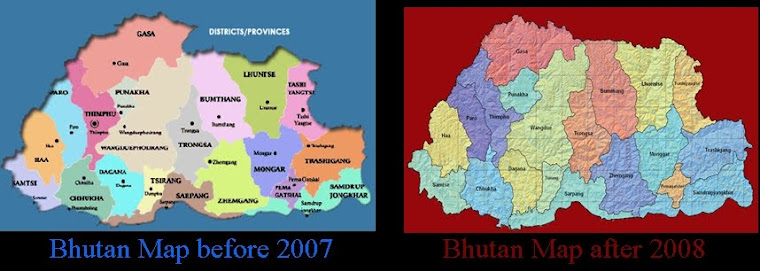
Click over the map to know the differences
Thursday, December 10, 2009

The Attempted Coup in Bhutan
Western Shugden Society
December 8, 2009
Filed under: buddhism — goldenmala
Thimpu, Bhutan
This is one of Open Secrets Concerning the Fourteenth Dalai Lama presented in the book A Great Deception by the Western Shugden Society. I found more details about the Attempted Coup in Bhutan in the book The Making of Modern Tibet By A. Tom Grunfeld. Below are a few excerpts from page 206.
In April 1973, just months before the official coronation of the current monarch, King Jigme Singye Wangchuck, the government of Bhutan announced the arrest of more than thirty individuals, almost all of them Tibetan refugees. The arrests were said to be in response to a plot that had begun a year earlier with the fatal heart attack of the previous monarch. During the latter years of this king’s reign, one of the most influential people was his alleged mistress. This woman, Ashi Yanki, was accused of being the ringleader of a group that had plotted to kill the young heir to the throne, set fire to the capital of Thimpu, and, in the resulting confusion, carry out a coup that would have effectively put Bhutan under the control of Tibetan refugees. The purpose of this coup, it was claimed, was to turn Bhutan into a military camp and a staging area for raids into neighboring China. It was further alleged that Ashi Yanki’s major source of support and encouragement was none other than Gyalo Thondup [the Dalai Lama's brother]. …
The Dalai Lama must maintain the absolute and undivided loyalty of the refugees in order to preserve his secular power. He is opposed to assimilation, and is especially opposed to the acquisition of citizenship in the settelment countries. In 1979, it was rumored that representatives of the Dalai Lama were warning Tibetans not to choose Bhutanese citizenship, lest they be barred from any future “independent” Tibet. …
In response, the Bhutanese, wanting all Tibetans to assume citizenship and profess their political loyaties solely to their king, have promised the refugees that they are free to renounce Bhutanese citizenship any time in the future – as are all Bhutanese.
December 8, 2009
Filed under: buddhism — goldenmala
Thimpu, Bhutan
This is one of Open Secrets Concerning the Fourteenth Dalai Lama presented in the book A Great Deception by the Western Shugden Society. I found more details about the Attempted Coup in Bhutan in the book The Making of Modern Tibet By A. Tom Grunfeld. Below are a few excerpts from page 206.

In April 1973, just months before the official coronation of the current monarch, King Jigme Singye Wangchuck, the government of Bhutan announced the arrest of more than thirty individuals, almost all of them Tibetan refugees. The arrests were said to be in response to a plot that had begun a year earlier with the fatal heart attack of the previous monarch. During the latter years of this king’s reign, one of the most influential people was his alleged mistress. This woman, Ashi Yanki, was accused of being the ringleader of a group that had plotted to kill the young heir to the throne, set fire to the capital of Thimpu, and, in the resulting confusion, carry out a coup that would have effectively put Bhutan under the control of Tibetan refugees. The purpose of this coup, it was claimed, was to turn Bhutan into a military camp and a staging area for raids into neighboring China. It was further alleged that Ashi Yanki’s major source of support and encouragement was none other than Gyalo Thondup [the Dalai Lama's brother]. …
The Dalai Lama must maintain the absolute and undivided loyalty of the refugees in order to preserve his secular power. He is opposed to assimilation, and is especially opposed to the acquisition of citizenship in the settelment countries. In 1979, it was rumored that representatives of the Dalai Lama were warning Tibetans not to choose Bhutanese citizenship, lest they be barred from any future “independent” Tibet. …
In response, the Bhutanese, wanting all Tibetans to assume citizenship and profess their political loyaties solely to their king, have promised the refugees that they are free to renounce Bhutanese citizenship any time in the future – as are all Bhutanese.
Lack of International Pressure on Situation of Bhutanese Refugees
How keen is the global community to find a "just and lasting" solution to this long held up Bhutanese Refugee Crisis? Perhaps there is no denying that the International community is equally interested in finding a solution to this prolonged impasse. However, the degree of attention and interest displayed by the global community does evidently waver time and again. They suddenly demonstrate periodical keenness, after a while such enthusiasm tends to recede. And this "once in a blue moon" pressure tactic has failed to maintain the momentum for too long.
Every time the global community has displayed strong eagerness, a comparatively positive impact has emerged on the overall issue of finding a lasting solution to this protracted crisis. The agreement on the Modalities of verification; the verification of refugees in the Khudunabari camp; and the promulgation of verification results, however flawed they might be, are some of the progressive steps the International pressure has successfully yielded.
Under the pressure from the International community and Human Rights organizations, Bhutan agreed in May 1993 that "the Royal government of Bhutan will accept full responsibility for [any] bona fide Bhutanese Nationals who has been forcibly evicted.”
Unfortunately such pressure is not sustained, thereby giving the entities directly responsible for creating such a demographic mess enough time and room to keep wrangling and sinisterly avoiding any serious discussions.
I sometimes feel that the Bhutanese refugee impasse has become more an issue to talk and show-off their charitable nature for the International community. They send their sympathy notes scribbled in pittance (read Dollars and Euros), and send plethora of delegation in various names -- quietly mocking the gullibility of this bunch of helpless and hopeless camp inhabitants, again and again.
The fate of Bhutanese Refugees languishing in seven camps in eastern Nepal has been tried and tested umpteen times, but nothing seems to work in their favor , except over a dozen of missions that come here every year from Europe and America for a "sightseeing" tour of the refugee camps. The assurances they bring are quite heavy to bear for a person with heart-ailment, well at the end --- as usual. Nothing moves. Nothing happens.
Many still accuse the global community of not doing anything to help avoid the orchestrated "ethnic cleansing." The United States and the European Nations knew what was going in Bhutan. Had they acted in time, they could have helped stop it from happening altogether.
The US State department has the full knowledge of the entire situation developing inside Bhutan. They could have helped to avoid the massive exodus as the situation deteriorated later in the absence of any international intervention.
An undated State Department country report on Human Rights in Bhutan speaks volume about the American Knowledge in this regard. It also underlines the absurd and impossible requirements Lhotshampas were asked to meet: “In recent years, assimilation has given way to Bhutanization…. The citizenship law [of 1985] retroactively stripped citizenship from Nepalese immigrants who could not document their presence in Bhutan prior to 1968, a nearly impossible requirement in a country with widespread illiteracy which only recently adopted administrative procedures."
Another similar report published by the State Dept. after the situation got out of hand endorses what Refugees have been telling all along. "Tens of thousands [of ethnic Nepalese] were forcefully evicted from the country voluntarily in the face of official sanctioned pressure , including arbitrary arrests , beatings, rape, robberies and other forms of intimidation by police and Army."
One finds enough reason to wonder as to why the International community especially the United States failed to take an initiative in Bhutan or Rwanda; and why it assumed moral high grounds and intervened in Kosovo.
One fails to understand if the basic doctrine of the Human Rights; the yardstick to judge the Rights violations is different in the east that from west. Although the United States displayed unequivocal support for the refugees in the year 2000 but by then much water had flown under the bridge. Karl Inderfurth and Julia Taft played a crucial role in getting the verification started. In his unprecedented move, President Clinton sided with the government of Nepal and the refugees, and urged Bhutan to reach an agreement with Nepal. Should Bhutan fail to agree in the tenth round, Clinton said he would urge multilateral donors to divert the international aid from Bhutan to refugee camps through UNHCR -- as a result Bhutan had no choice but to constitute JVT.
Though President Clinton set a time-frame for the Bhutan to agree, however he set no deadline for the completion of verification. Since his departure, the new administration has almost ignored this whole issue. Lately, the emergence of new Maoists across the sub-continent including Bhutan is worrying the US. Perhaps this new threat may hopefully bring a solution in disguise for the refugees.
India, being a part of the international community has a role to play. The unpleasantly conspicuous indifference of government of India has encouraged the Druk regime to delay and avoid serious discussions on the issue. India has long maintained that this is a bilateral issue and that it has no role to play. Most surprisingly, under the article 2 of Indo-Bhutan Friendship treaty of 1949, India can offer advice to Bhutan in regard to its external relations. But for some invisible reason India has made no move to exercise her prerogative for a noble cause.
After thirteen years of hectic activity, we suddenly find that the Bhutanese refugee impasse has reached nowhere. Instead it has become more complicated both in the matter of 'policy nightmare' of successive Nepalese govt. and in size. The head counts of these camp inhabitants has crossed the 100,000 mark and for obvious reason it won't take a downward turn or maintain status quo under the prevailing fertility rates.
As more refugees are arbitrarily being displaced into India, she will have to get involved eventually. But without a sustained International pressure neither Bhutan nor its patrons in South Block are likely budge substantially.
Teaching Bhutanese in America
Mission update November 23, 2009
Will you please forward to anyone that you think might be interested.
Thanks,
Elder Heaton
November 23, 2009
Dear Family and Friends,
Time moves on as we approach the conclusion of six months in the mission field. We can no longer call ourselves “GREENIES”. After six months in the mission field, if we were young missionaries we would have been through about three transfer periods and are getting the routine of missionary work down. They all have taught some type of lesson to prospective members, less active members or encouraged members to fulfill their calling as member missionaries. They have been met with disappointment as people break appointments and commitments and deny themselves the blessings of the gospel in the process. But most have rejoiced in seeing progressing investigators and some the miracle of conversion, baptism and receiving the gift of the Holy Ghost and the joy that it brings to those that receive it. Then they, the missionary, experience that great joy as it is found in the scriptures:
D&C 18: 13, 15-16
13 And how great is his joy in the soul that repenteth!
• • •
15 And if it so be that you should labor all your days in crying repentance unto this people, and bring, save it be one soul unto me, how great shall be your joy with him in the kingdom of my Father!
The blessing of success encourages them to move on to an even greater joy…
16 And now, if your joy will be great with one soul that you have brought unto me into the kingdom of my Father, how great will be your joy if you should bring many souls unto me!
More than one fourth of the missionaries that were here when we arrived in the mission field have gone home. To those that thrust in their sickle and labored with all of their strength, they were the ones that realized the great blessing of serving in their Father’s Kingdom and did not want to leave. They are the ones that understand what sacrifice and consecration really means and this great joy that comes from living it. They were the ones that the angels went before them to prepare the way
31 And the office of their (the angels) ministry is to call men unto repentance, and to fulfil and to do the work of the covenants of the Father, which he hath made unto the children of men, to prepare the way among the children of men, by declaring the word of Christ unto the chosen vessels of the Lord, that they may bear testimony of him.
32 And by so doing, the Lord God prepareth the way that the residue of men may have faith in Christ, that the Holy Ghost may have place in their hearts, according to the power thereof; and after this manner bringeth to pass the Father, the covenants which he hath made unto the children of men.
How wondrous it is, as a missionary, to find these chosen vessels of the Lord and to help our Father In Heaven fulfill His covenant with the children of men.
I have spoken in the past about a group of refugees from Bhutan that were in the camp in Nepal for seventeen years and somehow found themselves here in America. We have been actively teaching about 40 of these good people. Last night we baptized the first two. Moni and Raj Magar. What sweet spirits they and their two young children are and to have survived in such miserable circumstances is truly a miracle in itself. Just before they were baptized Sister Heaton and I went over to their humble apartment to break bread and enjoy the food of Bhutanese cuisine. While there, Raj told us that he had a plan to bring many of these people into the church. He wanted all too now have what he has and to know what he knows. That is the way with the truly converted; they can’t help but share the true gospel of Jesus Christ with everyone that they come in contact with, as the Lord directs. They are truly chosen vessels of the Lord.
I reflect on William Heaton receiving the gospel over in England; he being the very first convert and missionary on my Heaton side, and how much Raj is like him. I reflect on the joy William must be having as those he brought into the gospel of Jesus Christ have met him on the other side of the veil. How he must rejoice in his posterity and the missionary work that they have been involved with and how those that passed on before him have had their work done for them in the Holy Temples of the Lord, and how literally countless numbers have been affected by his choice to hear the word of the Lord and serve as a missionary for the Lord. He was a chosen vessel of the Lord that I will be ever grateful for. Now Raj has that same opportunity to bless his family and countless numbers that he will come in contact with both the living and the dead and how his posterity will call him blessed.
“ And if it so be that you should labor all your days in crying repentance unto this people, and bring, save it be one soul unto me, how great shall be your joy with him in the kingdom of my Father!”
I cannot express enough the gratitude that Sister Heaton and I have for each and every one of you that have touched our lives. You have given us great perspective and joy in our service here on our mission and you are a great part of anything that we do here. We feel your love every day and we hope that you feel ours for you as well. We have a constant prayer for you all that the Lord will bless and protect you. We also pray that the Lord’s great work; even a marvelous work and a wonder will roll forth until we kneel at Jesus feet and say, “Lord, here am I.” And that He who is all merciful will say, “Well done my true and faithful servant. I have prepared a place for you, enter in”
With all our love,
Elder and Sister Heaton
POSTED BY GRANDPA HEATON
From His Blog
Germany provides 50,000 euros in emergency relief to Bhutan
6 December, 2009 - The German government, through the federal foreign office’s humanitarian emergency aid programme, is providing 50,000 euros to UNICEF for earthquake relief operations in Bhutan. The funds will be used for procurement and distribution of relief material for people affected by the earthquake that hit eastern Bhutan on 21 September 2009.
Many of the affected families, in particular children, still show signs of fear and trauma. A sizeable portion of those affected continues to live in temporary shelters. The onset of cold winter conditions makes the vulnerable population susceptible to diseases and other health hazards. Several schools and health centres damaged due to the earthquake are still operating from makeshift shelters.
With the 50,000 euro funding from the German government, UNICEF will procure and distribute emergency family kits to prepare cooked food and boiled water, tarpaulins for use as temporary shelters and classrooms, blankets and a tent for the Jomtshang community primary school in Trashigang.
Though the relations between Germany and Bhutan are not formalised, regular bilateral contacts are maintained through the German embassy in New Delhi. In June 2008 and again in October 2009, a delegation from the said embassy visited Bhutan and held talks with parliamentarians, among others, on the new political order.
Over the last few years, Germany has also supported several cultural preservation projects in Bhutan, the most recent being the reconstruction of a cantilever bridge at the historic dzong in Punakha, which was officially opened by Bhutan’s Prime Minister on 10 May 2008. The newly established Trongsa Penlop Library, a public library in the Thimphu valley, received a donation of books from the German embassy in 2008.
In 2009, the German embassy provided 8,000 euros for procuring and distributing rice and maize grinding machines in eight remote mountain villages. The royal Bhutan police cooperate very successfully with German police on an ongoing basis.
Support is provided for postgraduate courses with relevance to developing countries, during which young executives from Bhutan’s administrative sector and non-governmental organisations receive practice-oriented training in Germany. Each year, three or four Bhutanese applicants are awarded scholarships, enabling them to study for two years and obtain a Master’s degree. Also, every year Germany’s international broadcaster Deutsche Welle invites journalists from Bhutan to Germany for conferences and workshops.
Beyond bilateral cooperation, Germany also makes a financial contribution to measures by international organisations active in Bhutan, such as the World bank, the Asian development bank, the European Union and the international centre for integrated mountain development (ICIMOD).
Worldwide, the German government funds appropriate relief projects run by UN humanitarian organisations, German NGOs and organisations of the Red Cross/Crescent movement. The federal foreign office is the lead ministry for this task. Germany’s key principle here is that humanitarian aid must be geared to the requirements of the emergency and nothing else. The German government is committed here to the humanitarian principles of humanity, neutrality, impartiality and independence.
The federal foreign office funds humanitarian emergency aid, especially help for refugees and internally displaced persons. It also promotes disaster reduction measures, which can help minimise the impact of natural disasters, alleviate human suffering and reduce material damage. In 2009 the federal foreign office has spent 123 million euro around the world to deal with humanitarian crises.
Open Your Heart and Home to a Refugee Child

( photo copyright Diana Johnson used w/permission)
Would you like to rekindle the hope of a refugee child who has fled civil conflict or persecution? If you live in King or Snohomish county you could become a long-term, short-term, or respite foster care provider with LCS' Refugee & Immigrant Children's Program. Many countries resettle refugee families and adult refugees. But only the U.S. welcomes the most vulnerable refugees: refugee youth without an adult caregiver. Recently, the need has been greatest for homes for teenagers and sibling groups from Burma, Bhutan, Congo, Somalia, and Sudan. Would you like to learn more about this rare opportunity? Please contact Erika Berg ateberg@lcsnw.org or (206) 694-5780 to sign up for our next Information Night on Monday, December 14, 6 - 8 pm. For more information: http://www.refugeechildren.net/
From New Blog
Journalists Reveal Human Rights Violations in Bhutan As State Presents Report
By Alan Gray, NewsBlaze
Bhutan is to present its first human rights report to the Universal Periodic Report Review Committee of the UN Human Rights Council in Geneva today at 1400 hours local time.
Bhutan has made a modest effort to present itself as clean in rights abuses, activists say, but gross human rights violations continue today.
Abuses include the eviction of over 100,000 citizens and other 80,000 restricted from exercising their voting rights during the first general elections,
To draw the attention of the international community to the previous and ongoing human rights violations in Bhutan, and to denounce the fabricated human rights report presented by Bhutan to the HRC, rights activists have published a new report. The report documents rights violations since 1990 and particularly since the so called democratic changes.
Written by I. P. Adhikari, president of the Association of Press Freedom Activists (APFA) Bhutan, and Raju Thapa, Director of Human Rights Without Frontiers, Nepal, the book provides vivid glimpse of the gross human rights violations in a country where "gross national happiness" is supposedly the guiding principle.
The book, entitled 'Human Rights and Justice in Bhutan', covers incidents beginning with the 1990s suppression, followed by the political changes and actions thereafter.
The book counters the claims made by the Royal Government of Bhutan in its report prepared for the Human Rights Commission. Substantive details of human rights violations are included, plus state failure to adhere by its legal obligation to protect the rights of its citizens.
Some noted instances of human rights violations include delay in repatriation Bhutanese refugees, restricting voting rights to it's 80,000-strong Nepali-speaking population still living in the country as well as to thousands of monks. The government has also failed to set up human rights mechanisms, there is an absence of any human rights organizations in the field, denial of the right to education to thousands of children because parents failed to present a no objection certificate.
There is discrimination in providing security clearances that are vital to obtain a business license and other government facilities. The state failed to register the birth of children born after 1990, even though Bhutan ratified the CRC in 1991.
Although Bhutan ratified the Convention on the Elimination of All Forms of Discrimination against Women (CEDAW) in 1981, discrimination against women continues today.
The journalists' Shadow Report shows that Bhutan's first human rights report is a sham.
BNC but whose?
December 4, 2009Platform Bhutanese Oversea citizenLeave a commentGo to comments
Rate This
Building Dutch Bhutanese identity
The exiled Bhutanese resettled in The Netherlands that forms the smallest ethnic group is now organized to maintain their identity. They have established a union named Bhutanese Community Netherlands (BCN) under the corporate law in Amsterdam. There are more than a hundred Bhutanese individuals most of them resettled in The Netherlands under the UNHCR program after the Bhutanese regime refused to take them back from the camps in Nepal. Their number will grow with the fourth batch of refugees scheduled to be invited from the camps early next year.
Maintaining ethnic and cultural identity along with the integration in the multicultural Dutch society is for Bhutanese a remedy to cultural shock and a solace to begin with new life for the second time. Their eighteen years of stay in the refugee camps in Nepal after being forced out of Bhutan indeed changed their concept of the world and bewildered to the extent that prudential approach and orientation became inevitable to begin life in this new country. This is essential particularly when they have to adjust their collectivistic societal norms and values to individualistic society of The Netherlands. The new organization should dedicate to identify the missing link and supports their successful integration.
Reorganizing among the resettled Bhutanese in their new circumstances and help each other appeared quite difficult, being confronted each time by their past experiences or personal point of references. Discussions leading to founding this community began early this year in the bars and private gatherings led by a few who were influential in the camps in Nepal. This was consolidated in April through a meeting called by those who came to Holland on their own and formed an adhoc committee of six members to expedite the legalizing procedures. Their work was disturbed when a Nepali expatriate Sashi Paudel intervened by holding a meeting on 20th June with the selected Bhutanese individuals. Suspicion among the Bhutanese population began whether BCN will practically be apolitical or a tool for a few interest groups to use in the manner many have experienced in the camps in Nepal. The adhoc committee accelerated their pace and the general meeting was held on 19 September that elected LP Dhakal as the president and also other office bearers. An statute was also ratified. Controversial clause that is not to allow political portfolio holders of any political parties to become central committee member of BCN was approved by the majority but the same gathering that constituted about 20 individuals ignored mechanism to prevent political portfolio holders getting elected. Thus violation of the rules and regulations began from the same day when BCN was formed. This continued to be aggravated when the president took the advisory committee’s advice supported by proof that the general secretary of BCN Ram Bdr Karki is already a central committee member of Bhutan People Party , as ‘disturbing issue’ and continued in clandestine the legalization procedures. It is yet not known who and how many of his subordinates represented BCN in the Notarial authority as founding members.
The way BCN began to operate appears non different from dozens of human rights, social and political organizations formed in the camps in Nepal that divided people and pained. This is evident from the first meeting minutes of the legalized BCN held in 29 November that absurdly suspended its women representative CK Dal with outrage because of the only fact that she asked the president to make clear from the beginning itself what the controversial issues could be and what spirit BCN will foster. According to the set rules in the statute member can be suspended for a month on the grounds of repeated damage done to the organization and the suspension must be followed by repeated warning. But, in the contrary, the president and the general secretary suspended her on their will and anger and it is ridiculous since that decision was taken in absence of the victim.
Therefore BCN is running out of its corporate values and responsibilities and thus became a tool to take revenge against the weaker section of the community instead of protecting them. It is contaminated with political manouvre and therefore already began to show no respect to whoever opposes their idea and operaton. The bigger dilemma for Bhutanese in Netherlands is the question whether their identity will be preserved collectively or exposed and what values will be passed down to the future generation ?. Gautam
From Nanda Gautam's Blog
On food security, art and snowboarding...

INTERVIEW WITH WFP REPRESENTATIVE RICHARD RAGAN
On food security, art and snowboarding...
SUBEL BHANDARI & UJJWALA MAHARJAN
Richard F. Ragan is the World Food Programme (WFP) Country Representative for Nepal. The charming 45-year old “almost professional” snowboarder is an adventurist at heart and claims his love for this country. Be it his attempt to come to Nepal as a Peace Corp volunteer in the late 80s (and sent to Philipines instead) or his recent snowboard escapade in Annapurna area when he nearly got “fried” by the avalanche, you can see the spark in his eyes when he talks about his stories of Nepal. The father of three kids is also possibly the only American to be a UN diplomat based in North Korea.
The Week editor Subel Bhandari and correspondent Ujjwala Maharjan talked to Ragan about Nepal, the food situation in the country, to his art and music interests. Excerpts:
What actually happened regarding the Jajarkot incident? A human-right NGO accused the WFP of providing bad food that caused the cholera outbreak earlier this year in which more than 200 people died.
I think it is important for any human-right organization to be concerned with the food security. That’s a good thing. Not enough people have paid attention to the problems that people in the remote parts of the country face. As I have said publicly earlier, it is medically and scientifically impossible for food to have caused any diarrhea epidemic. Maybe it is a misunderstanding between the organization and us.
All I can do is read quotes and see what was said in media and I don’t want to play blame games. The fact remains dry food rations cannot cause diarrhea related illnesses that would result in death. I don’t think it is useful to debate on whether food had a role to play in the incident in far west. The focus should have been on what needs to happen so that this does not occur next year because reality is every year in Nepal there are hundreds of diarrhea related deaths which are fundamentally a result of people drinking contaminated water and practicing poor hygiene. We have to figure out how to approach that and not look around and blame people.
At the moment, what are your operations?
We’re feeding over two million people all over the country and it’s quite a big operation that has grown from a US$25 million program to US$115 million a year. We are the largest airlift operation of WFP in the world. The challenges behind growing that fast and being that big are certainly there. We have been able to reach the remotest parts of the country.
We are using food as entry point to tackle questions around short and medium term food security and also use food like money to pay community to do development projects.
WFP has the Bhutanese refugee program where we feed over 90,000 refugees as many have been resettled already. We also feed over a quarter million kids, and have programs where we give away food as an incentive to parents for sending their children to school. We also do a mother and child health care programs primarily with government partners.
The quality of food that WFP provides has been questioned time and again by Nepali media. Do you think the media is being prejudiced?
We’re feeding over two million people in the country and it is never perfect. We have one of the most rigid systems to look at the quality of our food. When you are feeding this many people, you run into issues that you’ve got to deal with. The question is if we have an effective mechanism in place to monitor the food in all different stages as it moves. We check it when it is bought and it is checked when it is brought into the country by the government in the customs. We check it again as we get it and also our partners check it once they receive it. If there is any problem, we replace it. There is always going to be questions around food quality and we take it seriously. We spend close to a million dollars per year just to check food quality.
Do you also get food from local market?
Of our program, 85 per cent comes from the region, that is Nepal and India. Of that, 12 to 15 per cent, depending on the year and its harvest, is from Nepal suppliers. Rest is coming from suppliers who are buying either in India or directly from Indian suppliers. The government has now asked us not to buy food in Nepal because there is a deficit of production this year. They don’t want us to go into the market and take away food from the consumers. So we are primarily buying in India.
In the United Nations, WFP is the only agency that has to raise its funds by itself. How do you do that?
We do it through our projects where we present a concept to our board in Rome, Italy. The board approves it and we work with government on the concept and we go out and raise money for it. Governments generally give us money based on what they perceive to be the need in the country and the merits of our projects.
In a talk program few months ago, you portrayed a bleak image of food security in Nepal. Is it that bad?
Nepal has some of the worst chronic malnutrition rate. There are two types of malnutrition: acute malnutrition is weight to height and chronic malnutrition, the most pervasive, attacks children in the developmental stages from age zero to five. If you don’t get the right nutrition during that period, your mental and physical facilities is underdeveloped. In mid and far western region, you have chronic malnutrition rate as high as 68 to 70 percent. There is a combination of factors for it, one there is not enough food and the other is that there is no right kind of food to these children.

How about the food production that has gone down?
You have a growing population and the food production is not meeting up your population growth demand. You also had successive years of winter and summer droughts. I do not have the scientific data to say that change in weather patterns are result of climate change but anecdotally we can see that there is a lot less snow in higher mountains which means a lot less snow melt that is the source of water for irrigation for farmers during their winter crop. I am a mountain climber and I can see changing patterns in snowline. I came here in 1989 I climbed Mt Imja Tse and Khumbu and there was no lake at the bottom of Imja glacier and in 20 years, you got a new lake at the bottom of the biggest glacier coming out of Lhotse. Three very critical places on earth to look at climate change are the two poles and here in the Himalayas. Nepal has always been a disaster prone area, with floods and landslides every year. Now they seem to be growing in regularity and scale.
You said WFP program funds raised from US$ 25 million to US$ 155 million. Is it because Nepal is going down the dire road so fast?
There was always an emergency here but for whatever reasons people chose to ignore it. Maybe because it was too difficult or too expensive and these people were in unreachable places. We now have over 30 people who live out in the districts who have satellite phones and devices, who are food security surveillance monitors. They look at problems everyday, walk from village to village and we get real time information from them on what is actually happening and the dynamics of how VDCs in remote areas are dealing with things. Before, we had no idea what was happening and it was easy to say there was conflict and ignore it, but that is not sustainable. New Nepal cannot afford to ignore these populations. I don’t think it is sustainable to do large scale airlift aid operation into these places forever because it would cost too much. But we have to use the opportunities to gain with food, an entry point, which invest in activities that invest in food security. We also grew because Nepal is today in a unique position where the attention of the world is focused on it with the peace process, donors want the country to emerge from the process successfully and return to the state of peace, normalcy and self-sustainability. So they are investing in the country and as a result of that we are able to raise money.
One of our biggest donors last year was the Government of Nepal. They were confident in our programs and they wanted us to implement programs because we had the ability to move quickly and execute them when they needed to address some immediate food security issues.
What do you see as the main challenge of working towards the food crisis?
There is no main challenge. But there are three main areas we should focus on. We need a short term, medium and a long term response. Short term is trying to stabilize immediate food security targeting the households which are food insecure right now and provide the stock gap till they make it to the next agricultural cycle. The medium term is the mixture of providing food but also giving them developmental activities that promote food security like food for work program where we are building irrigation systems, access roads and farmer’s cooperatives to increase production, sustainability and increase community’s resilience to deal with fluctuation and future shocks. The third is the longer term agricultural production that has to happen in the country that requires proper structural investments, like the Jumla road and Karnali highway. Most of the rural parts have rain fed agricultural systems. Investment in irrigation is necessary. You have to develop a domestic seed stock production capability which gives farmers access to high yielding seed stocks on an annual basis. It is incredibly important for the government to have policy making mechanism because food security is a multi-Ministry issue. Like Yubaraj Khatiwada , the National Planning Commission Vice Chairman says -- Nepal needs to be a “food sovereign” state which means it needs to produce enough food on its own and be independent of external market. The conventional wisdom was you had to have strong economy so you could buy food in the global market.
What do you think of Nepal being a Wai Wai nation? It has become a national lunch, even in the furthest corner of our country.
I just read a very important book called the “Omnivore’s Dilemma” which looks at culture of eating in America. And I say Nepal is also moving in that direction but when we move too far away from how we produce our food, we loose a sort of food sovereignty. I think you have to balance these sorts of readymade products to the traditional way we as humans eat. It is good for people to have modern convenience of food but it is a problem when people rely too much on it and forget about origins of food.
Remote areas are not much concerned with variety of food and modern convenience. But we really should focus on potential of marketing incredible rare food found here like the morel mushrooms and Himalayan truffles to the higher European market.
You were in North Korea for some time. Tell us a little about that country because it is quite fascinating.
Before coming here I worked in North Korea and I was one of the first White House officials to travel there during the Clinton Administration. As an American, it is not an easy place to work. As individual people, they were nice. But as a country, they are very anti-American. It’s one of the last communist state.
Do you think Nepal could ever be like that if Nepal becomes a communist state?
Nepali people aren’t like that even if you become a communist state. Communism here tends to be more socialist. Democracy is not easy; it is not painless. If you’re waiting in line for petrol, and you’ve got power outages and no water, you do get frustrated but in terms of peace process, these things are slow and people have to be comfortable how they develop and there is progress.
Tell us about your snowboarding. Is it a viable tourism idea?
I have snowboarded in the Annapurna area in the base camp. It is a very specialized area, the only way to do it is you’ve got to be a mountaineer and climb up or you need a helicopter to fly you up. The snowline starts really high here so you begin in an altitude of 4,300 metres. In a helicopter, you need to be around 6,000 meters high. You need to go with people who have a lot of experience. Nepal is not a place that has people with skiing or snowboarding experiences. There are great mountaineers but they know climbing. Also, you don’t have a lot of helicopters in the country that can operate at those altitudes. And pilots don’t know how hill skiing works.
How dangerous is it?
It’s risky. The terrain is one of the most risky terrains in the world. Once, I got caught in the avalanche in the Annapurna in the south. I set it off when I was moving across the slope late in the afternoon. I was shooting a movie with three people for Nike. When you snowboard you push more snow than while skiing and I was third in the line that day. We knew the slope was unstable and when I went, the whole thing fractured. Annapurna is like the most avalanche prone mountain in the Himalayas. I stayed up and I couldn’t really ride it out, but it spit me out.
You have a solid art collection as well, some of which we got a glimpse of at the international art exhibition, Separating Myth from Reality: Status of Women, last month.
I’m a very bad painter. Three things I’d really wanted to be are rock star, world famous chef and a painter artist. But then I’ve got no real talent for any of it so those are just dreams.
I started collecting art even when I was in college. Then I really started buying art when I was in Washington DC and in China. When I was in China, my wife worked at an Asian fusion restaurant. Below the restaurant was one of the biggest art galleries in Beijing. I got to be friends with lot of these pre-Tiananmen artists who did gaudy art very much like pop art. After Tiananmen happened and everyone went underground, there were these post-Tiananmen periods when painters became subtly political and provocative.
In the States, I have some Salvador Dali. I have a Helen Frankenthaler and an Andy Warhol too.
What book are you reading?
I’m reading Michael Chabon’s Fatherhood for Amateurs. My favorite book of all time is The Amazing Adventures of Kavalier and Clay by Chabon. I am reading his Fatherhood for Amateurs because I am a dad and a total amateur at it. I am also listening to a book Philip Roth’s The Humbling.
Music that you are into these days…
I’m listening to Sparklehorse and Vampire Weekend. I’m also listening to Black Joe Louis and the Honey Bears and The Silver Sun Pickups; they are an LA based band, very fuzzy and very nice.
Subscribe to:
Posts (Atom)