STATEMENT OF MOTIKHAR ACHRAJA Date:-11/03/2011
1. My Father Mr. Devi Charan Acharja was forced to live Bhutan in June 1992.
2. In 1986 I separated from the joint family and staying with my nine family members. While appropriating the land among five brothers, I got the share of land measuring 10.31 acres under the old thram (land registration number) no.114 and the new 158.However, mean while the Home ministry had suspended the land registration and transfer or transaction of any land deal. While allotting the said land, I was also given the responsibility of education and marriage of four younger brothers and five sisters.
3. I also cleared the loan of Rs.31, 514.00 taken by my father from Bhutan Development Finance Corporation (BDFC) mortgaging the same land in 1994 for fishery development.
4. Since my father and other family members were evicted, I was mending the land until the then Dzongda of Sarbang district Dr.Sonam Tenzing on April 21, 1998 verbally to my shock told me that the land does not belong to me.
5. I could not approach the king immediately for consideration of my case due to financial constraint. I could do only in October 1998.
6. The king had ordered the Royal chamberlain (Zimpon) Dorji Gyeltshen to forward the case to the home ministry for verification .After that there was no any intimation to me pertain the case.
7. I approached the High court in 1999 for redress of my case as I did not get anything from the King. As there was no any response or action even from the High court, again I appealed to the high court in 2002 requesting to review my case .In 2003,the High court forwarded the case to Home Ministry to look into the matter. When I approached the Home ministry and met the then home minister Tinley Gyamtso, he told me that it is the duty of the court to ascertain whether you get the land or not. I was regularly paying land tax and other government liabilities.
8. To my surprise and in my absence, Mr. Nima Khandu came and claimed that the land had been allotted to him by the government under resettlement scheme along with the building. My children defied and sent him away when he came with some monks to lay the foundation.
9. I also appealed to the then Agriculture minister Sangay Nedup on 1-1-2004 and november2004 for transfer of registration of land to my name from my father.
10. On 6 April 2004, Dzongda Sonam Dawa, Dungpa and Gup (block head) Karma and Tshogpa in my absence came to my house and told my children to vacate the land and the house. When my children started crying, the Dzongda pointed the area leaving the house for demarcation. On 7th April 2004, Dzongkhag land surveyor Mr. I.K. Suncheuri, resettlement coordinator district livestock officer, Gup and Tshokpa came in my absence and demarcated the area along with 1.5 acres of betel nut orchard and paddy field totaling 5 acres.
11. When Nima Khandu came and started building house, my son Durga Prasad Acharja rejected and dismantled the poles.
12. On 8th may 2004 my son Durga Prasad Acharja was arrested and taken to Lodrai jail, Galephu and the court in Galephu sentenced him to one year jail on charges of violating section Na 1-4 of Thrimzhung Chenpo (supreme law).
13. Unsatisfied with the unfair decision of the Galephu court, I appealed to the Sarbhang district court for fair judgment and justice. However, the district court too did not give any decision of its own and justified the decision of the Galephu court.
14. On 21-9-2004, the Dzongda Sonam Dawa issued a last warning letter to me written in Dzongkha which I cannot read except the English word “Last Warning” written in bracket.
15. On 2-2-2005 again appealed the Agriculture minister on his visit to our block Chujegang (Danabari) to look into my case and on the spot decision. The minister then and there ordered the surveyor general Mr.Sithar Namgyel who was also with the minister’s entourage to look into the case and resolve the problem. After hearing my story and the facts by the Surveyor general, he told the two judges of sub-division Galephu and the Sarbhang district to transfer the land registration in my name as I posses the agreement from my father.
16. On 8-2-2005 the Surveyor General has written to the judge, Galephu to transfer the land registration in my name. It is more than 5 years, the court has not done anything to transfer the land and has not respected the Surveyor General’s letter too asking to transfer the land in my name.
17. In 2005 the Sarbhang court also justified the verdict of Galephu court of imprisonment of my son.
18. Since I felt injustice and unfair verdict of my son, I appealed to the high court Thimpu in 2005.
19. The High court judge Karma Sherpa also game the verdict that since the land has not been transferred within one year of the agreement, the land thus belongs to the government and the imprisonment of son is right (bench no.3). Further I was sent to the Royal Bhutan Police Central box, Thimpu and kept there for one month and 25 days without any question.
20. Not satisfied with the verdict of bench 3, I appealed to the full bench consisting of judges Passang Topgay, Thinglay weizer, K.B.Ghaley, Sithar Namgyal, Jigme Zangpo and Tshering Wangchuk. The judges instead of giving fair judgment, they alleged me of stealing betel nuts grown in my own land and fined me Rs. 27000.00 saying that the land belonged to the government and allotted to Nima Khandu. Further I was asked to pay fine of Rs 20000 for dry land Rs 35000.oo for wet land per acre totaling Rs 1,57,00.00 and also additional Rs9862 as compensation to Nima Khandu and asked to vacate the land. The decision was passed on 5-7-2006 vide case no.1583.
21. On 19-7-2006 not satisfied with the decision of the High court, again I approached the King. The king ordered the Royal chamberlain office to issue a letter to the Home minister to look into the matter and resolve it. The king also ordered that in case of complication and unable to solve the problem, the matter should be forwarded to Gyelpoi Zimpon’s office.
22. In 2007 the high court summoned and asked me to produce the decision paper. Along with the decision paper, I showed the letter issued by the Gyelpoi Zimpon’s office. Again I went to the Zimpon’s office to inquire the progress. I was told that nothing has come to the office from home ministry. I went to the home ministry and on inquiry, I was told that my letter was forwarded to local government section. At last the letter was found lying in the office without any action. The local government office told me that they would dispatch the letter to the Dzongkhag office. On 1-10-2007 the home ministry had sent the detail report of the plot no.SSD-03 to the Zimpon’s office.
a. On May 18, 2009, I appealed to the prime minister, Thimpu stating that nothing has happened in regard to transfer of my land registration from my father. The case was put up in the cabinet. The cabinet has written to the department of the land record to look into the case. The land record had written to the Dzongkhag citing all the correspondence regarding the said land but there was no any response to the query from the Land record. The office had inquired whether there is new land (Sathram no.158, previous 114).The new thram was also issued in my father’s name Devi Charan Acharja. This is so because he had not taken a pie as compensation.
23. On June 2010 I appealed the 5th king through the Gyelpoi Zimpon office, Thimpu. The Zimpon office; Thimpu had forwarded the appeal to the Zimpon welfare office, Bumthang as Sarbhang Dzongkhag falls under the jurisdiction of welfare office, Bumthang.
24. In 2010 legal officer from the sarbang Dzongkhag investigated and reported to the Gyelpoi Zimpon legal officer Wang Gyeltshen. Mr. Wang Gyeltshen submitted the report to Gyelpoi Zimpon and the Gyelpoi Zimpon according to the order of the King instructed the high Court to respect the verdict of case no.1583 dated 5-7-2006.
25. On 2-12-2010, according to the instruction from Dzongkhag, the Gup of Chujegang Sangay Tshering issued order asking me not to touch anything in the land, either sow or reap any crop.
26. The high court has sent a letter on 31-1-2011 to Dungkhag court Galephu Instructing to respect the old decision of 2006.
27. On 22-2-2011, I plucked 98 sacks of betel nut grown in my land. While plucking the nuts the Gup came to my house and went. Later on sent the Tshogpa to call me to his office with the laborers numbering 10. He handed me a letter written in Dzongkha and asked me immediately to go to Galephu to meet the Dungpa. When I came to Dungkhag to meet the Dungpa who was away and had to stay overnight in Galephu. The laborers packed the betel nuts in 98 sacks and loaded on the truck number BP-2-1326 and were bringing to Galephu, while on the way to Galephu, the truck with the load was intercepted by the Royal Bhutan Police and taken into custody and is kept in the police centre, Galephu.
Mr. Motikhar Acharja is arrested by the royal Bhutan Police, Galephu on 26th February 2011 and is kept in the Galephu jail without any question. The Human Rights organization of Bhutan (HUROB) has appealed to all the concern for Urgent Action on 26th February 2011 and requested to write to the Prime Minister of Bhutan for justice and immediate release of Mr. Acharja. HUROB firmly believes that the respective concern Human Rights Organizations and Diplomatic missions have taken appropriate steps to pressurize the Royal government of Bhutan (RGOB) and hopeful that Mr. Acharja gets justice and be released who is till date kept in the jail, Galephu.
The above statement was taken by HUROB staff on 24th February 2011from Mr. Acharja. He has availed more than 70 letters of correspondence and courts decisions for ready reference. Mr. Acharja statement and his untiring saga of fight for justice and right is one testimony to fathom by all conscientious human being that how much injustice being meted out to southern Bhutanese of Nepali speaking by the Bhutanese regime starting from the King, the supreme authority to the lowest Block head. Even the Court that talk of fair justice without favour and fear is biased when concerning the southern Bhutanese. One should also comprehend that people like Acharja who dares to challenge the government is not reaching any where to get justice that how many innocent Bhutanese especially the Nepali speaking are being suppressed, oppressed and denied justice. Again HUROB requests everyone who receives this statement to promptly take action. Your small gesture is doing to make big difference in the life of Mr. Acharja and thousands of southern Bhutanese who are silently suffering. The HUROB also request the core countries for Bhutanese refugees which are resettling the Bhutanese refugees to form a committee to independently study the unabated suppression of the southern Bhutanese, question of nationality and citizenship of about 80000 relatives of refugees still living in Bhutan and denial of justice.
Thank you for your kind and continuous support and solidarity.
S.B.Subba
Chairman
HUROB
Email: sbyongya@yhaoo.com
hurob1991@gmail.com
Mobile: +91-7602895197.
The Sorry Saga of Bhutan's North
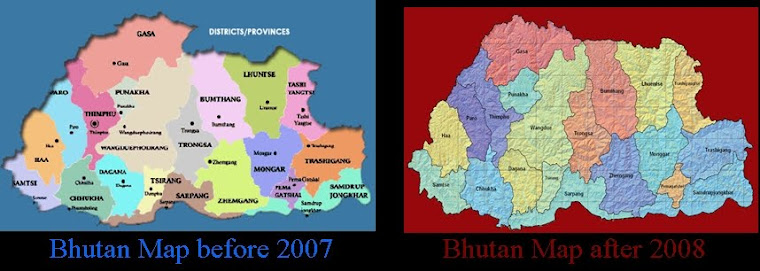
Click over the map to know the differences
Saturday, March 12, 2011

Monday, February 21, 2011
The National Commission for Women and Children-Bhutan Wins ADB-Japan Grant
News Release
21 February 2011
ADB, Japan Support Economic Opportunities for Women in Bhutan
MANILA, PHILIPPINES - The Asian Development Bank (ADB) and the Government of Japan are providing assistance of $1.95 million to Bhutan to support increased economic opportunities for women.
The grant from the Japan Fund for Poverty Reduction, administered by ADB, will strengthen the gender mainstreaming and monitoring capacity of the National Commission for Women and Children and other government agencies responsible for women's economic empowerment. Another key element of the project will be assistance for trade apprenticeships and skills training for women in partnership with the Ministry of Labor and Human Resources. Funds will also be used to help partner nongovernment organizations involved in promoting economic opportunities for women and micro enterprises.

"The project will improve the capacity of government agencies and civil society to address gender disparities, while helping increase livelihood opportunities for vulnerable women and girls in selected urban and rural areas," said Francesco Tornieri, Senior Social Development Specialist in ADB's South Asia Department.
Bhutan has a strong gender equality ethos but some disparities still exist, with female participation in the labor force under 42% in urban areas, compared to nearly 77% for men. In addition, illiteracy among rural women remains high. To address the gaps, the Royal Government of Bhutan has established a National Plan of Action on Gender to make gender mainstreaming and advocacy an integral part of its programs.
Project performance targets include the completion of 12-month apprenticeships in various trades for around 600 youths, with an 80% target for women, and the completion of trade skills training by up to 360 rural youths, 50% of them women. It also aims to help up to 1,200 individuals - the bulk of them women - to engage in microenterprises and other livelihood activities.
Along with the ADB-administered grant, the Government of Bhutan will provide in-kind support of more than $548,000, with beneficiary communities supplying $56,000, for a total investment cost of almost $2.6 million. The National Commission for Women and Children is the executing agency for the project which will run for three years.
About ADB
National commission for Women and Children in Bhutan
21 February 2011
ADB, Japan Support Economic Opportunities for Women in Bhutan
MANILA, PHILIPPINES - The Asian Development Bank (ADB) and the Government of Japan are providing assistance of $1.95 million to Bhutan to support increased economic opportunities for women.
The grant from the Japan Fund for Poverty Reduction, administered by ADB, will strengthen the gender mainstreaming and monitoring capacity of the National Commission for Women and Children and other government agencies responsible for women's economic empowerment. Another key element of the project will be assistance for trade apprenticeships and skills training for women in partnership with the Ministry of Labor and Human Resources. Funds will also be used to help partner nongovernment organizations involved in promoting economic opportunities for women and micro enterprises.

"The project will improve the capacity of government agencies and civil society to address gender disparities, while helping increase livelihood opportunities for vulnerable women and girls in selected urban and rural areas," said Francesco Tornieri, Senior Social Development Specialist in ADB's South Asia Department.
Bhutan has a strong gender equality ethos but some disparities still exist, with female participation in the labor force under 42% in urban areas, compared to nearly 77% for men. In addition, illiteracy among rural women remains high. To address the gaps, the Royal Government of Bhutan has established a National Plan of Action on Gender to make gender mainstreaming and advocacy an integral part of its programs.
Project performance targets include the completion of 12-month apprenticeships in various trades for around 600 youths, with an 80% target for women, and the completion of trade skills training by up to 360 rural youths, 50% of them women. It also aims to help up to 1,200 individuals - the bulk of them women - to engage in microenterprises and other livelihood activities.
Along with the ADB-administered grant, the Government of Bhutan will provide in-kind support of more than $548,000, with beneficiary communities supplying $56,000, for a total investment cost of almost $2.6 million. The National Commission for Women and Children is the executing agency for the project which will run for three years.
About ADB
National commission for Women and Children in Bhutan

Saturday, February 19, 2011
Beating Wives in Bhutan
Buddhist Bhutan Wrestles With 'Shocking' Abuse Study
By Vishal Arora
Religion News Service
NEW DELHI (RNS) The government commissioner charged with promoting "Gross National Happiness" in the tiny Buddhist nation of Bhutan said he was deeply dismayed by a recent study that found a majority of Bhutanese women think their husbands have the right to beat them.
Karma Tshiteem, head of Bhutan's Commission for Gross National Happiness, called the findings "surprising" and "shocking," and said such attitudes are "totally inconsistent" with Buddhist teachings.
The survey by Bhutan's National Statistics Bureau found that roughly 70 percent of women say they deserved beating if they neglect children, argue with their partners, refuse sex or burn dinner, reported the Business Bhutan newspaper.
The acceptance of domestic violence is highest (90 percent) among the women in Paro, a picturesque valley that's home to Bhutan's most revered monastery, Takshang. The capital city of Thimphu scores the lowest acceptance rate, about 50 percent, for wife beating.
"Any form of violence is totally contradictory to the teachings of the Buddha," Tshiteem said, noting that Ahimsa (non-violence) "is a central tenet in Buddhist philosophy."
Mahayana Buddhism is the state religion of Bhutan, where a vast majority of the 700,000 citizens are Buddhist.
Gross National Happiness, which seeks to create an "enlightened" society in which government fosters the well-being of people as well as other "sentient beings," was first envisioned by Bhutan's former King Jigme Singye Wangchuck in 1972.
The landlocked Himalayan nation -- about half the size of Indiana -- peacefully transitioned to democracy after the king abdicated power in 2006, but Buddhist principles continue to shape the country's government.
Bhutan's Gross National Happiness index -- as opposed to more traditional measures like a nation's economic activity -- is based on nine components of happiness: psychological well-being, ecology, health, education, culture, living standards, time use, community vitality and
good governance.

Because healthy family relationships are key to harmonious communities, "attitudes accepting such behavior, in these relationships or even outside, would be totally inconsistent" with Gross National Happiness, Tshiteem said.
Covering 15,000 households, the Bhutan Multiple Indicator Survey also found that more than one in four women believe HIV/AIDS is transmitted supernaturally; one in four children do not attend school and one in five children are involved in child labor.
Source: Huffington Post
Domestic violence in Bhutan: Bhutanese women are becoming conscious
Mehdi Hassan
Situated in the Himalayan region between India and China, Bhutan is a poorly developed country. Surprisingly, the country was ranked the 8th happiest country on the list of happy countries in the world compiled by University of Leicester. Low literacy rate, low rate of industrialization and zero exposure to foreign culture have enabled the country to keep its domestic culture and natural beauty intact.The irony is that the women of this happy country are not so happy because domestic violence is very common in Bhutan.
The worst thing is that the women who are victims of domestic violence do not go to the police. They are afraid of losing respect in the society. In many cases, women are illiterate and entirely dependent upon their husband for financial support. In addition, many women can not leave the family for their children. Silently they tolerate the brutal torture of their husbands. Kuensel Online reports:
“Most Bhutanese women just won’t shout for help, no matter how severe it gets,” said an observer. Bhutanese women, as in other countries, says Thimphu referral hospital’s Dr. Pakila Drukpa, do not want to come out in the open for various reasons. Factors like children’s welfare, fear of breakdown of marriage, and an innate embarrassment that relatives and others will come to know, influence their decisions, said Dr. Pakila.
The worst affected are those who were economically dependent on their husbands, said a spokesperson of RENEW, a non-government organisation, which provides support and services for victims of domestic violence.
The good thing is that the situation is changing. With the gradual spread of education and various NGO’s, women especially those who are living in urban areas have become conscious. Now, they seek legal counsel against domestic violence. The queen of Bhutan, her majesty Ashi Sangay Choden Wangchuck, established an organization named RENEW which deals with domestic violence.
Domestic violence can be more or less found in almost all the countries of the world but it is more common in under-developed countries. Last year, Razib Ahmed published another post about the crown prince of Nepal abusing his wife.
One of the major reasons the abusive husbands go unpunished in countries like Bhutan is that the social system and customs support men. Creating law against home violence is not enough. It has to be made sure that the law is strictly observed and at the same time awareness against violence has to be raised among women.
Source: South Asia Bussiness
By Vishal Arora
Religion News Service
NEW DELHI (RNS) The government commissioner charged with promoting "Gross National Happiness" in the tiny Buddhist nation of Bhutan said he was deeply dismayed by a recent study that found a majority of Bhutanese women think their husbands have the right to beat them.
Karma Tshiteem, head of Bhutan's Commission for Gross National Happiness, called the findings "surprising" and "shocking," and said such attitudes are "totally inconsistent" with Buddhist teachings.
The survey by Bhutan's National Statistics Bureau found that roughly 70 percent of women say they deserved beating if they neglect children, argue with their partners, refuse sex or burn dinner, reported the Business Bhutan newspaper.
The acceptance of domestic violence is highest (90 percent) among the women in Paro, a picturesque valley that's home to Bhutan's most revered monastery, Takshang. The capital city of Thimphu scores the lowest acceptance rate, about 50 percent, for wife beating.
"Any form of violence is totally contradictory to the teachings of the Buddha," Tshiteem said, noting that Ahimsa (non-violence) "is a central tenet in Buddhist philosophy."
Mahayana Buddhism is the state religion of Bhutan, where a vast majority of the 700,000 citizens are Buddhist.
Gross National Happiness, which seeks to create an "enlightened" society in which government fosters the well-being of people as well as other "sentient beings," was first envisioned by Bhutan's former King Jigme Singye Wangchuck in 1972.
The landlocked Himalayan nation -- about half the size of Indiana -- peacefully transitioned to democracy after the king abdicated power in 2006, but Buddhist principles continue to shape the country's government.
Bhutan's Gross National Happiness index -- as opposed to more traditional measures like a nation's economic activity -- is based on nine components of happiness: psychological well-being, ecology, health, education, culture, living standards, time use, community vitality and
good governance.

Because healthy family relationships are key to harmonious communities, "attitudes accepting such behavior, in these relationships or even outside, would be totally inconsistent" with Gross National Happiness, Tshiteem said.
Covering 15,000 households, the Bhutan Multiple Indicator Survey also found that more than one in four women believe HIV/AIDS is transmitted supernaturally; one in four children do not attend school and one in five children are involved in child labor.
Source: Huffington Post
Domestic violence in Bhutan: Bhutanese women are becoming conscious
Mehdi Hassan
Situated in the Himalayan region between India and China, Bhutan is a poorly developed country. Surprisingly, the country was ranked the 8th happiest country on the list of happy countries in the world compiled by University of Leicester. Low literacy rate, low rate of industrialization and zero exposure to foreign culture have enabled the country to keep its domestic culture and natural beauty intact.The irony is that the women of this happy country are not so happy because domestic violence is very common in Bhutan.
The worst thing is that the women who are victims of domestic violence do not go to the police. They are afraid of losing respect in the society. In many cases, women are illiterate and entirely dependent upon their husband for financial support. In addition, many women can not leave the family for their children. Silently they tolerate the brutal torture of their husbands. Kuensel Online reports:
“Most Bhutanese women just won’t shout for help, no matter how severe it gets,” said an observer. Bhutanese women, as in other countries, says Thimphu referral hospital’s Dr. Pakila Drukpa, do not want to come out in the open for various reasons. Factors like children’s welfare, fear of breakdown of marriage, and an innate embarrassment that relatives and others will come to know, influence their decisions, said Dr. Pakila.
The worst affected are those who were economically dependent on their husbands, said a spokesperson of RENEW, a non-government organisation, which provides support and services for victims of domestic violence.
The good thing is that the situation is changing. With the gradual spread of education and various NGO’s, women especially those who are living in urban areas have become conscious. Now, they seek legal counsel against domestic violence. The queen of Bhutan, her majesty Ashi Sangay Choden Wangchuck, established an organization named RENEW which deals with domestic violence.

Domestic violence can be more or less found in almost all the countries of the world but it is more common in under-developed countries. Last year, Razib Ahmed published another post about the crown prince of Nepal abusing his wife.
One of the major reasons the abusive husbands go unpunished in countries like Bhutan is that the social system and customs support men. Creating law against home violence is not enough. It has to be made sure that the law is strictly observed and at the same time awareness against violence has to be raised among women.
Source: South Asia Bussiness
Education Not for all
Choices for those cut offEnrol in a private school, repeat the same class or train for a blue-collar job
Labour Market 17 February, 2011 - With the cut off point fixed at 61 percent for Class X, the ministry of education will absorb only 3,727 students into 32 government higher secondary schools across country.
A total of 9,330 students appeared for the examination in 2010 and 5,236 students will have to either opt for private school, repeat the same class or hunt for jobs. The existing 13 private schools in Bhutan will absorb only about 50 percent of those who disqualified. Most of the private schools will absorb a maximum of 350 students each, with the minimum cut off point set at 45 percent.
But, with the recent release of labour market guide by the labour ministry, class X and Xll school graduates, who cannot make it to the government schools or pursue higher studies, may avail job opportunities.

There are 1,580 vacancies available in 92 occupations in the private and corporate sector. The salary ranges from Nu 3,000 to Nu 15,000. Some of the job includes bill collectors, caretakers, front desk personnel and receptionists.
Labour officials said the vacancies are merged together, since most companies provide vacancies for both Class X and XII students.
The labour market guide shows there are 908 training opportunities available for class X graduates in the public sector under six different institutes and under sustainable development projects.
The training opportunities under different institutes across country will take in 668 candidates to be trained under various courses, which includes electrical, mechanical, automobile, networking, carpentry, masonry, plumbing, driver and carpentry.
The sustainable development project would train candidates in hospitality, IT, construction and other sectors like education, media and production. The different sectors under the project would take about 240 candidates. Among others they will be trained as waiter and waitress, in fruit juice processing and food and beverage and housekeeping staff.

The guidebook, which is posted on the labour ministry website, will provide practical and timely information to help make career choices and find suitable employment. But officials said information on the guide is only from January to March. “We’ll provide job market information after every three months with new opportunities,” labour official said.
While many students, who didn’t meet the cut off percentage, said that they wouldn’t be able to afford private school, they said they showed strong preference to repeat than work as waiters or waitresses. “I need to continue my study, so that I can get a better job,” said Jigme Tshering, who failed the board exams.
The 367 students, who were not awarded pass certificate, labour officials said, can also apply for the training and job vacancies. Officials explained that, if there is a vacancy, which requires qualification, they would forgo qualification requirement to absorb interested candidates. “Class X student not awarded the pass certificate could apply for jobs meant for Class VIII pass students,” an official said.
Officials said that there are also certain training programs that do not require qualification.
By Yangchen C Rinzin
Kuensel
Labour Market 17 February, 2011 - With the cut off point fixed at 61 percent for Class X, the ministry of education will absorb only 3,727 students into 32 government higher secondary schools across country.
A total of 9,330 students appeared for the examination in 2010 and 5,236 students will have to either opt for private school, repeat the same class or hunt for jobs. The existing 13 private schools in Bhutan will absorb only about 50 percent of those who disqualified. Most of the private schools will absorb a maximum of 350 students each, with the minimum cut off point set at 45 percent.
But, with the recent release of labour market guide by the labour ministry, class X and Xll school graduates, who cannot make it to the government schools or pursue higher studies, may avail job opportunities.

There are 1,580 vacancies available in 92 occupations in the private and corporate sector. The salary ranges from Nu 3,000 to Nu 15,000. Some of the job includes bill collectors, caretakers, front desk personnel and receptionists.
Labour officials said the vacancies are merged together, since most companies provide vacancies for both Class X and XII students.
The labour market guide shows there are 908 training opportunities available for class X graduates in the public sector under six different institutes and under sustainable development projects.
The training opportunities under different institutes across country will take in 668 candidates to be trained under various courses, which includes electrical, mechanical, automobile, networking, carpentry, masonry, plumbing, driver and carpentry.
The sustainable development project would train candidates in hospitality, IT, construction and other sectors like education, media and production. The different sectors under the project would take about 240 candidates. Among others they will be trained as waiter and waitress, in fruit juice processing and food and beverage and housekeeping staff.

The guidebook, which is posted on the labour ministry website, will provide practical and timely information to help make career choices and find suitable employment. But officials said information on the guide is only from January to March. “We’ll provide job market information after every three months with new opportunities,” labour official said.
While many students, who didn’t meet the cut off percentage, said that they wouldn’t be able to afford private school, they said they showed strong preference to repeat than work as waiters or waitresses. “I need to continue my study, so that I can get a better job,” said Jigme Tshering, who failed the board exams.
The 367 students, who were not awarded pass certificate, labour officials said, can also apply for the training and job vacancies. Officials explained that, if there is a vacancy, which requires qualification, they would forgo qualification requirement to absorb interested candidates. “Class X student not awarded the pass certificate could apply for jobs meant for Class VIII pass students,” an official said.
Officials said that there are also certain training programs that do not require qualification.
By Yangchen C Rinzin
Kuensel
Wednesday, February 9, 2011
US Under Secy to visit India, Bhutan & Nepal
Press Trust Of India
Washington: US Under Secretary for Democracy and Global Affairs Maria Otero will visit India, Bhutan and Nepal this week to discuss bilateral issues and look into the situation of refugees in the region, the State Department has
said.
During her trip to southern India and New Delhi, Otero will discuss bilateral coordination on global issues, visit Tibetan refugee settlements, explore cooperation to strengthen elections organisations and consult on regional disaster management.
She will hold bilateral meetings with senior government officials while in New Delhi, the State Department said. Otero would travel to India from February 8 to 11, Bhutan February 11 to 12 and Nepal from February 13 to 14.

The senior most Obama administration official to visit Bhutan, she would discuss global issues as well as the protracted situation of the Bhutanese refugees in Nepal. Otero would also have a bilateral meeting with the Bhutanese Prime Minister Jigme Thinley and other senior officials, besides civil society leaders.
In her final stop, Otero will visit Kathmandu, where she will address the Disaster Risk Reduction Symposium entitled 'Be Aware, Be Prepared: Implementing lessons learned from other earthquakes.' The purpose of the event, which is hosted by the Government of Nepal in collaboration with the US Embassy and the United Nations, is to raise awareness among key decision makers of Nepal's vulnerability to a catastrophic earthquake. Otero will also hold meetings with senior Nepalese officials and civil society representatives and engage on Tibetan refugee and trafficking in persons issues, the State Department said.
As Under Secretary for Democracy and Global Affairs, Maria Otero oversees the bureaus of Population, Refugees and Migration, Democracy, Human Rights and Labour, Oceans and International Environmental and Scientific Affairs, the Office to Monitor and Combat Trafficking in Persons, and the Office of the Science and Technology Advisor. She also serves as the Special Coordinator for Tibetan issues.
Washington: US Under Secretary for Democracy and Global Affairs Maria Otero will visit India, Bhutan and Nepal this week to discuss bilateral issues and look into the situation of refugees in the region, the State Department has
said.
During her trip to southern India and New Delhi, Otero will discuss bilateral coordination on global issues, visit Tibetan refugee settlements, explore cooperation to strengthen elections organisations and consult on regional disaster management.
She will hold bilateral meetings with senior government officials while in New Delhi, the State Department said. Otero would travel to India from February 8 to 11, Bhutan February 11 to 12 and Nepal from February 13 to 14.

The senior most Obama administration official to visit Bhutan, she would discuss global issues as well as the protracted situation of the Bhutanese refugees in Nepal. Otero would also have a bilateral meeting with the Bhutanese Prime Minister Jigme Thinley and other senior officials, besides civil society leaders.
In her final stop, Otero will visit Kathmandu, where she will address the Disaster Risk Reduction Symposium entitled 'Be Aware, Be Prepared: Implementing lessons learned from other earthquakes.' The purpose of the event, which is hosted by the Government of Nepal in collaboration with the US Embassy and the United Nations, is to raise awareness among key decision makers of Nepal's vulnerability to a catastrophic earthquake. Otero will also hold meetings with senior Nepalese officials and civil society representatives and engage on Tibetan refugee and trafficking in persons issues, the State Department said.
As Under Secretary for Democracy and Global Affairs, Maria Otero oversees the bureaus of Population, Refugees and Migration, Democracy, Human Rights and Labour, Oceans and International Environmental and Scientific Affairs, the Office to Monitor and Combat Trafficking in Persons, and the Office of the Science and Technology Advisor. She also serves as the Special Coordinator for Tibetan issues.
India to contribute Rs.15 crores for education development in Bhutan
2011-02-07 18:30:00
India on Monday announced that it would provide a grant of Rs.15 crore to Bhutan for education development.
The announcement was made by visiting Indian External Affairs Minister S.M.Krishna after calling on Bhutan King Jigme Khesar Namgyel Wangchuck and meeting the country's acting Foreign Minister Lyonpo Khandu Wangchuk.iplomatic ties between India and Bhutan were established more than 40 years ago with the appointment of a resident representative in Thimphu.
Monday's meeting between Krishna and the Bhutanese leadership was aimed at further strengthening relations between the two.
The Rs.15 crore grant is being made to the Kidu Foundation, which was jointly launched by Bhutan's Prime Minister Lyonchhoen Jigmi Y. Thinley and India's Ambassador to Bhutan Pavan K. Varma on Februry 3 , 2011.
The foundation aspires to effectively complement government efforts to address critical issues in the areas of education development and to preserve the country's environmental and cultural heritage.
India and Bhutan have signed many agreements in various areas, including hydropower, information technology, health/medicine, and air services etc.
India is not only Bhutan's main development partner, but also its leading trade partner.
A free trade regime exists between the two nations. By Naveen Kapoor / Ravinder Singh Robin (ANI)
India on Monday announced that it would provide a grant of Rs.15 crore to Bhutan for education development.
The announcement was made by visiting Indian External Affairs Minister S.M.Krishna after calling on Bhutan King Jigme Khesar Namgyel Wangchuck and meeting the country's acting Foreign Minister Lyonpo Khandu Wangchuk.iplomatic ties between India and Bhutan were established more than 40 years ago with the appointment of a resident representative in Thimphu.
Monday's meeting between Krishna and the Bhutanese leadership was aimed at further strengthening relations between the two.
The Rs.15 crore grant is being made to the Kidu Foundation, which was jointly launched by Bhutan's Prime Minister Lyonchhoen Jigmi Y. Thinley and India's Ambassador to Bhutan Pavan K. Varma on Februry 3 , 2011.
The foundation aspires to effectively complement government efforts to address critical issues in the areas of education development and to preserve the country's environmental and cultural heritage.
India and Bhutan have signed many agreements in various areas, including hydropower, information technology, health/medicine, and air services etc.
India is not only Bhutan's main development partner, but also its leading trade partner.
A free trade regime exists between the two nations. By Naveen Kapoor / Ravinder Singh Robin (ANI)
India, Pakistan foreign secretaries meet in Bhutan
(AFP) –
NEW DELHI — The top diplomats of India and Pakistan held talks on Sunday in Thimphu, the Bhutanese capital, in the first high-level meeting between the two rival countries since July.
Indian foreign secretary Nirupama Rao and her Pakistan counterpart Salman Bashir met on the sidelines of a South Asian Association for Regional Cooperation (SAARC) conference, the Press Trust of India news agency reported.
India suspended a peace dialogue with Pakistan after the November 2008 Mumbai attacks, which claimed 166 lives, but the two countries last year began to explore a resumption of structured talks.
Pakistani Foreign Minister Shah Mehmood Qureshi held a meeting with his Indian counterpart S.M. Krishna in Islamabad in July.
"Dialogue between India and Pakistan is necessary and a must if we are to satisfactorily resolve the outstanding issues between our two countries," Rao was quoted as saying by the PTI news agency before Sunday's meeting.
"We have a number of outstanding issues. So we are going into this with an open mind and constructive attitude."
PTI quoted Bashir as saying that the talks on Sunday would focus on making progress towards another meeting between the countries' foreign ministers.
"My expectations are that we should be working towards continued engagement," he said.
India accuses Pakistan of failing to crack down sufficiently on militant groups on its territory, including those which New Delhi blames for the Mumbai attacks.
Relations between the two countries, which have fought three wars since the subcontinent was partitioned in 1947, have been plagued by border and resource disputes, and accusations of Pakistani militant activity against India.
Two of the three wars were over the disputed Kashmir region, and Kashmiri militants have been fighting New Delhi's rule for two decades in an insurgency that has claimed tens of thousands of lives.
NEW DELHI — The top diplomats of India and Pakistan held talks on Sunday in Thimphu, the Bhutanese capital, in the first high-level meeting between the two rival countries since July.
Indian foreign secretary Nirupama Rao and her Pakistan counterpart Salman Bashir met on the sidelines of a South Asian Association for Regional Cooperation (SAARC) conference, the Press Trust of India news agency reported.
India suspended a peace dialogue with Pakistan after the November 2008 Mumbai attacks, which claimed 166 lives, but the two countries last year began to explore a resumption of structured talks.
Pakistani Foreign Minister Shah Mehmood Qureshi held a meeting with his Indian counterpart S.M. Krishna in Islamabad in July.
"Dialogue between India and Pakistan is necessary and a must if we are to satisfactorily resolve the outstanding issues between our two countries," Rao was quoted as saying by the PTI news agency before Sunday's meeting.
"We have a number of outstanding issues. So we are going into this with an open mind and constructive attitude."
PTI quoted Bashir as saying that the talks on Sunday would focus on making progress towards another meeting between the countries' foreign ministers.
"My expectations are that we should be working towards continued engagement," he said.
India accuses Pakistan of failing to crack down sufficiently on militant groups on its territory, including those which New Delhi blames for the Mumbai attacks.
Relations between the two countries, which have fought three wars since the subcontinent was partitioned in 1947, have been plagued by border and resource disputes, and accusations of Pakistani militant activity against India.
Two of the three wars were over the disputed Kashmir region, and Kashmiri militants have been fighting New Delhi's rule for two decades in an insurgency that has claimed tens of thousands of lives.
Dhaka seeks Delhi notification to allow Nepal, Bhutan transit through its territory
Dhaka has requested New Delhi to issue notification to allow Nepal and Bhutan transit through India, which would give the two countries access to the Mongla and Chittagong ports, reports UNB.
The request came when Bangladesh Foreign Minister Dipu Moni held a discussion with Indian external affairs minister S M Krishna Monday in the sideline of the SAARC Council of Ministers' meeting at Thimphu, according to a foreign ministry press release issued on Tuesday
Moni also requested operationalisation of Rohanpur-Shinghabad rail link to provide access to Nepal, and for reestablishing rail links between Chilahati-Haldibari and Kulaura-Mahishashan.
The matter is expected to be looked into by the railway officials of the two countries soon.
During the discussion Krishna informed his Bangladesh counterpart that 300,000 tonnes of rice would soon be ready for export to Bangladesh.
Both the ministers discussed the entire gamut of bilateral and regional issues.
The Indian minister informed Dipu Moni that the rice price would be cheaper than that in the international market and that New Delhi was also ready to export 12,000 tonnes of sugar to Dhaka.
During the meeting, the Bangladesh foreign minister raised the issue of augmentation of the Ganges water during the dry season, and expressed interest in setting up joint venture projects to tap Bhutan's hydro-power.
"She also sought Delhi's support for the sale of 200 megawatt electricity, from Palatana power project in Tripura to Bangladesh," the release added.
Both the ministers discussed early operationalisation of the secretariat of BIMSTEC (Bay of Bengal Initiative for Multi-Sectoral Technical and Economic Cooperation) in Dhaka.
At another meeting with Bhutanese economic affairs minister Lyonpo Khandu Wangchuk, Dipu Moni discussed transit to Bhutan through India, hydropower generation, use of Mongla and Chittagong ports and the possibilities of Bhutan to use airports in Bangladesh.
The foreign minister informed that Bangladesh would be happy to welcome the king of Bhutan in Dhaka on the occasion of the 40th anniversary of Bangladesh's independence.
The request came when Bangladesh Foreign Minister Dipu Moni held a discussion with Indian external affairs minister S M Krishna Monday in the sideline of the SAARC Council of Ministers' meeting at Thimphu, according to a foreign ministry press release issued on Tuesday
Moni also requested operationalisation of Rohanpur-Shinghabad rail link to provide access to Nepal, and for reestablishing rail links between Chilahati-Haldibari and Kulaura-Mahishashan.
The matter is expected to be looked into by the railway officials of the two countries soon.
During the discussion Krishna informed his Bangladesh counterpart that 300,000 tonnes of rice would soon be ready for export to Bangladesh.
Both the ministers discussed the entire gamut of bilateral and regional issues.
The Indian minister informed Dipu Moni that the rice price would be cheaper than that in the international market and that New Delhi was also ready to export 12,000 tonnes of sugar to Dhaka.
During the meeting, the Bangladesh foreign minister raised the issue of augmentation of the Ganges water during the dry season, and expressed interest in setting up joint venture projects to tap Bhutan's hydro-power.
"She also sought Delhi's support for the sale of 200 megawatt electricity, from Palatana power project in Tripura to Bangladesh," the release added.
Both the ministers discussed early operationalisation of the secretariat of BIMSTEC (Bay of Bengal Initiative for Multi-Sectoral Technical and Economic Cooperation) in Dhaka.
At another meeting with Bhutanese economic affairs minister Lyonpo Khandu Wangchuk, Dipu Moni discussed transit to Bhutan through India, hydropower generation, use of Mongla and Chittagong ports and the possibilities of Bhutan to use airports in Bangladesh.
The foreign minister informed that Bangladesh would be happy to welcome the king of Bhutan in Dhaka on the occasion of the 40th anniversary of Bangladesh's independence.
Monday, January 24, 2011
Unemployment Promises: 3.3 to 2.5 %
2.5 percent unemployment rate achievable: PM
23 January, 2011 - With the kind of progress made in employment of Bhutanese, the government is optimistic to bring down the unemployment rate to 2.5 percent by the end of 2012.
The prime minister Jigmi Y Thinley said this during the third quarterly review of accelerating Bhutan’s socio economic development (ABSD) on January 20 in Thimphu.
“It seems to me that at this rate, the target of ensuring the goal of an economy that doesn’t have an unemployment rate exceeding 2.5 percent will be achieved,” the prime minister said.
The labour and human resources ministry had in October last year, signed an understanding with the leading construction company Larsen and Toubro to train Bhutanese workers for hydropower projects.
Thirty-four technical graduates are already trained in construction from L&T in Kolkota and Mumbai with another 60 currently undergoing training.
Labour and human resources minister Dorji Wangdi said they are optimist that this would help bring down the unemployment rate from 3.3 percent today.
Technical graduates who are mostly class 10 drop outs would be trained in masonry, carpentry, plumbing and mechanical operation.
In next three months the company will again train about 100 technical graduates in construction and 40 in electrical section.
Lyonpo Dorji Wangdi said the reason for such initiative was to have national skilled work force for hydropower projects in the country. He said with 10 projects already on, these skilled workers could work in hydropower projects until 2025.
“It is important we train Bhutanese from now so that companies can employ them in hydropower projects,” the minister said. “Once a project completes, the ministry will make sure that most of them are employed in another.”
The only challenge, the minister mentioned was the limited number of applicants willing to take up in-country trainings. “The number increases when the training is outside,” he said.
Another similar agreement with Hindustan Construction Company and Gammon India is also under process.
Impressed with the labour ministry’s achievement, Lyonchhoen said the ministry has created 600 jobs against its target of 500 for 2010.
“A good number of them trained outside are able to find employment if they wished outside as well,” Lyonchhoen said. “This creates prospects of Bhutanese earning and working in various firms, industries outside the country and return home with the kind of skills to contribute to the development of our own economy.”
By Yangchen C Rinzin
Kuensel
23 January, 2011 - With the kind of progress made in employment of Bhutanese, the government is optimistic to bring down the unemployment rate to 2.5 percent by the end of 2012.
The prime minister Jigmi Y Thinley said this during the third quarterly review of accelerating Bhutan’s socio economic development (ABSD) on January 20 in Thimphu.
“It seems to me that at this rate, the target of ensuring the goal of an economy that doesn’t have an unemployment rate exceeding 2.5 percent will be achieved,” the prime minister said.
The labour and human resources ministry had in October last year, signed an understanding with the leading construction company Larsen and Toubro to train Bhutanese workers for hydropower projects.
Thirty-four technical graduates are already trained in construction from L&T in Kolkota and Mumbai with another 60 currently undergoing training.
Labour and human resources minister Dorji Wangdi said they are optimist that this would help bring down the unemployment rate from 3.3 percent today.
Technical graduates who are mostly class 10 drop outs would be trained in masonry, carpentry, plumbing and mechanical operation.
In next three months the company will again train about 100 technical graduates in construction and 40 in electrical section.
Lyonpo Dorji Wangdi said the reason for such initiative was to have national skilled work force for hydropower projects in the country. He said with 10 projects already on, these skilled workers could work in hydropower projects until 2025.
“It is important we train Bhutanese from now so that companies can employ them in hydropower projects,” the minister said. “Once a project completes, the ministry will make sure that most of them are employed in another.”
The only challenge, the minister mentioned was the limited number of applicants willing to take up in-country trainings. “The number increases when the training is outside,” he said.
Another similar agreement with Hindustan Construction Company and Gammon India is also under process.
Impressed with the labour ministry’s achievement, Lyonchhoen said the ministry has created 600 jobs against its target of 500 for 2010.
“A good number of them trained outside are able to find employment if they wished outside as well,” Lyonchhoen said. “This creates prospects of Bhutanese earning and working in various firms, industries outside the country and return home with the kind of skills to contribute to the development of our own economy.”
By Yangchen C Rinzin
Kuensel
238 schools still without sufficient water
Some have taps but no water (file photo)
Perspective 23 January, 2011 - Access to clean drinking water in Bhutanese schools is improving with 290 schools out of 576 having sufficient water supply systems irrespective of the availability of taps, according to the annual education report, 2010.
Ensuring every school with sufficient drinking water was one of the longer time aims of education ministry. However, there are still 238 schools without sufficient water supply. In sufficient or lack of clean drinking water is a major cause for water borne diseases and every year, students across the country suffer from waterborne diseases, especially diarrhea and typhoid.
The report stated that 23 schools reported neutral.
The director general of department of school education, Tshewang Tandin said supplying sufficient water to schools has always been a priority of the ministry. He said every new construction is planned at a place where there are enough water supplies.
However, Tshewang Tandin said this is a challenge to the ministry since water sources are getting dried up after some years because of several climate change phenomena.
Meanwhile, of the 101 boarding schools in the country, only 36 schools reported to have sufficient water supply with tap stand and 44 schools reported to have insufficient water supply including 11 schools without tap stand.
There are 475 day schools, of which 250 schools reported to have sufficient water supply. 27 day schools across the country don’t have taps.
Tshewang Tandin said, while analyzing the water supply situation, most of the shortages were because of sources drying up. “Many remote schools have sufficient water supply even without taps because they have water sources in the forms of streams near the school,” he said.
Water shortage in schools, according to teachers is a major problem always hindering daily study routine. Chimmi Rinzin, a teacher in a rural school said quite often students spent time fetching water from nearby streams while they should be in classrooms studying.
A Paro teacher said students of schools with insufficient water supply often falls sick suffering from common health problems related to lack of hygiene and sanitation.
Education officials said to ensure sufficient water supply in schools without sufficient drinking water, the continuous maintenance of water sources are being carried out.
By Dawa Gyelmo
Kuensel
Perspective 23 January, 2011 - Access to clean drinking water in Bhutanese schools is improving with 290 schools out of 576 having sufficient water supply systems irrespective of the availability of taps, according to the annual education report, 2010.
Ensuring every school with sufficient drinking water was one of the longer time aims of education ministry. However, there are still 238 schools without sufficient water supply. In sufficient or lack of clean drinking water is a major cause for water borne diseases and every year, students across the country suffer from waterborne diseases, especially diarrhea and typhoid.
The report stated that 23 schools reported neutral.
The director general of department of school education, Tshewang Tandin said supplying sufficient water to schools has always been a priority of the ministry. He said every new construction is planned at a place where there are enough water supplies.
However, Tshewang Tandin said this is a challenge to the ministry since water sources are getting dried up after some years because of several climate change phenomena.
Meanwhile, of the 101 boarding schools in the country, only 36 schools reported to have sufficient water supply with tap stand and 44 schools reported to have insufficient water supply including 11 schools without tap stand.
There are 475 day schools, of which 250 schools reported to have sufficient water supply. 27 day schools across the country don’t have taps.
Tshewang Tandin said, while analyzing the water supply situation, most of the shortages were because of sources drying up. “Many remote schools have sufficient water supply even without taps because they have water sources in the forms of streams near the school,” he said.
Water shortage in schools, according to teachers is a major problem always hindering daily study routine. Chimmi Rinzin, a teacher in a rural school said quite often students spent time fetching water from nearby streams while they should be in classrooms studying.
A Paro teacher said students of schools with insufficient water supply often falls sick suffering from common health problems related to lack of hygiene and sanitation.
Education officials said to ensure sufficient water supply in schools without sufficient drinking water, the continuous maintenance of water sources are being carried out.
By Dawa Gyelmo
Kuensel
Subscribe to:
Posts (Atom)