Nepal-Bhutan Joint Verification of Refugees
| |||
Updated on January 31, 2003
So far, Bhutan has demonstrated its enigmatic and unpredictable character over the refugee issue. Although after a decade of uncertainty, it finally agreed to form the Joint Verification Team (JVT). The governments of Bhutan and Nepal after a protracted negotiations held since 1993 finally formed a Joint Verification Team (JVT) to determine the status of Bhutanese refugees, a realistic resolution of the Bhutanese refugee issue is still far off. The Tenth Nepal-Bhutan Joint Ministerial Level Committee Talk (JMLCT paved the way for creation of a Nepal-Bhutan refugee Joint Verification Team (JVT).
The JVT started its work of interviewing and verifying Bhutanese refugees from Khudunabari refugee camp in Jhapa on March 26 2001. The JVT selected Khudunabari camp to start with as it has the lowest number of refugee population. This camp had 12,447 refugees.
The refugee repatriation process is still expected to undergo the following eight stages/process (based on the analysis of current initiatives on the resolution of Bhutanese refugee issues) if Bhutan had its way of delaying tactics. In order to delay the actual repatriation of Bhutanese refugees, the Royal Government of Bhutan will insist on more delaying tactics. Verification of refugees in just one camp was completed on December 14, 2001. As of January 2003, even the first of the following stages/process has not been completed.
STAGES/PROCESS
1. The verification and documentation of entire refugees of all camps by the JVT which is a technical team. It took nearly nine months to verify the refugees in just one and smallest camp. The verification was completed on December 14, 2001. The JVT will take at least six more years to complete the interview of refugees and verification of their documents in the rest of six refugee camps at the current pace.
2. Harmonization of two governments' position on Categorization of refugees into four categories after verification and documentation at the JVT level. So far, harmonization of two countries' position has remained the most difficult task. As the two have conflicting views on categorization. the JVT should only categorize two categories - Bhutanese and non-Bhutanese. The categorization has lost its relevance since more that 98 percent of verified refugees possessed documents to prove their origin and habitual residence in Bhutan 3. Submission of verification report to the Joint Foreign Secretary Level Committee (JFSLC) - sorting of differences at this level. 4. Submission of complete verification report to the Joint Foreign Ministry Level Committee (JMLC) for approval. 5. Seeking approval or ratification of the final list by the government and parliament of Bhutan 6. Final agreement on repatriation. 7. Preparation of modalities, logistics, transport on movement of refugee to Bhutan and rehabilitation measures for refugees in Bhutan. 8. Final movement of refugees to Bhutan
The above process will take more than six years, if done within a time-frame.
Verification of Refugees completed in Khudunabari
The verification of refugees living in Khudunabari undertaken by the Nepal-Bhutan Joint Verification Team was completed on December 14, 2001 according to the office of the Joint Verification Team (JVT). Khudunabari was the smallest of seven refugee camps. It had 12,447 refugees with 1,963 families. The verification of refugees was started on march 26, 2001. The JVT has completed verification of 12,090 refugees from 1,935 families. The JVT took 264 days (153 working days) to complete Khudunabari camp.
There were 569 unregistered refugees living in Khudunabari camp. 589 refugees were absent during the verification process. The status of 67 persons married from outside the camps, 41 persons married from other camps and 4 persons of Khudunabari camp married outside were not verified. 173 children were born from the date of the start of verification till its completion.
Ironically, Dr Sonam Tenzin, the Director of the Special Task Force of Bhutanese Home Ministry, who is one of the perpetrators of the forced eviction of refugees, was the chief interviewer. As the Dzongda (Chief District Officer) of Sarbhang district, he evicted a large number of refugees. During the interviews, some refugees bluntly said that it was he who evicted them. The JVT has done nothing to wipe out the psychological stress of the refugees.
The forms the refugees required to fill up were complicated, unscientific, lengthy and time consuming. The questionnaire asking 'who evicted you' and 'why an appeal was not made to higher authority against your forced eviction', is improper, unsuitable and ridiculous. The eviction order came directly from the Bhutanese king and his ministers and hence there was no room for appeal. The JVT had been acting more like a Commission of Inquiry on forced eviction than a verification committee. It seemed that the Bhutanese head of JVT, Sonam Tenzing was trying to fix responsibility for the forced evictions. By making the refugees recall the nightmare of the torturous eviction days and excesses committed against them, the JVT was responsible for arousing the bitter feelings and animosity (dormant since long) among the refugees against the Royal Government of Bhutan (RGOB).
Slow Pace: The slow pace of the verification process has raised more questions than it could answer. The JVT checked the citizenship ID cards, house, land, marriage, tax paid certificates and other documents of the refugees. The average rate of interview was 50 refugees per day. At this pace, it will take six years of 260 working days per year to complete just the interviews of all the refugee families. The JVT should have distributed proforma forms to the refugees at least one week in advance to reduce the interview time. There was hardly any secrecy in the forms that needs to be guarded. The JVT should target at least 400 refugees per day and eliminate the lengthy process. It should minimize the interview time for refugees possessing citizenship IDs and stop wasting time finding out the reasons of eviction and the perpetrators. The JVT is there to identify Bhutanese citizens from non-Bhutanese and not to determine the reasons of their eviction or the names of perpetrators. These, if needed, can be done inside Bhutan. This will halve the interview time. Bhutan must agree to complete the interview of refugees and verification of their documents with in a year.
Speed up: The bilateral negotiations (JVT) cannot go on perennial basis. The process cannot be dragged on for ever. There must be a time-bound completion of verification process and the repatriation of refugees. Bhutan must agree to a time-bound completion of the current verification process and repatriation. Bhutan must agree to make the result of interview/verification of refugees public and speed up the immediate repatriation of those refugee who have been verified as genuine Bhutanese citizens. The process of verification must be made transparent.
The patience of refugee is wearing out due to the slow pace of verification/interview process and lost no faith in the JVT. Not only refugees, even the UNHCR and other international communities, including the European Union, have expressed their dissatisfaction over the slow progress in the refugee verification. Danish envoy to Nepal and representative of the European Union, Lars Hormann, on behalf of all the 15-member European Union countries, visited the camp and the JVT Office on 30th April said, "Although we are satisfied with the procedures applied, we are concerned with the speed of the process." The European Union (EU) is one of the major sponsors of the United Nations High Commissioner for Refugees' programme in the camps.
There was only one group of JVT. The refugees started to demand for the increase in the number of the JVT groups. They wanted the number of JVT increased to at least 3 to 5 groups to speed up the process. Due to the pressure from refugees and international community, Nepal and Bhutan agreed to hold the 11th round of JMLCT in Thimphu, the capital of Bhutan from 20-23 August 2001. Nepal proposed for the increase of the JVT into 3 groups and simplification of verification procedures -the simplification of proforma forms which refugees are required to fill up at the JVT office. Bhutan did not agree to the proposal of increasing the number of JVT group. It rather agreed to simplify the procedure of verification process. This could only add not more than 5-10 persons to current verification of 50 persons per day.
If the JVT is split into 5 groups of 7 members. They could interview 50 families per day. The entire process of verification will be completed within one and half years. Just simplification of procedures will not speed up the process. Bhutan government is not interested in speeding up the verification process. It still wants to delay the process.
Time-frame: No agreed time-frame on when the entire process of verification and repatriation can take place, have been fixed. The two nations cannot go on negotiations on perennial basis. The international community must demand a time frame and concrete road map on the completion of the verification, documentation and actual repatriation of Bhutanese refugees from Bhutan. The verification alone is expected to take six years. The total time on verification, categorization, other official procedures and final agreement on repatriation ( if it proceeds at all at the current pace) is bound to take over ten years. The international community must be prepared to provide funding to the refugee camps for another 10 years.
No Transparency: There was no transparency in the whole exercise and the JVT was keeping the entire process in secrecy under Bhutan's demand, thereby creating grounds for suspicion. This suspicion and fear was compounded by the non-inclusion of a third party, refugee representation or a point of appeal. The JVT was also found non-cooperative to the media. Refugees and people around the world have the right to information. Bhutanese officials have no culture of freedom. The JVT said that it will not disclose the result of the interviews on a daily basis.
The Rpyal Government of Bhutan demanded that the result of verification will not be announced before the completion of the entire verification process. Thus, the refugees who had completed their interviews with the JVT do not know their status until the end of the entire verification process. This is a matter of grave concern for Bhutanese refugees as it directly concerns their well-being and security. There is no guarantee of the JVT providing justice to the Bhutanese refugees, the victims of persecution by a government, which is a party to the JVT. In the best interest, security and mental health of the refugees, the result of the interviews must be made public the same day. What would be the future of the refugees and their children if they are declared non-Bhutanese ten years after the verification process?
Categorization: Bhutan forced Nepal to accept the categorization of refugees into four categories: a) Bonafide Bhutanese, if they have been evicted forcefully; b) Bhutanese who emigrated; c) Non- Bhutanese people; and d) Bhutanese who have committed criminal acts.
The Ministerial talks deadlocked on 'harmonising the two sides' positions on each categories. Bhutan deliberately proposed the categorization of refugees into four category, aimed at prolonging the resolution of problem and by doing so, Bhutan expected refugees' automatic assimilation in Nepal.
So far, harmonization of two countries' position has remained the most difficult task. They have not been able to harmonize their common position on categorization There are differences regarding the categorization of the refugees between Nepal and Bhutan. Nepal wants Bhutan to accept refugees in two categories - Bhutanese and non-Bhutanese. However, Bhutan insists on four categories. The categorization will be a messy affairs and it would be more complicated than the verification process. Discords, complications and confrontation are bound to occur between Nepal and Bhutan at every stage of categorization process after verification
The categorization must be done simultaneously with verification. The refugees should be categorized into two categories - Bhutanese and non-Bhutanese. In any case, the categorization has lost its relevance since more that 98 percent of verified refugees possessed documents to prove their origin and habitual residence in Bhutan. It is just a prolonging tactics employed by Bhutan.
Forced Eviction: The mass eviction order came from non other than the then all-powerful deputy home minister Dago Tshering. In his circular of 17 August, 1990 he ordered the Dzongdas of southern Bhutan to 'forfeit the citizenship of all the relatives' of those who participated in the first ever pro-human rights rallies in southern Bhutan. The JVT should refer to the circular rather than ask the refugees. The RGOB made the lives of southern Bhutanese miserable by stopping the supply of food stuffs including salt and oil to the interior districts in the south following peaceful rallies. RGOB ordered the burning down of the houses of the southern Bhutanese. It closed all schools, basic health units and other facilities in southern Bhutan. It introduced the mandatory No Objection Certificate (NOC), which blocked all opportunities for the southern Bhutanese. RGOB unleashed a reign of state terror on the Lhotshampas, including indiscriminate mass arrest, mass eviction, rape, looting, plunder and custodial death, which led to their forcible exile to Nepal.It is clear that the forced eviction was intentional and done on such a mass scale at RGOB's behest that an appeal would have never been accepted. In any case, an appeal by 100,000 refugees, 20 percent of the total population of Bhutan, makes no sense. There is no process of appeal or judicial review/redress available to citizens in Bhutan. Despite this a few southern Bhutanese dared to appeal, but their appeal was rejected. The classic case of Tek Nath Rizal who was imprisoned for ten years for daring to submit an appeal to the king for review of the draconian Citizenship Act 1985 is an example.
Since the JMLC comprises ministers, it will delay matters further. Bhutan's intransigence is going to create more problems, it will create complications for as many refugees ( could be fifty percent) by rejecting the documents or by other means. If the JVT is to place the problems of even 50 percent of the refugees before the JMLC, one can imagine the volume of work and amount of delay that will be involved. Will it be possible for the ministers on the JMLC to sit for a marathon meeting for three or four moths at a time to sort out the problems of over 50 percent of the refugees?. The whole JVT exercise is just an excuse for Bhutan to counter international pressure on it and mislead the international community that it is engaged in negotiation for repatriation of refugees.
Neither the JMLC nor the JVT is going to deal with the resettlement of other communities from the north and east in the land of the refugees in southern Bhutan. On the one hand, Bhutan is interviewing refugees for their eventual repatriation. On the other hand, it is continuing its resettlement programme in southern Bhutan. If the resettlement is not stopped, where will the refugees go? The whole basis and process of verification is defeated by the on-going resettlement programme in southern Bhutan. The verification process thus, seems to be unrealistic and fake. The process amply demonstrates that Bhutan is neither serious nor sincere in taking back its refugee citizens. Had it been sincere, it would not have made a simple process so complicated.
Practically, the refugee issue today is where it began in 1993, the first JMLC Talk. Without the involvement of a third party or international community, the Bhutanese refugee issue is not going to be resolved at all. We urge the international community to pressurize Bhutan to agree on speeding up the process of verification, categorization and final repatriation of Bhutanese refugees
The challenge for the international community now is to monitor that the verification process is fair, equitable and time-bound and to keep continuous pressure on Bhutan until all refugees can go back home.
Performa for Verification of Bhutanese Refugees PART A 1. Full name of the person..………………………………………………. 2. Father's Name…………………………………………………………. 3. Mother's Name………………………………………………………… 4. Age, date and place of birth……………………………………………. 5. Profession/Employment………………………………………………… 6. Present Address [a] Camp and no………………………………………………… [b] ID Card/Registration no./Ration card number of the camp ………………………………………………………………... [c] Date of admission to the camp………………………………. 7. List of Family Members [Details of each member attached] 1…………………………………………………………………. 2…………………………………………………………………. 3………………………………………………………………….. 4…………………………………………………………………. 5…………………………………………………………………. Signature/Thumb impression of the head of Family/Individual Attachment 1. Name of the Person……………………………………………………….. 2. Sex…………………………………………………………………………. 3. Age, date and place of birth………………………………………………… 4. Camp Identity Document…………………………………………………… 5. Marital Status……………………………………………………………….. 6. Occupation………………………………………………………………….. 7. Relation to Head of family………………………………………………….. 8. Proof of relation to head of family………………………………………….. [relevant documents if any] 9. Name of Camp………………………………………………………………. 10. Date of admission to camp………………………………………………….. Signature/Thumb impression Signature/Thumb impression of head of family DRAFT PERFORMA PART B 1. Details of last address before coming to camp Village…………………………………… Block…………………………………….. District…………………………………… Mandal…………………………………… Karbari…………………………………… 2. Documents at hand [a] Thram number……………………………………………………….. [b] House number………………….……………………………………. [c] Tax Receipts…………………….…………………………………… [d] Citizenship/ID Card number………………………………………… [e] Marriage Certificate…………………………………………………. [f] Other documents……………………………………………………. 3. Furnish the following details [a] Date of departure, from where………………………………………. [b] Reason for departure………………………………………………… 4. If forcefully evicted, specify the following [a] Date of eviction………………………… [b] Authority by whom eviction was done i. Civil official ii. Military official/Police iii. Any other [c] Any proof of eviction……………………………………………………… [d] If appeal was made to higher authority and if so whom? If not, why? [e] Please furnish any other details…………………………………………… 5. Neighbours in Bhutan…………………………………………………………… 6. The undersigned states that this Performa has been completed voluntarily after having fully understood the question listed on the form and that all the information given above have been filled in correctly. Signature/Thumb impression of head of family/Individual unit ......................
hutanese Refugee Verification: Serious Commitment or a Time-Buying Tactic?
Today more than 98,000 Bhutanese refugees live in seven camps in the eastern part of Nepal. In addition, 10,000 Bhutanese refugees live outside the camps in Nepal and another 20,000 live in India. The Bhutanese government evicted these refugees using various policies like the Citizenship Act of 1985, One Nation One People system, Marriage Act of 1988, No-Objection Certificate system, Voluntary Migration Forms (VMF) system, etc.
One of the major issues confounding these refugees is their verification as citizens of Bhutan. To address this problem, the Nepal-Bhutan Joint Ministerial Level Committee (JMLC) was formed on July 17, 1993 to find a just solution to the issue. The ninth round of bilateral negotiations held in May 2000 had remained a deadlock in the process of verification of refugees. While Nepal maintained that the verification team should interview the heads of the family (unit verification), Bhutan opted for interviews with individual members of the refugee family. After the tenth round of bilateral negotiations held in December 2001, the two parties finally agreed to form a Joint Verification Team (JVT) and the problem of unit verification that had remained a bottleneck during the ninth round was finally resolved. Consequently, the Bhutanese refugees for the first time sensed a certain degree of commitment on the part of the Bhutanese government towards facilitating an environment for their return to their cherished homes in Bhutan. Thus, the development reached between Nepal and Bhutan, to begin the field verification was appreciated and welcomed by the refugees and others concerned.
In principle, the JVT consists of five members each from Nepal and Bhutan. Sonam Tenzin heads the Bhutanese team while Sushil J. B. Rana heads the Nepalese team. The verification process starts with a briefing on the standardized blank forms provided, instructions on filling them out, photocopying, and scanning of documentary evidence, and photography (family as a whole and of individuals). Then the interviewing part is led by the Bhutanese team, which conducts the interviews while the Nepalese team merely monitors the process.
The verification itself is carried out in two phases where two separate Performa are given to the refugees in the JVT office. All the refugees are required to complete both forms inside the office. In the first form, the refugees present information about themselves and their families. In the second Performa, the refugees provide information about their address, land, etc. in Bhutan.
The JVT has agreed that the official documents issued by the Bhutanese government, such as the Bhutanese citizenship certificates, land ownership certificates, documents related to government/civil services, scholarship to the students, birth and marriage registration certificates, passports, trade licenses, receipts of voluntary labor contributions, and school registration documents, would be the basis for authentication of Bhutanese citizens from non-Bhutanese. Almost all of the refugees have some sort of documents to corroborate their nationality. But it is yet not clear if the Bhutanese government will welcome all of its citizens previously residing in southern Bhutan who fled the country primarily after the introduction of the "discriminatory" Citizenship Act of 1985. The Act in effect required anyone claiming to be a Bhutanese to have the land tax receipt of 1958. The 1988 census of Bhutan labeled those found without the document as non-nationals and caused their alleged forcible eviction.
The verification of Bhutanese refugees started on March 26, 2001. The first ten Bhutanese refugee families were brought to the JVT office in a bus from Khudunabari refugee camp in eastern Nepal. Only two out of the ten selected Bhutanese refugee families could undergo the complete verification process that day. However, today, an average of nine families are verified per day. Even then, the rate is still slow relative to the number of refugees that have fled Bhutan. Thus, such a snail-paced verification process appears to be a time-buying tactic that will eventually delay the refugee repatriation process.
In addition, the provision of filling up the forms before the interviews has led to several reservations. Questions such as who evicted you, and why did you not make an appeal to higher authority against your forced eviction are viewed as being unjustified and improper since the eviction order in most cases came directly from the Bhutanese high level authority and there was no room for appeal. Nevertheless, there are many cases where appeals were made, but failed. For instance, Tek Nath Rizal was imprisoned and finally evicted from the country for making an appeal to the King. Similarly, Aita Singh Magar, the first Bhutanese refugee interviewed by the Joint Verification Team comprising of Nepalese and Bhutanese officials at Damak, found later that the person interviewing him was none other than the man who had ordered him to leave his homeland more than a decade back.
Moreover, the JVT is a technical team set up to check the documents and interview the refugees. If there are complications, controversies, doubts etc, arising during the verification process, the JVT has to forward such issues to the secretary level and then to the JMLC for further decision. The JMLC is the final authority and since it is comprised of ministers, their decisions are likely to delay matters further. Bhutan's intransigence might further complicate matters--it might create complications for over fifty percent of refugees by rejecting the documents or by other means. If the JVT is to place the problems of even 50 percent of the refugees before the JMLC, one can imagine the volume of work and amount of delay that will be involved. Will it be possible for the ministers in the JMLC to sit for a marathon meeting for three or four months at a time to sort out the problems of over 50 percent of the refugees? Furthermore, the unstable situation in Nepalese politics and frequent changes in government will only exacerbate the situation. The replacement of the Nepalese leader in the JVT cast doubt over the JVT itself. The JMLC is bound to take another four or five years over and above the time it will take to announce the result. Who knows? The whole process can rebound into unknown rounds of meetings of the JMLC in the future.
It was only in 1993 that both Nepal and Bhutan agreed to categorize the refugees into four types, namely, 1) bonafide Bhutanese if they have been evicted forcefully; 2) Bhutanese who have emigrated; 3) non-Bhutanese people; and 4) Bhutanese who have committed criminal acts. The consequent differences in the positions of Nepal and Bhutan and heavy criticism from the refugee community itself took seven more years for the two parties to come to a common agreeable point.
There are many more hurdles for the refugees in the future. The joint press release of the JMLC does not spell out a word about the contentious issue of categorization. The National Assembly of Bhutan in its last session of July 2000 demanded that the Royal government should not admit responsibility for those refugees who supposedly signed the so-called voluntary migration forms or VMF (for Bhutanese who emigrated). It further demanded that the Royal government should bring to court all those individuals who have committed criminal acts or have written and spoken against the government. Sixty percent of the camps' population has signed under duress the so-called VMF.
To make matters worse, UNHCR, which is responsible for the relief and protection of the refugees, has no role in this process. Bhutanese refugee leaders and human rights groups have been demanding the involvement of a third party -- in this case, the UNHCR. The UNHCR at the most is expected to provide inputs and assistance only on technical issues like logistic support and peripheral information. However, both governments have not responded to such demands yet.
As time passes, the optimism among the refugees is bound to fade. The lengthy process of verification and the lack of commitment on the part of the Bhutanese government to take back all the refugees identified as its citizens raise questions about the entire exercise. Given the past record of accomplishment, people fear that the entire process might turn into a fiasco anytime soon.
The resettlement of the northern Bhutanese on the land that belongs to the refugees continues while Bhutan is interviewing refugees for repatriation. If the resettlement of the Northern Bhutanese does not cease, where will the refugees go? The result of verification is to be announced only after the completion of the endorsement of all the refugees. The refugees who have already completed their interviews with the JVT will not know their status until the end of the entire verification process. The verification process thus seems to be an unrealistic and only a time-buying tactic of the government of Bhutan. If the verification process continues at this pace, it will take at least six years to complete the entire process, while developing additional complications along the way.
Jagatmani Acharya is a research associate of the Kathmandu-based South Asia Forum for Human Rights (SAFHR),
For further information please contact: South Asia Forum for Human Rights (SAFHR), GPO Box 12855, Kathmandu, Nepal, ph (977-1) 541-026; Fax. (977-1) 527-852; e-mail: jagat@safhr. org ; www. safhr. org
............................Title: 15th MJC meeting agree on a number of issues Posted on: October 23, 2003. Published by: Kuensel. The 15th ministerial joint committee (MJC) meeting between Nepal and Bhutan on the refugee issue concluded yesterday in Thimphu. Described as a ‘historic’ and major breakthrough, the meeting ended on a happy note with both the sides agreeing on a number of issues. It was agreed that the appeals submitted by the people in Category 3 would be reviewed by the joint verification team (JVT) by the end of January 2004. People falling under Category 3 are non-Bhutanese who are claiming to be Bhutanese It was also agreed that people falling under category 4 (people who have committed crimes against the people and country of Bhutan) would be allowed to return and given a chance to prove their innocence in a court of law. Their family members will not be prosecuted on their return to Bhutan. It was also agreed that people in category one (people who claim they were forcefully evicted from the country), two (people who emigrated on their own free will), and four who have applied to return to Bhutan will be repatriated as ‘per the harmonized position on these categories.’ Those people in Category 2 who do not want to return to Bhutan will be allowed to apply for the Nepali citizenship. The terms and procedures for repatriation, reapplication and application for Bhutan and Nepal will be as prescribed by laws of the two countries. The 15th MJC has agreed to implement the outcome of the meeting with the JVT deciding to meet in Damak, Jhapa, in the last week of November this year. The MJC has also selected Sanischare as the next camp for verification and directed the JVT to explore ways and means of expediting the verification process in the remaining camps. Lyonpo Khandu Wangchuk said that the meeting came to a fruitful conclusion and that it was a major step forward for both the countries. The Nepalese foreign minister said that the MJC meeting was the ‘end of talk and the beginning of action.’ By Kinley Y Dorji kins@kuensel.com.bt ............................. Nepal Bhutan Joint Verification Team By madurai collective 09/06/2002 At 21:37 The Nepal Bhutan joint verification teams had left for their capitals on December 2001 to appraise their governments on the findings of the verified refugees of the Khudunabari camp. With the completion of the verification of a camp and the Ministerial Joint Committee Meeting of HMG Nepal and Bhutan at a distant have raised suspicion, hopelessness and frustration in the refugee community. The Ministerial talk remains as a dream of the refugees that may never be realized. The future of the refugees remain hanging in the congested camps of thatched roofed and bamboo made huts. Refugee population at a glance Camps 7: Beldangi I, Beldangi II, Beld.II-Ext., Sanischare Morang, Khudunabri, Goldhap, Timai Male :51473 Female: 49581 Total Jhapa: 1,01,054 Present Situation Mr. Madhav Kumar Nepal, General Secretary of CPN-UML and the leader of main opposition party at the House of Representatives left for four days visit to Bhutan on 22nd April, 2002 leading a six member delegation. The Rising Nepal, April 23, 2002 states “ that his visit to Bhutan would focus on seeking on amicable solution to the long festering Bhutanese Refugee problem as early as possible and thrashing out bilateral issues for mutual benefit”. The Kathmandu Post April 26, 2002 states that the “Opposition leader returns with new questions over refugee stalemate”. The Bhutanese government seems to have used the same strategy that has been implemented on the visit of the then Chairperson of UNHCR, Madame Sadako Ogata in May. Mr. Nepal seems to be on the impression that the Bhutanese government is ready for talks but “the refugee impasse cannot be resolved unless there is an atmosphere of trust between the governments of Nepal and Bhutan and between the latter and the refugees” Contradicting to Mr. Nepal’s impression, Bhutanese officials “told the delegation that they were still processing and reconciling the findings of the verification of the refugees in the Khudunabari camp where over 12000 refugees have already been verified” The Bhutanese government also blamed the refugee leaders for “ cajoling, threatening and driving out the common Lhotshampas for their own vested interest”. The refugee leaders have never left Bhutan as leaders but have taken up the leadership as a moral responsibility to guide and help the innocent victims of ethnic cleansing. Bhutan is afraid of India’s mediation, the largest and the oldest democratic nation. Mr. Panday, one of the delegates revealed “ They are open to Indian mediation but they want honest and impartial arbitration” (Kathmandu Post, April 26, 2002). Kuensel, the only news paper and the mouth piece of the Royal government of Bhutan, April 27, 2002 states that the “Bhutan- Nepal relations must go beyond refugee problem”. Mr. Nepal proposed to expand the relation” at people to people, institution to institution, organization to organization levels, at the intellectual and the boarder political levels”. Bhutan is a country in which the Human Right activists are termed as antinational or terrorist and does not have a constitution. There are no democratic organizations Trade Unions etc. that carry the aspiration of people of all levels. The intellectuals, leaders etc. are all based on the person’s ability to be the stooges of the persons in the authority. There are no democratically elected personalities leading the country. The Bhutanese government has said they have initiated the talks at the levels i.e with the Ex.-foreign minister of Nepal, Mr. Chakra Prasad Bastolla and with the delegation lead by Mr. Madhav Kumar Nepal. I would like to draw the attention of the government of Bhutan to initiate the same process by creating an atmosphere for the dialogue with the dissident leaders, lead by Mr. T. N. Rizal, to reach an amicable solution to the crisis so that we live peacefully forever. updates about the Bhutanese Refugee Joint Verification Process are prepared by the PFHRB. Any comments or questions should be emailed to  rizal_pfhrb@jhapa.info.com.np or Tele: - 00977-23-40824. rizal_pfhrb@jhapa.info.com.np or Tele: - 00977-23-40824. Update about the Bhutanese Refugee Crisis prepared by the PFHRB. Any comments or questions should be emailed to rizal_pfhrb@jhapa.info.com.np or Tele: - 00977-23-40824. Though we named it as weekly update but due to break in Verification process we prepare it on the issue basic till the new camp for verification will be started. Thanks, D.P.Kafley, General Secretary, PFHRB. ........................ Repatriation or resettlement, Resolving the Lhotshampa dilemma June 2007
It is eight o’clock on a tepid mid-April morning in Khundunabari, one of the seven refugee camps in the southeastern Nepal districts of Jhapa and Morang that are home to an estimated 106,000 Bhutani refugees. A few hundred people are gathered in the open grounds near the camp’s settlement of thatched-roof huts. The atmosphere is festive. A handful of large tents have been set up in the commons. Soon, the people here will begin to form long lines, waiting to enter these tents to identify themselves and be counted as refugees. Despite their presence in the camps for a full decade and a half, these people have never been granted that crucial identity marker.
This is the second day of the refugee census exercise in Khundunabari camp. The undertaking is being jointly overseen by Nepal’s Home Ministry and the United Nations High Commissioner for Refugees (UNHCR); Khundunabari was the last camp to be surveyed. Among other things, the completion of the census will allow UNHCR, at long last, to issue each refugee an identity card declaring his or her status.
The census is not all that has not taken place in these camps over the past 17 years. During that time, refugee families living here have seen no progress in their efforts to return to their homeland. They have suffered from the instability of the Nepali state, and have seen the Bhutani government run circles around team after negotiating team from Kathmandu. For 17 years, these refugees have lived on aid-agency rations in crowded camps in the hot Nepali plains; one, sometimes two families per hut; their children educated for free until high school but unable to work legally thereafter. For 17 years, frustration has been mounting.
October 2006 saw the first real movement in response to the refugee crisis – along humanitarian if not political lines. At a UNHCR conference in Geneva, US Assistant Secretary of State for Refugee Affairs Ellen Sauerbrey announced that her government was willing to resettle up to 60,000 Bhutani refugees. Since then, the other member countries of the Core Group on Bhutanese Refugees in Nepal – Australia, Canada, Denmark, the Netherlands, New Zealand and Norway – have expressed willingness to take in some refugees, and Nepal’s new foreign minister announced in late May that she had commitments for a total of 85,000. In April, a US State Department team visiting Nepal announced that 60,000 – a number that the US hopes to resettle over the coming five to six years – should not be considered a ceiling on the number of Bhutani refugees the country would be willing to accept.
17 long yearsBetween 1990 and 1992, 75,000 Bhutani citizens, most of them Lhotshampa (Nepali-speakers from south Bhutan), were forced out of the country. Bhutan’s minorities had suffered state-led persecution in the form of Bhutan’s ‘One Nation, One People’ policy of Ngalung cultural hegemony and exclusion under the country’s 1985 Citizenship Act. This policy, implemented under the command of King Jigme Singye Wangchuk, prompted Lhotshampa resistance before culminating in 1991 in wide-scale evictions, confiscation of citizenship cards, closure of schools in southern Bhutan, dismissal of Lhotshampa government employees, and the razing of homes.
As close to a thousand refugees a month began to enter Assam and West Bengal, seeking to set up camps in border towns, Indian authorities, seemingly unwilling to permit anything that would cause King Jigme discomfort, herded them into trucks and drove them to the Nepali border town of Kakarbhitta. In Nepal, in February 1992, the influx of refugees to the original camp on the floodplains of the Mai River reached 10,000 per month. Reprieve came in the form of UNHCR, which began assistance to the refugees at the request of the Kathmandu government. The refugee population was eventually moved to camps built in Beldangi, Khundunabari, Timai, Goldhap and Sanischare in Jhapa and Morang districts. According to Human Rights Watch, in addition to the 106,000 or so refugees currently in the camps, there are up to 15,000 more in Nepal who are not registered with the Nepal government, as well as up to 30,000 unregistered refugees in India.
Since 1993, Kathmandu and Thimphu have engaged in 15 rounds of ministerial-level talks (a 16th round, slated for late last year, never took place). While negotiations have been unsuccessful in addressing the concerns of the refugee population, even these have been halted since 2003, when a team from Thimphu confronted an angry crowd in Khundunabari camp. This incident seems to have provided an excuse for not returning. The Bhutani side has been continuously successful in stonewalling and duping Nepali delegations. One Nepali team was even convinced to agree to a nonsensical categorisation scheme, in which refugees would be classified according to whether they were ‘genuine’ Bhutani citizens forcefully evicted; Bhutanis who had left Bhutan voluntarily (which, under Bhutani law, results in loss of citizenship); non-Bhutani; or Bhutani criminals.
India, the only obvious lever of diplomatic pressure on its small, introverted neighbour, has been doggedly unwilling to interfere. While some cite New Delhi’s need for quid pro quo from Thimphu with regards to insurgent groups in Assam that seek to use Bhutan’s borderlands as safe havens, others point to its economic interests in Bhutani hydropower, or to an unwillingness to rock the boat in what is regarded as a sensitive Himalayan frontier. Whatever the reason, the Indian position has been unequivocal, and New Delhi continues to insist that the refugee issue is a bilateral one of concern only to Nepal and Bhutan. Indian authorities also continue to arrest Bhutani refugees trying to return to their country. What has been lacking in this position is a level of humanitarian sympathy for the second-largest group of refugees in the Subcontinent, barring the Afghans in Pakistan.
Until recently, the refugee leadership had not expressed a desire for any ‘durable solution’ except repatriation to Bhutan. Beginning in the early 2000s, however, some began to speak of the need to “open all options” to the refugees – ie, to give the population in the camps a choice between the three ‘durable solutions’ of repatriation to Bhutan, local integration in Nepal, or resettlement to a third country.
Since the Core Group’s creation in 2006, talks sought with Thimphu by representatives of those countries convinced many diplomats that Bhutan was not inclined to accept back any section of the refugee population in the near future. In Kathmandu, senior Community Party of Nepal (Unified Marxist-Leninist) leader K P Oli had come to a similar conclusion. After a new government made him foreign minister in the spring of 2006, Oli sought to bring 16 years of fruitless negotiations with Bhutan to a definitive conclusion.
It was with the backing of the Core Group countries that the Kathmandu government finally opened up to the idea of third-country resettlement, abandoning its ‘repatriation only’ stand. There is now a general agreement among all working on Lhotshampa refugee affairs that the refugees cannot be held hostage to the uncertain outcome of bilateral talks. Bhutan, meanwhile, has welcomed the offers of resettlement to a population it continues to deny is its own. Following the visit to Thimphu of the US ambassador to India this April, Bhutani Prime Minister Khandu Wangchuk told the press, “I expressed [to Ambassador David Mulford] our deep appreciation of their decision to resettle the people.”
Who wants to go?
Despite being energised by the fact that some movement is finally taking place with regards to the refugee issue – indeed, the month of May saw a sudden flurry of activity in Kathmandu, including the arrival of UNHCR chief António Guterres – the refugees are divided on how to approach the resettlement offers. While a majority would want to accept the promised evacuation to a Western country, some maintain that all they want is to return home. Some of the ambivalence among refugees with regards to resettlement is due to an apprehension with regard to the unknown among the elderly. But there also seems to be a fair degree of political intimidation going on, which keeps many refugees from being open about their choice of resettlement. Indeed, a small segment opposes resettlement not only for itself, but also for others. A lack of information on the modalities and extent of resettlement has caused a fair amount of confusion, and this has been stoked by those vehemently opposed to the option. UNHCR was only just beginning its first official information campaign on resettlement as Himal went to press.
Karna Bahadur Saukar, an elderly man of Beldangi I, says that he is not prepared to resettle in the West. “We don’t know the soil of that place. We don’t know the water, the air. We want to go back to Bhutan. If we can’t do that, we would rather stay here in Nepal.” Phurba Tamang, in his early 20s, says, “We are not Nepali. We are Bhutanese.” According to this view, it is either Bhutan or nothing: resettlement is out of the question.
Others worry how they will be treated in the countries offering resettlement. Teenager Buddhiman Rang Rai says he has heard that many Vietnamese refugees resettled to the United States have not received the all-important ‘green card’. Some suspect that Western countries want them only as cheap labour, while others feel that only the most capable should resettle, and then send money back to their families in the camps. D B Khawaas, a Beldangi resident in his late 20s, worries that he would not be able to care for his old parents and young children if everyone were to move. Clearly, information is lacking on the human-security aspects that would have to be guaranteed in any resettlement exercise. Arjun Pradhan, a journalist with the camp-published Bhutan Jagaran newspaper, says that some refugees are worried that Western countries may house them in conditions worse than they know here – perhaps even in other refugee camps.
Muna Giri, a young woman from Beldangi II who organises a women’s discussion group in a children’s library in the camp, laughs as she recounts some of the rumours that are circulating among the camp population: “They say that in America, if you get very sick they give you an injection and put you to sleep for good.” Krishna Maya Basnet, a feisty 79-year-old, chimes in: “They say that we’ll be made into fish feed. Well, let us be fish feed rather than stay here, where we don’t have firewood to feed ourselves!” In late May, it was heard that fake emails were circulating in the camps in which some of the refugees already resettled in the US and Canada (an initial ‘test group’ of 18 refugees were resettled last autumn) were said to be complaining of conditions in the resettlement countries and opposing resettlement.
Manoj Kumar Rai, the young and energetic camp secretary of Khundunabari camp, says that those currently opting not to resettle generally fall into three categories: the elderly; those who have already taken Nepali citizenship and so are out of the running; and young “school dropouts”, whom anti-resettlement die-hards have convinced that they do not have the skills required to survive abroad.
Humanitarian v political
Some of the most prominent refugee leaders say they do not consider third-country resettlement to be a solution to what they see as the most pressing issue facing the refugee community. Thinley Penjore, head of the Druk National Congress, a party functioning in exile, says that the refugee situation is “first and foremost a political problem. Our expulsion is not and must not be painted as merely an ethnic, cultural or racial problem. And our troubles today cannot be seen as a humanitarian problem alone.” As such, the solution to the refugee problem is political change in Bhutan – and that is a fight that must be fought within Bhutan itself. Penjore is positive about the current democratisation process in Bhutan and feels that, though it is taking place on the terms of the Druk monarchy, it is bound to open up space for greater political activity.
While Penjore says he believes that refugees who want to resettle to third countries should do so, he worries that resettlement, as a humanitarian solution, does not address the political problem. He and others fear that resettlement could sap energy from activism for repatriation, and also reduce the numbers fighting for democratisation should the door back to Bhutan be opened.
Frustrated with the prioritisation of the humanitarian cause, Tek Nath Rizal, chairman of the Bhutanese Movement Steering Committee and long the public face of the Bhutani movement for repatriation, retorts: “Don’t tell me about human rights. Is not the protection of your property a human right? Is not return to the land of your birth, the country of which you are a citizen, a human right?” Though Rizal, like others, had rejected resettlement in the wake of the offers last autumn, he too no longer publicly opposes it.
For many of those living in the camps, however, the most critical issue is indeed the humanitarian rather than the political. Rupa Monger, a mother of three from Khundunabari, says that life in the camps has been getting more and more difficult. Referring to the so-called bio-briquettes provided by UNHCR since last year, she says: “They cut our kerosene rations and have given us coal instead. To start a fire you need more firewood than coal, but we are not allowed to collect firewood. The funds for higher education have been cut. We were being told to stand on our own feet, but we are not allowed to work. We were worried sick. Now, with the resettlement offers, we have hope.”
That hope has not come cheaply, however. While Rupa had long hoped to return to her country, she now says, “Bhutan won; I have lost to Bhutan.” Similarly, Pingala Dhital says she feels as though her life has been “put on hold”, and that she can no longer live in hope of a political settlement. “I must think about my child, who doesn’t know Bhutan, and who mustn’t remain stateless,” she says.
UNHCR representative in Nepal Abraham Abraham feels strongly that the refugees should be given the option of ending their camp stay as soon as possible. “Repatriation will happen when the time and the situation are conducive to it,” he says. “Until that time, refugees need not be subjected to the harsh conditions in the camps. This is a freedom they have – a choice, an option.” Abraham also warns that resettlement must be taken up while it is still being held out. “Resettlement is not something that is on offer for everyone forever. It is not an easy thing to get countries to agree to. And if the resettlement option does not remain, what other viable option do we have?”
The seeming impossibility of repatriation to Bhutan is what is getting many refugees to fall on the side of resettlement. Ever since the conclusion of the first survey of the infamous Nepal-Bhutan Joint Verification Team – which divided the refugee population into the four categories of Thimphu’s creation – in Khundunabari camp in 2003, the Thimphu regime’s attitude has consistently been one of evasion or prevarication on matters of repatriation. Only 2.6 percent of the total 12,000 surveyed in Khundunabari were identified as “genuine Bhutanese”, and even these were offered return to Bhutan under denigrating and exploitative conditions. Even so, no repatriation has taken place to date.
Long-time refugee leader Ratan Gazmere says that though most refugees would like to return to Bhutan, next to nobody would opt to do so under current circumstances. “The situation does not exist in Bhutan for a safe and dignified return,” he says. “We must work towards the creation of such a situation, and this is where the international community must help us.”
Donor fatigue
If many Bhutani refugees seem to be in favour of third-country resettlement today, that change in mindset only came about recently. Father Varkey Perekkatt, head of both the Jesuit Refugee Services in Nepal and the INGO Caritas’s Bhutanese Refugee Education Programme, says: “Until two years ago, I’d say 80 percent of the population would have opted to wait for repatriation.” Now, he says, many of those people will opt to leave. A major reason for the shift, explains Perekkatt, is the fact that there has been no progress on the repatriation front since 22 December 2003, when the Khundunabari findings of the Nepal-Bhutan Joint Verification Team were announced and the Bhutani delegates departed, never to return.
In the intervening three years, a number of significant developments have taken place. Most important has been a shift in UNHCR policy, brought about by the organisation’s increasing lack of resources. “Given this,” Perekkatt says, “there has been much depression, disappointment and hopelessness over the past few years.” Against this backdrop, suddenly and unexpectedly came the resettlement offer from the US.
Graeme Lade, the Australian ambassador to Nepal and current chair of the Core Group in Kathmandu, cites two reasons why the resettlement offers were made at this time. “First, the offers have been made on humanitarian grounds,” he explains. “These refugees have spent a long period of time living in a camp situation, and this gives rise to various concerns. The second reason is basic donor fatigue.” UNHCR representative Abraham corroborates this: “Between 15 and 18 million dollars is spent on the camps annually. It’s just not sustainable.”
Indeed, over the past few years the refugees have seen cuts in the provision of, among other things, cooking fuel, food and medical services. In December 2006, the World Food Programme (WFP), which provides most of the food rations for the camps, warned that it had not yet received any contributions towards the next two years of its Bhutani-refugee operations. Though aid activities in the camps have been under increasing financial stress over the past decade and a half, the lack of funding has been increasingly palpable over the last few years. All of the major donors to the camps are also members of the Core Group on Bhutanese Refugees, with the exception of Japan. These are also the countries that are currently offering to resettle the refugees, indicating a strong correlation between resettlement and ‘donor fatigue’.
Camp breakdown
If the refugee population has been made desperate by cuts and uncertainty in support, an increase in threats and intimidation has made life in the camps that much worse. This makes camp residents all the more willing to relocate, at which point they are once again targeted by radicalised youth who claim to oppose resettlement. Former camp management committee member Laxmi Adhikari was surrounded and attacked near her home in Khundunabari on 10 November last year by a gang of young camp residents accusing her of wanting to "go to America". Similarly, Hari Adhikari ‘Bangaley’, camp secretary at Beldangi II and head of the new NGO Bhutanese Refugee Durable Solutions Coordination Committee, no longer lives in the camps after an attack made on him in August 2006. He now commutes to work from the town of Damak. “We have no technical support here to maintain security,” he says. “Sometimes, the police don’t arrive to help us. What should be small incidents quickly become big incidents.”
Adhikari says that intimidation has been on the rise since 2005. “These young people have seen the trajectory of Nepal’s Maoists, and how nothing seemed to stop them after they took up the gun.” Indeed, at various times during the ten-year conflict between the Communist Party of Nepal (Maoist) and the Nepali state, Maoist cadre treated the refugee camps in Jhapa and Morang as safe havens, forcing camp residents to feed and house them, and making use of camp medical facilities. Before the Comprehensive Peace Agreement was signed between the CPN (Maoist) and the Seven Party Alliance in Kathmandu last autumn, groups of camp youth had also been taken by the Maoists for indoctrination and arms training. The Bhutan Communist Party (Marxist-Leninist-Maoist), founded in early 2003, is believed to have grown out of this socialisation.
Sexual and gender-based violence has been a particular problem in these crowded and mostly unguarded settlements. UNHCR itself woke up to the issue when, in 2002, 18 cases of sexual abuse were discovered to have been perpetrated by people paid by the aid agency and its partner organisations. Tension has also been increasing between the camp populations and the surrounding communities. The most commonly cited example of this souring is the fight that broke out between refugees and locals in Morang District on 22 February this year. The refugees, reportedly frustrated by using the UNHCR-supplied bio-briquettes, had gone to the community forest near Sanischare camp in search of firewood. The ensuing fight resulted in the death of Gopal Khadka, a refugee from Sanischare.
“The conditions in the camps are worsening, and militancy is so much on the rise that it would be a crime to ask anyone to remain there even a year longer,” says Hari Adhikari ‘Bangaley’. Meanwhile, Ratan Gazmere, who is chief coordinator of the Association of Human Rights Activists (AHURA), Bhutan, worries that an increase in violence in the camps may affect chances of resettlement, as the refugees gain an image as a violent bunch, something they have thus far avoided. The increase in “violence and militancy” has been gradual, says Abraham Abraham, and is not showing any signs of abating. “The longer the refugees stay in the camps,” he notes, “the more frustration will build – the greater the social ills, the greater the animosity. As numbers start leaving, hopefully the social problems will decline.”
Many also hope that, with the start of mass information campaigns, intimidation that has found fuel in the confusion surrounding resettlement will decrease. At the end of May, UNHCR began distributing a pamphlet in the camps that seeks to answer questions refugees may have about the choice they face. It explains, among other things, that UNHCR will chose countries to which to refer individual refugees interested in resettlement on the basis of its assessment of their needs; that families will be resettled together; that resettlement avails refugees of permanent residency of the host country and eventually, if the refugees choose, its citizenship; and that refugees will be given assistance until assimilated in the country of resettlement. The US will also soon step up its own information campaign (a fact sheet on resettlement has already been distributed in the camps). Washington, DC will soon set up an Overseas Processing Entity, which will begin processing cases referred to it by UNHCR in September. On a recent visit to Kathmandu, Janice Belz, a high-level official with the US State Department’s refugee office, said that the first group of refugees opting for resettlement should be able to leave for the US by the beginning of 2008.
A global movement
At this point, ‘opening all options’ for the Bhutani refugees – the rhetoric used by refugee leaders and foreign diplomats alike – ultimately boils down to little more than the opening of the option of resettlement. After 17 years, any pressure that has been applied to Thimphu has come to nought. Even as the international community prepares the groundwork to wipe its hands clean of the Bhutani refugee issue, there is the lingering sense that ‘justice’ has not been delivered to this group of people.
With Bhutan less than a hundred miles from the camps, across Indian territory, some refugee leaders are saddened by the prospect of refugees leaving a place from which Bhutan is physically so close. “From where we are now, we can sneak into Bhutan if need be, and speak to people there,” says Thinley Penjore. “From afar, we will only be able to contact those people with access to online media. Not many people have this access, and many have been kept uneducated.”
Others point out that, in a few year’s time, there will no longer be a 100,000-strong population in the camps, functioning as a prod to the international conscience. At that time, whatever conviction there has been among the international community to resolve the refugee issue will disappear. As such, an injustice carried out by the Thimphu regime on a massive scale will have been excused.
But there are others who say that resettlement will in fact energise a refugee movement that has long stagnated. “We can do nothing sitting here in the camps,” complains camp secretary Manoj Rai. “We must give our movement a global scale.” A younger generation of refugees, he says, understands the power of information technology and the ways in which it is possible for an educated population across the globe to coordinate and mobilise effectively. Concurs one former Nepal foreign-ministry official: “Why do they not want to leave the camps? Because Jhapa is close to Bhutan? But they have been unable to reach Bhutan in 16 years. Maybe they will find Thimphu closer from elsewhere.”
Whether or not the Bhutani refugees can hope to galvanise as much support, the Tibetan movement stands as an example of the kind of solidarity that can be found in the West for the cause of an unjustly displaced people. “The world doesn’t know about the Bhutanese refugees. Outreach to the populace of a powerful democratic country could be very useful,” says Kimberly Robertson, who looks after durable solutions for UNHCR’s Nepal operation. Hari Adhikari ‘Bangaley’ says that experience has shown that a return to Bhutan cannot be achieved through reliance on the Nepal government alone. “If we have our people in Geneva, New York, London, we can lobby there,” he says. “Mechanisms unused until now can be utilised.”
If the refugees have been disadvantaged due to their geographical placement, they have been even more so for lack of funds. “Let them go. Let them be educated, earn and live well, and let them spend on their movement,” says the former Nepal foreign-ministry official, “Right now, refugees who seek to be heard often can’t scrape together enough money for a trip to Kathmandu.” Manoj Rai echoes these sentiments. “Our main problem in our efforts to pressure Thimphu is financial,” he says. “If our people resettle, they will be able to work. For ten years, they may struggle themselves. But after that, they will fund a movement in Bhutan.”
Will the Bhutani identity remain strong enough among the refugees to maintain a movement after a second displacement? D N S Dhakal, general-secretary of the Bhutan National Democratic Party, insists that the refugees will not disappear into a wider Nepali-speaking diaspora. Not only is the Bhutani identity distinct, he says, but, as has been seen with other groups, “Feelings for nationality become stronger when people become economically strong.”
The Bhutani refugees have held out hope for long enough that the international community – and, most importantly, India – would pressure Bhutan to allow their peaceful repatriation. With resettlement, perhaps they will be able to finally take the fate of their movement into their own hands. Perhaps it will end not only their dependency on international aid, but also their reliance on others for a movement for change back home.
There are refugees who will remain in the camps, choosing not to leave until they can do so for their own country. The success of a Bhutani movement overseas notwithstanding, the desires of this group of refugees must not be forgotten. It seems, however, that a large number will indeed opt to leave the camps in Jhapa and Morang for overseas resettlement. They will leave looking forward to opportunities and freedoms they have lived without for a decade and a half – seeking employment, and hoping for better futures for their children. The actions of this new diaspora, created out of a humanitarian response in the face of a grave injustice, will be worth watching in the decades to come.
~Himali Dixit is the assistant editor of the Himal Southasain.
............................... |
The Sorry Saga of Bhutan's North
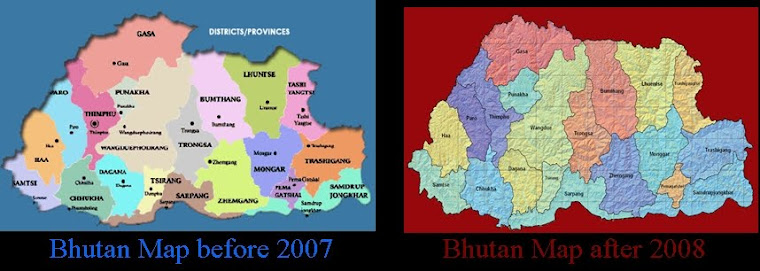
Click over the map to know the differences
Saturday, September 7, 2013
Bhutan-Nepal Joint verification Team

2003: Operation all Clear
|
 With the recent round of talks in Thimphu between the royal government and the ULFA and NDFB militant groups having failed to produce any positive results and the KLO not even responding to the royal governmentís invitation for dialogue, Bhutan may now have to implement the decision of the 81st session of the National Assembly. According to the Assembly resolution, the government must resort to military action if one final round of negotiations with the militants did not result in their agreement to close the main camps that serve as their central headquarters.
According to the home ministry the ULFA delegation, which had come for talks in October, had expressed their inability to decide on closing down their main camp saying that it would mean the closure of all their other camps inside Bhutan. They reasoned that without their central headquarters the rest of the camps would be completely untenable and that leaving Bhutan would be as good as giving up their cause for the independence of Assam.
"The ULFA delegation insisted that their executive council would have to discuss this matter and assured us that their top leadership would come back within the first week of December to convey their decision," said a member of the Bhutanese delegation that held negotiations with the ULFA.
The NDFB delegation, which came for talks with the royal government in the last week of November in Thimphu, had also conveyed that it would not be possible for them to leave Bhutan.
"The NDFB delegation told us that even if they left now because we told them to do so, they would have to come back and establish their camps in other parts of Bhutan," said a member of the Bhutanese delegation. "They said that it is up to Bhutan to weigh its relations with India, a relationship which has been in existence for a little more than 50 years, against the 2,000-year old fraternal relations with the Bodo people. Given such an attitude there is no scope for resolving the problem through dialogue with them."
Meanwhile, as pointed out by officials of the home ministry, several invitations for talks had been sent over the last three years but the KLO had not even taken the trouble to respond.
Speaking to Kuensel the prime minister and home minister, Lyonpo Jigmi Y. Thinley, said that, over the past six years, His Majesty the King and the royal government had made every effort to resolve the problem of the illegal presence of the militants from Assam and West Bengal through peaceful means.
"Since 1998, we have held five rounds of talks with the ULFA and three rounds with the NDFB," said Lyonpo Jigmi Thinley. "As the KLO had refused to respond to our invitation for talks, we sent a delegation led by the chairman of the royal advisory council to meet their middle level leaders in Lhamoizingkha in April this year and asked them to inform their top leaders to come for talks with the royal government.
During the third round of talks in June, 2001, the ULFA had agreed to close down four of their camps inside Bhutan by the end of the year. While four camps were closed down by December 31, 2001, as agreed by them, it had now been confirmed on the ground that these camps had all been relocated. Today, the ULFA had 13 armed military camps inside Bhutan while the NDFB had 12 camps, and the KLO five camps.
"We have always valued the warm and friendly age-old relations between the people of Bhutan and the peoples of Assam and West Bengal who are our immediate neighbours in India," said Lyonpo Jigmi Thinley. "That is why His Majesty the King and the royal government have shown extreme tolerance and patience since the time the militants entered Bhutan clandestinely, 12 years ago, and established their camps, initially without our knowledge. It is common knowledge among the people of Assam and West Bengal that the royal government of Bhutan has spared no effort to persuade the ULFA, NDFB, and KLO militants to leave our country peacefully."
Lyonpo Jigmi Thinley expressed his deep regret that the recent talks with the ULFA and the NDFB had failed to produce any results. Furthermore the top leadership of these two militant groups had refused to come for talks.
"It is with a very heavy heart, but without any choice, that I must admit that the long and arduous process of peaceful dialogue is coming to a close," said the prime minister. "This will leave the royal government no option but to entrust the Royal Bhutan Army with the sacred duty of removing the militants from our sovereign soil in accordance with the decision of the 81st session of the National Assembly."
Kuensel 15 December 2013
|
 December 20, 2003 - Five days after the launch of operations, Bhutan’s security forces have taken over the camps established in the country by the ULFA, NDFB, and KLO militants. Meanwhile the Bhutanese troops continue their efforts to flush out the Indian militants from the dense forests in the southern districts.
While both sides are reported to have suffered casualties, the total number of deaths and injuries are not yet known.
The three separatist groups, which had clandestinely crossed into Bhutan about 12 years ago, had established 30 camps across the southern belt of the country, between Daifam in the east to Samtse in the west. The ULFA had 13 camps, the NDFB 12 camps, and the KLO five camps.
Most of the camps were reported to be well fortified and the 3,000 militants heavily armed. The government has confirmed that, apart from armed women cadres, there were some wives and children of the militant leaders.
|
The operations began on December 15, after the government issued a 48-hour notice to the militants. It came after six years of negotiations during which the government tried to persuade the militants to leave Bhutan. “When all efforts at a peaceful solution failed the royal government, in the hopes of avoiding bloodshed, gave the militants 48-hour notice but this too was not heeded by any of the groups,” according to a government press statement this week. “It was, therefore, upon having exhausted all options to find a peaceful solution that the current action was taken.”
Military reports yesterday said that militants were still hiding in Bhutan, unable to flee into India because of the heavy presence of Indian troops along the border. India’s political and military leaders had announced early in the week that they had strengthened troops along the border to “intercept” fleeing militants.
The chief of army staff of the Indian army, General N C Vij, welcomed the move to flush out the militants who had been attacking targets in India. He said that the states of Assam and West Bengal were on “red alert” in case of retaliation by the militants. The general-officer-commanding-in-chief of the Indian army’s eastern command, Lt General J S Varma, also told Indian reporters that the militant leaders, including the ULFA chairman, Arobinda Rajkhowa, and the military chief, Paresh Barua, were hiding in Bangladesh.
The Indian army is providing helicopters to evacuate injured Bhutanese troops to nearby military hospitals.
The government is reported to be in close contact and consultations with the government of India.
On December 15 the announcement of the action against the militants was applauded by both houses of parliament in India. Indian foreign minister, Mr Yashwant Sinha, reported that Bhutan’s action would promote peace, stability, and security in the region and further cement the strong friendship and cooperation between India and Bhutan. “The government and people of India stand firmly and solidly behind the royal government of Bhutan at this critical juncture and would provide all necessary support as requested, until the task is completed,” Prime Minister Atal Behari Vajpayee said.
The ULFA is an insurgent outfit which is fighting for the independence of Assam from India, the NDFB is the Bodo group that wants an independent “Boroland” in Assam, and the KLO is a North Bengal-based outfit whose objective is to carve out a separate Kamtapur state from districts in Bengal and Assam. More than 10,000 lives have been lost since the groups began their separatist movements.
The ULFA and NDFB are believed to have moved into the Bhutanese forests in the early 1990s when the Indian army mounted two major operations against them.
“The royal government deeply regrets that the long and arduous process to find a peaceful solution leading to their departure from the country did not yield any fruit after six years of negotiations initiated by the government,” said the government’s official statement. “The government remains confident that the security forces of Bhutan will discharge their responsibility of flushing out the militants from Bhutanese soil which they have forcibly occupied for over 12 years.”
By Kinley Dorji
Bhutanese Army moves to flush out Indian militants
|
The prime minister, Lyonpo Jigmi Thinley, told the Bhutanese media this afternoon that the "valiant troops of the RBA" had begun to expel the Indian militants from their camps that were spread across the country's southern region, from Diafam in the east to Samtse in the west. Lyonpo Jigmi Thinley said that, by mid-day, the troops were able to overpower the central command headquarters of the ULFA, located at Phukaptong in Samdrup Jongkhar. This was the main camp of the ULFA which served as their central headquarters. "It is common knowledge for the citizens of Bhutan and, indeed, the people of Assam and West Bengal, that the royal government has exercised extreme patience and tolerance for a peaceful solution," he said. "It is, therefore, regrettable that the three groups refused to leave peacefully."
The relations between the people of Assam, West Bengal and Bhutan should not be hampered
|
"The people of Assam and West Bengal, who had been our close friends, are not our enemy," he added. "The relations between the people of Assam, West Bengal and Bhutan should not be hampered by this event." The prime minister appealed to the people not to indulge in "unprincipled news mongering" and rumours because "it could be harmful". This afternoon the Indian foreign minister, Mr. Yashwant Sinha, told the Indian parliament that the government of India strongly supported the military operations launched by the royal government of Bhutan against the Indian insurgent groups. He said the prime minister of India had conveyed to His Majesty the King that the government and the people of India stood firmly and solidly behind Bhutan at this critical juncture and would provide all necessary support, as requested, until the task was completed.
The Indian army was also taking necessary measures to intercept movement of militants from Bhutan into India, he said. He reminded the members of parliament that Bhutan had always assured the government of India that it would not allow its territory to be used for activities inimical to India's interest and added that the launch of military operations against Indian insurgent groups in Bhutan had struck a blow against terrorism and terrorist activities in the region.
The activity would foster peace, stability and security in the region and further cement the strong friendship and cooperation between India and Bhutan, he said.
Army operations continue
|
Five days after the launch of operations, Bhutan's security forces have taken over the camps established in the country by the ULFA, NDFB, and KLO militants. Meanwhile the Bhutanese troops continue their efforts to flush out the Indian militants from the dense forests in the southern districts. While both sides are reported to have suffered casualties, the total number of deaths and injuries are not yet known. The three separatist groups, which had clandestinely crossed into Bhutan about 12 years ago, had established 30 camps across the southern belt of the country, between Daifam in the east to Samtse in the west.
Military reports said that militants were still hiding in Bhutan, unable to flee into India because of the heavy presence of Indian troops along the border. India's political and military leaders had announced early in the week that they had strengthened troops along the border to "intercept" fleeing militants.
In Thimphu, the country's capital, the temperature does not rise above 10 degrees and during winter the mercury drops to minus 10 degrees. Up in northern Bhutan, the temperature sometimes drops to minus 20 degrees. "Who would like to fight in that kind of terrain, which is snow covered almost the entire year?" the Director of Foreign Affairs Yashey Dorji asked. "Security is the tightest ever. Everyone, including the visiting mediapersons, are advised not to venture into the markets unless it is absolutely necessary," a policeman posted at the gate in Samdrup Jongkhar on the Indo-Bhutan border said.
Bhutanese Army: Operations progessing as expected
|
The Royal Bhutan Army's operation to flush out the three Indian insurgent groups from Bhutan continues, the militants have been dislodged from all 30 camps and the camps burned and razed to the ground, according to a spokesman for the RBA.
A large arsenal of weapons and sophisticated communication equipment was recovered. A senior RBA officer said that more than 500 AK 47/56 assault rifles and 328 other assorted weapons including rocket launchers and mortars, along with more than 100,000 rounds of ammunition, were found or confiscated. An anti-aircraft gun was also found at the site of the GHQ of the ULFA.
Meanwhile the women and children who had been living in the camps - wives and children of senior leaders and cadres of the three insurgent groups - were handed over by the Bhutanese civil authorities to their counterparts from Assam and West Bengal. Earlier this week three injured militants, who were initially treated by the RBA in the military hospital at Deothang, had been evacuated by helicopter for further treatment.
The RBA confirmed that the ULFA had 14 camps: 10 in Samdrup Jongkhar district, three in Sarpang district, and one in lower Zhemgang. The NDFB had 11 camps: four in Sarpang and seven in Samdrup Jongkhar. The KLO had one camp in Samdrup Jongkhar, one in Kalikhola dungkhag, and three in Samtse district.
The RBA spokesman said that the efforts to flush out the militants from Bhutanese soil were progressing as expected.
The prime minister said he was deeply conscious that, as Indian nationals, the members of the insurgent outfits also had kith and kin among the innocent people in Assam and West Bengal. He added that special efforts had been made and taken care to ensure that the women and children did not come to any harm and that they were well taken care of before being handed over to the civilian authorities in Assam. Wounded militants had also been given medical treatment.
The prime minister said he was deeply conscious that, as Indian nationals, the members of the insurgent outfits also had kith and kin among the innocent people in Assam and West Bengal. He added that special efforts had been made and taken care to ensure that the women and children did not come to any harm and that they were well taken care of before being handed over to the civilian authorities in Assam. Wounded militants had also been given medical treatment.
The prime minister described the people of Assam and West Bengal as the age-old fraternal brothers and sisters of the Bhutanese people with whom they had always shared a mutually beneficial socio-economic relationship and a highly cherished fraternity. The prime minister said His Majesty the King desired that the people on both sides of the border could soon return to their daily lives and strive for development and economic progress in a peaceful and stable environment.
RBA makes good progress in flushing out operations
|
January 03, 2004
The last of the 30 camps that were established on Bhutanese soil by the three separatist groups from India was burnt down and the operation to flush out the militants who were dislodged from these camps was making good progress, according to Royal Bhutan Army sources. In addition to the 30 camps, 35 observation posts of the militants were destroyed.
The last of the 30 camps that were established on Bhutanese soil by the three separatist groups from India was burnt down and the operation to flush out the militants who were dislodged from these camps was making good progress, according to Royal Bhutan Army sources. In addition to the 30 camps, 35 observation posts of the militants were destroyed.
 |
Weapons, including an antiaircraft gun (right), ammunition, and communication equipment recovered by the RBA
The ULFA camp at Goburkonda, in lower Zhemgang, was taken over by the RBA three days ago and was burnt down yesterday.
|
"The Goburkonda camp, located on the Bhutanese side of the Manas Wildlife Sanctuary, was subjected to mortar fire during the operations on December 15 when the operations were carried out against all the camps between Daifam and Samtse," said a senior officer at RBA headquarters. "We had left the physical attack on this ULFA camp for a later date because of a shortage of troops. Now there is not a single camp of the militants inside Bhutanese territory and we are flushing out the remaining militants who escaped from the camps and are hiding in the rugged jungle terrain in the border areas."
The RBA spokesman told the national newspaper "Kuensel" that, among other items, they had recovered three television sets, a generator, and 20 metric tonnes of rice from the Goburkonda camp. He also said that the flushing out operations have resulted in the capture of 24 militants during the past week. While the Royal Bhutan Army would not give any figures of the casualties suffered by both sides the spokesman said that every effort had been made to keep casualties as low as possible.
"Our objective was to remove the presence of the militants and their camps from our soil and we have tried our best to do that with the minimum loss of lives on both sides," he added. "After all, as Indian nationals from Assam and West Bengal, the militants and their kith and kin are our immediate neighbours with whom the Bhutanese people have always enjoyed close fraternal bonds."
The prime minister, Lyonpo Jigmi Thinley, said that the Bhutanese people were most relieved that the situation in most of the security affected areas had been restored to normalcy and paid tribute to the Bhutanese security troops for carrying out the sacred responsibility entrusted to them, as a last resort, with complete dedication. "His Majesty the King has always maintained that the role of the army is not to make war but to keep peace," he said. "Our troops have shown that, under the leadership of His Majesty, they are prepared to defend the security and territorial integrity of the nation with their lives. Today, the Bhutanese people have an overwhelming sense of pride and appreciation for our courageous troops."
The prime minister also expressed the deep appreciation of the government and people of Bhutan for the full support and cooperation extended by India. "All sections of the population of India have been very supportive and I am confident that the excellent relations between the two countries will continue to grow and strengthen."
Meanwhile His Majesty the King returned to Thimphu last Sunday while His Royal Highness the Crown Prince, Dasho Jigme Khesar Namgyal Wangchuck, is visiting the officers and soldiers of the Royal Bhutan Army in the security affected areas.
.....................
|
 December 27, 2003 - As the Royal Bhutan Army’s operation to flush out the three Indian insurgent groups from Bhutan continues, the militants have been dislodged from all 30 camps and the camps burned and razed to the ground, according to a spokesman for the RBA.
A large arsenal of weapons and sophisticated communication equipment was recovered. A senior RBA officer told Kuensel that more than 500 AK 47/56 assault rifles and 328 other assorted weapons including rocket launchers and mortars, along with more than 100,000 rounds of ammunition, were found or confiscated. An anti-aircraft gun was also found at the site of the GHQ of the ULFA.
While there were casualties on both sides since the operation began on December 15, the RBA has not released the figures.
Meanwhile the women and children who had been living in the camps – wives and children of senior leaders and cadres of the three insurgent groups - were handed over by the Bhutanese civil authorities to their counterparts from Assam and West Bengal.
Earlier this week three injured militants, who were initially treated by the RBA in the military hospital at Deothang, had been evacuated by helicopter for further treatment.
The RBA confirmed that the ULFA had 14 camps: 10 in Samdrup Jongkhar district, three in Sarpang district, and one in lower Zhemgang. The NDFB had 11 camps: four in Sarpang and seven in Samdrup Jongkhar. The KLO had one camp in Samdrup Jongkhar, one in Kalikhola dungkhag, and three in Samtse district.
The RBA spokesman told Kuensel that the efforts to flush out the militants from Bhutanese soil were progressing as expected. “It is the sacred responsibility of the armed forces of Bhutan to safeguard the security of our country and we have been making efforts to remove the militants from Bhutanese soil as quickly as possible, in keeping with the directives and decisions of the royal government and the National Assembly,” he said. “At the same time the Royal Bhutan Army is very conscious of the fact that the militants are Indian nationals and we have been making every effort to conduct the flushing out operations with the minimum loss of lives on both sides.”
The prime minister, Lyonpo Jigmi Thinley, said that the royal government had made every effort to avoid taking military action. “It was with deepest regret that I had to acknowledge the failure of the prolonged process to find a peaceful solution,” he said. “Giving the responsibility of removing the three Indian insurgent groups from Bhutanese soil to the Royal Bhutan Army was indeed painful. Yet, having exhausted all non military options and endeavours over an extended period of six long years, the implementation of several successive decisions of the National Assembly to exercise the military option could no longer be averted.”
Lyonpo Jigmi Thinley said that the ULFA and the NDFB were extremely obstinate and uncompromising. “They maintained that they could not leave until they had fulfilled the objective of achieving independence from India,” he said. “In effect that meant their perpetual presence in Bhutan. The KLO, which also wants to carve an independent state from India, did not even make the effort to come for talks.”
“Quite clearly, the presence of the separatist groups from India was not only harming the interests of Bhutan but those of our friend and neighbour, India. This is something that no Bhutanese is prepared to tolerate under any circumstances.”
Referring to the casualties including fatalities on both sides, Lyonpo Jigmi Thinley said that it was “most regrettable”. “It could have been avoided had reason and wisdom on the part of the insurgents met with the patience, tolerance and hope that the Bhutanese had shown and harboured.
The prime minister said he was deeply conscious that, as Indian nationals, the members of the insurgent outfits also had kith and kin among the innocent people in Assam and West Bengal. He added that special efforts had been made and taken care to ensure that the women and children did not come to any harm and that they were well taken care of before being handed over to the civilian authorities in Assam. Wounded militants had also been given medical treatment.
The prime minister described the people of Assam and West Bengal as the age-old fraternal brothers and sisters of the Bhutanese people with whom they had always shared a mutually beneficial socio-economic relationship and a highly cherished fraternity. “I hope that the people of India will understand and appreciate the compulsion under which the royal government resorted to the unfortunate course of action that could no longer be avoided,” he said.
The prime minister said His Majesty the King desired that the people on both sides of the border could soon return to their daily lives and strive for development and economic progress in a peaceful and stable environment.
By Kinley Dorji
.................................
Thursday, August 8, 2013
Obama’s “Asia Pivot”: The Himalayan Angle
The Obama administration’s «Asia Pivot» is playing out in earnest in joint U.S.-Indian-Israeli intelligence operations in the Himalayan region. The actions by the three cooperative nations’ intelligence agencies are aimed at limiting Chinese influence here. The strategy in the mountainous area of the Sino-Indian border complements other U.S. strategies now being played out in the East China Sea, the Yellow Sea, the South China Sea, the South Pacific, and the Indian Ocean to box in China and prevent it from challenging America’s military presence in the Asia-Pacific region…
The most recent covert operation in the encirclement of China played out in the recent election in the Buddhist Himalayan Kingdom of Bhutan. Under its previous government, led by the first democratically-elected Prime Minister, Jigmi Y. Thinley, Bhutan championed the concept of «Gross National Happiness,» which measured the progress of a nation based on the happiness and well-being of its people rather than by cold economic figures and statistics. Thinley traveled to the UN General Assembly in 2012 to urge the world’s nations to adopt Gross National Happiness as a principal in running their economies.
Such a notion of Gross National Happiness is anathema to the globalist economists and bankers that infest the World Bank, International Monetary Fund, and worldwide central banks, and these institutions took note of Thinley’s proposal for a New Bretton Woods system to replace the current domination of the world economy by the World Bank and IMF. However, it was primarily Bhutan’s alteration of its traditional Indian-directed foreign policy that spelled ultimate doom for Thinley.
Thinley committed an unforgivable sin in New Delhi’s eyes by exerting a degree of foreign policy independence from India by opening up direct talks with China and considering establishing diplomatic relations with Russia and other nations. Thinley had already established diplomatic ties with 32 nations, a move that caused distress in New Delhi. Bhutan’s foreign policy independence was a bridge too far for the intelligence alliance of India’s Research and Analysis Wing (RAW), the U.S. Central Intelligence Agency (CIA), and Israel’s Mossad. Plans were put into motion to dump Thinley in the scheduled Bhutanese election and replace him with someone with more pro-India and anti-China credentials.
In 1975, U.S. Secretary of State Henry Kissinger gave India’s Prime Minister Indira Gandhi a «wink and a nod» when RAW staged phony protests against the Chogyal (King) of Sikkim, a semi-independent nation to the west of Bhutan that was attempting to exercise more independence from New Delhi. Sikkim’s Gyalmo (Queen) was American-born Hope Cooke, a New York debutant who married Sikkim’s King. The King of Sikkim, who was related to the Bhutanese royal family, had attempted to follow Bhutan into the United Nations as a member state. India staged anti-royal and anti-Buddhist demonstrations by Hindi Nepali residents of Sikkim and eventually sent in the Indian army to not only «restore order» but overthrow the King and declare Sikkim to be an integral state of India. Ever since the absorption of Sikkim into India, CIA station chiefs in New Delhi have kept track of attempts by Sikkimese, especially Bhutia and Lepcha Buddhists, former royalists, and some anti-India local politicians, to reassert the occupied nation’s independence from India.
Thanks to the revelations of National Security Agency (NSA) whistleblower Edward Snowden, independence-minded political leaders in Bhutan, Sikkim, and Nepal are now aware that a system code-named XKEYSCORE, which operates from a CIA/NSA Special Collection Service operations center at the U.S. embassy in New Delhi, intercepts satellite and Internet traffic transmitted to and from the Indian subcontinent, including the countries and territories of the Himalayan region. The presence of XKEYSCORE in New Delhi is primarily aimed at the strategically-important Himalayan region, as well as China to the north. Based on the close links between the CIA and RAW and NSA’s use of Israeli-developed interception technology, the intelligence services of India, the U.S., and Israel have virtually unimpeded access to all the communications of the Himalayan region. Therefore, Thinley and his government in Bhutan, advocates of Gross National Happiness, were up against Gross International Surveillance.
Undoubtedly, the NSA/CIA XKEYSCORE operation at the U.S. embassy in Brasilia was surged against the delegations of Thinley and Chinese Prime Minster Wen Jiabao before and after they met last year in Rio de Janeiro at the Rio plus 20 Summit. The two leaders agreed to begin negotiations on establishing diplomatic relations between Beijing and Thimphu, agree to demarcate their common border, and to have China push for Bhutan as a non-permanent member of the UN Security Council. All of these notions were non-starters for New Delhi and its American and Israeli allies.
The United States, which has refined the art of interfering with elections to a science, thanks to the global use of agents agitateurs financed by George Soros on behalf of the CIA, and India, which successfully interfered with elections in Sikkim prior to and after the Indian invasion, pooled their resources to guarantee a reversal of course in Bhutan. The pro-Indian candidate for Prime Minister, Tshering Tobgay of the People’s Democratic Party (PDP), trounced Thinley’s Druk Phuensum Tshogpa (DPT) party in the election, winning 32 of 47 parliamentary seats . Tobgay’s first action was to stop Bhutan’s outreach to other countries like China and Russia, and pledge total loyalty to India. That course also pleased Washington, which could devote its resources to other flash points on China’s borders and not worry about Bhutan.
Israel’s interests in the Himalayan region are murky. Several thousands of ethnic Mizo, Kuki, and Chins peoples in India’s northeast claim to be Jews, the Bnei Menashe, descendant from one of the so-called «Lost Tribes» of Old Testament folklore. In fact, Jewish proselytizers appeared in the region in the 1980s and began poaching Christian Mizos, Kukis, and Chins for conversion to Judaism in order to extend Israel’s political influence in the region and recruit new settlers to occupy Israel’s ill-gotten territories in the Middle East.
The claims of the Bnei Menashe are, therefore, specious. However, many thousands have emigrated to Israel after being declared «Jewish» by some rabbinical authorities and they are being moved into West Bank settlements to supplant Palestinians. Other Bnei Menashe remain in northeast India, where they give religious cover to many thousands of Israeli Mossad and Israel Defense Force personnel, most said to be former or reserve lDF members, who have become more and more active in the entire Himalayan region, particularly around the Tibetan government-in-exile community in Dharamsala, India. Kibbutzes and Chabad facilities are springing up all over northeastern India, all run by Israeli nationals, many with ties to Israeli intelligence and military branches. Israel has helped establish in Mizoram a political party, the Ephraim Union, which advocates conversion of all Mizos to Judaism and the establishment of a Jewish independent state in Mizoram. It claims India’s sovereignty over Mizoram was only to continue for ten years after India’s independence from Britain in 1947. In the 2008 election for the Indian Lok Sabha lower house of parliament, the party received a mere 1.87 percent of the vote.
Israel has obvious designs on other parts of the region. A Hindu political party, Panun Kashmir, which demands a separate Hindu state among the majority of Muslims in the Valley of Kashmir, suspiciously uses a white Star of David on its orange flag.
It is also no coincidence that Israel is now India’s second largest supplier of weapons. Mizoram, the location of many Bnei Menashe, is also the location of the Counter Insurgency and Jungle Warfare School (CIJW) in Vairengte where Indian, American, Israeli, Bhutanese, Nepali, and other allied special operations personnel jointly train in military operations.
RAW, the CIA, and Mossad are equally active in increasingly fragmented Nepal, where the priority has been to limit the political power of the Maoist political party. From primarily Buddhist Gilgit-Baltistan in Pakistan’s far north to Buddhist Ladakh in Kashmir, to Sikkim and Bhutan, and further east into Myanmar, there is a grab for influence between various parties that have committed to either side in a forthcoming Asia-wide conflict between the West and China.
Wayne MADSEN is an investigative journalist, author and syndicated columnist. Has some twenty years experience in security issues. As a U.S. Naval Officer, he managed one of the first computer security programs for the U.S. Navy. He has been a frequent political and national security commentator on Fox News and has also appeared on ABC, NBC, CBS, PBS, CNN, BBC, Al Jazeera, and MS-NBC. He has been invited to testify as a witness before the US House of Representatives, the UN Criminal Tribunal for Rwanda, and an terrorism investigation panel of the French government. A member of the Society of Professional Journalists (SPJ) and the National Press Club. Lives in Washington, D.C.
The most recent covert operation in the encirclement of China played out in the recent election in the Buddhist Himalayan Kingdom of Bhutan. Under its previous government, led by the first democratically-elected Prime Minister, Jigmi Y. Thinley, Bhutan championed the concept of «Gross National Happiness,» which measured the progress of a nation based on the happiness and well-being of its people rather than by cold economic figures and statistics. Thinley traveled to the UN General Assembly in 2012 to urge the world’s nations to adopt Gross National Happiness as a principal in running their economies.
Such a notion of Gross National Happiness is anathema to the globalist economists and bankers that infest the World Bank, International Monetary Fund, and worldwide central banks, and these institutions took note of Thinley’s proposal for a New Bretton Woods system to replace the current domination of the world economy by the World Bank and IMF. However, it was primarily Bhutan’s alteration of its traditional Indian-directed foreign policy that spelled ultimate doom for Thinley.
Thinley committed an unforgivable sin in New Delhi’s eyes by exerting a degree of foreign policy independence from India by opening up direct talks with China and considering establishing diplomatic relations with Russia and other nations. Thinley had already established diplomatic ties with 32 nations, a move that caused distress in New Delhi. Bhutan’s foreign policy independence was a bridge too far for the intelligence alliance of India’s Research and Analysis Wing (RAW), the U.S. Central Intelligence Agency (CIA), and Israel’s Mossad. Plans were put into motion to dump Thinley in the scheduled Bhutanese election and replace him with someone with more pro-India and anti-China credentials.
In 1975, U.S. Secretary of State Henry Kissinger gave India’s Prime Minister Indira Gandhi a «wink and a nod» when RAW staged phony protests against the Chogyal (King) of Sikkim, a semi-independent nation to the west of Bhutan that was attempting to exercise more independence from New Delhi. Sikkim’s Gyalmo (Queen) was American-born Hope Cooke, a New York debutant who married Sikkim’s King. The King of Sikkim, who was related to the Bhutanese royal family, had attempted to follow Bhutan into the United Nations as a member state. India staged anti-royal and anti-Buddhist demonstrations by Hindi Nepali residents of Sikkim and eventually sent in the Indian army to not only «restore order» but overthrow the King and declare Sikkim to be an integral state of India. Ever since the absorption of Sikkim into India, CIA station chiefs in New Delhi have kept track of attempts by Sikkimese, especially Bhutia and Lepcha Buddhists, former royalists, and some anti-India local politicians, to reassert the occupied nation’s independence from India.
Thanks to the revelations of National Security Agency (NSA) whistleblower Edward Snowden, independence-minded political leaders in Bhutan, Sikkim, and Nepal are now aware that a system code-named XKEYSCORE, which operates from a CIA/NSA Special Collection Service operations center at the U.S. embassy in New Delhi, intercepts satellite and Internet traffic transmitted to and from the Indian subcontinent, including the countries and territories of the Himalayan region. The presence of XKEYSCORE in New Delhi is primarily aimed at the strategically-important Himalayan region, as well as China to the north. Based on the close links between the CIA and RAW and NSA’s use of Israeli-developed interception technology, the intelligence services of India, the U.S., and Israel have virtually unimpeded access to all the communications of the Himalayan region. Therefore, Thinley and his government in Bhutan, advocates of Gross National Happiness, were up against Gross International Surveillance.
Undoubtedly, the NSA/CIA XKEYSCORE operation at the U.S. embassy in Brasilia was surged against the delegations of Thinley and Chinese Prime Minster Wen Jiabao before and after they met last year in Rio de Janeiro at the Rio plus 20 Summit. The two leaders agreed to begin negotiations on establishing diplomatic relations between Beijing and Thimphu, agree to demarcate their common border, and to have China push for Bhutan as a non-permanent member of the UN Security Council. All of these notions were non-starters for New Delhi and its American and Israeli allies.
The United States, which has refined the art of interfering with elections to a science, thanks to the global use of agents agitateurs financed by George Soros on behalf of the CIA, and India, which successfully interfered with elections in Sikkim prior to and after the Indian invasion, pooled their resources to guarantee a reversal of course in Bhutan. The pro-Indian candidate for Prime Minister, Tshering Tobgay of the People’s Democratic Party (PDP), trounced Thinley’s Druk Phuensum Tshogpa (DPT) party in the election, winning 32 of 47 parliamentary seats . Tobgay’s first action was to stop Bhutan’s outreach to other countries like China and Russia, and pledge total loyalty to India. That course also pleased Washington, which could devote its resources to other flash points on China’s borders and not worry about Bhutan.
Israel’s interests in the Himalayan region are murky. Several thousands of ethnic Mizo, Kuki, and Chins peoples in India’s northeast claim to be Jews, the Bnei Menashe, descendant from one of the so-called «Lost Tribes» of Old Testament folklore. In fact, Jewish proselytizers appeared in the region in the 1980s and began poaching Christian Mizos, Kukis, and Chins for conversion to Judaism in order to extend Israel’s political influence in the region and recruit new settlers to occupy Israel’s ill-gotten territories in the Middle East.
The claims of the Bnei Menashe are, therefore, specious. However, many thousands have emigrated to Israel after being declared «Jewish» by some rabbinical authorities and they are being moved into West Bank settlements to supplant Palestinians. Other Bnei Menashe remain in northeast India, where they give religious cover to many thousands of Israeli Mossad and Israel Defense Force personnel, most said to be former or reserve lDF members, who have become more and more active in the entire Himalayan region, particularly around the Tibetan government-in-exile community in Dharamsala, India. Kibbutzes and Chabad facilities are springing up all over northeastern India, all run by Israeli nationals, many with ties to Israeli intelligence and military branches. Israel has helped establish in Mizoram a political party, the Ephraim Union, which advocates conversion of all Mizos to Judaism and the establishment of a Jewish independent state in Mizoram. It claims India’s sovereignty over Mizoram was only to continue for ten years after India’s independence from Britain in 1947. In the 2008 election for the Indian Lok Sabha lower house of parliament, the party received a mere 1.87 percent of the vote.
Israel has obvious designs on other parts of the region. A Hindu political party, Panun Kashmir, which demands a separate Hindu state among the majority of Muslims in the Valley of Kashmir, suspiciously uses a white Star of David on its orange flag.
It is also no coincidence that Israel is now India’s second largest supplier of weapons. Mizoram, the location of many Bnei Menashe, is also the location of the Counter Insurgency and Jungle Warfare School (CIJW) in Vairengte where Indian, American, Israeli, Bhutanese, Nepali, and other allied special operations personnel jointly train in military operations.
RAW, the CIA, and Mossad are equally active in increasingly fragmented Nepal, where the priority has been to limit the political power of the Maoist political party. From primarily Buddhist Gilgit-Baltistan in Pakistan’s far north to Buddhist Ladakh in Kashmir, to Sikkim and Bhutan, and further east into Myanmar, there is a grab for influence between various parties that have committed to either side in a forthcoming Asia-wide conflict between the West and China.
Wayne MADSEN is an investigative journalist, author and syndicated columnist. Has some twenty years experience in security issues. As a U.S. Naval Officer, he managed one of the first computer security programs for the U.S. Navy. He has been a frequent political and national security commentator on Fox News and has also appeared on ABC, NBC, CBS, PBS, CNN, BBC, Al Jazeera, and MS-NBC. He has been invited to testify as a witness before the US House of Representatives, the UN Criminal Tribunal for Rwanda, and an terrorism investigation panel of the French government. A member of the Society of Professional Journalists (SPJ) and the National Press Club. Lives in Washington, D.C.
Sunday, August 4, 2013
Former PM of Bhutan submits resignation after his party lost the election
 After results declaration: On his return journey from the east Jigmi Y Thinley thanks party workers and voters at one of the stops for their support
NA speaker says he would have to study the reasons for resignation to accept it
NA: The former prime minister and Druk Phuensum Tshogpa president Jigmi Y Thinley has submitted his resignation.
Since the speaker had not yet been elected then, Jigmi Y Thinley had put in his resignation on July 31 through the National Assembly secretary to the speaker.
A provision in the National Assembly Act states that should a member wish to resign his or her seat when the house is not in session, it should be to the secretary general that the resignation is addressed.
Jigmi Y Thinley wished not to specify the reasons for his decision, which he feared would only be subject to more nitpicking over tiny details and subsequent germination of speculations from certain sections of the public.
The letter is, however, subject to acceptance by the speaker, who was elected on August 2 during the first sitting of the second Parliament.
Recently elected speaker Jigme Zangpo said he would look at the resignation letter today, the day he formally takes office and carefully study the reasons for the member’s application for resignation.
“While I’ll be guided by law, there are many concerns,” he said. “What if the law is not so clear, what happens then?”
National Assembly Act lays down four reasons –resignation, death, disqualification or removal, or expiration of term of office – for an elected member’s seat to be considered vacant.
Apart from that, a member’s seat would also be declared vacant if he or she remains absent for more than one-fourth of the number of days in the session without the assembly’s permission.
One of the concerns on his mind, Jigme Zangpo said was the precedent such actions today would set.
“We’ll have to see because if a candidate wins but the party it represents loses and if he or she wishes to resign and we allow it, what precedent will that set?” he said. “It makes me think of the 2008 case when there were only two member opposition, what if they wanted to resign.”
The resignation, should it be accepted, would mean that the office of a member is vacant much before the expiration of its five-year term, under which circumstance a writ for an election, National Assembly Act stipulates, to fill the vacancy would be issued within a month of its occurrence.
The same rules and laws prescribed in the election Act would apply in the case of bye-election, as it would apply to the real elections.
The election of a member to fill the vacancy, election Act states would be held within 90 days from the date of the vacancy’s occurrence.
By Samten Wangchuk
Subscribe to:
Posts (Atom)