The Sorry Saga of Bhutan's North

The Sorry Saga of Bhutan's North
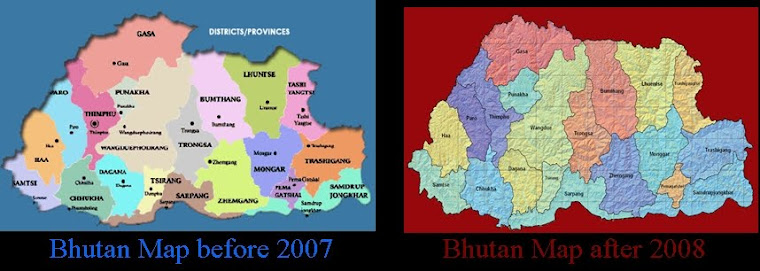
Click over the map to know the differences

Saturday, December 8, 2018

Exile groomed journalists inscribe struggle

Published on Jul 21 2009 // COMMENTARY
By Govinda Rizal
For any book to survive and perform well in today’s market, when the cyber store has piles of freely accessible information, it’s content must be of  interest un-accessible through  internet browsing. This criterion is highly upheld by TP Mishra’s “Becoming a journalist in exile”.

The first of the four parts may, at first, appear deceitful to the readers who have bought the book under the influence of its cover.  It resembles a college guy’s pocket note for a final viva-voce.  But before reaching the last page the readers feel that this part had cemented the gaps in the subsequent chapters, shortening length through reduction of repetitions and footnotes. It provides a pleasant coffee-time go-through material to anyone novice to journalism, and does not make idiot of the professionals. The basic concepts offer an abridged bible of journalism. While it makes the novice grab the pen and begin scratching words for articles, it also makes the professionals crease their faces recalling serious overlook in their previous write ups. The unique language structures and snaky sentences may even irritate a niggling orthodox grammarian. The sentence structures must be unique even to native English speakers, but there is little for them to spend red ink. It has broken many of the established rules of English grammar.

The second section explains the scenario of media in Bhutan. The status of media in Bhutan is blended with the struggle for democracy. Media in exile together with its concept began in early 1990s along with the start of the eviction of Bhutanese from their country. Initial papers carried and promoted voices of dissidents. Many short-lived papers represented minority views, whose contents passed through ideology coating rather than through journalist editing. Financial predicaments affected their regularity and continuity. In many instances, on top of the financial crunches, the then political and human right leaders and local administration officers are accused of hammering the publication to shut down. The Sangrila Sandesh, aborted in its infancy, when the British NGO Photo Voice, which supported since its launch, pulled down its scaffold on pretext of carrying politically biased contents.

Covering news inside refugee camp demands extra journalistic abilities and qualities of conviction, language, rapport and perseverance. Besides facing the crunches of deprivation in refugee camps, the Bhutanese media personal are also in a desert of support from local authorities. The refugee publication lack legal support. Lack of registration and valid identity cards add acid into the wounds left behind by the economic, political and technological hammers. The book also carries a fleeting mention of an incarceration of a refugee photo journalist to seven and half years by his government for taking snaps of a police post.

The readers’ expectations of success stories from the book may change with realization of the sorry state of Bhutanese media in exile, when the notable successful events include: publication of annual reports, getting their reports mentioned in the reports of International Federation of Journalists, getting affiliated to Third World Media Network, coming together of media organizations on to a common platform, etc. Although there is no climax in this book, this section, for sure, offers a striking anti climax. Limited numbers of pictures are made to speak volumes, which they have successfully done.

tp-book-cover-front-for-web1Many banners of short lived journals, magazines and news prints, in Nepali and English, are available, today, for mention and to share credits of media popularization and literature development. Their impacts were more than their contents. Their fateful demise has left behind fountain of inspiration and lessons for the present day media workers. The numerous attempts and short-lived success stories have successfully accumulated to the present three media organizations operating in exile namely, Bhutan Chapter of Third World Media Network, Association of Press Freedom Activists (APFA) and Bhutan Press Union, who came to a mutual arena after signing Declaration De Exile in 2007. APFA news with its Bhutan News Service (BNS) has gone online. BNS also runs a 30 minute radio program ‘refugee concern’ in Kathmandu based Nepal FM. The most widely read ‘Bhutan Jagaran’ a fortnightly Nepali vernacular, has resumed its pace after resurrection. A monthly ‘The Bhutan Reporter’ is celebrating its sixth year of continuous hard copy print. On the scene are monthlies ‘Nawlo Awaz’, Yug Awaz’, and “The Class Struggle” propping communist ideology.

Although the book seriously lacks the history of media, especially the presence of effective local and mass communication system of  the ancient and medieval days, the  authors have strategically filled up the gap with the continuous stories. What so ever, a decent mention of the role and system of Gainees- the singers; Jogis- the night pied pipers; katwals- the messengers etc. would not have undone the scope of the book. .

The last two sections carry proficient scrutiny and scorched experiences of veteran journalists. The authors are on the way to create a distinct vision to which they appear to be close to target. In the media and its role, the author sermons a sweet prophesy, to sooth himself, that internet can bring together all sections of his community and serve as a conduit for communication and a connector.

The readers will have to complete the book or even meditate after that to find out what the book is preparing the reader to be: an honest journalist, a sting journalist who go down to whistle blowing to spying, or an opinion builder.

How neutral? David Brewer takes time to define an activist as someone who pushes a cause without aiming to reflect an alternative view, and raises a question whether a journalist can also be an activist for a freedom of expression and still remain objective and impartial. He considers two types of journalists. First type who are taken out and wined and dined by powerful and influential, and the second type who are simply taken out with bullets and bombs. As R. P. Subba writes “Corruption is reportedly rampant in the corridors of Tashichho dzong, as well as in the lanes of refugee camps”; neutrality may not be non alignment with either of contradictory parties as much as pinpointing the involved parties for their over or under doings.

It is surprisingly unexpected that a book compiled and edited by the journalist of a media organization banned in his country, is free from anger and revengeful expressions against his government. “Bhutan’s education system hailed as the best in South Asia failed to produce conscious citizenry” is too mild to underscore the gravity of the fact.

Writers’ modesties are apparent throughout the book. “If length of service equals experience, then I guess I qualify as an experienced journalist” writes David Brewer. He further adds “However, as far as certificates go, my walls are bare”.

Nanda Gautam’s experiences burden readers to seek control of their heart beat, choking breath and tear falls. He explains the effect of his audacious reporting in Bhutan. Nanda Gautam, a radio journalist of government run national broadcast, joins an affluent inauguration of a bridge. He sees laborers, who built the bridge, chased away during luncheon. He reaches to them and records their stories. An old Brahmin man’s properties were confiscated, and he was deceitfully forced to join the national work force under the Home Ministry. A promise of extra land, house, and loan after 10 years of blue color service never materialized. Other, a  Tamang  couple with an infant, victimized by the people from the western part of the country who usurped their land, were weak and sick through cruel treatment in the construction works. Mr. Gautam aired the news to get immediate but negative results. While he was threatened to death, the laborers were made to meet it, all for speaking the truth.

Deepak Adhikari, a Nepalese journalist’s memoir takes the readers to Pittsburg in USA, where he finds Nepali speaking Bhutanese. Together they end the nostalgia to speak in their common native language.

Subir Bhaumik’s “Journalism: Rising above identity barriers” is a complete non Bhutan article. He explains the fact and façade behind the influence of identity on journalism with his experiences in the communal riots in Tripura and Assam. His gradual but early rise against the identity barriers in journalism, through three decades, has established him as the most widely read and appreciated columnist by both bitter rivals, Bengalis and Assamese in Assam.

Towards the end, a relief comes to the reader, when Laura Elizabeth Pohl, slips a few lines in praise of the Bhutanese refugee journalist running newspaper in Nepal. She writes “only a few had formal journalism training. They certainly did not have a lot of money. What they did have though, was mentors, readers and a drive to provide informative and interesting news to their readers. Their editorial meeting was as spirited and serious as any I have attended at American magazines and newspapers”

On top of all there is a cause over the cost. The proceeds from the book go to the development of media only.

(The writer is doing his PhD on Improvement of Protein Quality in Soybean Through Gene Modification from Kyoto University, Japan.)

http://apfanews.com/commentary/exile-groomed-journalists-inscribe-struggle.html


An Open letter to the Bhutanese parliamentarians

Published on Nov 20 2009 // OPINION
Date: November 19, 2009 (6:30 GMT)
Dear Parliamentarians,
On the eve of the 4th session of the first Bhutanese parliament, we want to put forth the immediate concern of the Bhutanese people both inside the country and in exile. The historical importance of your deliberations will be judged by the historians as well as by the Bhutanese people. It is important to bring some of the pertinent issues to discussion before it is late.
A state comprises of the people, the land, a government and sovereignty. In absence of any of these, the state ceases to exist.  The land has a fixed border. The people belong to the state as state belongs to the people. In case of Bhutan, however, the border is constricting and the citizens are expelled from country to statelessness. The authority is in the hands of a few people, who are neither able to fend off external pressures and prevent incursion, nor are they able to appease the people inside.
This letter aims to draw the attention of ‘you’, the elected representatives of a sovereign parliament to some of the crucial issues that need your intervention.
Before proceeding into other issues, we urge you to deliberate on the issues of people, country, king and the sovereignty. You, the present parliamentarians, who should be responsible for the welfare of the people, integrity and sovereignty of the nation should also correct the mistakes and iniquitous deeds of the past governments and lay foundation for a friction free future for Bhutan and the Bhutanese people.
People and Democracy
The people of Bhutan chose to come together and stay united under the leadership of one man- Sir Ugyen Wangchuck to avert the then prevalent forces of colonization. A unitary leadership was necessary to consolidate political unity and maintain regional stability in a country torn apart by political feud and civil wars. After the WW1, Bhutan chose neutral position which led to self isolation. Bhutan’s isolation that time was a necessity born of insulating the country against the colonizers. After the WW2, the voices of democracy began to be heard. In Bhutan, the wake up calls for democracy rang as early as 1950s. Bhutan may have escaped from becoming a colony but it could not immunize itself against the wave of ‘democracy’ that swept the subcontinent at that time. Although the voices were brutally silenced, some reforms did follow the event; parliament was started, judiciary system appeared, slavery system was abolished and many positive developments took place.
At the time when Berlin wall was being deposed and USSR was cracking into fragments, the call for democracy was resonating in Bhutan. Many people may link these global changes to be the catalysts of political unrest in Bhutan. In reality, it was Bhutan’s own political misadventures and its unfriendly treatment of its citizens that turned the country into a political ferment. People’s voice was silenced again using brute force. The people who professed and supported democracy were killed, imprisoned or deprived of rightful living in the country. Worst of all, political and human rights activists were punished through eviction and in a demonic manifestation of brutality, their family members were coerced to leave country at gunpoint. Each one of you is an eye witness to the scene. The wounds are fresh and the scars are yet to appear. The rulers in order to secure their position in the power blotted out the political opponents from the country systematically. When the pressure on the rulers and the government was mounting from all directions, face saving strategy was chalked out. Democracy was ‘proclaimed from the palace’ instead of being ‘declared by the Bhutanese people’. The same people who were accustomed to and benefited from the autocratic system and were against democracy were retained to facilitate old ways in new system. Thus Bhutan’s political machinery retains the former attitude and tries to control everything by force of authority, inherited from the earlier regime. The people who advocated for democracy are still excluded. Not a single opponent has been allowed to participate in the said democratic process. The farce democracy and all of you are used as a cordon to avert the pressure from outside; no mistake and misdeed was corrected.
Country
The constitution which has pages of description of flag and emblems lacks any schedule on map and border of the country or the country itself. The flags and emblems are more flexible to change than the land. Article 1, part 3 of the constitution mentions that “The international territorial boundary of Bhutan is inviolable and any alteration of areas and boundaries thereof shall be done only with the consent of not less than three-fourths of the total number of members of Parliament”. By accepting the constitution parliament is made responsible authority to decide on Bhutan’s international boundary and parliament is the embodiment of Bhutan’s sovereignty. Thus the responsibility of securing the border lies with the parliament and the elected parliamentarians.
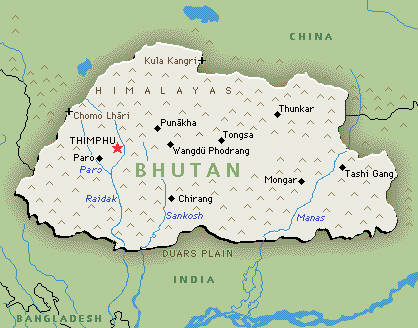
At first look at the map of Bhutan that we all learnt in our school days, the map of Bhutan used in the publications of United Nations. There is a rhino horn shaped protuberance on the northern border where the nation’s highest peak and the pride of the country, the Kula Kangri crowns the country.
This map was retrieved from: http://wwp.greenwichmeantime.com/time-zone/asia/bhutan/map.htm
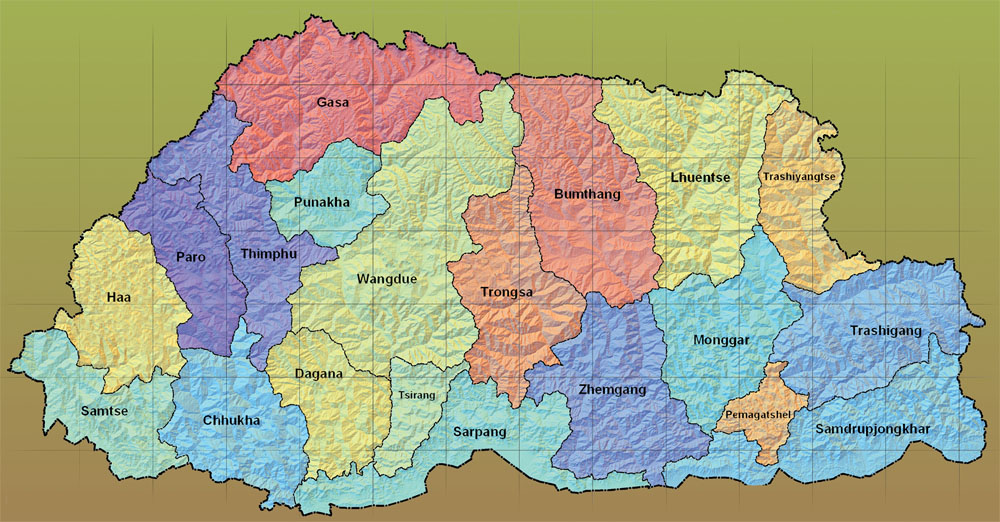
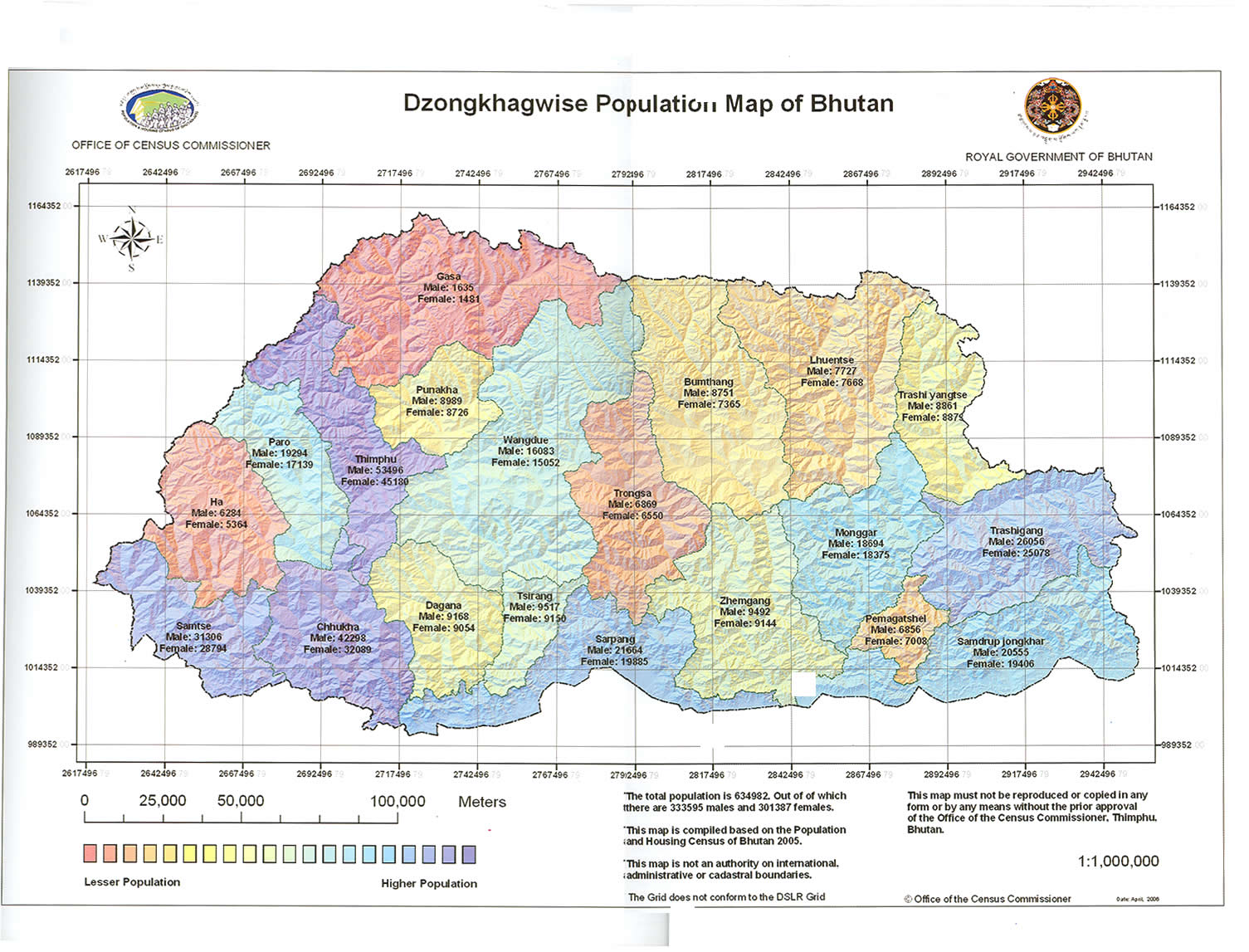
Then look at the new map of Bhutan, used in the new government’s portal- the rhino horn shape of the north looks amputated or truncated. We have observed painfully though, that none of you parliamentarians have questioned the use of a faulty map by the Election Commission, to determine the different election constituencies in the country. All of you belong to the class of highly educated elites of the country, but none of you dare to remember the shape and size of the country that you studied since your elementary schools. But the elected members must not miss the talk on national border. Territorial integrity is always a prized possession for every Bhutanese.
The Truncated map of Bhutan (districts-wise), that was handed down to the new parliament
The truncated map according to municipalities and population
China, which shares border with us in the north has not included this area in its map until recently.  Where did the land go? If true, Bhutan has created a ‘no man’s land’ out of its own land. Bhutan had dispute over the border and has ongoing talks with both the neighbors. China has been respectful on the treaty on Maintenance of tranquility and peace in Sino- Bhutanese border areas signed between the two countries in 1998.  The land has become no man’s land and you, the elected members who are directly responsible to the issue are quiet.
In the earlier Sino-Bhutan border talks Indian representative(s) used to be present. Obviously, India is not happy with Bhutan for its direct involvement in the Sino-Bhutan talks. The Sino-Bhutan border talks after 1990 began to end in lavish gift exchange ceremonies but not in driving results. Outcomes of the meeting, if at all, are quickly buried under the carpet. News sources have reportedly mentioned that in order to pacify India, the government of Bhutan has offered to cede one of the southern districts to India. A noted Indian Professor Mahendra P Lama has published in  the journal “Protracted Refugee Situations: Political, Human Rights and Security Implications” (November 2008) edited by Gil Loescher, James Milner, Edward Newman and Gary Troeller and Published by United Nations University leaks the information about Bhutan’s offer of land to India.
The country’s land, the sovereign authority over which lies with the people, is used as gift with a wrong motive, without the knowledge of the people. It is very strange that you elected parliamentarians are not awakening to this reality. No element should be allowed to sell the land or exchange for a gift. You, the present parliamentarians are directly responsible for accepting this faulty map of Bhutan. You must create a new schedule in the constitution to include the map of Bhutan with specification of border.
Although the earlier parliamentarians were either un-lettered or were considered less literate, they were able to quiz the king’s ministers and could keep their concern correctly and timely, though several of them had to risk their life.  You, the people elected representatives with varsity certificates and people’s support are not able to speak of the people and of the country. In fact you have spoken nothing besides praising the kings. It is unfortunate that you have not performed to the expectations of the public. You are still the king’s henchmen in disguise. It is hoped that you begin to speak only truth and necessities here after.
King
Monarchy has been a powerful institution in Bhutan for over a century. While securing power and privileges for itself, it has more than often fallen short of duty. The institution of monarchy has resorted to divide and rule policies. The king for long time had misunderstood democracy and rejected its import to Bhutan. Today the word ‘democracy’ is used to fool the outside world.
The era in which lives of people depended on the mercy of rulers has vanished gone from most parts of the world and will soon end in Bhutan too. Now the continuity of the institution of the monarchy depends on the mercy of the people. In context of Bhutan too, the future of this institution depends on the activities of the present rulers. It depends on their role whether they want to remain a pious symbol of sovereignty and national unity like in England and Japan; or choose to be guillotined like the regals of France, or get removed from the scene like the king of Nepal.
You must inform the present monarch correctly that the original advocates of democracy and human rights are redressing their punishments given by the former regime, either in prisons in Bhutan or in exile. Their only mistake was their demand for democracy. The future of Bhutan and her image in the international arenas depend on these people and so is the future of the monarchy.
Abuse of Parliament
Being elected parliamentarians, it is your obligation to meet public expectations and deliver results that will benefit the constituents. You are expected to uphold values of democracy and political stability in Bhutan, not the other way round. The half a century old struggle for democracy by the people is nowhere acknowledged. You are seen working to hide the misdeeds of the previous regime. Instead of cultivating democracy, you parliamentarians religiously proclaim that “democracy is the gift from the King”, which, in itself defeats the drum beat that is going on in the name of this democracy. Your prayers praising the kings right from national assembly of Bhutan to United Nations’ General Assembly insult the martyrs who sacrificed their lives for democracy; and offend the spirit of the hundreds of thousands of people who are suffering in prisons and in exile.
The 4th session of the first elected Bhutanese parliament could be yet another opportunity for you to mend fences. You should use this opportunity to:
– clarify what has happened to the land in north; and if necessary calling on the government to work towards restoring Bhutan’s northern border to its original position;
-include a schedule in the constitution to describe Bhutan, its territorial extent and international border;
– confirm and if found true take back the offer of a southern district as a gift to India;
– reinstate all the Bhutanese people from exile to their original status;
-release all the political prisoners;
-keep the kings and judiciary confined to respective duties of their position.
If you cannot do all these urgent works, you must accept your failures and resign immediately. If not, be prepared to face the people’s verdict in the days to come. People will never excuse those who support the sell and cede of land and eviction of fellow citizens.
We urge you to take up actions beginning from the 4th session of the parliament.
On behalf of the concerned people
Govinda Rizal, Uji Shi, Okubo Machi, Postal code: 611-0033 Kyoto Japan. Phone: 0081 80 3812 9610, Email:  govindarizal@gmail.com
T.P. Mishra, New York, USA.
Deo Maya Giri, 1807, A. Santa Clara, Alameda, CA 94501, California.
Rajen Giri, 1807 Santa Clara AVE Alameda CA 94501, USA.
Naresh Subba, 1710 Franklin Avenue, Apt 2, Kent, OH 44240, USA. Ph. (330)-931-4157 (home),  (330)-672-0092 (work)
Ganesh Subedi, 1130 Regent street # B, Alameda CA-94501, United States of America. E:mail: subediganesh@hotmail.com , Tel: 510-326-0804.
Ram Bahadur Chhetri, Pijnacker Hordijkstraat 44, 2593 HE The Hague, The Netherlands.
Santi Ram Poudel, 1277 Cove Avenue, Apartment 208 Lakewood, Ohio, 44107 USA. Telephone- 216-228-2461 (Home), – 216-374-3577 (Cell).
Bikram Adhikari, 1 Wellington St, KIemzig, SA 5087, Australia. Phone: 61-8-72256077
Jeetan Subba, Beldangi II, Jhapa Nepal.
Vidhyapati Mishra, EPC 2377, Kathmandu, Nepal, Phone:+977-9841 869725 Email: vidhyapati@yahoo.com, Website: www.bhutannewsservice.com
Puskar Sharma Poudyal, 38/16 crozier TCE,Oaklands Park,SA 5046, Australia. mob:0421704709
Tek Nath Mishra, 3127 Pleitner Ave, Oakland,CA USA.
Nanda Gautam, Post box 120, 5280 AC Boxtel, The Netherlands.
Parsuram Sharma Luital, 133A south St, Hadfield 3046, Melbourne Victoria, Australia.
Rajani Basnet, Via Botticelli 3 , 40036 , Monzuno, Italy. Email: lisrah@gmail.com
Sushil K Niroula, 38/16 Crozier Tce, Oaklands Park, SA 5032.
Mohan Subedi, Email : monsubedi@gmail.com, Address: Adelaide, SA,  Australia.
Ramesh Gautam, Fjellvegen 46, 5563 Førresfjorden, Tysvær Kommune. Norway.    E-mail: rashu_re96@yahoo.com
Bhim Lal Bastola, 3154 Lapland Dr, Cincinnati, OH 45239.


http://apfanews.com/opinion/an-open-letter-to-the-bhutanese-parliamentarians.html

Delhi Calls Bhutan King for an Orientation

Published on Dec 17 2009 // NEWS ANALYSIS
By Govinda Rizal
The Fifth Monarch Jigme Kesar Namgyal Wangcghuck is called to India to ensure that every step in Thimphu is in tune with trumpet played from New Delhi. Two year after the revision of Indo Bhutan Treaty 1949, a year after the enthronement of the king, the declaration of a royal democracy, election in Bhutan and comeback of the Congress (I) with a majority in the Delhi, South block wants to ensure that Bhutan is still in its cocoon. 
Until 2007, Bhutan was virtually an Indian protectorate state with Indo- Bhutan Treaty 1949 holding Bhutan’s foreign affairs under its surveillance. The 1949 treaty was rephrased into Indo Bhutan Treaty 2007 and signed on February 8 by Indian Foreign Affairs Minister Pranab Mukharjee and then Crown Prince Jigme Khesar Namgyal Wangchuck. The amendment particularly promoted Bhutan to take independent decision over her foreign affairs. 
Junior Jigme: Jigme Khesar
Soon after Bhutan’s independence in the treaty, the People’s Republic of China and United States of America expressed their necessities for establishing their embassies in Bhutan. Now Bhutan is under decision time to say “Yes” or “No” to China and USA. Bhutan’s “Yes” to either or both the countries shall give an unexpected fever to India, and her “No” a source of continuous pressure on herself.

Territory and terrorism
India is worried about the Bhutan’s exchange of land with china in its north and west, the land that has strategic advantage for all the three countries. Bhutan shares 470-kilometer long partially demarcated border with China. China wanted a direct diplomatic relationship with Bhutan for all issues. China wanted to give Bhutan 495 square kilometers area of land in exchange for an area of 269 square kilometers of land of Sinchulumba from Bhutan’s North West. Sinchulumba is in militarily strategic position that touches the border with Sikkim and is very close to Chumbi valley. Both Bhutan and China had agreed to talk further, which has worried India.
Both the governments in New Delhi and Thimphu have lost the control of their rational over their people’s demands. A good number of India’s neo political activists and separatist groups are at a run in Bhutan’s jungles. Thimphu’s political opponents in exile are urging Delhi to change its side; to withdraw its existing support to the kings’ government and prop the struggle for people’s government in Bhutan. Instead, for a mutual hold on the power two governments are blind at the people’s concern.
Article 2 of Indo Bhutan Treaty 2007 mentions that   “…. Neither Government shall allow the use of its territory for activities harmful to the national security and interest of the other”. This clause is abused to harass the political activists even when they are in other countries. India is expected to ask the new king to flush out the Indian separatist groups hiding in Bhutan, with an assurance in return to check the Bhutanese in exile from returning to Bhutan via India. This sinister ploy has have worked in the past. 
Regarding the extradition of Bhutanese democratic leader and Thimphu’s head ache Rongthong Kuenley Dorji who is under house arrest in India for last 13 years, South bloc shall assure Bhutan that they’ll keep him confined and his voice silenced.
It may be noted that although the Bhutan has been declared democratic with a constitution, only the people from the earlier autocratic regime continue to exercise their rule. None of the present ministers or MPs had advocated a word for democracy, which the king was compelled to let under pressure from the people in exile and international community. Those who raised voice for democracy were banished from the country and were prohibited from taking part in inside- the- country activities, those who advocated for the autocratic royal system were let to continue their rule in the name of democracy.
Bussiness
On the business front, New Delhi shall ask Bhutan to use the Calcutta port to its fullest and reduce the reliance on Dhaka port in Bangladesh. It shall also aware the king on the possibilities of Chinese goods taking market in Bhutan and may suggest ways to mitigate it.

New Delhi may ask the king to be considerate if the Indian business community and Indians living in Bhutan decide to form an organization by name Non- Resident Indian (NRI) inside Bhutan. Bhutan is one of the three countries in the world where NRI does not exist. The other two countries are North Korea and Pakistan.
Bhutan’s hydro power shall remain a binding force between two parties. It is a source of royal income and royal happiness to Thimphu, and a source of energy to Delhi.

Roads and Airport
India had been skeptical in funding for an international airport in Gaylegphug and East west highway connecting Bhutan’s southern districts. Neither did it fund nor did it permit any donor to fund Bhutan’s national projects. The cause of India’s reluctance behind the international airport in Gaylegphug is that the true owners of the land were evicted and are now living in exile either in refugee camps in Nepal or in countries of Europe, America or Australia. India expects yet fears their return some day soon to put a claim on their land.
Regarding the road, when the people of the southern districts have to go to the next district they have to traverse via India. India is concerned about the networking and empowerment of the Southern Bhutanese people who were long deprived of their rights and freedom. Recently, Asian Development Bank granted US$36 million for the construction of roads joining southern districts. It shall also reduce the people’s interaction with the Indian people and their business.
Chief Guest
The Bhutan’s young monarch may ask a few astrologers to predict a gratifying date to visit India, how ever India may consider its republic day celebration appropriate for invitation and assignation. India has a tradition of inviting guests from neighboring states to grace republic day parade on January 26 every year. The political calendars show an overlap of events on the auspicious of  Indian Republic Day 2010; the possibility of the new king of Bhutan gracing the parade as the chief guest as well as taking orientation classes in Delhi, signing various agreements and memorandum of understandings.
To read similar stories by Govinda Rizal visit his Red Room
http://apfanews.com/news-analysis/delhi-calls-bhutan-king-for-an-orientation.html

Address the refugee impasse


Published on Jun 09 2006 // MAIN NEWS
Honorable Prime Minister,
Refugees languishing in eastern region of Nepal since 15 years with a hope of returning home are facing new problems day-by-day. On behalf of Nepali Civil Society, we would like to draw your attention in the following matters.

1. Establish a permanent commission for refugees
It would be better if Nepal government could form a permanent commission to deal with refugee problem that can study past trials and form future strategies and take initiatives to find the solution.

2. Security of Tek Nath Rizal
Leader of Bhutan’s democratic and human rights movement, Tek Nath Rizal is in Nepal since two and half years. Security of Rizal, settlement of his family and management for his living is our responsibility. We demand you to manage this.

3. Talks with India Government
Bhutanese refugee problem in Nepal is not only of two countries, it is necessary to involve India directly in the process. In the ‘Peace and Friendly 1949’ treaty between India and Bhutan, it is clearly mentioned that Bhutan’s foreign policy is guided by India. Accordingly, India shouldn’t cite any reasons considering Bhutanese refugee mess a problem between Nepal and Bhutan only. Thus, Nepal government should hold talks with India regarding the same.

4. Evaluation of loss wealth and property
Refugees who were made homeless and forcibly evicted from the country are citizens of Bhutan staying there since generations. Their properties are still in Bhutan. We seek international community to help collect details of how much property of these people was seized, of what worth houses were burnt, how many people were sentenced to death and imprisonment.

5. Proper Educational Environment
With the cut in facilities by UNHCR, it is unable to pay reliable salary to camp based teachers. As a result there are no able teachers in camp schools. Students who pass secondary level from camps are facing problems for higher education. If steps be taken towards standardizing the educational system in camps and for further studies, the future of refugees would be secured.

6. Health Problem
Health treatments in refugee camps have taken deteriorating form. Many refugees are bound to die due to drugs shortage. The people with diseases uncured with limited treatment have different obstacles to receive proper treatment outside camps. We request to organize proper health treatments in camps and outside camps as well for treatment of diseases with high expenditure.

7. Handicrafts selling-distributing and showroom
Refugees staying in camps produce handicraft materials. If a show/selling room could be managed in Katmandu or some appropriate areas, those handicraft products of refugees can get a market which can give them small earning.

8. Regarding cut in kerosene oil
There has been an excessive cut in facilities provided to refugees. Citing fuel price hike, UNHCR has replaced kerosene with briquette coals. We request in pressurizing UNHCR to make available kerosene oil or LP gas instead of coal which is injurious to human health.

9. Appointment of legal advisor
Refugee issue has both legal and political aspects. This problem, an interest of international community, is beyond international law, agreements that Bhutan has created. As there is a need of legal advice to present this problem in international forums, Nepal government should institute a Legal Advisory Group.

10. Special identity card for refugees
Refugees, who are living in border, sometimes for health treatments and other reasons need to move to-and-fro India. It is necessary for Bhutanese refugees, who are neither Nepalese citizen nor Indians, to carry cards so that they can be identified.

Honorable Prime Minister,
From a long experience in democratic movements, as a government head and senior politician, you are aware of the problem. We are also informed of your faith towards this problem. Thus, we are hopeful that the points mentioned above will be addressed with additional sensitiveness.

On behalf of human rights and civil society movement

1. Dr. Devendra Raj Pande- Former minister
2. Daman Nath Dhungana- Former Speaker of the House of Representatives
3. Padma Ratna Tuladhar- Human Rights Activist
4. Krishna Pahadi- Human Rights Activist
5. Kedar Bhakta Mathema- Former Ambassador
6. Ragina Upadhaya- Artist
7. Yadhay Kharel- Cine Artist
8. Subod Raj Pyakurel- Chirman, INSEC
9. Charan Parsai- Chairman, Human Rights Organization of Nepal
10. Dr. Govinda Raj Bhattarai- Professor
11. Hem Raj Gyawali- Chairman, Kantipur Publications
12. Purushotam Dahal- Human Rights Defender
13. Bishnu Bivu Ghimire- Chairman, Sajha Publication
14. Bharat Bhurtel- Journalist

(Summary of Full text letter to PM Koirala before his departure to New Delhi)
(unofficial translation)

http://apfanews.com/stories/address-the-refugee-impasse.html

Monday, November 19, 2018

Other REFUGEES IN Nepal


सोमवार, मंसिर ३, २०७५

अन्य मुलुक जाने बाटो खोलिदिन शरणार्थीको माग

हिमालखबर
117

काठमाडौं- नेपालमा रहेका विभिन्न मुलुकका शरणार्थीले काठमाडौंस्थित संयुक्त राष्ट्रसंघीय शरणार्थीसम्बन्धी उच्च आयोग (यूएनएचसीआर)सँग सहायता र पुनर्वासका लागि अन्य मुलुक जाने बाटो खोलिदिन माग गरेका छन्।


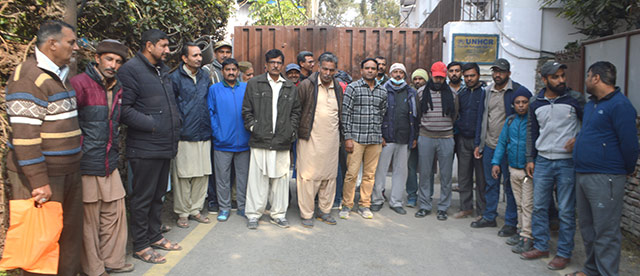
उनीहरूले २ मंसिर दिनभर काठमाडौंस्थित यूएनएचसीआरको कार्यालयमा धर्नासमेत दिए। धर्ना दिनेहरूमा पाकिस्तान, म्यानमार, अफगानिस्तान र श्रीलंकाबाट नेपाल आई बसेका करिब ७० शरणार्थी थिए।
यूएनएचसीआरले उनीहरूलाई शरणार्थीको परिचय दिए पनि नेपाल सरकारले भने अवैध आप्रवासी मान्ने गरेको छ। हाल नेपालमा रहेका आप्रवासीहरूमध्ये कतिपय मुलुकमा रहेका नेपाली दूतावासबाट भिसा लगाएर आई म्याद नघाउँदै नेपाल बसेका र कतिपयचाहीं भारत हुँदै स्थल मार्गबाट नेपाल छिरेका हुन्।
यस्ता अवैध आप्रवासीलाई अध्यागमन विभागले अध्यागमन नियमावली २०५१ को अनुसूची ९ को बुँदा नम्बर २ अनुसार भिसाको म्याद थप र जरिवानावापत प्रतिव्यक्ति दैनिक ५ अमेरिकी डलर बराबरको नेपाली मुद्रा असुल्ने गरेको छ।
उक्त भुक्तानी नगरुन्जेल उनीहरूको नेपाल बसाई अवैध हुन्छ। साथै, त्यस्तो जरिवाना नतिरुन्जेल उनीहरू नेपाल हुँदै अर्को मुलुक पुनर्वासमा जानसमेत सक्दैनन्।
हाल काठमाडौंका कपन, टोखा, बुढानीलकण्ठलगायत ठाउँमा यूएनएचसीआरबाट शरणार्थी परिचयपत्र पाएका पाकिस्तान, म्यानमार, अफगानिस्तान, श्रीलंका, सोमालिया, कंगो, इरान, इराक र बाङ्लादेशका गरी २४० परिवारका ६३९ जना शरणार्थी छन् भने थप ७८ जनाले यूएनएचसीआरसँग शरणार्थी परिचयपत्र माग गरिरहेका छन्।
नेपालले तिब्बती र भुटानीलाई मात्र शरणार्थीको पहिचान दिएको छ। हाल नेपालमा २४ हजार ५०० तिब्बती र ६ हजार ६५६ भूटानी शरणार्थी छन्।

SOURCE


Blowback from India’s strategic blunder in Bhutan?


Bhim Bhurtel NOVEMBER 18, 2018 4:51 AM (UTC+8)