JOHN NARAYAN PARAJULI
SWANSEA, DEC 03 - Dozens of Bhutanese refugees resettled in Europe are scheduled to protest against Thimpu’s atrocities against ethnic minorities in front of the UN office in Geneva on Friday. Bhutan presents its human rights report for Universal Periodic Review (UPR) before the UN Human Rights Council (HRC) in Geneva.
The refugees say they will submit reports on Thimpu’s continuing violation of human rights to the Council’s working group on UPR.
Bhutan’s own human right report submitted for review makes no mention of refugees. However, the OHCHR report expresses concern over discrimination of people of Nepali origin.
“This is an international forum and we don’t want to give Bhutan a free pass,” said Ram Bahadur Karki Chettri, one of the organisers of the protest. He hopes this review will begin the accounting process of Bhutan’s human rights.
Under UPR, the Council is mandated to review the rights record of all member-states every four years. The rights situation is assessed on the basis of the national human rights report prepared by member-states, reports of independent rights bodies and information and testimonies provided by all stakeholders including non-governmental organisations.
Bhutan is likely to defend its record highlighting the recent stride from absolute monarchy to a democracy. Thimpu is sending a 12-member delegation.
The refugee delegation, meanwhile, says it will draw the Council’s attention to the disfranchisement of 80,000 citizens still inside Bhutan during the 2008 parliamentary elections on grounds of ethnicity. They argue that Bhutanese of Nepali origin still inside Bhutan will be forcefully evicted if the world doesn’t speak up now.
More than 20,000 Bhutanese refugees have been resettled in Western countries so far, out of which more than 600 are in Europe. About 90,000 still remain in refugee camps in Nepal
The Sorry Saga of Bhutan's North
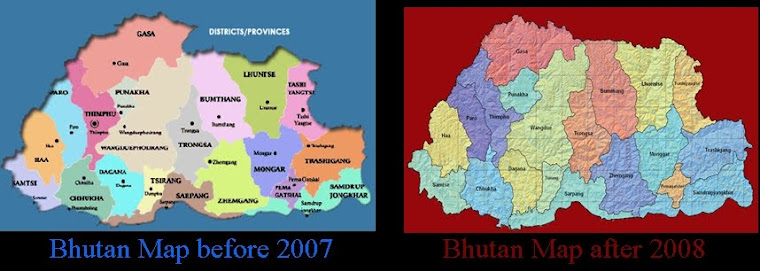
Click over the map to know the differences
Thursday, December 10, 2009

Bhutan is falling behind in GNH

PM and delegation return with deepened commitment to the pursuit of GNH
Lyonchhoen Jigmi Y Thinley returns from the 5th GNH conference in Brazil
5th International GNH Conference30 November, 2009 - The concept of gross national happiness (GNH) may have originated in Bhutan but, when it came to its implementation, Bhutan was falling behind other countries.
This is what the Bhutanese delegation, led by the prime minister Lyonchhoen Jigmi Y Thinley, realised after attending the 5th international GNH conference in Iguassu, Brazil.
Prime Minister Lyonchhoen Jigmi Y Thinley, who arrived home yesterday, said that he has come back with a determination to mainstream gross national happiness (GNH) in a way that every Bhutanese begins to play a more involved role. “The conference was highly educational and we learnt a lot. GNH is being implemented by NGOs, businesses and local government in certain parts of Brazil, which is far beyond what Bhutan is actually doing or has achieved,” said Lyonchhoen. “We’ve returned with the kind of concern that the people and the country, where GNH has originated, are actually falling behind.”
The conference was held from November 20 to 24 and attended by more than 800 professionals, including doctors, lawyers, educationists, as well as policy makers, civil society leaders, intellectuals and academics, students, and corporate leaders. The conference was organized by the Future Vision Ecological Institute and the Itaipu Bi-national Hydroelectric Facility.
Leading a 24-member delegation from different sections of Bhutanese society, Lyonchhoen said that the four pillars of GNH, which are divided into nine domains and further divided into 72 variables, are fully understood and appreciated by two Brazilian city governments – with a population of 130,000 and almost 300,000 people respectively. The cities are adapting GNH principles as public policy, along with 14 other municipalities, which are also reported to be taking up GNH surveys.
A nationally known cosmetics company, Natura, has also adopted its own GNH approach to enhance the well being of its employees, according to the prime minister. “This company has started implementing GNH not only in the way they manage the organisation, organisational and personnel management structures, but in terms of production as well as marketing,” he said.
Lyonchhoen said that a university in Brazil, Campinas, has also started a course on GNH and is conducting research on GNH. “In Bhutan, none of our institutes has done that,” he said.
GNH is also being practised at the community level in Brazil, according to Lyonchhoen. “In a particular village, called eco-village, the nine dimensions of GNH are being practised on a day-to-day level,” he said.
>From the first international conference to the fifth, Lyonchhoen Jigmi Y Thinley said that GNH has grown. “The focus and discussions during the 5th conference were mostly on the practice and implementation of GNH,” he said. He also said the GNH idea is spreading and that, although Bhutan is the origin of this concept, it needs to learn and understand more. “GNH remains as an idea that needs constant development and refinement. The concept has not been infused and imbedded in our policies. At the school level, university, civil servants and at the level of business people, the concept is not well understood,” he said.
Brazil is the longest journey that GNH has made, in terms of geographical distance, language and culture, according to information and communication secretary, Dasho Kinley Dorji, a member of the delegation. He said that, for Brazilians, who are taking up GNH activities, the fifth conference was an introduction to people and ideas from Bhutan, the source and the home of GNH. “Bhutanese participants actually saw people doing GNH in Brazil,” he said.
A senior government official said that they were now aware that Bhutan was not really implementing GNH.
The Bhutanese delegation has decided to form a core-group of people, who will now begin discussing how to start implementing GNH at the individual, family, community and various institutional levels, according to the Lyonchhoen. “Media will also have to play an important role,” he said.
Lyonchhoen said that Bhutan has now reached a stage where GNH can confidently be infused in very practical ways within the society, beginning from the education system. “The international conference has deepened and furthered our understanding of how GNH can be implemented, measured and monitored,” he said. “It has also deepened and furthered our commitment to its pursuit,” he said.
By Phuntsho Choden
From : Kuensel
Griego: Thankful for having come this far
By Tina Griego
Denver Post Columnist
Deg Adhikari, formerly of Sector C/2, hut No. 55, Beldangi-II camp, Nepal, moved into a one-bedroom apartment in Aurora two months ago. The building is just off East Colfax Avenue, and from his front window, he can look out upon men walking down the sidewalk drinking beer. He has been told it is not safe to go out at night.
The apartment is furnished in this way: a dingy love seat, a tiny kitchen table, a computer not connected to the Internet, a rug upon which he and two roommates place shoes. The walls are bare but for a large Denver map, held by electrical tape.
He studies this map often, the grids and curving roads that make up the city's skeleton. He has learned Broadway divides east from west and Ellsworth Avenue, south from north. He has learned that when describing his location to someone he should begin by naming the nearest intersection and a helpful landmark. He comes from a place that does not have traffic signals.
He has yet to explore the city. It overwhelms him. He rides the bus to scheduled appointments with case managers or to class on American work culture or for English lessons, though, in fact, Adhikari's English is excellent. He also speaks Nepali, Hindi and Dzongkha. When he finishes his appointments, he returns to his apartment and closes the door behind him. Even that simple act feels strange. He has been raised to believe that a neighbor who always closes the door is a bad neighbor. He makes rice for supper. Rice and lentils, the food of the refugee camp.
At night, he lies in bed and wonders what the future will bring.
Adhikari, who is 26, brought with him two small, tattered photo albums. He looks at the pictures when he cannot sleep. There are his school friends. There are his mother and father and his brothers and sisters. They sit on straw mats on the floor of their hut. The walls were bamboo, but the family covered them with newspapers. The roof was plastic, opaque, as if the sky were perpetually overcast, which it was not.
How green the refugee camp is, people say when looking at the pictures. True, the land was very pretty, though you cannot eat pretty.
It is not quite right to say he misses the camp, but it is all he knew. He was 8 years old when his parents fled Bhutan for Nepal with him and his brothers and sisters. He spent 18 years in the camps. He finished all 10 grades of school and received permission to leave the grounds to finish grades 11 and 12. He was always bright. The Catholics helped him get into college in Darjeeling, India. In three years, he had his bachelor's degree in chemistry. He brought that with him, too.
His family remains in the camp. They are waiting for their visas. He did not cry on the day he left them, "but my heart was crying inside."
Adhikari flew from Kathmandu to Delhi to Brussels to New Jersey to Denver. On the way from the airport to his apartment, he looked out at the plains and the mountains, and he imagined it looked like Darjeeling.
Adhikari knew no one in Colorado. He was simply told that it was where he would be going. When he arrived, he was so happy. He is happy, still, but he is also anxious. He worries about finding a job. He worries about money. He has deadlines by which he must be employed, by which he must repay the $1,416 he borrowed to get here. "I thought I would get a good job, but here it is two months, and I have no work."
Adhikari took a two-week course for refugees on finding work in America. He did not know what a resume was. He could not believe that one was supposed to look the boss in the eye. His classmates included a fellow Bhutanese refugee, several Iraqis and a few Africans, including Nowerina Nakayiza from Uganda.
Nakayiza, who is 25, arrived one month ago, joining her mother who has been here 10 years. "I don't how to say it," she says, "but seeing my mother again, it was the best moment. I missed her motherly love."
They graduated from their work course last Friday. It was a joyful afternoon. The Ugandans danced; the American staff sang, "This land is your land, this land is my land." Adhikari accepted his certificate of completion and, beaming, raised it above his head. "It is a new life," he said. "I am trying to adapt myself."
Someone tried to explain Thanksgiving to him. "From what I know," he recounted, "it is ancient history of when people starting coming to America. Many people died, and sometimes the harvest was not good, and so at the end of the year, they all got together to give thanks to God. Thanks for the harvest, and thanks for those who survived."
This is how this Bhutanese refugee understands Thanksgiving, as the holiday celebrated by grateful survivors. Of which Adhikari is one.
Tina Griego writes Tuesdays, Thursdays and Saturdays. Reach her at 303-954-2699 or tgriego@denverpost.com.
Read more: http://www.denverpost.com/griego/ci_13854333#ixzz0ZMKmtAEY
From Denver Post
Reflection on our Ministry
A friend of our friends called us suddenly and asked whether I would have the time to go grocery shopping for a Bhutanese refugee family coming from Nepal. They even lured me more by saying that they'd also buy my portion of grocery if I went with them and showed what most Nepalese used for cooking. I was delighted since I was a poor student then and could use any generous offerings like this.
Secondly, the same friend asked me whether we could write "Welcome" in Nepali for a placard. That was simple, too and my husband and I made one. Thirdly, she wanted me to make something Nepali for her. Every Nepali thinks of the Nepali 'chia' or tea first. I grew up having tea multiple times of the day. So, I offered her some Nepali tea, which she enjoys a lot till this day.
All of these were pretty easy. I had not even wondered what all the connections were and why this friend of a friend was coming into our picture. We ran into her now and then. She also came to meet my new born son with a gift. This friendship was slowly developing.
This friend was very involved with the refugees. People called her mother of all Bhutanese refugees since she was so available to them all. Then, in the summer of 2008, my pastor and his family came on a furlough to the United States. Word had already spread to them that they were many Bhutanese refugees being resettled in the Grand Rapids area. He made it a big deal and invited many Bhutanese refugees for a gathering. This turned out to be a time of sharing the love of Christ with them.
The ball had already been rolled. We just had to pick it up and keep the pace. The friend pulled us in more and more, God cleared our vision of this people and we could not turn back any more. Yes, we picked that ball and with the help of some volunteers we started doing to forth-weekly fellowship at an inner-city church. For the first few months, the turn-out was great. Every one seemed eager to know and see what this fellowship was about. We created this Nepalese Service with potluck to keep the interest going. Gradually, the interest waned. People did not want to hear about the Man being shared in this fellowship. Yet we did not lose hope. The faithful and interested few kept coming. However, the zeal in the volunteer was reducing since the turnout was less, the potluck was a hassle and the vehicles were not always available. This led us to stop meeting at this inner-city church.God was forming something else for us. In closing this door, he was opening a new one in which all of our cares were taken care by Him. We were invited to work along side a church. Now we have a church that we can call home, a church that is nurturing us and a church that is providing the ground for us to prepare for our ministry among the Nepalese populations in town.
POSTED BY SATYA MAHARJAN
From Blog: NepaEnglish
Exiled Bhutanese to protest in Geneva
Exiled Bhutanese to protest in Geneva
Posted on 01 December 2009 by Editor
By Tej Man Rayaka, Germany
Dec 1: When Bhutan is scheduled to present its human rights report to the Human Rights Council for the sixth session on Universal Periodic Review in Geneva, dozens of resettled Bhutanese and their fellow-asylees in the European countries of Germany, Norway, Holland, Denmark are demonstrating in front of the United Nations main building on December 4.
The demonstration is organized to make the statement on behalf of more than one hundred thousand Bhutanese languishing in Eastern Nepal since 19 years and a few thousands resettled under the present resettlement scheme, said a statement issued by Durga Giri from Germany on behalf of the Bhutanese delegation.
The delegation will also distribute report from the perspective of human rights violation in Bhutan to delegates from 47 participating countries in the meeting.
The event will focus on the denial of the right to adult franchise of more than 80,000 Bhutanese citizens inside Bhutan in the last election of 2008. These citizens are likely to receive regime’s planned eviction in the near future unless the attention of the International community is timely drawn, statement said.
Likewise, the Bhutanese delegation will also raise concern regarding gross national happiness, which is not meant for citizens but just for those who are in power
“Such happiness is meant in the holistic slogan, not in reality,” the statement mentioned.
The group will also hold separate meetings with the representatives of Geneva based UN Refugee Agency, International Organization for Migration and core group countries prior to their demonstration.
We will discuss the issues of delayed cases of families which have declared their interest to get relocated, said Giri in the statement.
Source: BNS
Exploring ‘uncomfortable’ truths
Exploring ‘uncomfortable’ truths
MADHUR TANKHA
His fascination for the dream factories of Bollywood has given us films like “My Brother …Nikhil”and “Sorry Bhai”. Filmmaker Onir speaks about his experiences in life and his upcoming film highlighting various social issues.
For him, filmmaking is a tool to create awareness about contemporary issues plaguing our society. Bollywood filmmaker Onir insists an audience willing to explore the uncomfortable truth about the plight of refugees, homosexuals and child abuse victims exists in our country.
The dream factories of the Hindi film industry fascinated him even as a child. “To pursue my goal, I went to Berlin to hone my editing skills. After the course, I was keen on making a socially enlightening film. But producing a film on social issue is a risky proposition. I was increasingly getting frustrated that I couldn’t fulfil my dream because there were no takers for my subject in Bollywood. Finally lady luck smiled on me when ordinary people and talented artistes who could relate to my story agreed to finance my project.”
To raise funds for his first film “My Brother …Nikhil” which explored the subject of gays and AIDS, Onir gave details of his film on the Facebook. He invited bloggers to become co-owner of the project by giving donations. Some gave money, others chipped in through other means. A lady from Bangalore said she couldn’t give money but would cook food for the entire unit for two days.
Onir’s upcoming project “I Am” has four short stories. To reach out to a large number of film buffs, he has used some of the best mainstream actors, scintillating music and divergent stories. Even if 10 per cent of the audience feels that the movie connects with their lives, it would succeed in creating awareness on these issues, he says.
The first story of “I Am” focuses on the plight of Kashmiri Pandits who have been driven out of their homeland. “Paradoxically, there is a huge silence over this issue even though 300,000 Pandits have been forced to abandon their homeland. Juhi Chawla plays a Kashmiri Pandit who has lost her home and identity, while Manisha Koirala is a Muslim who finds living in a militant-dominated Kashmir a nightmarish experience. Juhi is such a sensitive person that she decided to pump her own money into my film.”
The second story of “I Am” is about the gay community that is intimidated by the police even though the High Court struck down that provision of Section 377 of the Indian Penal Code that deals with homosexuality. “Rahul Bose agreed to play a homosexual character. Anurag Kashyap, who was himself a victim of child abuse, called me up that he would play the molester.”
Onir’s third story is about sexually abused children. “Statistics reveal that a staggering 53 per cent of our children have been sexually abused. Sanjay Suri is playing an adult who was sexually molested as a child. The film shows the psychological effect on the victim. Filmmaker Anurag Kashyap volunteered to do anything to support my film. So I gave him the role of the perpetrator that nobody was willing to play.”
The fourth story is about problems existing in NGOs.
Though Onir has Bengali roots, he grew up in Bhutan where his father opened an educational institution. “My family was there for three decades but one fine day we were asked to leave. Suddenly we were unwelcome and my dad was asked why he cannot recruit a local as a principal. So I could relate to the plight of the Kashmiri Pandits who were thrown out of the Valley for no fault of theirs. I went to Srinagar for my upcoming film and found that the young don’t know a thing about their earlier neighbours. I feel that truth must be told even if it is uncomfortable.”
Source: The Hindu
Child Stars of 2009
Prabin, Sancha Maya became child star 2009
Posted on 30 November 2009 by Editor
File photo: Prabin Diwali
By Kedar Upreti, Sanischare
Nov 30: Performing the best among 14 participants selected for final round, Prabin Diwali, 11, of Beldangi-I camp and Sancha Maya Tamang, 12, of Beldangi-II became male and female child start 2009 respectively yesterday.
Similarly, Indra Prasad Gazmere from Khudunabari and Nirmala Sanyashi from Sanischare Pathri ranked second in the Inter-camp Child Song Competition.
Organized by Sanischare children forum, the event was jointly funded by the Lutheran World Federation and UN Refugee Agency.
Some 600 children from seven camps participated in various selection rounds and were finally reduced to 14 participants, one male and one female from each camp.
Representatives of aid agencies distributed medals and trophy to winners amidst a program organized in Sanischare camp yesterday. Around 25 000 spectators witnessed the final program.
Source: BNS
An interesting Video of Bhutanese
An interesting Video of Bhutanese refugees at Nashville city, Tennessee, USA
Starting a new life is a challenging and indeed a difficult task. We need lots of passion and desire to go through the hardships and struggle hard for existence. There are ample instances of struggle that refugees resettled in USA has been doing. In particular, they are struggling for their new life thinking ahead for better and progressive future.
The video below by Nashville Public Television(NPT) Productions is an interesting video which outlines the plight and sorrow of resettled Bhutanese Refugees while starting their new lives in Nashville city of Tennessee State of USA. Watch it:
Please Go to its own Blog to watch .
Courage Beyond Their Years
For 'lost' refugee children, ‘education is their mother and father.’
IExaminer, News feature, Dori Cahn, Posted: Nov 29, 2009
The journey a refugee takes is, at best, challenging: leaving home and loved ones behind, surviving war or political turmoil, living in a refugee camp for an uncertain period of time, and eventually ending up in an unfamiliar place and having to learn an entirely new language and culture.
It must be impossibly hard when you are a child with no family.
Every year, unaccompanied refugee children come to the U.S. to find a new life and a new family. They have either lost their parents to war, politics, or disease, or have been separated from their families. Some, like the “lost boys” of Sudan, have endured long treks to safety. They have all spent time in refugee camps, many not knowing if their parents are alive and with little means to communicate back home.
Surprisingly, perhaps, many of these kids are secure and successful in their new lives.
“The kids we work with are incredibly resilient and gracious. They want to be part of a family and they want to go to school,” says Molly Daggett, program manager for Refugee and Immigrant Children’s program of Lutheran Community Services Northwest, the Seattle area agency that resettles unaccompanied refugee minors with foster families. “Our kids overwhelmingly graduate from high school, and many go on to college. They do incredibly well.”
Relief workers first became aware of child refugees traveling on their own in the late 1970’s, when waves of displaced Vietnamese flooded into refugee camps in Southeast Asia. The United Nations created a special designation for these minors, resettling them with foster families in third countries.
LCSNW began placing Vietnamese and later Cambodian and Laotian children, finding foster families and training them for the challenges of caring for refugee youth. Seattle and Tacoma have since been home to hundreds of refugee children, coming from countries as varied as Haiti, Cuba, Rwanda, Somalia and Afghanistan.
Most are older teens when they arrive, but they usually had strong family connection and upbringing before they were displaced.
“For being refugees, most of these kids are different,” says Christy Hedman, who fostered 2 boys from Sudan. “They became refugees at 5, or 6, or 7. They had been raised by their mothers, and despite the horrors they went through, had a strong early raising and good relationships.”
Hedman’s boys were 17 when they arrived in 2000, along with 28 other minors from Sudan. They had both left their homes when they were 5 or 6, and had spent the intervening years in refugee camps in Ethiopia and Kenya. When they arrived in Seattle, “they were really skinny,” Hedman says. “In the camps they were only getting about 1,000 calories a day.”
The years they spent with her were like “18 years of a childhood compressed into three.” She had to show them how to climb stairs and to turn on a light switch. One of them thought that, when they were driving, the car was signaling to her which way to turn. They were curious about everything: “They were like 3 or 4 year-olds, when you can’t keep them out from under your feet,” she said.
But when it came to school they were serious and committed. They adapted quickly because they already spoke English, having learned in the Kenyan refugee camp. Hedman thinks the years spent in camps made them hungry for a chance at a good education.
“They hit the ground running when they got here,” she says. “They knew it was a great opportunity and wanted to take advantage of it.”
“The Sudanese kids had an expression,” says Molly Daggett, “‘Education is my mother and father.’ They had lost their parents, so education was going to be what would guide them.”
In the past year, LCS has resettled a number of Burmese children who were living as refugees in Malaysia. Daggett anticipates more Burmese arrivals, and possibly Bhutanese refugees from Nepal. But she stresses that they never know where the next arrivals may come from.
“They are survivors, they are the kids who had the resiliency, and the ability to engage adults and get the help,” says Daggett. “It is quite amazing. I still marvel at it.”
For more information about the program, or about becoming a foster family, visit Refugee Children
Copied from Here
Saturday, November 28, 2009
Jesuit program breaks culture of violence in refugee camps
Published : November 27 2009
DAMAK, Nepal : The Jesuit Refugee Service has stepped in to break a cycle of violence, drug and sexual abuse that had been plaguing thousands of ethnic Nepali youths from Bhutan living in refugee camps in East Nepal.
"All kinds of evils were plaguing the camps," says Jesuit Father Peter Jong Lepcha, program coordinator of Youth Friendly Centres (YFC).
"We realized that there are so many programs being implemented for the refugees in general but nothing for the youth as such."
The YFC program is part of the Jesuit Refugee Service's (JRS) Bhutanese Refugee Education Program, supported by the United Nations High Commission for Refugees (UNHCR) and Caritas Nepal.
Ganesh Pradhan, 37, in charge of the YFC program in Sanischare refugee camp told UCA that the initiative has given the youths a platform to develop their skills and overall personality.
"The various programs under the YFC have changed the lives of the youths here. Instances of violence that existed earlier, the drug abuse, the sexual abuse and other problems have gone down dramatically," he said.
The Bhutanese of Nepali origin -- known as Lhotsampas -- are caught in a no man's land.
Thousands fled Bhutan fearing for their lives after new citizenship rules were introduced about two decades ago. The government says the refugees are migrants and have no right to live in Bhutan.
The refugees believe their only options are settling down in foreign countries or repatriation to the homeland they still love.
Sun Maya Tamang, 39, wants to go back to her homeland in Bhutan, but she says she still has not made up her mind if she will opt for a third-country resettlement.
"I may just opt for it, I am not sure," she said. "I still feel bad about leaving behind, 18 years ago, the home, the farmland we had, and the happy memories."
According to the JRS, there are now more than 108,000 refugees living in the seven camps in East Nepal.
JRS field director Father PS Amalraj, told UCA News that young people are vital to conditions in the camps.
"The power of the youth can either build or destroy the refugee camps. Keeping this in mind, we established one youth friendly center in each camp and we now have 14,000 members," Father Amalraj said.
The YFC initiative consists of education in journalism, television presenting, sports, music and awareness of HIV/AIDS and other social issues.
An online education program has recently been added to address the growing school drop-out rate in the camps, Father Lepcha says.
The UNHCR reported in September that more than 20,000 Bhutanese refugees had been resettled overseas -- mostly in the US -- with a further 5,000 expected to leave Nepal by the end of 2009.
Courtesy : UCAN
SOurce: INDIAN CATHOLIC
Subscribe to:
Posts (Atom)