The Sorry Saga of Bhutan's North

The Sorry Saga of Bhutan's North
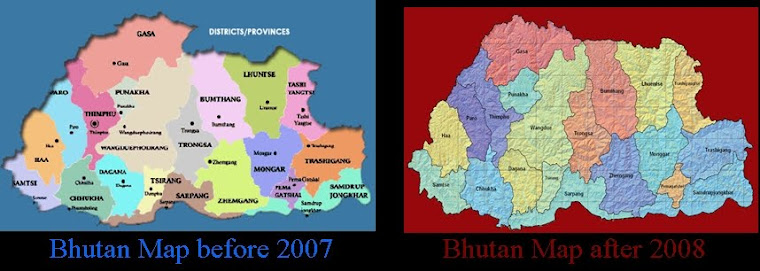
Click over the map to know the differences

Saturday, April 4, 2009

BCCI elects new President and Vice-Presidents


April 2: The Bhutan Chamber of Commerce and Industries (BCCI) elected Topgyal Dorji the co-owner of Tashi Group of Companies as the new BCCI president. He was elected at the annual general meeting of BCCI today.

The Bhutan Chamber of Commerce and Industry began its annual general meeting with the election of the president and vice presidents.

The elections were conducted using electronic voting machine. Topgyal Dorji, co-owner of Tashi group of companies, has been elected as the president and Chen Chen Dorji and Thinley Palden Dorji as vice presidents. Chen Chen Dorji is runs a private IT institute. Thinley Palden Dorji runs manufacturing and mining business.

Topgyal Dorji succeeds Ugyen Dorji who served as the BCCI President for over 18 years.

The Economic Affairs Minister Lyonpo Khandu Wangchuk in his opening address said the government and private sector have a collective responsibility for the economic development of the country.

The three day meeting will see discussions on various issues related to private sector and approve this year’s annual budget. Over 50 representatives of business communities across the country are attending the meeting.

The Bhutan Chamber of Commerce and Industry was established in 1980 to promote private sector in Bhutan. Currently it has over 200 registered business members.

Peradeniya University in Sri Lanka to take Bhutanese students to study medicine


March 30: The Peradeniya University in Sri Lanka will take between five to 10 Bhutanese students every year to study medicine. An agreement to this effect was signed by the Education Minister Lyonpo Thakhur Singh Powdyel while he was in the Sri Lankan capital Colombo to attend the first meeting of SAARC Education Ministers this week.

The agreement will be implemented for five years initially.

While in Colombo, Lyonpo Thakur Singh Powdyel also had bilateral meetings with his SAARC counterparts and discussed possibilities of collaboration in areas like Fine Arts for Bhutanese students in Bangladesh.

The Education Minister said similar MoUs will be signed with the University of Kelaniya and the University of Colombo. The delegation also met Bhutanese students in Colombo and Thailand.


BBS

Gosaling’s bone of contention – a slaughterhouse

Besides hurting villagers’ religious sentiments, the abbatoir is accused of contaminating the entire place, water source and all
3 April, 2009 - Gosaling villagers in Tsirang just celebrated, what they call, a peaceful month. With the month of March coinciding with the first auspicious month in the Bhutanese calendar, farmers were spared from witnessing the butchering of cattle at the slaughterhouse located in their village.

With 70 percent of the village’s population Hindu with a deep regard for the sacred cow, villagers say that the sight of cattle being taken to the slaughterhouse was painful. “It hurts our sentiments as it is located in the middle of a community where people worship cows,” said a resident, Tamang.

But it’s not just religious sensitivity that has farmers complaining about the abbatoir. According to farmers, it was also the environment they had to live and work in.

“It’s time to bear the foul smell again,” said a villager, calling it a torture. “We’ve spent sleepless nights and had to miss meals at times as the smell is too foul,” he said.

The one-storied abattoir of stone kills about 40 to 50 cattle every month. It is located in the heart of the upper Gosaling within a five-acre land belonging to the owner of the abattoir.
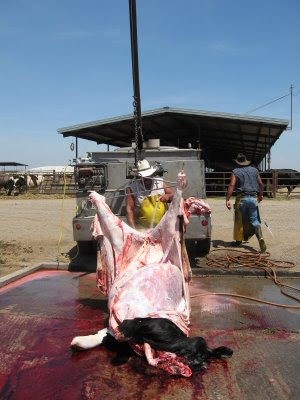
A 48-year-old father of four said that, although the cattle were slaughtered on the owner’s land, dogs scattered the discarded parts and waste in the village. “It defiles the whole community and we’re falling ill,” he said.
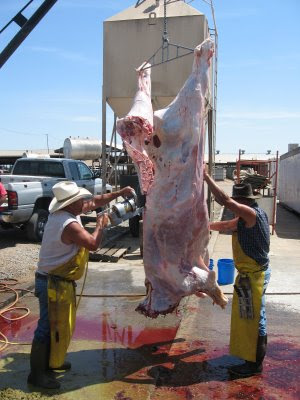
The source of the village’s water supply is located about 200 m away from the slaughterhouse and residents accuse the place of contaminating their drinking water. Sura Bir Alley, 62, whose mandarin orchard borders the abbatoir, said that he had lost orange trees, as his orchard was filled with skull, horns, tails and other carrion waste. “It’s becoming difficult to hire hands to work in my orchard. They feel dirty and disturbed,” he said. “My investment in the orchard will be wasted.”

Residents also said that the owner of the place of death had misused kidu land by turning it into a slaughterhouse. “He should cultivate the kidu land and slaughter somewhere else if he has the license for a slaughterhouse,” said an angry neighbor.

Gosaling gup, K B Tamang, said that the gewog took the matter seriously since it was affecting the water source and hurting the sentiments of the people. “W discussed the matter in the dzongkhag yargye tshogdu (DYT) thrice,” he said, adding that dzongkhag has now intervened.

Tsirang dzongda, Lhendu Wangchuk, said that the dzongkhag respected the public sentiment. “The slaughterhouse lacked proper standard before but lately it constructed proper drainage system and disposal pits,” he said.

Meanwhile, the dzongkhag’s livestock sector is in the process of identifying a new location. “There is a site at Mithuntar, about 32 km away from Tsirang proper, but we’ll have to finalise the process,” said the dzongkhag livestock officer, Dorji Dukpa.

The slaughterhouse owner, Penjor, is not deterred. He said that he obtained a permit to butcher animals when the livestock department introduced the policy of reducing unproductive cattle. “I consulted the dzongkhag and gewog before opening this slaughterhouse,” he said. “The then dzongkhag livestock officer and gewog officials forced me to open the slaughterhouse before I was even ready.”

Penjor said he did not contaminate the water and added that the water was not supplied for people’s consumption but for an outreach clinic. There are other settlements living nearby the source, he said, adding that he spent about Nu 750,000 in constructing and renovating the abattoir. “I‘ll only shift if they compensate my money,” he said.

Tsirang Lam Neten, Namgay Wangchuk, said that the dratshang tried to stop the slaughterhouse but it clashed with the government’s policy to reduce unproductive livestock. “I fully understand the agriculture ministry’s policy and also that it will uplift poor farmers, but that’s a temporary measure,” he said. He said that the dratshang is discouraging people from buying meat for rituals.


By Tashi Dema
t_dyel@kuensel.com.bt
Bhutanese student arrested in India


13 March 2009


A Bhutanese student was among 100 people arrested by police on the outskirts of Bangalore, India, in the early hours of March 8.

The Indian media reported that the people were attending a rave party at a farmhouse near Bangalore. The police raided the farmhouse after the locals complained about the party.

The 21-year-old Bhutanese girl was bailed out on March 10, according to Tashi Wangdi, the president of the Bhutanese Students’ Association (BSA) in Bangalore.

Tashi Wangdi said that it was not the first time that such a thing had happened to Bhutanese. “There have been cases where Bhutanese students were arrested for drug-related cases. There have also been deaths because of drugs,” he said.

He said that the girl had not taken drugs but police charged her on other grounds. He, however, added that drug-related cases among Bhutanese students in Bangalore have increased and that most students there were into drugs. Thirty-nine of the arrested were non-Indians. Besides a huge quantity of liquor and over 40 vehicles, musical instruments, cash and cell phones were seized. Although no drugs were found, the police arrested them on various charges.

There are around 558 Bhutanese students studying in Bangalore.

BY TANDIN PEM
Bhutan Observer

Gearing up for local government elections

2 April, 2009 - The election commission of Bhutan (ECB) expects to start the formal process for conducting local government elections by August 2009.

The ECB, during its first annual conference, reviewed work on delimitation of local government demkhongs (constituencies) and proposed a strategy to conduct local government elections.
“If the law (Local Government Act 2007) is in place by July or earlier, the process could begin by August,” said election official.

The LG Act will be discussed in the coming summer session of parliament.

It would start with the public hearings of the draft delimitation plan for local government demkhongs.

The nomination procedure of the LG election process will start with the test of functional literacy, followed by the process of calling zomdues in the demkhongs to the offices of gups, mangmis and tshogpas, and thrompons, dzongkhag thromde tshogpas, dzongkhag thromde thuemis and yenlag thromde thuemis to dzongkhag tshogdus.

Meanwhile, the chief election commissioner (CEC), Dasho Kunzang Wangdi said that national council candidates, who were not elected, would be allowed to seek nominations to contest in the LG election.

The same rule would apply to unsuccessful national assembly election candidates and other members of political parties, so long as they meet the requirement of having resigned one year prior to the filing of nominations to contest LG elections.

Dasho Kunzang Wangdi said that the zomdues would be held after conducting the test of functional literacy, so that eligible persons, including those issued with the certificate of functional literacy, could file nominations to contest the elections.

Meanwhile, Bhutanese journalists will find more restrictions covering elections in the future with ECB drafting new rules.

Election officials said they would regulate the time limit for media visiting polling stations. “We may allow them to be in the polling station for around five minutes,” said CEC Dasho Kunzang Wangdi.

Reporters, wanting to interview voters, will do so from a distance of at least 100 m from the polling station.

Dasho Kunzang Wangdi told Kuensel that, unlike in the past parliamentary election, all media would be treated equally. He said that, in the past, some media were given access while others were deprived.

“As we wanted to share all footage, Bhutan broadcasting service was given privileged access during the counting of votes. On the other hand, other reporters filed online stories and it was alleged that other media agencies covered the results while BBS could not do so even with access to counting centres,” he said.

“This will not happen in the future,” said the CEC.

Media agencies will also not conduct opinion or exit polls before the election results are declared.

By Nima Wangdi
nimasharma@kuensel.com.bt

Kuensel

Police beat three boys in Thimphu

March 11: In Thimphu, three young boys have been beaten by the police on suspicion of stealing a wallet from a neighbour’s house in Changjiji. The boys are 11, 12, and 13 years old. They were beaten by the police on Saturday evening after a neighbour who has lost a wallet complained to the police and named the three boys as suspects.

None of the parents of the three boys knew that their children have been beaten by the police. They knew about the incident only after they arrived on the scene after they were informed by the neighbours. The father of one of the boys said they took the children to the hospital the next day because they could not sleep on Saturday night- complaining of pain.

A doctor at the national referral hospital said the boys have been beaten with cable wires. He said the mark of the beating was visible on their thighs.

Later the parents and the neighbour who complained to the police reached a compromise. The neighbour gave the three boys Nu. 500 each.

Police admitted to beating the boys but they said they gave each boy a single lashing because they were talking back. Police said their intention was to scare the boys so that they will cooperate.


BBS

Japanese grant to reduce poverty

16 March, 2009 - The Japanese government has committed a grant assistance of 442 million Yen (about USD 4.9 million) to Bhutan.

The grant is an extension for the two projects, which the Japanese government has been supporting: the food security project for underprivileged farmers and the reconstruction of bridges (phase III) project.
The food security project will get 180 million Yen (USD two million) of the total grant amount. Two wheel tractors and attachments, ploughs and spare parts will be provided to underprivileged farmers especially in rural areas under this project.

The Phase III project received 62 million Yen (about 689,000 USD) of the total grant. The grant will be used to implement the detailed design of the reconstruction of bridges on the National highway No 5. Japan has also supported phase I and II projects.

The remaining 200 million Yen (about 2.2 million USD) is a non-project grant aid given to developing countries to promote economic developments including poverty reduction. This is the first time Bhutan has received such a grant from Japan.

Agreeing the extension of the grant, the formalising notes were signed yesterday at the Embassy of Japan between the Japanese ambassador Hideak Domichi and Bhutan’s ambassador to India Vestop Namgyel.


FROM Kuensel

His Majesty grants land kidu to farmers of Tsenkar geog

March 11: His Majesty the King met with more than 1,000 people from Tsenkar geog and granted land kidu to landless people and issued Kasho granting the excess land to the people and waiving the excess land payment.

Those who have been living on government land have also been issued Kasho granting them the land they have been occupying so far. For the more than 1,000 people from five chiwogs of Tsenkar geog who gathered at Domkhar village, this was an unforgettable day. Many of the people had genuine problems with excess land. They had come in the hope of receiving kidu. But they had also come to meet their King who had come on foot to their village to meet them personally and discuss and solve their problems. Today, they went home happy, their hopes answered, their land related problems solved once and for all.

Talking to the people, His Majesty the King said land issues are the single most pervasive problem for the people. He said it is the prerogative of the King to grant land kidu to the people. His Majesty said the kidu is being granted to the people for their wellbeing and solve their problems.

His Majesty said it is his hope and prayer that the kidu will benefit not only them but also their children and their children’s children. His Majesty urged the kidu recipients to protect and use their land properly. His Majesty then met with the kidu recipients individually to discuss their problems.

His Majesty also distributed coronation coins to the people. Most of the kidu recipients who talked to BBS had problems with excess land. They said they were blessed that His Majesty himself came personally to their village in person to their very door step to look into their problems. Many said they were deeply moved by the concern and devotion of His Majesty for his people. Most of the kidu recipients said as poor subsistence farmers, they cannot afford to pay for excess land and they have been worrying day and night over this.

His Majesty also met with the representatives of the 537 households who came to the meeting. Tomorrow, His Majesty will trek to the villages and meet the people who could not attend the meeting today. Around 800 kidu cases have been identified by the office of the Gyalpoi Zimpoen in Tsenkar geog. Yesterday hundreds of people waited along the highway from Sengor to Lingmithang in Monggar to meet and offer Khadhar to His Majesty the King.

His Majesty is accompanied by His Royal Highness Prince Jigyel Ugyen Wangchuck and Her Royal Highness Ashi Dechen Yangzom Wangchuck and the people’s representative to the parliament from Lhuentse, officials from the National Land Commission, dzongkhag officials from Monggar and Lhuentse and local leaders.

Source: BBS

Conference to initiate the translation of Kanjur into English ends


March 21:The five day landmark conference to translate the teachings of Lord Buddha –the 108 volume kanjur into English ended yesterday. The conference was held in the tiny village of Bir in northern India.

The translation will be done under the guidance and leadership of His Eminence Dzongsar Jamyang Khyentse Rinpoche.

Dzongsar Jamyang Khyentse Rinpoche who initiated and hosted the conference at Deer Park Institute in Bir said the survival of Buddha dharma could depend on the Kanjur being translated in other languages which will make the teachings of the Buddha available to millions of people.

The conference decided that they will complete the monumental task of translating the Kanjur into English in 25 years. It was also decided that in one hundred years, they will translate and make the entire Buddhist literary heritage universally accessible.

Already, enthusiastic expression of support has been received from all parts of the world, with more than 11,000 people sending letters of appreciation to translators in the conference. Among the letters, the appreciation letter sent by the Prime Minster of Bhutan, Lyonchhen Jigmi Y. Thinley to His Eminence Dzongsar Jamyang Khyentse Rinpoche was also read out at the conference on Thursday. In his message, the Prime Minister said the translation of the Buddhist text into English will make the sacred words of Buddha available and accessible to countless number of people. He said it will also benefit the people of Bhutan especially the youth most of whom have come through the modern education system and therefore cannot understand Chhoekey.

Lyonchhen Jigmi Y. Thinley said the task is enormous and daunting. However with best scholars and practitioners translating under the personal guidance of His Eminence the Dzongsar Khyentse Rinpoche, he is confident that this venture will meet with success.During the conference the translators also made plans to train more qualified translators, improve their tools and resources, and strengthen collaboration between western translators and Buddhist lineage masters and teachers.

Courtesy: BBS

First private school to rise in the east


19 February, 2009 - Students in the east, who could not make it to government schools after class X, can continue their higher studies closer to home with the opening of the first private higher secondary school in Mongar.

Sherub Reldri higher secondary school at Yakgang, two kilometres away from Mongar town, will open to admission next month. The proprietor Lt Colonel (retd) Rinchen Thinley said that the school would take in 500 students. The school offers all three disciplines, with two sections each of science and commerce and one of arts. Sherub Reldri provides boarding with indoor and outdoor sport facilities.

Since the school admission opened from February 13, at least five hundred application forms were sold and more than a hundred have registered with the school as of yesterday, according to the proprietor.

The first private school in the east is just only convenient for easterners, but has drawn interest from students elsewhere.

“There are admission requests from as far as Thimphu, Phuentsholing and Dagana,” Rinchen Thinley told Kuensel. “The highest requests were, however, from the east, especially from the four eastern districts of Mongar, Trashigang, Lhuentse and Trashiyangtse.”

Chimi Wangmo from Changmi, Trashigang, a class X graduate with 51 percent said that the private school opened at the right time. “I’ve no relative in Thimphu and there’s a conducive learning environment here,” said Chimi, who will study commerce.

The proposal for a private venture was submitted and sanctioned by the education ministry in 2005 and its construction started in May 2007 at a cost of Nu 24 million.

Rinchen told Kuensel that a number of students from the east ended up in Thimphu to continue their higher secondary education and, in the process, got caught up in city life. Fooding and lodging was another problem. “The private school will ease the problem for both parents and students of eastern Bhutan and should serve as a good option to parents in western Bhutan,” said Rinchen.

It is the seventh private higher secondary school in the country and first ever in the eastern region. Thimphu has three and Bumthang, Phuentsholing and Zhemgang, one each.

By Tshering Namgay , Kuensel