Association of Press Freedom Activists
(APFA-Bhutan)
GPO 8975, EPC 2377 Kathmandu Nepal, Ph: 016219996 Email: apfa2004@yahoo.co.uk
Dated: December 16, 06
Press Release
Bhutan witnesses one of the most emotional moments in Bhutanese history. King Jigme Singye Wangchuck has abdicated the throne on December 9, which was announced formally on Thursday, December 14. Jigme Khesar Namgyel Wangchuck has succeeded his father as the fifth monarch of this country. It has been claimed that he stepped down to make ways for the new king to get as much experience before the parliamentary democracy is formally established by 2008.
APFA-Bhutan here feel to point out that the reality is just opposite. During his 34 years of autocratic rule in Bhutan, King Jigme Singye Wangchuck suppressed his citizens and is held responsible for gross violation of human rights and eviction of above one-lakh innocent citizens. Hundreds of citizens were tortured, killed, rapped and inhumanly treated in the jails by the Royal Bhutan Army he led. The limited rights granted to people during the reign of third king was seized and the national legislature made a rubber stamp. The state mechanism was turned into a personal propaganda machinery leading gross misuse of the national treasury for family luxuries.
He has abdicated the throne to prove himself to be democratic. The important point to remember for of his misdeeds is that all officials in Bhutan, who questioned his one-person authoritarian regime, are fired.
APFA-Bhutan believes that his abdication is just to blindfold international community about democratization and election propaganda slated for 2008. His abdication just indicates democracy passed to his son but not to general public. He is absconding from taking the responsibility of all the misdeeds carried out in his tenure by abdicating the throne before the problem is solved.
However, APFA-Bhutan considers this as a historic moment in Bhutan as well as a lesson to dictators of world. We also congratulate the His Majesty King Jigme Khesar Namgyel Wangchuck for succeeding his father. We hope that the long-standing refugee issue would find a better approach towards repatriation during his reign. We urged the new king to take initiatives for early solution of the crisis and establishment of people’s democracy.
Vidhyapati Mishra
General Secretary
Mob: 9803032106
The Sorry Saga of Bhutan's North
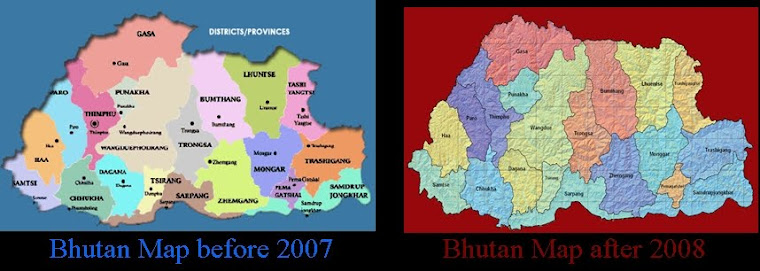
Click over the map to know the differences
Sunday, December 17, 2006

Friday, December 15, 2006
An old story
Thailand swoons over Bhutan's spicy crown prince
PRINCE CHARMING: The kingdom was won over by the prince during a visit this month, but now a photo published of him with a mysterious woman has Thai police scrambling
AP, BANGKOK
Friday, Jun 30, 2006, Page 5
Bhutan's Crown Prince Jigme Khesar Namgyel Wangchuck is seen arriving at an airport in Bangkok on June 11.
PHOTO: AP
Handsome and well-mannered, the crown prince of Bhutan has become the talk of Thailand.
Women have swooned over the bachelor prince's shiny, neatly combed hair and easy smile. Front pages have featured him as "Prince Charming," and a poll named him the most popular of all 25 royals who visited Thailand this month to celebrate King Bhumibol Adulyadej's 60th anniversary on the throne.
Now, a small scandal -- involving one woman in particular -- has spiced things up.
Among the many pictures of Crown Prince Jigme Khesar Namgyel Wangchuck that circulated around Thai Internet sites after his visit is one that has sparked an uproar.
It shows the 26-year-old prince staring into the camera, leaned in close to a smiling mystery woman. He looks relaxed, with his chin resting on the head of the woman, who is wearing a halter top and dangling earrings.
The picture has trees in the background, leading some to speculate it was taken in his Himalayan kingdom, and it suggests a close relationship -- which is precisely the problem.
In Thailand, a royal's private life is not for public consumption.
Thai media never intrudes on the personal life of the country's royals, who are respected with a genuine reverence. Much of the country is honoring 78-year-old King Bhumibol during this celebratory year by wearing yellow shirts every Monday, the color that symbolizes the day of the week he was born.
Out of respect for the Bhutanese prince, police this week called for a halt to the online distribution of the photo and are searching for the culprit who initially posted it. Questions have arisen over whether the picture was doctored, which police say would carry criminal charges.
Police have asked the Bhutanese Embassy, which declined comment, to help determine its authenticity.
Thai authorities say it's their job to protect Jigme, who returned to his Himalayan kingdom more than a week ago after visiting a Thai beach resort following the king's June 9-12 celebrations.
"This may violate the prince's reputation. It requires thorough and careful examination," said police Major General Prachin Waree of the national police force's cyber crimes unit.
One Thai-language newspaper splashed the image across the top of its front page on Tuesday, but apparently sought to deflect criticism with an accompanying banner headline that denounced the picture as "very inappropriate."
Online chat rooms are abuzz with criticism over the photograph's circulation, speculation that it's a fake and general disgust over the prospect of offending the Oxford-educated prince, who became a media darling during his trip to Thailand.
Much talk was generated by widely publicized images of the prince giving a "wai" -- the Thai greeting of palms pressed together with a head bow -- during his outings in Thailand. A sign of humility and respect, it showed his "charm and easy manners," the Nation newspaper reported.
As a result of all the attention, tourism from Thailand to Bhutan is projected to increase this year, said Somyos Limthongkam, vice president of the Thai Travel Agents Association.
"Ever since Prince Jigme's visit, TV, radio and newspapers have been talking nonstop about Bhutan," he said. "Many people are interested in traveling to the country -- and they're mostly women."
This story has been viewed 1544 times.
PRINCE CHARMING: The kingdom was won over by the prince during a visit this month, but now a photo published of him with a mysterious woman has Thai police scrambling
AP, BANGKOK
Friday, Jun 30, 2006, Page 5
Bhutan's Crown Prince Jigme Khesar Namgyel Wangchuck is seen arriving at an airport in Bangkok on June 11.
PHOTO: AP
Handsome and well-mannered, the crown prince of Bhutan has become the talk of Thailand.
Women have swooned over the bachelor prince's shiny, neatly combed hair and easy smile. Front pages have featured him as "Prince Charming," and a poll named him the most popular of all 25 royals who visited Thailand this month to celebrate King Bhumibol Adulyadej's 60th anniversary on the throne.
Now, a small scandal -- involving one woman in particular -- has spiced things up.
Among the many pictures of Crown Prince Jigme Khesar Namgyel Wangchuck that circulated around Thai Internet sites after his visit is one that has sparked an uproar.
It shows the 26-year-old prince staring into the camera, leaned in close to a smiling mystery woman. He looks relaxed, with his chin resting on the head of the woman, who is wearing a halter top and dangling earrings.
The picture has trees in the background, leading some to speculate it was taken in his Himalayan kingdom, and it suggests a close relationship -- which is precisely the problem.
In Thailand, a royal's private life is not for public consumption.
Thai media never intrudes on the personal life of the country's royals, who are respected with a genuine reverence. Much of the country is honoring 78-year-old King Bhumibol during this celebratory year by wearing yellow shirts every Monday, the color that symbolizes the day of the week he was born.
Out of respect for the Bhutanese prince, police this week called for a halt to the online distribution of the photo and are searching for the culprit who initially posted it. Questions have arisen over whether the picture was doctored, which police say would carry criminal charges.
Police have asked the Bhutanese Embassy, which declined comment, to help determine its authenticity.
Thai authorities say it's their job to protect Jigme, who returned to his Himalayan kingdom more than a week ago after visiting a Thai beach resort following the king's June 9-12 celebrations.
"This may violate the prince's reputation. It requires thorough and careful examination," said police Major General Prachin Waree of the national police force's cyber crimes unit.
One Thai-language newspaper splashed the image across the top of its front page on Tuesday, but apparently sought to deflect criticism with an accompanying banner headline that denounced the picture as "very inappropriate."
Online chat rooms are abuzz with criticism over the photograph's circulation, speculation that it's a fake and general disgust over the prospect of offending the Oxford-educated prince, who became a media darling during his trip to Thailand.
Much talk was generated by widely publicized images of the prince giving a "wai" -- the Thai greeting of palms pressed together with a head bow -- during his outings in Thailand. A sign of humility and respect, it showed his "charm and easy manners," the Nation newspaper reported.
As a result of all the attention, tourism from Thailand to Bhutan is projected to increase this year, said Somyos Limthongkam, vice president of the Thai Travel Agents Association.
"Ever since Prince Jigme's visit, TV, radio and newspapers have been talking nonstop about Bhutan," he said. "Many people are interested in traveling to the country -- and they're mostly women."
This story has been viewed 1544 times.
Bhutan on the way of Srilanka
Bhutan's inheritance of loss
By Indian Express
Friday December 15, 03:59 AM
Bhutan has perhaps been the only South Asian country to be untouched by terrorism. Till the recent bomb blast in Phuntsholing. No known militant group so far has directly waged a campaign against the Himalayan kingdom. However, a host of Indian insurgent groups (IIGs) have been indignant ever since the Royal Bhutan Army (RBA) flushed out in 2003 some 3,000 insurgents belonging to three different groups - ULFA, the National Democratic Front of Boroland and the Kamatapur Liberation Organisation - that were operating from bases in southern Bhutan.
India, in fact, believes ULFA is at least back in the kingdom, which Bhutanese agencies deny. But it does seem the needle of suspicion this time is point at groups other than the ULFA, particularly on the displaced Bhutanese of Nepali origin who were evicted by Bhutan in early 1990s. The Bhutanese refugee crisis has taken many twists and turns. Several measures like the Citizenship Acts (1977) & (1985), Marriage Act (1980), and promulgation of Driglam Nam Za (code of social etiquette, 1989) were aimed at downsizing the ethnic Nepali influence.
There are around 106,000 refugees living in seven UNHCR camps in eastern Nepal. Protracted negotiations between Bhutan and Nepal for almost one and a half decades have so far failed to resolve the crisis. Intense political pressure and lobbying for the cause of refugees by Indian civil society and political circles have made the issue murkier. It is quite clear that the success of the Maoist armed struggle and retreat of King Gyanendra in Nepal have provided a fresh impetus to Bhutan's Nepalese to carry out a similar armed insurgency not only against Bhutan, but also against India.
Resentment is also growing against India for its indifferent attitude towards the problem. At a recent gathering, refugee solidarity groups gave a veiled warning, "The time bomb is ticking in the refugee camps and India will repent for its apathy towards the Bhutanese refugees should the youths in the camps decide to collude with the regional outfits, for example, ULFA, NFDB or KLO, in addition to Nepali Maoists." They have indicated that these desperate groups now have easy access to resources which were not available to them earlier. The recent bomb blast in Phuentsholing twin town is significant in this regard.
The US is the largest donor of UNHCR's humanitarian assistance to Bhutanese refugees. In an unprecedented development, the US in October announced it would take 60,000 refugees, giving the 16-year-old crisis a completely new dimension. The US offer comes as a major relief for Bhutan. But American calculations may be greater than simply resolving a minor refugee crisis. The US is expected to get a major footing in this strategically located patch between India and China.
The new development comes against the backdrop King Jigme Singye Wangchuck's reformist act that he would step down from power in favour of holding national elections and turning Bhutan into a parliamentary democracy by 2008. A Draft Constitution was circulated in March 2005 that would be put to a referendum. It reaffirms the 1985 citizenship laws that make it difficult for refugees, particularly those married to foreigners, to regain full citizenship rights.
Bhutanese citizenship law, especially the number and the criteria for repatriation, could snowball into a major ethnic conflict and could very well parallel the Sri Lanka conflict. However, at the moment, options for the refugees are limited. Should they miss the US offer for resettlement, as one of the factions says, "they are doomed to become identity-less manual workers, hawkers or rickshaw-pullers pushing their progenies to a never-ending cycle of poverty". At the same time, relief for the Bhutanese government could also prove temporary. Remember it's been overseas Tamils who have largely sustained the ethnic movement, providing succour to the LTTE.
A new conglomerate of separatists groups and the possible nexus between Maoists and the Bhutanese refugees and their collusion with the IIGs seems to be taking serious shape.
The writer is a fellow at the Centre for Strategic and Regional Studies, University of Jammu
By Indian Express
Friday December 15, 03:59 AM
Bhutan has perhaps been the only South Asian country to be untouched by terrorism. Till the recent bomb blast in Phuntsholing. No known militant group so far has directly waged a campaign against the Himalayan kingdom. However, a host of Indian insurgent groups (IIGs) have been indignant ever since the Royal Bhutan Army (RBA) flushed out in 2003 some 3,000 insurgents belonging to three different groups - ULFA, the National Democratic Front of Boroland and the Kamatapur Liberation Organisation - that were operating from bases in southern Bhutan.
India, in fact, believes ULFA is at least back in the kingdom, which Bhutanese agencies deny. But it does seem the needle of suspicion this time is point at groups other than the ULFA, particularly on the displaced Bhutanese of Nepali origin who were evicted by Bhutan in early 1990s. The Bhutanese refugee crisis has taken many twists and turns. Several measures like the Citizenship Acts (1977) & (1985), Marriage Act (1980), and promulgation of Driglam Nam Za (code of social etiquette, 1989) were aimed at downsizing the ethnic Nepali influence.
There are around 106,000 refugees living in seven UNHCR camps in eastern Nepal. Protracted negotiations between Bhutan and Nepal for almost one and a half decades have so far failed to resolve the crisis. Intense political pressure and lobbying for the cause of refugees by Indian civil society and political circles have made the issue murkier. It is quite clear that the success of the Maoist armed struggle and retreat of King Gyanendra in Nepal have provided a fresh impetus to Bhutan's Nepalese to carry out a similar armed insurgency not only against Bhutan, but also against India.
Resentment is also growing against India for its indifferent attitude towards the problem. At a recent gathering, refugee solidarity groups gave a veiled warning, "The time bomb is ticking in the refugee camps and India will repent for its apathy towards the Bhutanese refugees should the youths in the camps decide to collude with the regional outfits, for example, ULFA, NFDB or KLO, in addition to Nepali Maoists." They have indicated that these desperate groups now have easy access to resources which were not available to them earlier. The recent bomb blast in Phuentsholing twin town is significant in this regard.
The US is the largest donor of UNHCR's humanitarian assistance to Bhutanese refugees. In an unprecedented development, the US in October announced it would take 60,000 refugees, giving the 16-year-old crisis a completely new dimension. The US offer comes as a major relief for Bhutan. But American calculations may be greater than simply resolving a minor refugee crisis. The US is expected to get a major footing in this strategically located patch between India and China.
The new development comes against the backdrop King Jigme Singye Wangchuck's reformist act that he would step down from power in favour of holding national elections and turning Bhutan into a parliamentary democracy by 2008. A Draft Constitution was circulated in March 2005 that would be put to a referendum. It reaffirms the 1985 citizenship laws that make it difficult for refugees, particularly those married to foreigners, to regain full citizenship rights.
Bhutanese citizenship law, especially the number and the criteria for repatriation, could snowball into a major ethnic conflict and could very well parallel the Sri Lanka conflict. However, at the moment, options for the refugees are limited. Should they miss the US offer for resettlement, as one of the factions says, "they are doomed to become identity-less manual workers, hawkers or rickshaw-pullers pushing their progenies to a never-ending cycle of poverty". At the same time, relief for the Bhutanese government could also prove temporary. Remember it's been overseas Tamils who have largely sustained the ethnic movement, providing succour to the LTTE.
A new conglomerate of separatists groups and the possible nexus between Maoists and the Bhutanese refugees and their collusion with the IIGs seems to be taking serious shape.
The writer is a fellow at the Centre for Strategic and Regional Studies, University of Jammu
Monday, December 11, 2006
To US via Bhutan- Leaders
PM assures of repatriation to Bhutanese refugee leaders
Prime Minister Girija Prasad Koirala has assured Bhutanese refugee leaders that the new government would take stronger measures for repatriation of all refugees languishing in Nepal for the last 17 years.
During the meeting with the 7-member delegation of refugee leaders led by human rights activist Tek Nath Rizal Monday morning, Koirala said the government has repeatedly asked the Indian government for involvement in finding the solution of the crisis.
"We have repeatedly asked India for support, but it has been avoiding saying the problem was between Nepal and Bhutan," Rizal quoted PM Koirala as saying.
The delegation of the refugee leaders, including Thinley Penjor of Druk National Congress and Bala Ram Poudel of Bhutan People's Party, urged the Nepalese government to end bilateral talks with Bhutan and take necessary steps to get support from the Indian government for repatriation.
In the half-an-hour long meeting, home minister Krishna Prasad Sitaula, who hails from Jhapa where the refugees are taking shelter, was also present.
Rizal quoted PM Koirala as saying that the Nepal government has not received any kind of formal application from the US or any other western countries for third country settlement of the refugees.
The US government has time and again expressed its willingness to take some 60,000 refugees to the US for settlement.
Two rounds of Nepal-Bhutan talks that were to be held after the formation of the new government in Nepal has been postponed indefinitely.
Meanwhile reports said that refugees organised rallies in Beldangi camps in Jhapa on Sunday, making the international human rights day, demanding unconditional and early repatriation to their land.
nepalnews.com ia Dec 11 06
Kantipur Report
Nepal govt giving high priority to Bhutanese refugee crisis: PM
KATHMANDU, Dec 11 - Prime Minister Girija Prasad Koirala on Monday said that the Nepal Government attaches high priority to the Bhutanese refugee crisis.
Stating that the issue could not be resolved because of the fickle political situation in the past, the PM assured that the present democratic government has perceived this as a high priority issue.
PM Koirala made the comments today during a meeting with the refugee leaders who had called on the PM earlier today at his official residence in Baluwatar.
According to refugee leader Thinley Penjor, who was present during the meet, the PM assured that no stones would be left unturned in the resolution of the longstanding Bhutanese refugee crisis.
The refugee leaders said that they should be allowed to visit Bhutan one last time before the US resettlement the Bhutanese 60,000 refugees, Penjor said.
A seven-member team led by refugee leader Tek Nath Rijal had gone to Baluwatar to meet the PM today.
According to sources, the leaders demanded that they be allowed to go to Bhutan, arguing that if they were to be resettled in the US without once stepping foot in their homeland, they would become refugees of life.
Over a dozen foreign ministerial level discussions between Nepal and Bhutan in the past have repeatedly failed to resolve the long standing Bhutanese refugee crisis and the latest round of talks slated for November 21-22 failed to materialize.
As the undercurrent of the United States' offer made in October to resettle 60,000 Bhutanese refugees continues to further deepen the division in the refugee community, at least three other countries, including Austrailia, Canada and New Zealand have agreed with the United Nations Refugee Agency (UNHCR) to make similar offers in a "burden-sharing" effort.
Earlier this week, in an interview with ekantipur, Deputy Prime Minister and Minister for Foreign Affairs KP Sharma Oli had said that Nepal government wants to hold final talks with the Bhutanese government to settle the refugee imbroglio.
"As the 15 rounds of bilateral talks between Nepal and Bhutan could not materialize, Nepal wants to hold next round of talks for a concrete decision on this issue," Oli said.
He said that Nepal Government wants a dignified repatriation and guarantee of a secured life in Bhutan is the desired solution to the refugee problem.
More than 106,000 Bhutanese refugees are languishing in seven UNHCR administered camps in eastern Nepal since past 16 years.
Posted on: 2006-12-11 01:06:14 (Server Time)
Prime Minister Girija Prasad Koirala has assured Bhutanese refugee leaders that the new government would take stronger measures for repatriation of all refugees languishing in Nepal for the last 17 years.
During the meeting with the 7-member delegation of refugee leaders led by human rights activist Tek Nath Rizal Monday morning, Koirala said the government has repeatedly asked the Indian government for involvement in finding the solution of the crisis.
"We have repeatedly asked India for support, but it has been avoiding saying the problem was between Nepal and Bhutan," Rizal quoted PM Koirala as saying.
The delegation of the refugee leaders, including Thinley Penjor of Druk National Congress and Bala Ram Poudel of Bhutan People's Party, urged the Nepalese government to end bilateral talks with Bhutan and take necessary steps to get support from the Indian government for repatriation.
In the half-an-hour long meeting, home minister Krishna Prasad Sitaula, who hails from Jhapa where the refugees are taking shelter, was also present.
Rizal quoted PM Koirala as saying that the Nepal government has not received any kind of formal application from the US or any other western countries for third country settlement of the refugees.
The US government has time and again expressed its willingness to take some 60,000 refugees to the US for settlement.
Two rounds of Nepal-Bhutan talks that were to be held after the formation of the new government in Nepal has been postponed indefinitely.
Meanwhile reports said that refugees organised rallies in Beldangi camps in Jhapa on Sunday, making the international human rights day, demanding unconditional and early repatriation to their land.
nepalnews.com ia Dec 11 06
Kantipur Report
Nepal govt giving high priority to Bhutanese refugee crisis: PM
KATHMANDU, Dec 11 - Prime Minister Girija Prasad Koirala on Monday said that the Nepal Government attaches high priority to the Bhutanese refugee crisis.
Stating that the issue could not be resolved because of the fickle political situation in the past, the PM assured that the present democratic government has perceived this as a high priority issue.
PM Koirala made the comments today during a meeting with the refugee leaders who had called on the PM earlier today at his official residence in Baluwatar.
According to refugee leader Thinley Penjor, who was present during the meet, the PM assured that no stones would be left unturned in the resolution of the longstanding Bhutanese refugee crisis.
The refugee leaders said that they should be allowed to visit Bhutan one last time before the US resettlement the Bhutanese 60,000 refugees, Penjor said.
A seven-member team led by refugee leader Tek Nath Rijal had gone to Baluwatar to meet the PM today.
According to sources, the leaders demanded that they be allowed to go to Bhutan, arguing that if they were to be resettled in the US without once stepping foot in their homeland, they would become refugees of life.
Over a dozen foreign ministerial level discussions between Nepal and Bhutan in the past have repeatedly failed to resolve the long standing Bhutanese refugee crisis and the latest round of talks slated for November 21-22 failed to materialize.
As the undercurrent of the United States' offer made in October to resettle 60,000 Bhutanese refugees continues to further deepen the division in the refugee community, at least three other countries, including Austrailia, Canada and New Zealand have agreed with the United Nations Refugee Agency (UNHCR) to make similar offers in a "burden-sharing" effort.
Earlier this week, in an interview with ekantipur, Deputy Prime Minister and Minister for Foreign Affairs KP Sharma Oli had said that Nepal government wants to hold final talks with the Bhutanese government to settle the refugee imbroglio.
"As the 15 rounds of bilateral talks between Nepal and Bhutan could not materialize, Nepal wants to hold next round of talks for a concrete decision on this issue," Oli said.
He said that Nepal Government wants a dignified repatriation and guarantee of a secured life in Bhutan is the desired solution to the refugee problem.
More than 106,000 Bhutanese refugees are languishing in seven UNHCR administered camps in eastern Nepal since past 16 years.
Posted on: 2006-12-11 01:06:14 (Server Time)
Sunday, December 10, 2006
Government of Bhutan is not only undemocratic, it is racist and dictatorial in nature-Hariprasad Adhikari
Bhutan's Queens, Denmark And Refugees [ 2006-12-8 ]
By Hariprasad Adhikari
It is a well-known fact that the so-called constitutional reforms, such as writing of the constitution by the king, appointment of the chief election commissioner and other members of the commission, demarcation of the constituency of the lower house (National Assembly) and the registration of the voters from all the constituencies, are going on in Bhutan. In order to make the king's democracy successful, electronic machines were purchased and tentative dates for the so-called first general election were declared to be held in sometime in 2008.
Expenditure
Similarly, the National Assembly buildings for the upper and lower houses and a hostel for the members of parliament for both the houses are being constructed. Furthermore, the wide office and accommodation for the chief justice of the Supreme Court (who will stage-manage all the executive, judiciary and legislative activities of the king's democracy) are being erected. The expenditure for the so-called constitutional and judicial reforms, except for the construction of the parliament house and MP's hostel, are being borne by the countries of the European Union such as Denmark, the Netherlands and the like.
Interestingly, the countries of the European Union are also the pilots who generously provided relief materials and scholarships to the Bhutanese refugees and selflessly helped to advocate their cause everywhere at world forums. The ambassadors of the EU countries based in Kathmandu visited the refugee camps frequently since their establishment in the 1990s. Also, the EU generously passed a resolution in their parliaments indicating the main defects in the Bhutanese citizenship laws of 1985, which resulted in ethnic cleansing in Bhutan.
The EU nations are well aware that the allegations made by the Royal Government of Bhutan (RGOB) that the "people in the camps are not genuine Bhutanese"is completely hollow and baseless. They know very well that the people in the camps have genuine documents and evidence to prove they are bonafide Bhutanese. For updates, the EU conducted several surveys through researchers in their universities. Moreover, the result of the first verification process carried out by the joint verification team of Bhutan and Nepal of Khudunabari (one of the Bhutanese refugee camps) helped them to understand the issue clearly.
Furthermore, Denmark during a round table meeting had firmly said that if the regime of Bhutan does not accept the demand of democratic reform, then it will be very difficult for Denmark to continue with its aid because the voters and taxpayers of the country do not allow help to non-democratic governments. Surprisingly, the Government of Bhutan is not only undemocratic, it is racist and dictatorial in nature and is run by the relatives and inmates of the king.
Be this as it may, Queen Ashi Dorjee Wangmo Wangchuk (actually the key player of King Jigme Singye's regime) was invited by the Queen of Denmark on an official visit. Queen Wangchuk is not only the queen, but the chairperson of the non-governmental organisation, Tarayana Foundation. It is likely that the foundation is funded by Denmark for the betterment of human beings irrespective of caste, creed and race. Therefore, it is possible that both the queens of Bhutan and Denmark might have discussed the matter relating to the Bhutanese refugees in the seven camps of Eastern Nepal, who have been suffering immensely due to the discriminatory policy of the Royal Government of Bhutan. The queens might have realised the efforts of many civilised countries of the West to repatriate the refugees to their homes.
Though it may sound very hypothetical, there is an incredible chance that the queens of Bhutan need some big platform to keep themselves alive politically in the country because the present privileges of the three queens (out of the four ) will begin to erode after 2008 when the fifth king of Bhutan will ascend the throne if the scheduled coronation is not withdrawn by King Jigme Singye Wangchuk.
Therefore, what is the harm if Ashi Dorjee Wangmo Wangchuk and her sisters rush in democratic politics? Why should she not be suggested to take confidence-building measures (CBM) to correct the wrong deeds carried out during the period of ethnic cleansing? Why not suggest her to relocate the people who have been settled on the land of the refugees in southern Bhutan and declare fair compensation to all those affected by the ongoing ethnic cleansing?
She can encourage the king to declare unconditional clemency to all and have all those Bhutanese who had been given citizenship identity cards in 1981-84 to be repatriated. She can ask the king to honour the Sukumbasi list prepared jointly by Dasho Stewang Penjore, Dasho Angay, Khandu Wangchuck, the present prime minister, and the screened list of the sukumbasis by Trimpons or Dragpons (Judges) Dasho R. N. Dhital and Dasho Pashang Tobge. She can keep the draft constitution as an interim constitution and arrange to accommodate the dissident voices and their presence in the making of a final constitution.
It is hard to understood how the proposed elections can be free and fair when 19 per cent of the total population, containing most of the ethnic groups, are not included or not allowed to get registered in the voters' list. Why have not the political parties formed in exile not been invited to be registered in the so-called first general election? Therefore, the need of the hour is to make arrangements to register the refugee population in the voters' list in the refugee camps if early repatriation is not possible.
Registration
There are plenty of examples of registering people in the refugees camps such as in Afghanistan and Iraq. Not only were they registered, they were also allowed to vote from the camps. For this, the aegis of the United Nations could be explored. Otherwise, the so-called general election of Bhutan will be nothing but a well-known tactic of the RGOB, which has orchestrated one plot after another for more than a decade, to hoodwink or betray the well-wishers of the world as well as the citizens of Bhutan.
(Adhikari is a former National Assembly member of Bhutan)
By Hariprasad Adhikari
It is a well-known fact that the so-called constitutional reforms, such as writing of the constitution by the king, appointment of the chief election commissioner and other members of the commission, demarcation of the constituency of the lower house (National Assembly) and the registration of the voters from all the constituencies, are going on in Bhutan. In order to make the king's democracy successful, electronic machines were purchased and tentative dates for the so-called first general election were declared to be held in sometime in 2008.
Expenditure
Similarly, the National Assembly buildings for the upper and lower houses and a hostel for the members of parliament for both the houses are being constructed. Furthermore, the wide office and accommodation for the chief justice of the Supreme Court (who will stage-manage all the executive, judiciary and legislative activities of the king's democracy) are being erected. The expenditure for the so-called constitutional and judicial reforms, except for the construction of the parliament house and MP's hostel, are being borne by the countries of the European Union such as Denmark, the Netherlands and the like.
Interestingly, the countries of the European Union are also the pilots who generously provided relief materials and scholarships to the Bhutanese refugees and selflessly helped to advocate their cause everywhere at world forums. The ambassadors of the EU countries based in Kathmandu visited the refugee camps frequently since their establishment in the 1990s. Also, the EU generously passed a resolution in their parliaments indicating the main defects in the Bhutanese citizenship laws of 1985, which resulted in ethnic cleansing in Bhutan.
The EU nations are well aware that the allegations made by the Royal Government of Bhutan (RGOB) that the "people in the camps are not genuine Bhutanese"is completely hollow and baseless. They know very well that the people in the camps have genuine documents and evidence to prove they are bonafide Bhutanese. For updates, the EU conducted several surveys through researchers in their universities. Moreover, the result of the first verification process carried out by the joint verification team of Bhutan and Nepal of Khudunabari (one of the Bhutanese refugee camps) helped them to understand the issue clearly.
Furthermore, Denmark during a round table meeting had firmly said that if the regime of Bhutan does not accept the demand of democratic reform, then it will be very difficult for Denmark to continue with its aid because the voters and taxpayers of the country do not allow help to non-democratic governments. Surprisingly, the Government of Bhutan is not only undemocratic, it is racist and dictatorial in nature and is run by the relatives and inmates of the king.
Be this as it may, Queen Ashi Dorjee Wangmo Wangchuk (actually the key player of King Jigme Singye's regime) was invited by the Queen of Denmark on an official visit. Queen Wangchuk is not only the queen, but the chairperson of the non-governmental organisation, Tarayana Foundation. It is likely that the foundation is funded by Denmark for the betterment of human beings irrespective of caste, creed and race. Therefore, it is possible that both the queens of Bhutan and Denmark might have discussed the matter relating to the Bhutanese refugees in the seven camps of Eastern Nepal, who have been suffering immensely due to the discriminatory policy of the Royal Government of Bhutan. The queens might have realised the efforts of many civilised countries of the West to repatriate the refugees to their homes.
Though it may sound very hypothetical, there is an incredible chance that the queens of Bhutan need some big platform to keep themselves alive politically in the country because the present privileges of the three queens (out of the four ) will begin to erode after 2008 when the fifth king of Bhutan will ascend the throne if the scheduled coronation is not withdrawn by King Jigme Singye Wangchuk.
Therefore, what is the harm if Ashi Dorjee Wangmo Wangchuk and her sisters rush in democratic politics? Why should she not be suggested to take confidence-building measures (CBM) to correct the wrong deeds carried out during the period of ethnic cleansing? Why not suggest her to relocate the people who have been settled on the land of the refugees in southern Bhutan and declare fair compensation to all those affected by the ongoing ethnic cleansing?
She can encourage the king to declare unconditional clemency to all and have all those Bhutanese who had been given citizenship identity cards in 1981-84 to be repatriated. She can ask the king to honour the Sukumbasi list prepared jointly by Dasho Stewang Penjore, Dasho Angay, Khandu Wangchuck, the present prime minister, and the screened list of the sukumbasis by Trimpons or Dragpons (Judges) Dasho R. N. Dhital and Dasho Pashang Tobge. She can keep the draft constitution as an interim constitution and arrange to accommodate the dissident voices and their presence in the making of a final constitution.
It is hard to understood how the proposed elections can be free and fair when 19 per cent of the total population, containing most of the ethnic groups, are not included or not allowed to get registered in the voters' list. Why have not the political parties formed in exile not been invited to be registered in the so-called first general election? Therefore, the need of the hour is to make arrangements to register the refugee population in the voters' list in the refugee camps if early repatriation is not possible.
Registration
There are plenty of examples of registering people in the refugees camps such as in Afghanistan and Iraq. Not only were they registered, they were also allowed to vote from the camps. For this, the aegis of the United Nations could be explored. Otherwise, the so-called general election of Bhutan will be nothing but a well-known tactic of the RGOB, which has orchestrated one plot after another for more than a decade, to hoodwink or betray the well-wishers of the world as well as the citizens of Bhutan.
(Adhikari is a former National Assembly member of Bhutan)
Thursday, December 7, 2006
Bhutanese teachers maintain standard of English in Jhapa Schools
Pressure to expel Bhutanese teachers [2006-12-07]
Damak, December 07: The Nepalese teachers working in the private boarding schools in Jhapa district have demanded that the school management should expel all the Bhutanese teachers working in the schools and recruit Nepalese in their place.
During a press conference here, the members of the Institutional Schools Teachers Union made this demand. Secretary of the union Lila Bhandari told reporters that private schools have been exploiting the teachers working in those schools.
They claimed that over 500 Bhutanese teachers have being working in various private boarding schools in Jhapa district alone. The organisation demanded that the Bhutanese teachers should be immediately expelled and the unemployed educated Nepalese people should be recruited as the teachers.
Exiled Bhutanese have been the major source of teachers for the private schools in Nepal for years. Several attempts were made to expel them but school managements denied replacing the Bhutanese teachers with Nepalese. The school authorities say, expulsion of Bhutanese teachers would hamper in maintaining standard of English in teaching.
Bhutan News Service
Damak, December 07: The Nepalese teachers working in the private boarding schools in Jhapa district have demanded that the school management should expel all the Bhutanese teachers working in the schools and recruit Nepalese in their place.
During a press conference here, the members of the Institutional Schools Teachers Union made this demand. Secretary of the union Lila Bhandari told reporters that private schools have been exploiting the teachers working in those schools.
They claimed that over 500 Bhutanese teachers have being working in various private boarding schools in Jhapa district alone. The organisation demanded that the Bhutanese teachers should be immediately expelled and the unemployed educated Nepalese people should be recruited as the teachers.
Exiled Bhutanese have been the major source of teachers for the private schools in Nepal for years. Several attempts were made to expel them but school managements denied replacing the Bhutanese teachers with Nepalese. The school authorities say, expulsion of Bhutanese teachers would hamper in maintaining standard of English in teaching.
Bhutan News Service
Tuesday, December 5, 2006
Australian envoy visits Bhutanese refugee camp

Australian envoy visits Bhutanese refugee camp [ 2006-12-5 ]
RSS
DAMAK, Dec. 4: Australian Ambassador Graeme Lade has said that the Government of Australia would provide support as much as possible to resolve the problem of the Bhutanese refugees in Nepal.
Speaking at a programme organised at the refugee camp in Beldangi-1, Damak of Jhapa district today, Ambassador Lade also gave assurances for Australian support to the proposal put forward by the Government of Nepal in order resolve the protracted problem of the refugees.
On the occasion, the Australian Ambassador also inspected the census and relief distribution works taking place at the camp.
He can be contacted atEmail: dfat.publications@dfat.gov.au
Bhutanese exiles are on the verge to accept the proposal of America -Hari Adikari
Ethnic cleansing in Bhutan and US rehabilitation
By Hariprasad Adhikari
To put an end to this long agony, Bhutanese refugees called for the influential governments and bodies of the world with special request to India, as a leader of South Asia, to voice concern against such inhuman policies. But officials and leaders of either parties of the government or opposition did not show their interest publicly to help repatriate the Bhutanese.
It is a well known fact that the legal ethnic cleansing against the Bhutanese of Nepalese origin in their motherland Bhutan is in the peak of its sinister process and progress. Around 150 thousand people were evicted from their ancestral homeland (Bhutan) during the early 90’s and was compelled to seek international protection and support against the atrocities and injustice faced. Consequently, these people have been languishing in the Bhutanese refugee camps in Eastern Nepal under the supervision of United Nation High Commissioner for Refugees (UNHCR).
At the beginning in 90’s, these homeless Nepali Bhutanese tried their best to seek asylum in the adjacent provinces of Bhutan such as Assam and Bengal in India. Unfortunately, officially, these unlucky people were doomed from getting the opportunity to get refuge in their Devbhumi Bharat.
With a calculative design to commence the ethnic cleansing in Bhutan, the Royal Government of Bhutan (RGOB) began to provoke its citizens by imposing the code of conduct, the so-called discipline (Diglam Namja). The Code of conduct instructed behaviours as to how to speak with the Government official, what to wear and which language to speak so as to get distinguished as a Bhutanese from people of other countries of the world, how and what to eat (Arian or Nepali Bhutanese are restricted from having beef and pork traditionally in their culture but the served feast of government included these) etc. Further, married couples with either spouse from India or Nepal or abroad were restricted to live in Bhutan. They had to have a written order from the RGOB permitting them to reside. The sale and purchase of landed property were barred under different pretences. As a result, the common villagers began to feel unsecured and terrorised under the administration of RGOB and its newly enforced laws. Following these sufferings and on being summoned by Bhutan People Party (BPP) formed in exile at Siliguri Bairagipara of West Bengal, more than lakhs of people from entire southern Bhutan came into the streets to demonstrate against the RGOB’s inhuman policy. These protests became the launching pads for the RGOB to begin ethnic cleansing through martial law. The imposition of martial law on October 1990 is still a nightmare to the Southern Bhutanese.
As intended earlier, the RGOB enforced the scheme of “Volunteer Migration Form (VMF)”. Under this scheme, innocent people were summoned in the Dzongkhag (District administration office) and forced to fill the form at gunpoint, where the form stated that the people were also taking certain amount of their properties along with them as given by the RGOB. In case of non-acceptance of the government offer, the person concerned were warned to bear the whole responsibility of mishappenings during the patrolling by militia and army who were deployed to maintain the so-called law and order according to martial law.
Prominent people of the community were imprisoned and tortured with vigorous punishment such as beating by cane stick until he or she was unconscious or started to vomit blood from mouth. Arrested people were sent to construction sites to break big boulders and ordered to make gritty from them as was ordered to Nelson Mandela by the then racist government of South Africa while in his 27-year long prison during the period of apartheid. Such atrocities became normal routine for government all over South and Eastern Bhutan. Not only this, such was the hatred of RGOB that they did not prevent themselves from destroying material things of Southern Bhutan. For instance, houses in Lalai (attached to Bagmara village of Kokrajhar district in India) and Hillay village (attached to Mude village of same district in India) were burnt and other thousands of houses were ordered to be erased by the Chief District administrative officers in Sarbhang, Chirang and other parts of southern Bhutan. Later, many orphan children, victims of rape by army officials during eviction are born in refugee camps in Nepal. The horror of that martial law was similar to the trauma of separation of Pakistan from India in 1947.
Subsequent to eviction, the personal land of Nepalese Bhutanese has been distributed to those who were the supporters of the RGOB’s atrocities. The names of villages are changed to some other names meaningful to Drukpa language. For instance, village Lalai before 1990 is now (Umling), Danabari (Chhuja Gang), Surey (Jigmiling), Lamidara (Minte Gang) etc.
The King, during eviction of southern Bhutanese, acted in a similar fashion. He visited places to meet with people and told them not to leave the country. But, the next day the Dzongdah (chief of district) and the superintendent of police arrived with orders to evict the same people whom the king had met. That was the reality of making 150 thousand people homeless and stateless in 16 years.
To put an end to this long agony, Bhutanese refugees called for the influential governments and bodies of the world with special request to India, as a leader of South Asia, to voice concern against such inhuman policies. But officials and leaders of either parties of the government or opposition did not show their interest publicly to help repatriate the Bhutanese refugees to their mother land. They always made the pretext that the time has not come for the Indian leader to interfere and speak on the Bhutanese democratic movement. Consequently, though unwillingly, Bhutanese of Nepalese origin are on the verge to accept the proposal of America and English speaking country to resettle in the foreign lands to put and end to the humanitarian trauma of injustice.
(The author is a former National Assembly member of Bhutan and can be contacted at B 3/84, Bhutanese refugee camp, Khuduna bari, Jhapa, Nepal, e-mail- higare_podema@yahoo.com)
By Hariprasad Adhikari
To put an end to this long agony, Bhutanese refugees called for the influential governments and bodies of the world with special request to India, as a leader of South Asia, to voice concern against such inhuman policies. But officials and leaders of either parties of the government or opposition did not show their interest publicly to help repatriate the Bhutanese.
It is a well known fact that the legal ethnic cleansing against the Bhutanese of Nepalese origin in their motherland Bhutan is in the peak of its sinister process and progress. Around 150 thousand people were evicted from their ancestral homeland (Bhutan) during the early 90’s and was compelled to seek international protection and support against the atrocities and injustice faced. Consequently, these people have been languishing in the Bhutanese refugee camps in Eastern Nepal under the supervision of United Nation High Commissioner for Refugees (UNHCR).
At the beginning in 90’s, these homeless Nepali Bhutanese tried their best to seek asylum in the adjacent provinces of Bhutan such as Assam and Bengal in India. Unfortunately, officially, these unlucky people were doomed from getting the opportunity to get refuge in their Devbhumi Bharat.
With a calculative design to commence the ethnic cleansing in Bhutan, the Royal Government of Bhutan (RGOB) began to provoke its citizens by imposing the code of conduct, the so-called discipline (Diglam Namja). The Code of conduct instructed behaviours as to how to speak with the Government official, what to wear and which language to speak so as to get distinguished as a Bhutanese from people of other countries of the world, how and what to eat (Arian or Nepali Bhutanese are restricted from having beef and pork traditionally in their culture but the served feast of government included these) etc. Further, married couples with either spouse from India or Nepal or abroad were restricted to live in Bhutan. They had to have a written order from the RGOB permitting them to reside. The sale and purchase of landed property were barred under different pretences. As a result, the common villagers began to feel unsecured and terrorised under the administration of RGOB and its newly enforced laws. Following these sufferings and on being summoned by Bhutan People Party (BPP) formed in exile at Siliguri Bairagipara of West Bengal, more than lakhs of people from entire southern Bhutan came into the streets to demonstrate against the RGOB’s inhuman policy. These protests became the launching pads for the RGOB to begin ethnic cleansing through martial law. The imposition of martial law on October 1990 is still a nightmare to the Southern Bhutanese.
As intended earlier, the RGOB enforced the scheme of “Volunteer Migration Form (VMF)”. Under this scheme, innocent people were summoned in the Dzongkhag (District administration office) and forced to fill the form at gunpoint, where the form stated that the people were also taking certain amount of their properties along with them as given by the RGOB. In case of non-acceptance of the government offer, the person concerned were warned to bear the whole responsibility of mishappenings during the patrolling by militia and army who were deployed to maintain the so-called law and order according to martial law.
Prominent people of the community were imprisoned and tortured with vigorous punishment such as beating by cane stick until he or she was unconscious or started to vomit blood from mouth. Arrested people were sent to construction sites to break big boulders and ordered to make gritty from them as was ordered to Nelson Mandela by the then racist government of South Africa while in his 27-year long prison during the period of apartheid. Such atrocities became normal routine for government all over South and Eastern Bhutan. Not only this, such was the hatred of RGOB that they did not prevent themselves from destroying material things of Southern Bhutan. For instance, houses in Lalai (attached to Bagmara village of Kokrajhar district in India) and Hillay village (attached to Mude village of same district in India) were burnt and other thousands of houses were ordered to be erased by the Chief District administrative officers in Sarbhang, Chirang and other parts of southern Bhutan. Later, many orphan children, victims of rape by army officials during eviction are born in refugee camps in Nepal. The horror of that martial law was similar to the trauma of separation of Pakistan from India in 1947.
Subsequent to eviction, the personal land of Nepalese Bhutanese has been distributed to those who were the supporters of the RGOB’s atrocities. The names of villages are changed to some other names meaningful to Drukpa language. For instance, village Lalai before 1990 is now (Umling), Danabari (Chhuja Gang), Surey (Jigmiling), Lamidara (Minte Gang) etc.
The King, during eviction of southern Bhutanese, acted in a similar fashion. He visited places to meet with people and told them not to leave the country. But, the next day the Dzongdah (chief of district) and the superintendent of police arrived with orders to evict the same people whom the king had met. That was the reality of making 150 thousand people homeless and stateless in 16 years.
To put an end to this long agony, Bhutanese refugees called for the influential governments and bodies of the world with special request to India, as a leader of South Asia, to voice concern against such inhuman policies. But officials and leaders of either parties of the government or opposition did not show their interest publicly to help repatriate the Bhutanese refugees to their mother land. They always made the pretext that the time has not come for the Indian leader to interfere and speak on the Bhutanese democratic movement. Consequently, though unwillingly, Bhutanese of Nepalese origin are on the verge to accept the proposal of America and English speaking country to resettle in the foreign lands to put and end to the humanitarian trauma of injustice.
(The author is a former National Assembly member of Bhutan and can be contacted at B 3/84, Bhutanese refugee camp, Khuduna bari, Jhapa, Nepal, e-mail- higare_podema@yahoo.com)
Monday, December 4, 2006
the US option would be better than local integration- Kazi Gautam
Registration Of Refugees Will It Solve The Deadlock? [ 2006-12-3 ]
By Kazi Gautam
The much-anticipated re-registration of the Bhutanese refugees has eventually begun since mid-November, bringing in it a ray of hope among the refugees waiting to see a permanent solution to the crisis. To my mind, this can be viewed as having two objectives: to record the precise statistical data of the refugees and to find the actual data of those willing to opt for any one of the three options available for them. However, the latter motive is not stated directly. Here I feel it necessary to take a stance on the process at hand.
Census
This is the only census and the registration conducted after 1990. So this move of the Nepal government and the UNHCR certainly wins plaudits and has been viewed with great �clat. Nevertheless, how far this would be practical is a question. Over 40,000 genuine Bhutanese are sheltering in various parts of India, and they are not registered in the refugee camps. Some of them do not have any supportive document to prove them Bhutanese.
The elderly members of some of the families have already expired. So interrogating about the house number, Thram number and the like to those who have been born and brought up in exile would not yield any fruit. What about those who possess nothing to prove their identity? Some extrinsic people have been trying to get registered in the camps off and on. One cannot refute that those non-Bhutanese might get registered as it�s easy to produce fake credentials.
The next point to be noted is the issuing of identity cards to the refugees. If only adults are provided with them, there might be a security problem to those who are below 18. I feel the aforementioned points deserve grave thought.
While the registration is going on, Bhutan is conducting a census in the country. It has also proclaimed that the refugees of category one and four would be accepted. India, which has always been indifferent towards the long protracted issue, pretending it to be a problem between Bhutan and Nepal, has shown some interest this time.
Sita Ram Yechuri, Indian CPM leader who was on an official visit to Nepal only recently, said that the refugee issue could be solved only with the active involvement of the Indian government. If India really becomes honest and pressures Bhutan to take back its citizens, there would be no need of the involvement of a third country.
Let us suppose, all the refuges are taken back. Can their rights be guaranteed? The draft constitution denies the citizenship rights of the southern Bhutanese. In August 2006, when a delegation led by Jim Kolbe from the United States met the king at Tashi Chho Dzong, the latter put forth the act of Driglam Namza and said, �One nation, one people concept is essential for the survival of Bhutan because it is very small to accommodate all.�
It is clear that he would never fulfil the demand of democracy and cultural identity. Unless a complete political change comes in Bhutan and the king becomes ready to accept the exiled people as first class citizens, and compensate the loss, repatriation becomes futile. In this scenario, the peace movement or armed struggle within the country becomes inevitable.
Besides repatriation, the US proposal of resettlement also deserves attention. If the first option fails, the US option would be better than local integration. Since some of the criteria of resettlement highlighted by Ellen Sauergrey, the US Assistant Secretary of State for Population, Refugees and Migration seem plausible, a haste judgement should not be made to discard it. The US package should be studied and then rejected or accepted, otherwise the refugees might be wasting some more decades in vain.
The UNHCR and Nepal should not expect to seek factual information from the refugees as regards their future plan through this registration. What plan do fate-stricken people have? Moreover, the study shows that when the movement began in the early 1990s, the people were politically unaware and they did not know what they were agitating for. Even the leaders were led astray. As a result they became refugees. Even this long stay in exile has not taught the commoners what they should look for.
Even after having lived in an internment for such a long period of time, the refugees have not been able to pluck up courage to speak any thing appropriate about their future. They are often intimidated and made to plagiarise others� views. Unless they are clearly told about the provision of the options at hand, nothing accurate will turn up.
So we hope the benefactor itself will come forward with a comprehensive way out, respecting the sentiments and the rights of the individual refugees as soon as the registration is complete without waiting for the scheduled bilateral talk, which is sure not to resume.
(Gautam is Editor in Chief, The Bhutan Reporter)
By Kazi Gautam
The much-anticipated re-registration of the Bhutanese refugees has eventually begun since mid-November, bringing in it a ray of hope among the refugees waiting to see a permanent solution to the crisis. To my mind, this can be viewed as having two objectives: to record the precise statistical data of the refugees and to find the actual data of those willing to opt for any one of the three options available for them. However, the latter motive is not stated directly. Here I feel it necessary to take a stance on the process at hand.
Census
This is the only census and the registration conducted after 1990. So this move of the Nepal government and the UNHCR certainly wins plaudits and has been viewed with great �clat. Nevertheless, how far this would be practical is a question. Over 40,000 genuine Bhutanese are sheltering in various parts of India, and they are not registered in the refugee camps. Some of them do not have any supportive document to prove them Bhutanese.
The elderly members of some of the families have already expired. So interrogating about the house number, Thram number and the like to those who have been born and brought up in exile would not yield any fruit. What about those who possess nothing to prove their identity? Some extrinsic people have been trying to get registered in the camps off and on. One cannot refute that those non-Bhutanese might get registered as it�s easy to produce fake credentials.
The next point to be noted is the issuing of identity cards to the refugees. If only adults are provided with them, there might be a security problem to those who are below 18. I feel the aforementioned points deserve grave thought.
While the registration is going on, Bhutan is conducting a census in the country. It has also proclaimed that the refugees of category one and four would be accepted. India, which has always been indifferent towards the long protracted issue, pretending it to be a problem between Bhutan and Nepal, has shown some interest this time.
Sita Ram Yechuri, Indian CPM leader who was on an official visit to Nepal only recently, said that the refugee issue could be solved only with the active involvement of the Indian government. If India really becomes honest and pressures Bhutan to take back its citizens, there would be no need of the involvement of a third country.
Let us suppose, all the refuges are taken back. Can their rights be guaranteed? The draft constitution denies the citizenship rights of the southern Bhutanese. In August 2006, when a delegation led by Jim Kolbe from the United States met the king at Tashi Chho Dzong, the latter put forth the act of Driglam Namza and said, �One nation, one people concept is essential for the survival of Bhutan because it is very small to accommodate all.�
It is clear that he would never fulfil the demand of democracy and cultural identity. Unless a complete political change comes in Bhutan and the king becomes ready to accept the exiled people as first class citizens, and compensate the loss, repatriation becomes futile. In this scenario, the peace movement or armed struggle within the country becomes inevitable.
Besides repatriation, the US proposal of resettlement also deserves attention. If the first option fails, the US option would be better than local integration. Since some of the criteria of resettlement highlighted by Ellen Sauergrey, the US Assistant Secretary of State for Population, Refugees and Migration seem plausible, a haste judgement should not be made to discard it. The US package should be studied and then rejected or accepted, otherwise the refugees might be wasting some more decades in vain.
The UNHCR and Nepal should not expect to seek factual information from the refugees as regards their future plan through this registration. What plan do fate-stricken people have? Moreover, the study shows that when the movement began in the early 1990s, the people were politically unaware and they did not know what they were agitating for. Even the leaders were led astray. As a result they became refugees. Even this long stay in exile has not taught the commoners what they should look for.
Even after having lived in an internment for such a long period of time, the refugees have not been able to pluck up courage to speak any thing appropriate about their future. They are often intimidated and made to plagiarise others� views. Unless they are clearly told about the provision of the options at hand, nothing accurate will turn up.
So we hope the benefactor itself will come forward with a comprehensive way out, respecting the sentiments and the rights of the individual refugees as soon as the registration is complete without waiting for the scheduled bilateral talk, which is sure not to resume.
(Gautam is Editor in Chief, The Bhutan Reporter)
Bomb blasts in Phuntsholing
Four injured in Phuentsholing bomb blast
Posted on Sunday, December 03, 2006, @ 10:27:03 EST
3 December, 2006 - Four men were injured, three critically, in a bomb blast that went off around 6:30 yesterday morning in Phuentsholing town.
The blast took place near the Dharamsala building
Three of the blast victims are Indians working as cleaners and one is a Bhutanese working as a bank security guard.
The sweepers were said to be working while the security guard on his way to work when the bomb went off along the town’s main street near the building popularly known as the “Dharamsala” opposite hotel moonlit.
The Phuentsholing hospital’s superintendent, Dr. Rana, said that three of the victims were in critical condition and were taken to a hospital in Hashimara, India. The security guard was in coma, according to Dr. Rana.
“They were suffering from bone fractures on the legs and facial injuries. One had his fingertips severely damaged,” said Dr. Rana.
The blast had shattered the windowpanes of a building, the windshield and window glass of a maruti van parked nearby, and portions of the footpath and railing.
The victims were brought to the hospital by the police, city corporation and bank officials, according to hospital staff.
The Phuentsholing police are investigating the blast.
Posted on Sunday, December 03, 2006, @ 10:27:03 EST
3 December, 2006 - Four men were injured, three critically, in a bomb blast that went off around 6:30 yesterday morning in Phuentsholing town.
The blast took place near the Dharamsala building
Three of the blast victims are Indians working as cleaners and one is a Bhutanese working as a bank security guard.
The sweepers were said to be working while the security guard on his way to work when the bomb went off along the town’s main street near the building popularly known as the “Dharamsala” opposite hotel moonlit.
The Phuentsholing hospital’s superintendent, Dr. Rana, said that three of the victims were in critical condition and were taken to a hospital in Hashimara, India. The security guard was in coma, according to Dr. Rana.
“They were suffering from bone fractures on the legs and facial injuries. One had his fingertips severely damaged,” said Dr. Rana.
The blast had shattered the windowpanes of a building, the windshield and window glass of a maruti van parked nearby, and portions of the footpath and railing.
The victims were brought to the hospital by the police, city corporation and bank officials, according to hospital staff.
The Phuentsholing police are investigating the blast.
Subscribe to:
Posts (Atom)