By Alexander Casella
After dragging on for close to 18 years - often in almost farcical fashion - at an estimated cost of some US$350 million, resolution of the Bhutan refugee crisis is at hand. This month, the first batch of 25,000 refugees left camps in seven United Nations-supervised camps in eastern Nepal, and the vast majority of the 86,000 remaining have signed up for resettlement in the West; most of them are heading for the United States.
The origin of the crisis, which has exposed bureaucratic bungling and nationalist fervor at their worst, lies not so much in Bhutan as in Sikkim, which provided a foreshadow of what could have been the fate of Bhutan.
With porous borders and a weak state apparatus, the diminutive kingdom of Sikkim had become a destination of choice for a creeping ongoing uncontrolled immigration from nearby Nepal. As
the Nepalese slowly increased in number they also brought with them the political factionalism and dissent that plagued their country of origin. By 1975, the local Sikimese Bhutia had become a minority in their own country and the level of political unrest had become such that New Delhi had to step in and annex Sikkim.
The lesson was not lost on the Bhutanese, who were also exposed to similar immigration pressure from Nepal and where government circles had come to the conclusion - a view shared by many Western specialist of the region - that Bhutan was destined for extinction if decisive measures were not taken to bring to a stop what had become a process of creeping demographic encroachment.
Thus, by the early 1980s, the government of Bhutan started to tighten rules regarding immigration. Likewise, residency requirements regarding the acquisition of citizenship, though still relatively liberal in comparison to those of many Western countries, were made more stringent. Admittance to government service was also restricted to nationals and the use of the national language, Dzongkha, was made mandatory for official business.
These measures were increasingly badly received by the immigrant community and with unrest spreading in southern Bhutan, where most of the newcomers had congregated, the authorities decided to resort to a more radical solution - the wholesale expulsion of immigrants. Thus, between the end of 1990 and 1992, some 100,000 illegal immigrants were expelled from Bhutan.
While there was considerable debate as regards the precise composition of the group, the fact that some 70,000 moved to Nepal, which had no common border with Bhutan as it is separated by a strip of land that is part of India, made a compelling case for them being of Nepali origin. As for the remaining 30,000, they moved to India, where they joined the some four million strong Nepalese community.
While the expulsions were at times brutal, for the half million indigenous inhabitants of Bhutan what was at stake was the cultural survival of the last Tantric Buddhist kingdom in the Himalayas.
Had events been permitted to run their course, the 70,000 who arrived in Nepal would have faded away and the impact of their arrival in a country of some 28.5 million inhabitants which, for all practical purposes was their own, would have passed unnoticed. That events took another turn was due to an odd set of circumstances, namely the failure of the United Nations High Commissioner for Refugees (UNHCR), the UN refugee agency, to properly address the Kurdish crisis in northern Iraq in 1991.
In the wake of the first Gulf War in 1991, the US government encouraged the Kurds in northern Iraq to revolt against Saddam Hussein. When, however, Saddam turned against the Kurds, Washington did not come to their help and the result was a massive population displacement which saw hundreds of thousands of Kurds seek refuge in areas in northern Iraq not under Saddam's control, while others sought refuge in Iran and Turkey.
The exodus caught the then-high commissioner for refugees, Madame Sadako Ogata, completely unprepared and exposed her to a wave of criticism both from Western governments and the non-governmental organization community.
To mitigate censure for her failure, Ogata created, within the UNHCR bureaucracy, a so-called Emergency Response Unit allegedly responsible for ensuring that the refugee agency be capable of responding at short notice to a sudden refugee crisis anywhere in the world.
However, with no further crises in sight but an unemployed emergency unit at hand, the UNHCR bureaucracy became a solution in search of a problem. That problem suddenly emerged in 1992, when the government of Nepal asked the UNHCR to take charge of the group expelled from Bhutan on the grounds that these were "refugees", that is, foreign nationals who had fled persecution in their country of origin.
Normally, the UNHCR, before intervening, would have undertaken a survey of the caseload to determine exactly their nationality and reasons for departure. Had this been undertaken, the inescapable conclusion would have been that the overwhelming majority were actually Nepalese and hence, by the fact that they were in their own country, did not qualifying for refugee status.
But Ogata did not run a tight shop and spurred by the urge to be perceived as active, the UNHCR opened seven camps without undertaking even a semblance of a survey of the arrivals. Over subsequent years, as the UNHCR kept on pouring money into the camps, Bhutan and Nepal embarked on a series of protracted and fruitless discussions as to how to deal with the group.
While Bhutan acknowledged that among the camp population there might be a few bona-fide Bhutanese citizens whom they could accept back, they where wary of exposing themselves to a massive return. Conversely, the Nepali authorities, already embroiled in a major internal crisis, were insisting on the wholesale return of the group. By then, the camps had become hotbeds of opposition to the Bhutanese government and were in part controlled by various Marxist groups, including some of Maoist extraction.
In 1996, a senior UNHCR official on a visit to Bhutan acknowledged that the UNHCR should never have opened the camps in the first place, with the extenuating explanation that the decision to do so derived from plain stupidity rather than evil intent. But Japanese Ogata was not one to acknowledge her mistakes, and though she visited Bhutan in November 2000, she remained impervious to any recommendations to close the camps.
By the time Ogata left the UNHCR in December 2000, the situation in the camps had undergone a thorough Palestinization and with Nepal dead-set against local integration schemes, no solution appeared in sight other than the prospect of an unending financing for the camps.
Within the UNHCR, it was not a situation with which the hardcore bureaucracy found fault. With the agency's existence justified by the existence of refugees, the incentive was in opening camps rather than closing them and the more refugees to care for so much the better. And when the beneficiaries were not exactly "refugees", the temptation to stretch the rules and thus increase the number of the organization's constituents proved irresistible.
It was only in 2004, with the nomination of a new director for Asia, that the UNHCR started to reconsider the issue. With neither repatriation nor local settlement in the cards, resettlement appeared as the only viable option. Thus, by 2006, following a Canadian initiative, the so-called "Core Group" of countries which had monitored the problem and that included Australia, Canada, Denmark, the Netherlands, New Zealand, Norway and the US, decided that they would all offer resettlement slots to the camp population. With the US ready to accept up to 70 000 and a resettlement rhythm of some 20,000 a year, it was estimated that in four to five years the problem could be solved and the camps closed.
The announcement of the resettlement scheme provoked a major outcry throughout the camps. Fearful of losing their captive constituencies, the various political factions active in the camps, such as the Bhutan Communist Party, the Bhutan Peoples' Party and the Democratic Socialists, supported by exiled movements, launched a massive campaign against resettlement. Riots erupted and in May 2007 three camp inhabitants who had volunteered for resettlement were killed. As for the Nepal government, for whom the camps represented a source of income, it was only after severe pressure from the "Core Group" that it agreed to deliver exit permits to those who had been accepted for resettlement.
While the resettlement selection process proved laborious for most of the camp inhabitants, the opportunity to move to a developed country finally proved irresistible. Thus, this December, the UNHCR announced that 25,000 refugees had signed up for resettlement in the West. The Nepal office of the UNHCR said the US had so far accepted the largest number, 22,060, followed by Australia (1,006), Canada (892), Norway (316), Denmark (305), New Zealand (299) and the Netherlands (122).
With the trend towards resettlement now irreversible, it is only a matter of time before the Bhutan "refugee" issue is brought to its final conclusion.
Source: Asia Times
From blog Himalyan Watch
The Sorry Saga of Bhutan's North
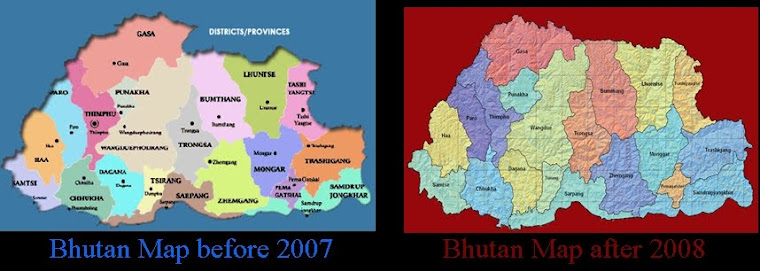
Click over the map to know the differences
Tuesday, December 15, 2009

Denmark donates to feed Bhutanese in exile
Denmark donates to feed Bhutanese refugees
Monday, 14 December 2009 17:52
Denmark government has extended financial assistance of Rs 4.6 million (USD60,000) to United Nations World Food Programme (WFP) on Monday to help feed more than 85,000 Bhutanese refugees who have been living in camps in Eastern Nepal over the last 18 years.
"As Chairperson for the core group of countries concerned about the refugees from Bhutan, I am happy that we can give WFP a helping hand," Danish Ambassador, Finn Thilsted is quoted in a statement issued by Danish embassy in Kathmandu.
"The number of refugees resettled to a third country has now reached 25,000. The process of solving the problem of the refugees is moving fast now. It is therefore important we do not meet obstacles including food shortages to the refugees," Thilsted added.
The contribution from Denmark will support both emergency and longer-term humanitarian projects in Nepal.
"We are very grateful for this contribution and the ongoing support from the Government of Denmark for the refugees from Bhutan," said WFP Deputy Country Representative, Dominique Hyde.
Under their current status, the Bhutanese refugees are restricted from engaging in economic activities outside the camps and from owning land. This makes humanitarian assistance, such as food assistance supported by the international donor community, essential to fulfilling their basic needs.
At the request of the Government of Nepal, WFP has been providing food assistance to the refugees since 1992, in close coordination with the UN refugee agency, UNHCR. nepalnews.com
Sunday, December 13, 2009
Bhutanese start new life in Sacramento
By Stephen Magagnini, smagagnini@sacbee.com
Published: Saturday, Dec. 12, 2009 - 12:00 am
A crowded apartment in east Sacramento became a colorful dream factory recently when Bhanu Adhikari married his childhood sweetheart, Kamala Chauhan.

[ Relatives bless wedding couple Bhanu Adhikari, 29, left, and Kamala Chauhan, 27, by putting "tika" – rice mixed with yogurt, sugar and red dye – on their foreheads during a Hindu wedding ceremony in east Sacramento. The newlyweds met in eighth grade, but years in Nepalese refugee camps kept them from sealing their union. ]
The couple – who sealed their long-anticipated union in an elaborate Hindu ceremony – fell in love 12 years ago behind barbed wire in a Nepalese refugee camp.
Clad in red, gold and green wedding clothing, they celebrated not just the culmination of their love and bonding of their families, but their new life of religious and political freedom in the United States.
"Good climate, good soil, good people," declared a bubbly Adhikari, one of the first 400 Bhutanese refugees who have been resettled in Sacramento this year.
His bride's family resettled in Phoenix in March. The Hindu wedding ceremony at Adhikari's apartment welcomed Chauhan, 27, into his family and covered all her new responsibilities as a daughter-in-law.
Adhikari, 29, became a teacher in the refugee camp. Here he works as a cook. "It took me four months to find this job – it's easier to find a diamond," he said. "I want to be a pharmacist."
The Bhutanese represent the latest chapter in Sacramento's rich immigrant history, which embraces more than 100,000 refugees from across the globe.
Bhutan is a poor nation of 700,000 people perched in the Himalayas between India and Tibet. Most of the Bhutanese seeking refuge in the United States are Hindus who say they were persecuted by the government. As many as 600 more will be resettled in the Sacramento region.
Half the Bhutanese already in Sacramento who speak some English are working, said Rachel Lau, whose agency, International Rescue Committee, is helping resettle them.
"Bhutanese are very different in comparison with a lot of our other clients," Lau said. Most couldn't work in the camps in Nepal.

"So they basically were idle for two decades. They've used that experience as motivation," Lau said. "They pretty much get off the plane ready to work and they will do whatever."
Many, including several of the groom's relatives, work as $8 an hour hotel maids.
Others have gotten jobs at Fry's Electronics, grocery stores, gas stations, fast food franchises and a uniform cleaning company, Lau said. "The larger Indian Hindu community has taken them under their wing with some furniture donations and jobs."
Chauhan, the new bride, was a social worker in the camps. She plans to become a cashier, the job she had in Phoenix, and eventually hopes to become a nurse.
Outcasts in the camps
The couple said their families fled to Nepal to escape Bhutan's oppressive government, along with about 100,000 other Bhutanese Hindus of Nepali origin who settled in seven camps in Nepal.
The Bhutanese Hindus – called Lhotsampas, or people of southern Bhutan – claim they were driven off their lands and jailed for holding nonviolent protests.
About 20,000 have been resettled in the United States since March 2008, according to the U.S. State Department.
Bhutan denies human rights violations against the Lhotsampas and considers them illegal immigrants who threaten Bhutan's "distinct political and cultural" identity, according to Tshewang C. Dorji of the Permanent Mission of the Kingdom of Bhutan to the United Nations.
"The citizenship laws of Bhutan are not discriminatory. It will only be found discriminatory by illegal residents," Dorji wrote in an e-mail exchange with The Bee.
"Granting citizenship to such people would create a dangerous precedent for a small country like Bhutan."
The United Nations High Commissioner for Refugees said most of the refugees are descendants of Nepalese who migrated to southern Bhutan in the late 19th century to farm and settled in malaria-infested lowlands.
The Lhotsampas who left the lowlands for the camps in Nepal spent nearly 20 years there before the United States and other countries agreed to resettle them.
"Many of them were stripped of citizenship rights and were effectively expelled from the country," said UNHCR spokesman Tim Irwin. "They … feel they had no option but to leave."
About 80 percent of the Bhutanese newcomers were farmers famous for their orange orchards, ginger and nuts.
The groom's grandfather, 83-year-old Badri Pokharel, misses his 17 acres, his home and his temple. In a corner of his Sacramento apartment, Pokharel recites mantras from the holy Gita and kneels in prayer before Laxmi, the goddess of wealth, depicted on an electric prayer wheel that spins and hums.
"There are 18 chapters, and every day he recites one chapter," explained his son Rup Pokharel, the groom's uncle. As Hindus, the Lhotsampas were the religious minority in a primarily Buddhist country.
Badri Pokharel said his Buddhist friends who did not support the government's mistreatment of the Lhotsampas were not "allowed to raise their voice."
He said he and other Lhotsampas staged a peaceful protest in 1990 demanding freedom of speech and religion.
[
Bride and groom Bhanu Adhikari, right, and Kamala Chauhan, center, arrive with suitcase from the bride's family home in Phoenix for the welcoming ceremony Dec. 2 in east Sacramento. Seven lamps welcome Hindu goddess Laxmi in a prayer for wealth and harmony with the entrance of the new bride. ]
"They were tortured in the jail, hundreds of women were raped in public, houses were burned and people were forced to leave the country at gunpoint," said Rup Pokharel, 35, a journalist and teacher in the camps.
Inside the camps, he said, people died from starvation, lack of medical care and poor sanitation.
Launching a new life
Between his shifts at a uniform store, Rup Pokharel takes fellow Bhutanese immigrants to see doctors.
"We've noticed an incredible amount of health issues in the community," said Lau, the refugee coordinator. "There are a lot of urgent hospital visits, trying to find specialists."
Some are malnourished, others suffer from epilepsy and bacterial infections but never had medication until they got to Sacramento, Lau said.
But on this joyous Wednesday night in December, several dozen Bhutanese made happy memories. The groom, Bhanu Adhikari, hugged his new bride and recalled how she won his heart in eighth grade.
"She was pretty, of good moral character, a good student from a good family," he said, making her smile.
"He was very talented, friendly, had a good personality and was very helpful in school," she said.
[ Sabitra Pokharel, left, grandmother of the groom, smiles as relatives watch the wedding video. The couple delayedmarriage while they were in the refugee camp. "We were always beggars," Adhikari said. "For 19 years it was a kind of hell, but it teaches a lot of lessons on how to progress in life, and go further." ]
They didn't get married in the camp because he couldn't provide for her, Adhikari said. "We were always beggars. For 19 years it was a kind of hell, but it teaches a lot of lessons on how to progress in life, and go further.
"I don't want to be a burden," he said, "but the U.S. has helped us to save our lives."
Call The Bee's Stephen Magagnini, (916) 321-1072. Bee researcher Pete Basofin contributed to this report.
Published: Saturday, Dec. 12, 2009 - 12:00 am
A crowded apartment in east Sacramento became a colorful dream factory recently when Bhanu Adhikari married his childhood sweetheart, Kamala Chauhan.

[ Relatives bless wedding couple Bhanu Adhikari, 29, left, and Kamala Chauhan, 27, by putting "tika" – rice mixed with yogurt, sugar and red dye – on their foreheads during a Hindu wedding ceremony in east Sacramento. The newlyweds met in eighth grade, but years in Nepalese refugee camps kept them from sealing their union. ]
The couple – who sealed their long-anticipated union in an elaborate Hindu ceremony – fell in love 12 years ago behind barbed wire in a Nepalese refugee camp.
Clad in red, gold and green wedding clothing, they celebrated not just the culmination of their love and bonding of their families, but their new life of religious and political freedom in the United States.
"Good climate, good soil, good people," declared a bubbly Adhikari, one of the first 400 Bhutanese refugees who have been resettled in Sacramento this year.
His bride's family resettled in Phoenix in March. The Hindu wedding ceremony at Adhikari's apartment welcomed Chauhan, 27, into his family and covered all her new responsibilities as a daughter-in-law.
Adhikari, 29, became a teacher in the refugee camp. Here he works as a cook. "It took me four months to find this job – it's easier to find a diamond," he said. "I want to be a pharmacist."
The Bhutanese represent the latest chapter in Sacramento's rich immigrant history, which embraces more than 100,000 refugees from across the globe.
Bhutan is a poor nation of 700,000 people perched in the Himalayas between India and Tibet. Most of the Bhutanese seeking refuge in the United States are Hindus who say they were persecuted by the government. As many as 600 more will be resettled in the Sacramento region.
Half the Bhutanese already in Sacramento who speak some English are working, said Rachel Lau, whose agency, International Rescue Committee, is helping resettle them.
"Bhutanese are very different in comparison with a lot of our other clients," Lau said. Most couldn't work in the camps in Nepal.

"So they basically were idle for two decades. They've used that experience as motivation," Lau said. "They pretty much get off the plane ready to work and they will do whatever."
Many, including several of the groom's relatives, work as $8 an hour hotel maids.
Others have gotten jobs at Fry's Electronics, grocery stores, gas stations, fast food franchises and a uniform cleaning company, Lau said. "The larger Indian Hindu community has taken them under their wing with some furniture donations and jobs."
Chauhan, the new bride, was a social worker in the camps. She plans to become a cashier, the job she had in Phoenix, and eventually hopes to become a nurse.
Outcasts in the camps
The couple said their families fled to Nepal to escape Bhutan's oppressive government, along with about 100,000 other Bhutanese Hindus of Nepali origin who settled in seven camps in Nepal.
The Bhutanese Hindus – called Lhotsampas, or people of southern Bhutan – claim they were driven off their lands and jailed for holding nonviolent protests.
About 20,000 have been resettled in the United States since March 2008, according to the U.S. State Department.
Bhutan denies human rights violations against the Lhotsampas and considers them illegal immigrants who threaten Bhutan's "distinct political and cultural" identity, according to Tshewang C. Dorji of the Permanent Mission of the Kingdom of Bhutan to the United Nations.
"The citizenship laws of Bhutan are not discriminatory. It will only be found discriminatory by illegal residents," Dorji wrote in an e-mail exchange with The Bee.
"Granting citizenship to such people would create a dangerous precedent for a small country like Bhutan."
The United Nations High Commissioner for Refugees said most of the refugees are descendants of Nepalese who migrated to southern Bhutan in the late 19th century to farm and settled in malaria-infested lowlands.
The Lhotsampas who left the lowlands for the camps in Nepal spent nearly 20 years there before the United States and other countries agreed to resettle them.
"Many of them were stripped of citizenship rights and were effectively expelled from the country," said UNHCR spokesman Tim Irwin. "They … feel they had no option but to leave."
About 80 percent of the Bhutanese newcomers were farmers famous for their orange orchards, ginger and nuts.
The groom's grandfather, 83-year-old Badri Pokharel, misses his 17 acres, his home and his temple. In a corner of his Sacramento apartment, Pokharel recites mantras from the holy Gita and kneels in prayer before Laxmi, the goddess of wealth, depicted on an electric prayer wheel that spins and hums.
"There are 18 chapters, and every day he recites one chapter," explained his son Rup Pokharel, the groom's uncle. As Hindus, the Lhotsampas were the religious minority in a primarily Buddhist country.
Badri Pokharel said his Buddhist friends who did not support the government's mistreatment of the Lhotsampas were not "allowed to raise their voice."
He said he and other Lhotsampas staged a peaceful protest in 1990 demanding freedom of speech and religion.

[
Bride and groom Bhanu Adhikari, right, and Kamala Chauhan, center, arrive with suitcase from the bride's family home in Phoenix for the welcoming ceremony Dec. 2 in east Sacramento. Seven lamps welcome Hindu goddess Laxmi in a prayer for wealth and harmony with the entrance of the new bride. ]
"They were tortured in the jail, hundreds of women were raped in public, houses were burned and people were forced to leave the country at gunpoint," said Rup Pokharel, 35, a journalist and teacher in the camps.
Inside the camps, he said, people died from starvation, lack of medical care and poor sanitation.
Launching a new life
Between his shifts at a uniform store, Rup Pokharel takes fellow Bhutanese immigrants to see doctors.
"We've noticed an incredible amount of health issues in the community," said Lau, the refugee coordinator. "There are a lot of urgent hospital visits, trying to find specialists."
Some are malnourished, others suffer from epilepsy and bacterial infections but never had medication until they got to Sacramento, Lau said.
But on this joyous Wednesday night in December, several dozen Bhutanese made happy memories. The groom, Bhanu Adhikari, hugged his new bride and recalled how she won his heart in eighth grade.
"She was pretty, of good moral character, a good student from a good family," he said, making her smile.
"He was very talented, friendly, had a good personality and was very helpful in school," she said.

[ Sabitra Pokharel, left, grandmother of the groom, smiles as relatives watch the wedding video. The couple delayedmarriage while they were in the refugee camp. "We were always beggars," Adhikari said. "For 19 years it was a kind of hell, but it teaches a lot of lessons on how to progress in life, and go further." ]
They didn't get married in the camp because he couldn't provide for her, Adhikari said. "We were always beggars. For 19 years it was a kind of hell, but it teaches a lot of lessons on how to progress in life, and go further.
"I don't want to be a burden," he said, "but the U.S. has helped us to save our lives."
Call The Bee's Stephen Magagnini, (916) 321-1072. Bee researcher Pete Basofin contributed to this report.
Thursday, December 10, 2009
Stateless Refugee Children from Bhutan Living in Nepal
Testimony of Bill Frelick to a Joint Briefing for the Congressional Children's Caucus and the Congressional Human Rights Caucus on the Status of Stateless Children
FEBRUARY 14, 2007
On February 15, 2007 Bill Frelick testified before the Congressional Children's Caucus and the Congressional Human Rights Caucus on stateless Bhutanese refugee children living in Nepal.
Recognizing that we have a very full panel of witnesses today and bearing in mind that the legal human rights framework I presented in my previous testimony is for the most part unchanged, and available on the Human Rights Caucus web page, I will today confine my remarks to one particular group that illustrates this problem—stateless children from Bhutan living in refugee camps in Nepal. I had the opportunity to visit all seven refugee camps in November to assess conditions in which the children there are living. Out of a total camp population of about 105,000 refugees, 40 percent are children. I must note at the outset, however, that the adult members of this population are stateless as well and are also left vulnerable due to their lack of a recognized nationality.
Let me first provide some background on the origins of these children.
Restrictive Citizenship Laws in Bhutan—the Cause of Statelessness and the Refugee Problem
These refugees are ethnic Nepalese. Their ancestors first began migrating to Bhutan in the nineteenth century. Many became eligible for Bhutanese citizenship under a 1958 Nationality Law. However, by the late 1970s the ethnically, culturally, and politically dominant Drukpa establishment had come to see the Nepali speakers’ growing numbers and influence as a threat to Bhutan’s cultural identity and to their own privileged position. Increasingly, the government asserted that the majority of the Nepali speakers in Bhutan were not in fact citizens but illegal immigrants who threatened Bhutan’s political, religious, and cultural identity.
The government invoked these perceived threats as justification for a series of discriminatory measures aimed at the political, economic and cultural exclusion of Bhutan’s Nepali speakers, including two Citizenship Acts that tightened the requirements for citizenship. The 1977 Citizenship Act was followed by a nationwide census, and citizenship cards were issued only to those who met the strict qualifications of that Act.
A 1985 Citizenship Act tightened the requirements for Bhutanese citizenship still further. Under the 1985 Act, a child would qualify for citizenship by birth only if both parents were Bhutanese. The requirements for eligibility for citizenship by naturalization under the 1985 Act were: residence in Bhutan of 15 years for government employees and children with one Bhutanese parent, and 20 years for all others; the period of residence must be registered in the government records; proficiency in Dzongkha, the language of the ruling ethnic group, the Ngalongs; good knowledge of the culture, customs, traditions, and history of Bhutan; good moral character; no record of imprisonment for criminal offences; and no record of having spoken against the king, country and people of Bhutan. The 1985 Act granted the government of Bhutan the right to reject any application for naturalization without giving reasons. The 1985 Act also provided for citizenship by registration, which required that one must have been permanently domiciled in Bhutan on or before December 31, 1958 and one’s name must have been registered in the Ministry of Home Affairs census register.
The 1985 Citizenship Act was followed by a new census in 1988. This census amounted to a selective, arbitrary and retroactive implementation of the 1985 Act. First, it took place only in southern Bhutan, where the Nepali-speaking population resided. Second, Nepali speakers were denied the benefits of the provisions in the 1985 Act on citizenship by naturalization; instead, Bhutanese citizenship for Nepali speakers was restricted to those who could prove residence in Bhutan since before December 31, 1958. The citizenship identity cards issued after the previous census were disregarded: people who could not prove residence since before the 1958 cut-off date were classified as illegal immigrants, even if they were in possession of a citizenship card.
The 1988 census placed people into one of seven categories. Only those people who could prove they resided in Bhutan in 1958 were categorized as “genuine Bhutanese”; everyone else was placed in one of six other categories. The Bhutanese authorities applied exceedingly strict criteria in this regard. For example, people who had documents proving residence before and after 1958, but not 1958 itself, were categorized as “returned migrants”, that is, people who had left Bhutan and then returned again. Census officials frequently confiscated the citizenship cards of people who had no documents to prove residence in 1958.
The census caused considerable anxiety among the Nepali speaking population in southern Bhutan. This state of fear and resentment was exacerbated by a series of “Bhutanization” measures aimed at enforcing a distinct national identity, in line with Bhutan’s “one nation, one people” policy. For example, on January 16, 1989, the king issued a decree requiring all citizens to observe the traditional Drukpa code of values and dress. This was followed in February 1989 by a decision to remove Nepali from the curriculum in all schools in southern Bhutan.
These policies were perceived as a direct attack on the cultural identity of the ethnic Nepalese, and led to growing unrest in southern Bhutan, culminating in mass demonstrations in September and October 1990. The government response was swift. All participants in the demonstrations were classed as ngolops (“anti-nationals”), and thousands of people accused of taking part in the demonstrations were arrested and detained. Many were subjected to ill-treatment and torture; a number of people were reported to have died in detention. The security forces staged frequent raids on the homes of ethnic Nepalese, and there were numerous accounts of women and girls being raped in the course of these raids.
By the end of 1990, the first Nepali speakers fled Bhutan. Some had been released from prison on condition that they would leave the country, while others fled to avoid falling victim to arbitrary arrest and detention. People who were categorized as non-nationals under the 1988 census were told to leave the country or face imprisonment. The security forces harassed many Nepali speakers, in some case destroying their homes, and forced others into exile by intimating them into signing so-called “voluntary migration forms.”
Protracted Statelessness: No Resolution after 15 years in Refugee Camps
The Bhutanese have been living in the camps in Nepal for more than 15 years. Despite 15 rounds of bilateral talks between Bhutanese and Nepalese government authorities, there has been no progress toward resolving their situation. Exhaustive negotiations, so far, have resulted only in a “verification exercise” carried out over a two-year period by a Joint Verification Team of Nepalese and Bhutanese officials. The verification exercise was intended to resolve the nationality status of the refugees and pave the way for the repatriation of those found to be Bhutanese nationals who were forced out of the country by placing them in one of four categories. The results, released in 2003, were disappointing to say the least. First, the verification exercise never expanded beyond one camp, Khundunabari, so, at best, was able to verify the status of only 10 percent of the total refugee population. Even so, only 2.5 percent of the refugees were found to be Bhutanese citizens who had been forcibly expelled and who would be allowed to repatriate with full citizenship rights.
To date, none of this small “category 1” group has actually been allowed to return. The bulk of the refugees, 70 percent, were categorized as “Bhutanese who voluntarily migrated”—category 2, which supposedly provides for the right to return (though none have yet been allowed back), but without compensation or restoration of lost property and with an arduous process for reclaiming the Bhutanese citizenship. Another 24.5 percent were categorized as non-Bhutanese—utterly stateless. Finally, 3 percent were categorized as “criminals”—usually as a result of the nonviolent expression of their political beliefs, who presumably would be subject to arrest upon return.
Bhutan’s attempts to limit the unconditional right of return to people in category 1 violate its obligations under international law. Regarding the people in category 2, Bhutanese who are deemed to have left Bhutan voluntarily, Bhutan argues that these people have renounced their Bhutanese citizenship. However, the circumstances surrounding people’s departure from Bhutan in the early 1990s make clear that, far from leaving voluntarily, Nepali-speakers were either forced to leave, or felt compelled to leave the country to avoid harassment, physical abuse and imprisonment. There is, thus, no basis for distinguishing between people in categories one and two: they should all be allowed to exercise their right to return to Bhutan should they so wish and have their status as citizens of Bhutan restored to them with immediate effect.
The verification exercise put children in a particular quandary. Under the 1985 Citizenship Act, only children whose parents are both citizens of Bhutan are citizens by birth. Since only 2.5 percent of the refugees in one camp have been recognized as citizens, few children will have two Bhutanese citizen parents. Those belonging to Category 2, the largest category that theoretically will be allowed to return will find it nearly impossible to obtain Bhutanese citizenship upon return. They will be required to qualify under the 1985 Citizenship Act. Among other strict provisions, the Act requires proficiency in the Dzongkha language, which in almost all cases the children have not heard spoken their entire lifetimes outside primary school language classes in the camps. The Act also requires 20 years of residency in Bhutan (or 15 years for children with one Bhutanese parent)—which no child could fulfill. After returning, they would have to wait 15-20 years before being able to apply for citizenship. This means that it is likely that most Bhutanese children currently living in the Nepalese refugee camps if they ever are allowed to repatriate will most likely remain stateless. As stateless persons they would face significant restrictions to their basic rights. Under the current Bhutanese ID system, they would not be able eligible for higher education or to obtain government jobs, trading or business licenses without a “No Objection Certificate”. Such certificates would not be issued to the children of stateless people. They would be reduced to being subsistence farmers, but would not have land, so no means to sustain themselves.
While voluntary repatriation is recognized, in principle as the optimal refugee solution, it presumes fundamental changes in the conditions that caused the refugees to flee in the first place. Available evidence suggests that conditions in Bhutan have not significantly improved for ethnic Nepalis. Human Rights Watch interviewed Bhutanese Nepali speakers who managed to avoid expulsion and still live in Bhutan, and found their status in Bhutan to be very insecure. Some have been denied citizenship cards following the latest census in 2005 and so they are now effectively stateless in their own country. Without documents, their situation in Bhutan is so difficult that some said that even if they are not going to be forced out of the country, they might have to leave at some point in the future simply because they won’t be able to survive in Bhutan.
Schools have reopened in southern Bhutan, but Nepali speakers have difficulty getting admission. This is true even for the ones with documents. There are very few health care facilities in the south, so in effect Nepali speakers are denied access to health care much of the time. This is true even for people with documents.
Another acceptable durable solution for refugees is local integration. The statelessness of some of the refugees—and particularly the one-quarter of the population categorized as non-Bhutanese—could be resolved through naturalization and integration into the fabric of life in Nepal. However, the policy of the government of Nepal has been firmly aimed at precluding the Bhutanese refugees from integrating in Nepal, both in legal and in economic terms. While Nepal allows the Bhutanese refugees to remain on its territory, it accords them few rights. First, regardless of the fact that many Bhutanese refugees have now resided in Nepal for more than 15 years, and that a significant proportion of the Bhutanese refugee population consists of children who were born in Nepal, no provision is made for Bhutanese refugees to acquire Nepalese citizenship.
The most recent development is an offer the U.S. government made publicly late last year to resettle up to 60,000 Bhutanese refugees from the camps in eastern Nepal. While many welcome this initiative, resettlement as a durable solution is not well understood among the refugees and has been the cause of some tension and conflict in the camps.
The Children: Misery, Frustration, Hope
We spoke with many young people during our visit to the camps. On one hand we were struck at how bright and capable they appeared to be. Despite living all or most of their lives in the restrictive setting of a refugee camp, they have benefited from parents who for the most part value education. The children were generally vocal in expressing their desires and in articulating their human rights. On the other hand, they are extremely frustrated and see their lives as wasting away. For the most part, they are not set on a particular solution, but do not want to remain in limbo any longer.
Time and again, the refugees expressed their gratitude for the support they have received from the international community. They consistently said that their true desire was to be restored to the status of full citizens with full respect for their political, civil, economic, social, and cultural rights. A young man expressed his frustration, saying, “I cannot live in the camp any more. I will go to any country where they will give me citizenship, even if it is Afghanistan.” Another young man told me:
I don’t want the mask of a refugee any longer. We don’t know about things in Bhutan. I was only 5 or 6 years old when I left. I don’t remember much about my country. I wasn’t even in school yet. Now when young people talk about Bhutan, they have no sense of what it is. We want to brighten our future. And we want a speedy solution—by any means.
A student said:
Young people in the camp are frustrated. We have many talents, but as refugees we don’t get a chance to express ourselves. Sometimes I feel I want to end my life.
Another said:
I was only 6 or 7 when I left Bhutan. I have little memory of the country. The refugee life is miserable. We are suffering. We lack financial support. Our brothers and sisters have no jobs. The only job is to be a teacher [in the camp]. We can’t go outside the camp to work. We are not allowed to go outside the camp. We are hearing about third country resettlement. We want to know about life in America. My aim is to return to Bhutan, but the autocratic government of Bhutan would make if very hard to change the system of government of Bhutan. There is no UNHCR officer there, no human rights office in Bhutan. It would have to change. That is so very difficult. Lhotshampas [a name some give the Nepalese who lived in southern Bhutan] are living in miserable conditions. We hear news from people in Bhutan, but we have no direct communication with them. We have lived here for 15 years. I am not married, but one day I will have children. I want to know what it will be like. Our first aim is repatriation, but if that is not possible, we need to think of something else. We need Nepalese nationality as our second aim.
A young woman said:
Sometimes when we walk at night it is dangerous. There are difficulties inside and outside the camp. It is not safe to walk alone at night. I have to walk with friends. There is no guarantee for safety. We [women] do not get full opportunities compared to men. Women don’t get applications to work. I don’t get a full opportunity in any field. I want to work to improve women’s rights in our society. I am deprived. We are not able to do work other than teaching. We are stateless. We are compelled to do teaching….We want to go to our country. My motherland where I was born is precious to me. My family feels the same way. I want to go back to a Bhutan that is better than this. Until now, Bhutanese have been deprived of their rights. Men and women should be equal and free. If we go back to our motherland, I have the same hope for human rights.
A middle-aged man speaking to me with his daughter sitting in his lap told me:
Repatriation would be the best solution, but there is no way that will happen. The government of Bhutan, we have learned that it would not like to address us. The Royal Government of Bhutan does not want to call us Bhutanese. In such conditions people like me, having been tortured by pointing a weapon at my chest, I cannot go back to Bhutan. My life is at stake and I am at risk. Nothing they say would convince me to go back. I also would not like to appeal to the Nepalese to allow us to stay here. The Nepalese themselves are landless. They are homeless, so how can we stay here? My wife and I have heard the rumors all over camp. We have talked about it with our children. Our children said that we want resettlement. We want to live in an atmosphere where we can eat our own bread earned from our own sweat. We don’t want to be dependent on others. We no longer want the tag of “refugee.” Half our lives have been spent as refugees. We don’t want that tag on our children’s forehead. We want them to be proud citizens.
Durable Solutions?
The refugees do not have a uniform opinion about their future. When asked, most initially say that their first choice is to return, and many stick to that as the only acceptable solution. But they differ on the terms and conditions of return. And they differ on how much longer they can wait for repatriation.
So far, Nepalese citizenship has not been an option. Nepal sees this population as Bhutan’s responsibility. There are some refugees, particularly those married to local Nepalese, who would opt for local integration in Nepal if that were an option. Nepal has recently passed a new citizenship law, which looks promising. Until now children born to a Nepalese mother and a Bhutanese father were not entitled to Nepalese citizenship. Now, although they are not accorded the automatic citizenship that applies to children of Nepalese fathers and Bhutanese mothers, they can be eligible for Nepalese citizenship if they have permanent residence in Nepal, and have not acquired citizenship of a foreign country on the basis of the father’s citizenship.
Many of the refugees—particularly among the youth—are thrilled with the prospect of resettlement to the United States. But what they lack is clear information about the resettlement process, and this creates anxiety and fear. In particular, they are anxious to know more about the conditions for acquiring US citizenship. Given their history of expulsion from Bhutan, they have understandable fears that without citizenship, their status would remain insecure and that they could even be expelled again.
This is an understandable reaction under the circumstances of their lives. The refugees need clear information about all three durable solutions—repatriation, local integration, or resettlement, and the terms and conditions of all three, including the feasibility of it happening at all. In any case, a “solution” without citizenship in the view of the overwhelming majority of the refugees would be no solution at all.
Recommendations to the U.S. Government:
Because this is testimony for a congressional briefing, our recommendations are confined to the U.S. government.
Despite the lack of diplomatic relations with Bhutan, the U.S. Government should use whatever diplomatic tools it is able to marshal to convince or pressure the Bhutanese government to allow all refugees to return if they so wish and restore their Bhutanese citizenship to them immediately; to respect the human rights of the remaining Nepali-speakers in Bhutan and to stop discriminating against them; and ensure that Bhutan doesn’t expel any more Nepali-speakers. Bhutan should allow Category 1 refugees from the Khundunabari camp to repatriate immediately and to permit the UN High Commissioner for Refugees and other international observers to monitor the repatriation.
The U.S. government should work with UNHCR to provide information to refugees in the Nepalese camps about the three durable solutions and, in particular, to provide information about the offer or refugee resettlement to the United States, particularly emphasizing that it is entirely voluntary, that it is intended to lead to U.S. citizenship, and that it does not preclude the possibility of returning at some future date to Bhutan.
The U.S. government should proceed expeditiously with plans to begin processing those refugees who express an interest in U.S. resettlement and who meet U.S. eligibility criteria. The longer the delay between the time the offer was announced and resettlement actually starts, the greater the chance for misunderstanding and for obstruction by elements opposing resettlement.
The U.S. government should encourage the Nepalese government to allow Bhutanese refugees to naturalize.
Taxpayers bear the burden as refugee resettlement soars
Posted by acorcoran on December 9, 2009
That is the title of an opinion piece that appeared today in the Tennessean. Freelance writer Don Barnett raises many of the same issues we have been raising here for the last 2 and a half years. Unfortunately, reform of the program won’t happen until the media begin to investigate what is hidden behind a ‘presumption of good intentions.’
I’ll have more comments later on this excellent op-ed, but wanted to get it to you right away.
This fiscal year, the U.S. resettled almost three times as many refugees as all the rest of the countries in the industrialized world combined.
Despite the recession, growing poverty, unemployment and homelessness, the U.S. resettled 75,000 refugees, the highest number of admissions since 9/11.
This is possible only because what was once the calling of true sacrificial charity and private sponsors is now the responsibility of the American taxpayer. Traditional sponsor duties have been replaced by access to welfare upon arrival for refugees and an opaque stream of grant money from seemingly every government agency except NASA.
In recent years up to 95 percent of the refugees coming to the U.S. were referred by the U.N. High Commissioner for Refugees (UNHCR) or were the relatives of U.N.-picked refugees. Until the late 1990s, the U.S. picked the large majority of refugees for resettlement in the U.S.
Considering that the refugee influx causes increases in all legal and illegal immigration as family and social networks are established in the U.S., the U.N. is effectively dictating much of U.S. immigration policy.
A nonprofit nation of hundreds of taxpayer-funded organizations has grown up around refugee resettlement in the U.S. A government-funded study finds “U.S. resettlement communities are awash with ECBOs that exist in name only but provide little meaningful assistance.” ECBO stands for Ethnic Community Based Organization, a government-defined category of grant recipients.
The expansion of the fraud-prone refugee program and the transformation of refugee resettlement into a federal contracting business have given birth to a global refugee industry well-adapted to the federal grant and contract environment.
Catholic Charities with its parent the U.S. Conference of Catholic Bishops (USCCB ) is the largest refugee agency both nationally and in Nashville. It is neither a charity nor Catholic, but more an extension of a state welfare agency.
Sixty-five percent of Catholic Charities USA’s $3.6 billion annual budget comes from government sources. Refugee resettlement, a relatively small portion of its services, is covered by the government at closer to 100 percent. For nonprofits, it is profitable to be in refugee resettlement, and the executive directors of some of the 10 major resettlement agencies make almost as much as the president of the United States.
Nashville Catholic Charities devotes about 26 percent of its budget to “immigrants and refugees,” an amazingly high percentage considering most of that aid is going to recent refugee arrivals — a fraction of 1 percent of Nashville’s population. Interestingly, Tennessee recently put Nashville Catholic Charities in charge of distributing and monitoring federal “refugee” grant money to other NGOs in the state.
The possibility of a generous reception in the U.S. has created a “magnet effect” for refugees deciding between resettlement in the U.S. and integration in the region where they reside.
The once-independent faith-based and civic organizations have suffered their own “magnet effect,” causing a shift of efforts away from traditional works toward the more profitable refugee program. USCCB even lobbies for more business — that is, for higher refugee admission quotas.
Incentives built into refugee resettlement are behind much of its growth, especially as refugees themselves enter the federal contracting and lobbying business.
It is long past the time to lift the curtain of myth that protects this program from scrutiny.
From This Blog Refugee Resettlement Watch
Bhutan reports 17 border intrusions by China in 2009
Phayul[Wednesday, December 09, 2009 23:11]
By Kalsang Rinchen
Dharamsala, December 9 – It's not just India that is at loggerheads with China on border issues. Bhutanese Secretary for International Boundaries, Dasho Pema Wangchuk, told the Bhutanese parliament that Chinese soldiers had intruded into Bhutanese territory as many as seventeen times in 2009 alone, reported Kuenselonline, web edition of Bhutan's national newspaper.
Dasho Pema Wangchuk was presenting an updated status report on the Bhutan-China boundary negotiations on December 4 in the Bhutanese National Assembly. Chinese soldiers have entered as far as the Royal Bhutan Army (RBA) outpost at Lharigang in the Charithang valley, according to Wangchuk.
According to Wangchuk, China started road construction work from Langmarpo stream towards Zuri ridge in 2004 but later stopped work after protests from the Bhutanese government. However, in August this year the Chinese started extension of the road construction work between Zuri to Phuteogang ridge, which overlooks the Charithang valley, Wanghuk said, adding that his government protested five times and asked China to stop construction on the basis of 1998 agreement on the maintenance of peace and tranquility in Bhutan-China border areas which states that “the two sides agree to maintain peace and tranquility in their border areas pending a final settlement on the boundary question, and to maintain status quo on the boundary as before March 1959” and that “they will also refrain from taking any unilateral action to change the status quo of the boundary”.
Dasho Pema Wangchuk said that the main reason why Bhutan has not been able to successfully demarcate the northern border with China even after many years is because of the differences of views and positions of the boundary between Bhutan and China. “At present we have four areas which are disputed in the western sector- Doklam, Charithang, Sinchulumpa and Dramana pasture land, ” Wangchuk was quoted by Kuensel online as saying.
The two countries have met 18 times since 1984 for border talks with the latest being in August 2006 in Beijing. China had proposed the 19th round of the border talks to be held in December this year but Bhutan has proposed the border talks to be held in Thimphu in January next year. Wangduephodrang MP, Gyem Dorji, said thousands of people from Tibet enter Bhutan every year to "illegally" collect Cordyceps (yartsa gunbu) along the northern border of Sephu Gewog.
Analysts say that China has not been able to woo Bhutan the way it had wooed Nepal. Bhutan has been a loyal neighbor for many years to India which has been providing various assistance to the Himalayan Kingdom.
Many Tibetans settled in Bhutan after fleeing Tibet through its southern border at Dromo after Chinese invasion. However, the Tibetan population in Bhutan dwindled after the royal government of Bhutan expelled many Tibetans and Nepalese refugees in early eighties.
From : Phayul
Democracy and freedom, yes, but scarves and mittens too

Commentary
by Evelyn Lennon
December 9, 2009
As Minnesotans, we have a long tradition of opening our arms to refugees and asylum seekers. This year, a new wave of refugees from Asia and east Africa arrived in Minnesota: Bhutanese, Karen from Burma, and small populations of Oromo from Ethiopia and Somalis.
Like the refugees who came before them, these men and women set foot in a state notorious for brutally cold winters. This group also had the misfortune of arriving in communities experiencing tremendous economic strain.
This season, with state and nonprofit budgets squeezed even tighter, we should be sure that the most vulnerable don't feel the pinch. We must ask our political leaders to stop deep cuts to non-profits.
During this period of staggering joblessness, social services help sustain families with no other options. When contemplating cuts to nonprofits, our political leaders should reflect on the men and women who are so desperate for a safe haven that they sleep on other people's living room floors.
For most, an inflatable mattress is an unaffordable luxury. What will deeper cuts mean for them and their families?
We must also ask ourselves what we can give. The answer may be as simple as a scarf or a pair of boots. Several years ago, a new client asked to have his appointments scheduled on specific days of the week. He shared a winter coat with a friend who was off work and home those days.
Every year, we refer clients to community resources for coats, sweaters, mittens and other warm clothing. If you have an extra coat in good condition in your closet, donate it to an organization.
For many new arrivals, that first coat is a lifeline. These men and women often rely on public transportation to get to the grocery store, the doctor or their children's school. In a season when temperatures dip well below freezing, it's unthinkable that anyone should have to wait at a bus stop without a coat.
For one of my clients from East Africa, receiving her first warm scarf and hat -- a small, practical gift -- is something she has not forgotten. Now she knits scarves, with donated yarn, for other clients.
There are other, less tangible, things we can do to help. We can help give asylum seekers dignity. Like us, they want jobs. They want to support themselves and their families. Between arriving in Minnesota and finding jobs, however, many need outside support. Deep cuts to nonprofits will result in fewer resources for clothing, food and shelter that help bridge gaps.
Our communities are better places when every family flourishes. As we weather bitterly cold days and nights, let's remember our new neighbors.
Sometimes the gesture is as important as the actual delivered resource. However, in Minnesota, cold weather clothing is essential.
----
Evelyn Lennon is a social worker at the Center for Victims of Torture. She suggests people who would like to donate clothing contact Joseph's Coat (651-291-2472) in St. Paul, and the Refugee Services effort of the Minnesota Council of Churches (612-230-3227) in Minneapolis.
Don’t drag India in Nepal-Bhutan bilateral Imbroglio: Indian envoy

TGW
Rakesh Sood, the Indian Ambassador to Nepal has provided a new dimension in the historical relations between the two neighboring countries.
Look what he says, “Our relations are not just neighborly but are Familial and Cultural as well.”
Sood is hundred per cent right when he says so, but, it is advised that one step ahead of what he says could invite trouble for Mr. Sood.
Sood who prefers to remain out from Kathmandu’s messy Politics, haphazard traffic conditions and his occupation in political advisory business, has been of late visiting Nepal’s hilly areas rather than the Tarai plains.
Similar to the Chinese envoy who prefers to head to the plains whenever he is free from his newly acquired role of making inroads in Nepali politics, Ambassador Sood has the knowledge that it is more important to consolidate relations with the Hilly people of Nepal who have of late acquired somewhat bitter feelings towards India.
Nevertheless, Sood who was in Lakhanpur, Damak of Jhapa District, December 9, 2009 speaking at a program to lay the foundation stones of a School said “There are people who live in Nepal and have their family members in India and the otherwise...this clearly states that we have familial relations.”
“We will continue to support Nepal”, Sood further assured.
However, analysts claim “Even after thousands of years of association between the two countries, familial and cultural as says Sood, what is it that a diplomat of the likes of Sood need to assure and reassure the Nepali mass that India and Nepal were not just neighbors but much more than that.”
“There exist conjugal relations between the citizens of the countries”, Sood also told the attending School Children who had offered him bouquet of flowers upon his arrival.
Thanks the Indian Ambassador did not press the innocent school students to sing a Hindi song as he forced the Mustang students a few months back.
However, after so much of sweet talks, Sood as is expected of him disappointed many when he said “India has no role to play to sort-out the overly stretched issue of Bhutanese Refugee crisis”.
Sood knows perhaps that sans the Indian support the refugee issue will never arrive at a solution that will, analysts claim, provide India with the opportunity to continue twisting the Nepali arms.
This is perhaps the reason why the Nepali citizens need to be assured and reassured by India that it mean no harm to Nepal.
Analysts wish to pose a question to Ambassador Sood.
“Did the Bhutanese refugees fly over to Nepal from Bhutan without flying over the Indian Sky”? Or did they-the Bhutanese nationals-made a record high jump?
2009-12-10 09:14:03
Source: TWG
Don’t drag India in Nepal-Bhutan bilateral Imbroglio: Indian envoy
TGW
Rakesh Sood, the Indian Ambassador to Nepal has provided a new dimension in the historical relations between the two neighboring countries.
Look what he says, “Our relations are not just neighborly but are Familial and Cultural as well.”
Sood is hundred per cent right when he says so, but, it is advised that one step ahead of what he says could invite trouble for Mr. Sood.
Sood who prefers to remain out from Kathmandu’s messy Politics, haphazard traffic conditions and his occupation in political advisory business, has been of late visiting Nepal’s hilly areas rather than the Tarai plains.
Similar to the Chinese envoy who prefers to head to the plains whenever he is free from his newly acquired role of making inroads in Nepali politics, Ambassador Sood has the knowledge that it is more important to consolidate relations with the Hilly people of Nepal who have of late acquired somewhat bitter feelings towards India.
Nevertheless, Sood who was in Lakhanpur, Damak of Jhapa District, December 9, 2009 speaking at a program to lay the foundation stones of a School said “There are people who live in Nepal and have their family members in India and the otherwise...this clearly states that we have familial relations.”
“We will continue to support Nepal”, Sood further assured.
However, analysts claim “Even after thousands of years of association between the two countries, familial and cultural as says Sood, what is it that a diplomat of the likes of Sood need to assure and reassure the Nepali mass that India and Nepal were not just neighbors but much more than that.”
“There exist conjugal relations between the citizens of the countries”, Sood also told the attending School Children who had offered him bouquet of flowers upon his arrival.
Thanks the Indian Ambassador did not press the innocent school students to sing a Hindi song as he forced the Mustang students a few months back.
However, after so much of sweet talks, Sood as is expected of him disappointed many when he said “India has no role to play to sort-out the overly stretched issue of Bhutanese Refugee crisis”.
Sood knows perhaps that sans the Indian support the refugee issue will never arrive at a solution that will, analysts claim, provide India with the opportunity to continue twisting the Nepali arms.
This is perhaps the reason why the Nepali citizens need to be assured and reassured by India that it mean no harm to Nepal.
Analysts wish to pose a question to Ambassador Sood.
“Did the Bhutanese refugees fly over to Nepal from Bhutan without flying over the Indian Sky”? Or did they-the Bhutanese nationals-made a record high jump?
2009-12-10 09:14:03
Source: TWG
Subscribe to:
Posts (Atom)