Web posted at: 5/18/2007 8:27:49
Source ::: REUTERS
KATHMANDU • An offer by the United States to resettle tens of thousands of Bhutanese refugees living in Nepal has raised many hopes but the gesture has also sparked tension in the camps, Human Rights Watch said yesterday.
Refugees who insist on repatriation as the only acceptable solution have been threatening and intimidating those who voice support for resettlement in the United States, the New York-based group said in a report.
Tens of thousands of ethnic Nepalis were expelled or fled from the Himalayan kingdom of Bhutan in 1991, and around 106,000 live in poverty and exile in crowded camps in eastern Nepal, roughly one-sixth of Bhutan’s population.
Last year, Washington offered to take 60,000 refugees from the camps in a move that has divided the exiled population.
“Refugees fundamentally have the right to return to a country that expelled them,” said Bill Frelick, the group’s refugee policy director. “But all refugees also have the right to make essential choices about their lives without threats and intimidation.”
The expulsions of the ethnic Nepalis followed protests in southern Bhutan in favour of democracy and human rights, and over discrimination against their Hindu religion, culture and language.
The government of mainly Buddhist Bhutan says most of those who left were illegal immigrants, and that they have been joined in the camps by opportunists from elsewhere falsely claiming to have come from Bhutan, while many others left the country voluntarily. It has yet to take back a single refugee, despite several rounds of meetings with the government of Nepal.
Human Rights Watch rejects those arguments, saying most of the camp population was expelled forcefully from Bhutan on the basis of ethnicity.
It added that there was continuing discrimination against ethnic Nepalis still living in Bhutan, who live in fear of being stripped of their citizenship and expelled from the country.
“While repatriation would be the best option for most refugees, it can only be viable if Bhutan upholds its duty to guarantee the returnees’ human rights,” Frelick said.
Bhutan’s government also says it fears being swamped by a growing population of illegal immigrants, mindful of the way ethnic Nepalis helped overthrow the Buddhist rulers of neighbouring Sikkim, annexed by India in 1975.
But Frelick said the US offer of resettlement offered a solution to the deadlock, so Bhutan could take back those who still wanted to return without needing to fear being swamped.
“It is in no one’s interest to have permanent refugee camps,” he told Reuters. “It is very much in Bhutan’s interest to embrace this as an opportunity, and to respond in a positive way.”
In a report, “Last Hope: The Need for Durable Solutions for Bhutanese Refugees in Nepal and India”, the group said Nepal should grant citizenship to refugees who prefer local integration to resettlement or repatriation.
The Sorry Saga of Bhutan's North
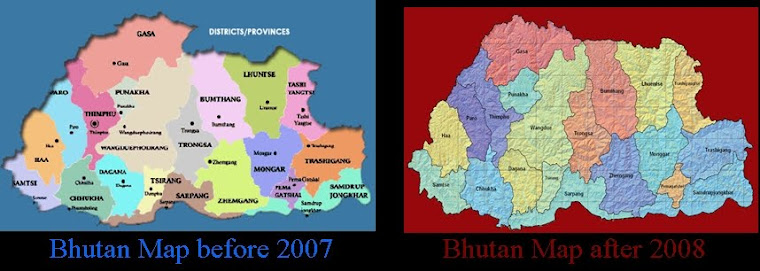
Click over the map to know the differences
Friday, May 18, 2007

Népal : L’offre des Etats-Unis d’accueillir des réfugiés bhoutanais ravive les tensions
Les réfugiés ont le droit au retour, mais devraient être libres de choisir d’autres options
(Katmandou, le 17 mai 2007) – L’offre des Etats-Unis d’accueillir 60 000 réfugiés bhoutanais a donné espoir à un grand nombre des 106 000 réfugiés qui vivent au Népal depuis plus de 16 ans, mais elle a aussi ravivé les tensions dans les camps, affirme Human Rights Watch dans un rapport publié aujourd’hui. Les réfugiés qui insistent sur le rapatriement comme étant la seule solution acceptable ont menacé et intimidé ceux qui expriment leur soutien à la réinstallation aux Etats-Unis.
Les réfugiés ont fondamentalement le droit de retourner dans le pays qui les a expulsés. Mais tous les réfugiés ont aussi le droit de faire des choix essentiels pour leurs vies sans être menacés ni intimidés.
Bill Frelick, directeur de la division Réfugiés à Human Rights Watch
La crise des réfugiés bhoutanais a démarré en 1991 quand le Bhoutan a commencé à expulser des personnes de l’ethnie népalaise, politique qui a abouti à l’expulsion d’un sixième de la population du pays. Mais depuis l’annonce de l’offre des Etats-Unis en octobre 2006, des groupes de réfugiés qui soutiennent que la seule solution acceptable est le retour au Bhoutan ont menacé des réfugiés favorables à la réinstallation.
« Les réfugiés ont fondamentalement le droit de retourner dans le pays qui les a expulsés », a déclaré Bill Frelick, directeur de la division Réfugiés à Human Rights Watch. « Mais tous les réfugiés ont aussi le droit de faire des choix essentiels pour leurs vies sans être menacés ni intimidés. »
Le rapport de 90 pages, intitulé « Last Hope: The Need for Durable Solutions for Bhutanese Refugees in Nepal and India » (« Dernier espoir : La nécessité de solutions durables pour les réfugiés bhoutanais au Népal et en Inde »), aborde les solutions possibles à cette situation prolongée des réfugiés et les choix qui se présentent maintenant à eux. Ce rapport décrit les conditions des réfugiés népalais qui languissent en exil au Népal et en Inde, et fait état de la discrimination permanente contre les Népalais qui vivent encore au Bhoutan, dans la peur d’être eux aussi dépouillés de leur citoyenneté et expulsés du pays.
« Bien le rapatriement soit la meilleure option pour la plupart des réfugiés, celle-ci n’est viable que si le Bhoutan remplit son devoir de garantir les droits humains des rapatriés », a affirmé Frelick. « En attendant, le rapatriement au Bhoutan ne peut pas être mis en avant comme une solution durable pour les réfugiés bhoutanais au Népal. »
Jusqu’ici, le Bhoutan n’a pas autorisé un seul réfugié à retourner au pays. En conséquence, les réfugiés ont supporté des années dans des camps surpeuplés sans perspectives de solutions. Le rapport expose la vie dans les camps, la violence domestique et d’autres problèmes sociaux qui surgissent après des périodes prolongées dans des camps fermés.
« Nous ne voulons pas dépendre d’autres personnes », a dit un réfugié bhoutanais à Human Rights Watch. « Nous avons passé la moitié de notre vie comme réfugiés. Nous ne voulons pas de cette étiquette sur le front de nos enfants. Nous voulons qu’ils soient des citoyens fiers. »
Depuis l’annonce de l’offre de réinstallation faite par les Etats-Unis, les tensions dans les camps se sont accrues. Ceci est dû en partie aux rumeurs et aux fausses informations sur la nature de l’offre elle-même. C’est dû aussi à l’intimidation exercée par des groupes activement opposés à la réinstallation et qui maintiennent que la seule solution acceptable est le retour au Bhoutan.
« Les gens ne se sentent pas en sécurité, » a dit un jeune homme. « Si d’autres personnes entendent que vous cherchez d’autres options que le rapatriement, ils vont vous condamner parce que vous ne soutenez pas le rapatriement, ou parce que vous affaiblissez les perspectives de rapatriement. D’autres vont vous accuser de ne pas aimer votre pays. »
Human Rights Watch a appelé le gouvernement népalais à poursuivre les intimidateurs qui menacent ou maltraitent ceux qui exercent leurs droits à la liberté d’opinion, d’expression et d’association.
« Avant de pouvoir parvenir à des solutions, le Népal doit garantir une sécurité suffisante dans les camps pour permettre aux réfugiés d’exprimer leurs opinions et d’échanger librement des informations », a insisté Frelick.
Le rapport aborde les solutions éventuelles à cette situation prolongée des réfugiés et les choix qui se présentent maintenant à eux.
« Pour être efficace, l’offre de réinstallation des Etats-Unis ne peut fonctionner de façon isolée », a dit Frelick. « Les réfugiés bhoutanais ont besoin de véritables choix. »
Ceci requiert une stratégie tripartite. Premièrement, la réinstallation devrait être une option réelle pour autant de réfugiés qui le souhaitent. Ceci signifie que d’autres pays devraient s’unir dans un effort coordonné pour maximiser le nombre de lieux de réinstallation. Les réfugiés bhoutanais qui vivent à l’extérieur des camps au Népal et en Inde devraient aussi y avoir droit. Le Népal devrait coopérer à l’option de réinstallation, en particulier en accordant sans délai des permis de sortie aux réfugiés dont la candidature à la réinstallation est acceptée.
Deuxièmement, le Népal devrait accorder la citoyenneté aux réfugiés qui expriment une préférence pour une intégration locale plutôt que pour une réinstallation ou un rapatriement. Et enfin, les Etats-Unis, l’Inde et d’autres pays devraient redoubler d’efforts pour persuader le Bhoutan de permettre aux réfugiés qui veulent être rapatriés de le faire dans des conditions qui soient compatibles avec la législation relative aux droits humains.
« La possibilité que beaucoup de réfugiés puissent maintenant choisir d’autres options devrait grandement faciliter l’acceptation du rapatriement par le Bhoutan », a dit Frelick. « Les pays de réinstallation devraient faire pression sur le Bhoutan pour trouver une solution véritablement globale à cette situation prolongée des réfugiés. »
(Katmandou, le 17 mai 2007) – L’offre des Etats-Unis d’accueillir 60 000 réfugiés bhoutanais a donné espoir à un grand nombre des 106 000 réfugiés qui vivent au Népal depuis plus de 16 ans, mais elle a aussi ravivé les tensions dans les camps, affirme Human Rights Watch dans un rapport publié aujourd’hui. Les réfugiés qui insistent sur le rapatriement comme étant la seule solution acceptable ont menacé et intimidé ceux qui expriment leur soutien à la réinstallation aux Etats-Unis.
Les réfugiés ont fondamentalement le droit de retourner dans le pays qui les a expulsés. Mais tous les réfugiés ont aussi le droit de faire des choix essentiels pour leurs vies sans être menacés ni intimidés.
Bill Frelick, directeur de la division Réfugiés à Human Rights Watch
La crise des réfugiés bhoutanais a démarré en 1991 quand le Bhoutan a commencé à expulser des personnes de l’ethnie népalaise, politique qui a abouti à l’expulsion d’un sixième de la population du pays. Mais depuis l’annonce de l’offre des Etats-Unis en octobre 2006, des groupes de réfugiés qui soutiennent que la seule solution acceptable est le retour au Bhoutan ont menacé des réfugiés favorables à la réinstallation.
« Les réfugiés ont fondamentalement le droit de retourner dans le pays qui les a expulsés », a déclaré Bill Frelick, directeur de la division Réfugiés à Human Rights Watch. « Mais tous les réfugiés ont aussi le droit de faire des choix essentiels pour leurs vies sans être menacés ni intimidés. »
Le rapport de 90 pages, intitulé « Last Hope: The Need for Durable Solutions for Bhutanese Refugees in Nepal and India » (« Dernier espoir : La nécessité de solutions durables pour les réfugiés bhoutanais au Népal et en Inde »), aborde les solutions possibles à cette situation prolongée des réfugiés et les choix qui se présentent maintenant à eux. Ce rapport décrit les conditions des réfugiés népalais qui languissent en exil au Népal et en Inde, et fait état de la discrimination permanente contre les Népalais qui vivent encore au Bhoutan, dans la peur d’être eux aussi dépouillés de leur citoyenneté et expulsés du pays.
« Bien le rapatriement soit la meilleure option pour la plupart des réfugiés, celle-ci n’est viable que si le Bhoutan remplit son devoir de garantir les droits humains des rapatriés », a affirmé Frelick. « En attendant, le rapatriement au Bhoutan ne peut pas être mis en avant comme une solution durable pour les réfugiés bhoutanais au Népal. »
Jusqu’ici, le Bhoutan n’a pas autorisé un seul réfugié à retourner au pays. En conséquence, les réfugiés ont supporté des années dans des camps surpeuplés sans perspectives de solutions. Le rapport expose la vie dans les camps, la violence domestique et d’autres problèmes sociaux qui surgissent après des périodes prolongées dans des camps fermés.
« Nous ne voulons pas dépendre d’autres personnes », a dit un réfugié bhoutanais à Human Rights Watch. « Nous avons passé la moitié de notre vie comme réfugiés. Nous ne voulons pas de cette étiquette sur le front de nos enfants. Nous voulons qu’ils soient des citoyens fiers. »
Depuis l’annonce de l’offre de réinstallation faite par les Etats-Unis, les tensions dans les camps se sont accrues. Ceci est dû en partie aux rumeurs et aux fausses informations sur la nature de l’offre elle-même. C’est dû aussi à l’intimidation exercée par des groupes activement opposés à la réinstallation et qui maintiennent que la seule solution acceptable est le retour au Bhoutan.
« Les gens ne se sentent pas en sécurité, » a dit un jeune homme. « Si d’autres personnes entendent que vous cherchez d’autres options que le rapatriement, ils vont vous condamner parce que vous ne soutenez pas le rapatriement, ou parce que vous affaiblissez les perspectives de rapatriement. D’autres vont vous accuser de ne pas aimer votre pays. »
Human Rights Watch a appelé le gouvernement népalais à poursuivre les intimidateurs qui menacent ou maltraitent ceux qui exercent leurs droits à la liberté d’opinion, d’expression et d’association.
« Avant de pouvoir parvenir à des solutions, le Népal doit garantir une sécurité suffisante dans les camps pour permettre aux réfugiés d’exprimer leurs opinions et d’échanger librement des informations », a insisté Frelick.
Le rapport aborde les solutions éventuelles à cette situation prolongée des réfugiés et les choix qui se présentent maintenant à eux.
« Pour être efficace, l’offre de réinstallation des Etats-Unis ne peut fonctionner de façon isolée », a dit Frelick. « Les réfugiés bhoutanais ont besoin de véritables choix. »
Ceci requiert une stratégie tripartite. Premièrement, la réinstallation devrait être une option réelle pour autant de réfugiés qui le souhaitent. Ceci signifie que d’autres pays devraient s’unir dans un effort coordonné pour maximiser le nombre de lieux de réinstallation. Les réfugiés bhoutanais qui vivent à l’extérieur des camps au Népal et en Inde devraient aussi y avoir droit. Le Népal devrait coopérer à l’option de réinstallation, en particulier en accordant sans délai des permis de sortie aux réfugiés dont la candidature à la réinstallation est acceptée.
Deuxièmement, le Népal devrait accorder la citoyenneté aux réfugiés qui expriment une préférence pour une intégration locale plutôt que pour une réinstallation ou un rapatriement. Et enfin, les Etats-Unis, l’Inde et d’autres pays devraient redoubler d’efforts pour persuader le Bhoutan de permettre aux réfugiés qui veulent être rapatriés de le faire dans des conditions qui soient compatibles avec la législation relative aux droits humains.
« La possibilité que beaucoup de réfugiés puissent maintenant choisir d’autres options devrait grandement faciliter l’acceptation du rapatriement par le Bhoutan », a dit Frelick. « Les pays de réinstallation devraient faire pression sur le Bhoutan pour trouver une solution véritablement globale à cette situation prolongée des réfugiés. »
Bhutanese refugees divided over US offer
KATMANDU: Bhutanese refugees at camps in Nepal are bitterly divided over a US offer to resettle tens of thousands of them, with those wanting to hold out for a return to Bhutan threatening those who favor going to America, a rights group said Thursday.
More than 100,000 ethnic Nepalis - a Hindu minority in Bhutan for centuries - have been living as refugees in Nepal since the early 1990s, when they were forced out by Bhutanese authorities who wanted to maintain the country’s dominant Buddhist culture.
While Bhutan, the world’s last Buddhist kingdom, is slowly moving toward democracy, it refuses to allow the refugees to return, claiming most left voluntarily and renounced their citizenship. The result has been a festering stalemate that Washington tried in part to resolve last year by offering to resettle 60,000 of the refugees. ap
More than 100,000 ethnic Nepalis - a Hindu minority in Bhutan for centuries - have been living as refugees in Nepal since the early 1990s, when they were forced out by Bhutanese authorities who wanted to maintain the country’s dominant Buddhist culture.
While Bhutan, the world’s last Buddhist kingdom, is slowly moving toward democracy, it refuses to allow the refugees to return, claiming most left voluntarily and renounced their citizenship. The result has been a festering stalemate that Washington tried in part to resolve last year by offering to resettle 60,000 of the refugees. ap
Bhutanese in Nepal face eviction
18 May, 2007 l 0323 hrs ISTlTIMES NEWS NETWORK
KATHMANDU: While Washington's offer of resettlement has given the first ray of hope to Bhutanese refugees living like prisoners in camps in Nepal for 16 long years, it has also fuelled an insidious fear among over 80,000 ethnic Bhutanese in the kingdom, who apprehend it will be their turn to be forcibly evicted once the resettlement process begins.
Bhutanese of Nepali origin have been burdened with more misgivings since April 2006, when the Population and Census Commission made public the result of the 2005 census, fixing the population at 634,972. The catch is, the commission says it includes both bona fide citizens and "foreigners".
The number of such "foreigners" has been calculated to be almost 80,000. Interestingly, nearly 70,000 have been prevented from taking part in the mock election.
The fear has spread to the seven refugee camps in eastern Nepal, where the victims of the 1991 persecution have been living under the supervision of the UN High Commission for Refugees for nearly two decades.
On Wednesday, yellow pamphlets began to appear in the Beldangi camp, urging the refugees to ready for an armed struggle to restore democracy in Bhutan.
Though the refugees remain tightlipped, the source of fear is said to be the rising militant groups of young people: the Bhutan Communist Party- Marxist-Leninist-Maoist, Bhutan Tigers and War and Peace Group.
The last sent a signed threat note to two camp secretaries who were explaining to residents the implication of the US offer. However, the militants, five out of six Bhutan parties operating from India and Nepal are opposed to third-country resettlement.
"While repatriation would be the best option for most refugees, it can only be viable if Bhutan upholds its duty to guarantee the returnees' human rights," said Bill Frelick, refugee policy director at Human Rights Watch. "People feel insecure," young man in the camp said.
KATHMANDU: While Washington's offer of resettlement has given the first ray of hope to Bhutanese refugees living like prisoners in camps in Nepal for 16 long years, it has also fuelled an insidious fear among over 80,000 ethnic Bhutanese in the kingdom, who apprehend it will be their turn to be forcibly evicted once the resettlement process begins.
Bhutanese of Nepali origin have been burdened with more misgivings since April 2006, when the Population and Census Commission made public the result of the 2005 census, fixing the population at 634,972. The catch is, the commission says it includes both bona fide citizens and "foreigners".
The number of such "foreigners" has been calculated to be almost 80,000. Interestingly, nearly 70,000 have been prevented from taking part in the mock election.
The fear has spread to the seven refugee camps in eastern Nepal, where the victims of the 1991 persecution have been living under the supervision of the UN High Commission for Refugees for nearly two decades.
On Wednesday, yellow pamphlets began to appear in the Beldangi camp, urging the refugees to ready for an armed struggle to restore democracy in Bhutan.
Though the refugees remain tightlipped, the source of fear is said to be the rising militant groups of young people: the Bhutan Communist Party- Marxist-Leninist-Maoist, Bhutan Tigers and War and Peace Group.
The last sent a signed threat note to two camp secretaries who were explaining to residents the implication of the US offer. However, the militants, five out of six Bhutan parties operating from India and Nepal are opposed to third-country resettlement.
"While repatriation would be the best option for most refugees, it can only be viable if Bhutan upholds its duty to guarantee the returnees' human rights," said Bill Frelick, refugee policy director at Human Rights Watch. "People feel insecure," young man in the camp said.
Forgotten in Nepal
By Bill Frelick, published in The Wall Street Journal Asia
May 17, 2007
KATHMANDU—The effects of ethnic cleansing aren’t confined to places like Darfur and Kosovo. Today, over 100,000 of Bhutan’s ethnic Nepali citizens languish in refugee camps here, stripped of their citizenship and stateless. It’s a decade-long tragedy that’s only getting worse.
In the early 1990s, demonstrations by ethnic Nepalis demanding better civil liberties touched off an ethnic cleansing campaign by Bhutan’s ruling Drukpa elite. Between 1990 and 1992, the government forced tens of thousands of ethnic Nepali citizens to India, which in turn sent them to Nepal.
Bhutan insists the majority left voluntarily and forfeited their right to return, but the refugees tell a different story. “The army took all the people from their houses,” one young man told me, recalling childhood memories of the expulsion. “On the way there were many police. We were forced to sign the document. They snapped our photos. The man told me to smile . . . He wanted to show that I was leaving my country willingly, happily.”
Today, most languish in camps in the eastern part of Nepal, living in bamboo huts that offer little physical protection from the elements. Confined to these living quarters by Nepali officials, they are completely dependent on international aid to survive. The willingness of donors to continue indefinite handouts is waning, however, and refugees are now experiencing major cutbacks in food, fuel and shelter materials.
The vast majority of refugees want to return home, as is their right. Bhutan has signed binding international treaties such as the Convention on the Rights of the Child, which enshrines the right of return. During this long period of exile, however, Bhutan has not officially allowed any refugees back.
And while it may be “home,” Bhutan doesn’t offer much better economic prospects. The government’s rhetoric is catchy: According to Bhutan’s draft constitution, “the state shall strive to promote those conditions that will enable the pursuit of Gross National Happiness.” But the reality is that Bhutan is a poor, developing country that’s only now opening up to trade with the outside world.
It is also unclear how ethnic Nepalis would be treated in today’s Bhutan. The country’s draft constitution enshrines “fundamental rights and freedoms of the people.” But these ideals are a far cry from reality. Ethnic Nepalis remain a marginalized group in constant fear of losing their citizenship and being evicted. More generally, Bhutanese citizens, of any ethnicity, can’t enroll in higher education, get a government job, obtain business licenses, or buy or sell land unless they have a police-issued card attesting that the bearer is not “anti-national,” or critical of the monarchy.
Most Bhutanese refugees only want to repatriate to their home country if they are given safety guarantees. But the government has shown no willingness to let them back at all, let alone meet such conditions. So they remain in closed camps in Nepal, subject to the societal dysfunction typical in protracted camp settings, including depression, and domestic and sexual violence.
There is a spark of hope: The United States, tired perhaps of shoveling humanitarian aid into these camps, has offered to resettle up to 60,000 refugees. Australia has offered homes to another 1,000, and other countries may follow suit.
But that’s not a complete solution. There are some refugees who see these offers as undercutting their right of return to Bhutan. Some have even threatened fellow refugees who support resettlement, seeking to intimidate those who speak out in favor of a move away.
To solve this conundrum, the U.S. and other countries might make clear that resettlement in a third country does not extinguish a refugee’s right of return. Pressure, too, could be increased on Bhutan to allow refugees to return safely and with dignity. After well over a decade in the camps, this mountain kingdom’s forgotten citizens deserve as much.
Mr. Frelick is Refugee Policy director at Human Rights Watch in Washington, D.C.
May 17, 2007
KATHMANDU—The effects of ethnic cleansing aren’t confined to places like Darfur and Kosovo. Today, over 100,000 of Bhutan’s ethnic Nepali citizens languish in refugee camps here, stripped of their citizenship and stateless. It’s a decade-long tragedy that’s only getting worse.
In the early 1990s, demonstrations by ethnic Nepalis demanding better civil liberties touched off an ethnic cleansing campaign by Bhutan’s ruling Drukpa elite. Between 1990 and 1992, the government forced tens of thousands of ethnic Nepali citizens to India, which in turn sent them to Nepal.
Bhutan insists the majority left voluntarily and forfeited their right to return, but the refugees tell a different story. “The army took all the people from their houses,” one young man told me, recalling childhood memories of the expulsion. “On the way there were many police. We were forced to sign the document. They snapped our photos. The man told me to smile . . . He wanted to show that I was leaving my country willingly, happily.”
Today, most languish in camps in the eastern part of Nepal, living in bamboo huts that offer little physical protection from the elements. Confined to these living quarters by Nepali officials, they are completely dependent on international aid to survive. The willingness of donors to continue indefinite handouts is waning, however, and refugees are now experiencing major cutbacks in food, fuel and shelter materials.
The vast majority of refugees want to return home, as is their right. Bhutan has signed binding international treaties such as the Convention on the Rights of the Child, which enshrines the right of return. During this long period of exile, however, Bhutan has not officially allowed any refugees back.
And while it may be “home,” Bhutan doesn’t offer much better economic prospects. The government’s rhetoric is catchy: According to Bhutan’s draft constitution, “the state shall strive to promote those conditions that will enable the pursuit of Gross National Happiness.” But the reality is that Bhutan is a poor, developing country that’s only now opening up to trade with the outside world.
It is also unclear how ethnic Nepalis would be treated in today’s Bhutan. The country’s draft constitution enshrines “fundamental rights and freedoms of the people.” But these ideals are a far cry from reality. Ethnic Nepalis remain a marginalized group in constant fear of losing their citizenship and being evicted. More generally, Bhutanese citizens, of any ethnicity, can’t enroll in higher education, get a government job, obtain business licenses, or buy or sell land unless they have a police-issued card attesting that the bearer is not “anti-national,” or critical of the monarchy.
Most Bhutanese refugees only want to repatriate to their home country if they are given safety guarantees. But the government has shown no willingness to let them back at all, let alone meet such conditions. So they remain in closed camps in Nepal, subject to the societal dysfunction typical in protracted camp settings, including depression, and domestic and sexual violence.
There is a spark of hope: The United States, tired perhaps of shoveling humanitarian aid into these camps, has offered to resettle up to 60,000 refugees. Australia has offered homes to another 1,000, and other countries may follow suit.
But that’s not a complete solution. There are some refugees who see these offers as undercutting their right of return to Bhutan. Some have even threatened fellow refugees who support resettlement, seeking to intimidate those who speak out in favor of a move away.
To solve this conundrum, the U.S. and other countries might make clear that resettlement in a third country does not extinguish a refugee’s right of return. Pressure, too, could be increased on Bhutan to allow refugees to return safely and with dignity. After well over a decade in the camps, this mountain kingdom’s forgotten citizens deserve as much.
Mr. Frelick is Refugee Policy director at Human Rights Watch in Washington, D.C.
US home offer sparks tension in Bhutanese refugee camps
From correspondents in Kathmandu, Nepal, 05:02 PM IST
Email Print Download PDF Comments (0)
A leading human rights organisation Thursday said Washington's offer to provide a home for the over 100,000 Bhutanese languishing in Nepal for nearly two decades has created a high level of tension in the refugee camps with militants threatening those welcoming the resettlement bid.
'Two Bhutanese acting as camp secretaries, who were explaining the US resettlement offer to the inmates, were sent a threatening note signed by a group calling itself the War and Peace Group,' said Bill Frelick, refugee policy director at Human Rights Watch.
'The note said their heads would be cut off if they advocated resettling refugees on US soil.'
Winding up a visit to eastern Nepal, where over 100,000 Bhutanese have been living for 16 years in seven camps administered by the UN High Commission for Refugees, the HRW Thursday released a report in Kathmandu on its findings in the camps.
The report, 'Last Hope: The Need for Durable Solutions for Bhutanese Refugees in Nepal and India', says there is heightened tension in the camps with militant refugees who insist on returning to Bhutan as the only acceptable solution threatening and intimidating those supporting resettlement in the US.
It says there is also continuing discrimination against the ethnic Nepalis still living in Bhutan, who live in fear that they too could be stripped of their citizenship and expelled from the country.
'Refugees fundamentally have the right to return to a country that expelled them,' Frelick said. 'But all refugees also have the right to make essential choices about their lives without threats and intimidation.'
Bhutanese of Nepali origin, living mostly in southern Bhutan, began to face a crackdown from the 80s after the Druk government promulgated a new citizenship act and followed it up with a census in 1988, both combining to strip thousands of their citizenship.
Becoming 'foreigners' and persona non grata overnight, the families were intimidated into leaving the country and fled to India across the border from which a large number moved to Nepal, where they were given restricted refugee status by the Nepal government.
Since then, forced by the international community to begin a repatriation process, Bhutan began talks with Nepal but so far, has not taken a single refugee back, even after 15 rounds of bilateral talks.
It is felt that the process might have succeeded if India, Bhutan's biggest donor and trading partner, had added its persuasion.
But India continues to call the issue a bilateral matter between Nepal and Bhutan.
HRW officials said they had repeatedly tried to meet officials of India's external affairs ministry this week to discuss the issue but were not given an appointment.
The US offer has also created fear among the ethnic Bhutanese in Bhutan that they could face a new series of crackdown.
'The fears are legitimate given the new census and history,' Frelick said.
A 2005 census lists Bhutan's population as nearly 640,000, of which about 82,000 have been listed as 'foreigners'.
'That's nearly 13 percent of the population,' says Ratan Gazmere, president of the Association of Human Rights Activists Bhutan. 'We have little doubt that the Bhutan government will force this percentage of population to leave once the US resettlement process is started.
'While the US generosity allows refugees, who have spent 16 years in camps to start afresh, it also creates a dangerous precedent.
'It can signal to other despotic regimes that the international community is ready to clear the mess they make.
'The world should also double pressure on Bhutan to take its refugees back.'
Email Print Download PDF Comments (0)
A leading human rights organisation Thursday said Washington's offer to provide a home for the over 100,000 Bhutanese languishing in Nepal for nearly two decades has created a high level of tension in the refugee camps with militants threatening those welcoming the resettlement bid.
'Two Bhutanese acting as camp secretaries, who were explaining the US resettlement offer to the inmates, were sent a threatening note signed by a group calling itself the War and Peace Group,' said Bill Frelick, refugee policy director at Human Rights Watch.
'The note said their heads would be cut off if they advocated resettling refugees on US soil.'
Winding up a visit to eastern Nepal, where over 100,000 Bhutanese have been living for 16 years in seven camps administered by the UN High Commission for Refugees, the HRW Thursday released a report in Kathmandu on its findings in the camps.
The report, 'Last Hope: The Need for Durable Solutions for Bhutanese Refugees in Nepal and India', says there is heightened tension in the camps with militant refugees who insist on returning to Bhutan as the only acceptable solution threatening and intimidating those supporting resettlement in the US.
It says there is also continuing discrimination against the ethnic Nepalis still living in Bhutan, who live in fear that they too could be stripped of their citizenship and expelled from the country.
'Refugees fundamentally have the right to return to a country that expelled them,' Frelick said. 'But all refugees also have the right to make essential choices about their lives without threats and intimidation.'
Bhutanese of Nepali origin, living mostly in southern Bhutan, began to face a crackdown from the 80s after the Druk government promulgated a new citizenship act and followed it up with a census in 1988, both combining to strip thousands of their citizenship.
Becoming 'foreigners' and persona non grata overnight, the families were intimidated into leaving the country and fled to India across the border from which a large number moved to Nepal, where they were given restricted refugee status by the Nepal government.
Since then, forced by the international community to begin a repatriation process, Bhutan began talks with Nepal but so far, has not taken a single refugee back, even after 15 rounds of bilateral talks.
It is felt that the process might have succeeded if India, Bhutan's biggest donor and trading partner, had added its persuasion.
But India continues to call the issue a bilateral matter between Nepal and Bhutan.
HRW officials said they had repeatedly tried to meet officials of India's external affairs ministry this week to discuss the issue but were not given an appointment.
The US offer has also created fear among the ethnic Bhutanese in Bhutan that they could face a new series of crackdown.
'The fears are legitimate given the new census and history,' Frelick said.
A 2005 census lists Bhutan's population as nearly 640,000, of which about 82,000 have been listed as 'foreigners'.
'That's nearly 13 percent of the population,' says Ratan Gazmere, president of the Association of Human Rights Activists Bhutan. 'We have little doubt that the Bhutan government will force this percentage of population to leave once the US resettlement process is started.
'While the US generosity allows refugees, who have spent 16 years in camps to start afresh, it also creates a dangerous precedent.
'It can signal to other despotic regimes that the international community is ready to clear the mess they make.
'The world should also double pressure on Bhutan to take its refugees back.'
HRW stresses all options open for solution to refugee crisis
The New York-based Human Rights Watch (HRW) has said the Bhutanese refugees have right to return to their country, but other options for finding a solution to the crisis should be kept open.
A new HRW report made public in Kathmandu on Thursday states that the US offer to resettle 60,000 of them has given hope to many of the 106,000 refugees living in Nepal for more than 16 years, but has also heightened tensions in the camps.
The report further said that refugees who insist on repatriation as the only acceptable solution have been threatening and intimidating those who voice support for resettlement in the US and other countries.
"Refugees fundamentally have the right to return to a country that expelled them. But all refugees also have the right to make essential choices about their lives without threats and intimidation," said Bill Frelick, refugee policy director at the HRW while releasing the report.
The 86-page report entitled "Last Hope: The Need for Durable Solutions for Bhutanese Refugees in Nepal and India" discusses the possible solutions to this protracted situation and the choices the refugee community now faces. The report documents life in the camps and domestic violence and other social problems that have come after protracted periods in closed camps. It also describes conditions of the refugees and also mentions about continuing discrimination against the ethnic Nepalis still living in Bhutan, who live in constant fear that they too could be stripped of their citizenship and expelled from the country.
"While repatriation would be the best option for most refugees, it can only be viable if Bhutan upholds its duty to guarantee the returnees' human rights," Frelick said further. "Until then, repatriation to Bhutan cannot be promoted as a durable solution for the Bhutanese refugees in Nepal," he said.
"We don't want to be dependent on others. Half our lives have been spent as refugees. We don't want that tag on our children's forehead. We want them to be proud citizens," the report quoted a refugee as saying.
Since the announcement of the US resettlement offer, tensions in the camps have been building, the report notes. Partly, this is because of rumors and misinformation about the nature of the offer itself. It is also due to intimidation by groups militantly opposed to resettlement who insist that the only acceptable solution is return to Bhutan.
"People feel insecure. If others hear you are looking for other options than repatriation, they will condemn you as not favoring repatriation, or diluting the prospects for repatriation. Others will accuse you of having no love for the country," another refugee said.
"Before any solutions can be achieved, Nepal must provide sufficient security in the camps to enable refugees to express their opinions and exchange information freely," said Frelick urging the Nepali government to provide adequate security to the refugees.
The report said the resettlement offer requires a three-pronged strategy. First, resettlement should be a real option for as many refugees as want it. This means that other countries should join in a coordinated effort to maximize the number of resettlement places. Bhutanese refugees living outside the camps in Nepal and India should also be eligible. Nepal should cooperate on the resettlement option, in particular, by issuing exit permits without delay to refugees accepted for resettlement.
Second, the rights groups said, Nepal should grant citizenship to those refugees who express a preference for local integration over resettlement or repatriation.
And finally, the US, India and other countries should redouble their efforts to persuade Bhutan to allow refugees who want to repatriate to do so under conditions that are compatible with human rights law.
"The possibility that many refugees may now choose other options should make it much easier for Bhutan to accept repatriation. Resettlement countries should press Bhutan for a genuinely comprehensive solution to this protracted refugee situation," Frelick said. nepalnews.com ia May 17 07
A new HRW report made public in Kathmandu on Thursday states that the US offer to resettle 60,000 of them has given hope to many of the 106,000 refugees living in Nepal for more than 16 years, but has also heightened tensions in the camps.
The report further said that refugees who insist on repatriation as the only acceptable solution have been threatening and intimidating those who voice support for resettlement in the US and other countries.
"Refugees fundamentally have the right to return to a country that expelled them. But all refugees also have the right to make essential choices about their lives without threats and intimidation," said Bill Frelick, refugee policy director at the HRW while releasing the report.
The 86-page report entitled "Last Hope: The Need for Durable Solutions for Bhutanese Refugees in Nepal and India" discusses the possible solutions to this protracted situation and the choices the refugee community now faces. The report documents life in the camps and domestic violence and other social problems that have come after protracted periods in closed camps. It also describes conditions of the refugees and also mentions about continuing discrimination against the ethnic Nepalis still living in Bhutan, who live in constant fear that they too could be stripped of their citizenship and expelled from the country.
"While repatriation would be the best option for most refugees, it can only be viable if Bhutan upholds its duty to guarantee the returnees' human rights," Frelick said further. "Until then, repatriation to Bhutan cannot be promoted as a durable solution for the Bhutanese refugees in Nepal," he said.
"We don't want to be dependent on others. Half our lives have been spent as refugees. We don't want that tag on our children's forehead. We want them to be proud citizens," the report quoted a refugee as saying.
Since the announcement of the US resettlement offer, tensions in the camps have been building, the report notes. Partly, this is because of rumors and misinformation about the nature of the offer itself. It is also due to intimidation by groups militantly opposed to resettlement who insist that the only acceptable solution is return to Bhutan.
"People feel insecure. If others hear you are looking for other options than repatriation, they will condemn you as not favoring repatriation, or diluting the prospects for repatriation. Others will accuse you of having no love for the country," another refugee said.
"Before any solutions can be achieved, Nepal must provide sufficient security in the camps to enable refugees to express their opinions and exchange information freely," said Frelick urging the Nepali government to provide adequate security to the refugees.
The report said the resettlement offer requires a three-pronged strategy. First, resettlement should be a real option for as many refugees as want it. This means that other countries should join in a coordinated effort to maximize the number of resettlement places. Bhutanese refugees living outside the camps in Nepal and India should also be eligible. Nepal should cooperate on the resettlement option, in particular, by issuing exit permits without delay to refugees accepted for resettlement.
Second, the rights groups said, Nepal should grant citizenship to those refugees who express a preference for local integration over resettlement or repatriation.
And finally, the US, India and other countries should redouble their efforts to persuade Bhutan to allow refugees who want to repatriate to do so under conditions that are compatible with human rights law.
"The possibility that many refugees may now choose other options should make it much easier for Bhutan to accept repatriation. Resettlement countries should press Bhutan for a genuinely comprehensive solution to this protracted refugee situation," Frelick said. nepalnews.com ia May 17 07
US resettlement offer divides Bhutanese refugees
US resettlement offer divides Bhutanese refugees
The Associated PressPublished: May 17, 2007
KATMANDU, Nepal: Bhutanese refugees at camps in Nepal are bitterly divided over a U.S. offer to resettle tens of thousands of them, with those wanting to hold out for a return to Bhutan threatening those who favor going to America, a rights group said Thursday.
More than 100,000 ethnic Nepalis — a Hindu minority in Bhutan for centuries — have been living as refugees in Nepal since the early 1990s, when they were forced out by Bhutanese authorities who wanted to maintain the country's dominant Buddhist culture.
While Bhutan, the world's last Buddhist kingdom, is slowly moving toward democracy, it refuses to allow the refugees to return, claiming most left voluntarily and renounced their citizenship.
The result has been a festering stalemate that Washington tried in part to resolve last year by offering to resettle 60,000 of the refugees.
But Human Rights Watch said in a report released Thursday the U.S. offer has divided the refugees, with those who see resettlement as a capitulation to Bhutanese authorities creating a "climate of fear and intimidation" to keep those who want to move to America from going.
Today in Asia - Pacific
Trains cross divided Korean PeninsulaChina grapples with food contamination credibility crisisIn the new India, the old problem with electricityRefugees "are extremely reluctant to express an interest in the resettlement offer publicly," the New York-based group said in its report.
Bill Frelick, refugee policy director of Human Rights Watch, said some supporters of the U.S. offer have received death threats.
"There are many who have supported the plan but very few of them are willing to say so publicly because they are afraid," Frelick told reporters in Katmandu.
Frelick said it was impossible to say how many refugees wanted to go to the U.S. because they have not been able to express their feelings.
Those in favor of going say resettlement offers the best option for themselves and their children, according to the report. Those opposed to the U.S. offer argue the move could endanger ethnic Nepalis still in Bhutan.
Refugee leaders are also divided over the issue.
Tek Nath Rizal, Bhutan's most noted dissident who had served 10 years in prison in Bhutan, has opposed the resettlement plan.
"This is not a solution to the whole problem. If it had been we would have openly welcomed it. Resettlement is only one of the options and comes after repatriation to Bhutan and local integration in Nepal," Rizal said. "Our demand is that there should be progress in all three options at the same time."
Rizal also claimed that real refugee leaders have been kept out of the process.
But another prominent refugee leader, Ratan Gazmeher, said he supported the U.S. plan.
"No Bhutanese will ever forgo aspiration to return to Bhutan. But given the political situation and that we have been living as refugees for 16 years, it is impossible to see light at the end of the tunnel," Gazmeher said.
The refugees are living in seven U.N.-run camps in southeast Nepal, about 500 kilometers (310 miles) east of Nepal's capital, Katmandu.
Relations between Nepal and Bhutan have been strained by the refugee issue.
There have been several rounds of talks between ministers and top officials of the two nations but there has not been any significant progress.
____
On the Net:
Human Rights Watch report: http://hrw.org/reports/2007/bhutan0507/
The Associated PressPublished: May 17, 2007
KATMANDU, Nepal: Bhutanese refugees at camps in Nepal are bitterly divided over a U.S. offer to resettle tens of thousands of them, with those wanting to hold out for a return to Bhutan threatening those who favor going to America, a rights group said Thursday.
More than 100,000 ethnic Nepalis — a Hindu minority in Bhutan for centuries — have been living as refugees in Nepal since the early 1990s, when they were forced out by Bhutanese authorities who wanted to maintain the country's dominant Buddhist culture.
While Bhutan, the world's last Buddhist kingdom, is slowly moving toward democracy, it refuses to allow the refugees to return, claiming most left voluntarily and renounced their citizenship.
The result has been a festering stalemate that Washington tried in part to resolve last year by offering to resettle 60,000 of the refugees.
But Human Rights Watch said in a report released Thursday the U.S. offer has divided the refugees, with those who see resettlement as a capitulation to Bhutanese authorities creating a "climate of fear and intimidation" to keep those who want to move to America from going.
Today in Asia - Pacific
Trains cross divided Korean PeninsulaChina grapples with food contamination credibility crisisIn the new India, the old problem with electricityRefugees "are extremely reluctant to express an interest in the resettlement offer publicly," the New York-based group said in its report.
Bill Frelick, refugee policy director of Human Rights Watch, said some supporters of the U.S. offer have received death threats.
"There are many who have supported the plan but very few of them are willing to say so publicly because they are afraid," Frelick told reporters in Katmandu.
Frelick said it was impossible to say how many refugees wanted to go to the U.S. because they have not been able to express their feelings.
Those in favor of going say resettlement offers the best option for themselves and their children, according to the report. Those opposed to the U.S. offer argue the move could endanger ethnic Nepalis still in Bhutan.
Refugee leaders are also divided over the issue.
Tek Nath Rizal, Bhutan's most noted dissident who had served 10 years in prison in Bhutan, has opposed the resettlement plan.
"This is not a solution to the whole problem. If it had been we would have openly welcomed it. Resettlement is only one of the options and comes after repatriation to Bhutan and local integration in Nepal," Rizal said. "Our demand is that there should be progress in all three options at the same time."
Rizal also claimed that real refugee leaders have been kept out of the process.
But another prominent refugee leader, Ratan Gazmeher, said he supported the U.S. plan.
"No Bhutanese will ever forgo aspiration to return to Bhutan. But given the political situation and that we have been living as refugees for 16 years, it is impossible to see light at the end of the tunnel," Gazmeher said.
The refugees are living in seven U.N.-run camps in southeast Nepal, about 500 kilometers (310 miles) east of Nepal's capital, Katmandu.
Relations between Nepal and Bhutan have been strained by the refugee issue.
There have been several rounds of talks between ministers and top officials of the two nations but there has not been any significant progress.
____
On the Net:
Human Rights Watch report: http://hrw.org/reports/2007/bhutan0507/
Bhutan Refugees Said Split on U.S. Offer
By BINAJ GURUBACHARYA
Associated Press Writer
Bhutanese refugees long stranded at camps in Nepal are divided over a U.S. offer to resettle thousands of them, with those wanting to hold out for a return to Bhutan threatening those in favor of immigrating to America, a rights group said Thursday.
More than 100,000 ethnic Nepalis - a Hindu minority in Bhutan for centuries - have been stranded for nearly two decades in neighboring Nepal because of strained relations between the two Himalayan kingdoms.
Bhutan, the world's last Buddhist kingdom, is slowly moving toward democracy but the country sandwiched between India and China refuses to allow the refugees to return, claiming most left voluntarily and renounced their citizenship.
Most of the refugees fled Bhutan in the late 1980s, when the country's government, dominated by the majority Drukpa ethnic group, accused the minority Lothsampa group of being illegal immigrants. Talks between Nepal and Bhutan on the refugee issue produced no breakthrough.
The result has been a festering stalemate that Washington tried in part to resolve last year by offering to resettle thousands of refugees.
Ellen Sauerbrey, the U.S. assistant secretary of state for refugee affairs, said in October that the United States is prepared to take in 50,000 to 60,000 of the Bhutanese refugees. She also said that Australia and Canada also have indicated they would be willing to resettle many of them.
Human Rights Watch said in a report released Thursday that the U.S. offer has divided the refugees, with those who see resettlement as a capitulation to Bhutan threatening violence against those who want to move to America.
There has been no violence so far, but 'fear among the refugees is widespread and most are extremely reluctant to express an interest in the resettlement offer publicly,' the New York-based group said.
Those in favor of moving to the U.S. say resettlement offers the best option for themselves and their children, according to the report.
Associated Press Writer
Bhutanese refugees long stranded at camps in Nepal are divided over a U.S. offer to resettle thousands of them, with those wanting to hold out for a return to Bhutan threatening those in favor of immigrating to America, a rights group said Thursday.
More than 100,000 ethnic Nepalis - a Hindu minority in Bhutan for centuries - have been stranded for nearly two decades in neighboring Nepal because of strained relations between the two Himalayan kingdoms.
Bhutan, the world's last Buddhist kingdom, is slowly moving toward democracy but the country sandwiched between India and China refuses to allow the refugees to return, claiming most left voluntarily and renounced their citizenship.
Most of the refugees fled Bhutan in the late 1980s, when the country's government, dominated by the majority Drukpa ethnic group, accused the minority Lothsampa group of being illegal immigrants. Talks between Nepal and Bhutan on the refugee issue produced no breakthrough.
The result has been a festering stalemate that Washington tried in part to resolve last year by offering to resettle thousands of refugees.
Ellen Sauerbrey, the U.S. assistant secretary of state for refugee affairs, said in October that the United States is prepared to take in 50,000 to 60,000 of the Bhutanese refugees. She also said that Australia and Canada also have indicated they would be willing to resettle many of them.
Human Rights Watch said in a report released Thursday that the U.S. offer has divided the refugees, with those who see resettlement as a capitulation to Bhutan threatening violence against those who want to move to America.
There has been no violence so far, but 'fear among the refugees is widespread and most are extremely reluctant to express an interest in the resettlement offer publicly,' the New York-based group said.
Those in favor of moving to the U.S. say resettlement offers the best option for themselves and their children, according to the report.
Bhutan's New Plot
Bhutan's New Plot [ 2007-5-17 ]
By T. P. Mishra
AT a time when the so-called first and historical general election in Bhutan is drawing closer, the Druk regime is hatching conspiracies to evict an estimated 80,000 people from the country, especially from the southern belt. This was made public by various international media houses including the BBC.
During the recently concluded 14th SAARC summit, Bhutanese Prime Minister Khandu Wangchuk had flashed a verbal green signal towards resolving the refugee impasse. Thus, Bhutan's whimsical technique to present itself well in the eyes of the international community shows that the Land of Thunder Dragon isn't sincere about doing away with the atrocities in the country. Not only this, the international media have already revealed that an estimated 17,000 people from the southern division of the country have been barred from registering for the upcoming general election.
Conspiracies
A recent news report stating Bhutan's plot to evict a large section of innocent Nepali-speaking people from the country should, at the earliest, draw the attention of the international community and be condemned in the strongest terms. Otherwise, the Druk regime will continue with its cleansing process as in the early 1990s. Actually, Bhutan has been always kept under the armpit of the world's giant democracy, India. For years, India has been seen as one of the passive states in the context of extending its helping hands for resolving the refugee quandary.
Meanwhile, the recent plot to evict more people, at a time when there has been an offer for third country resettlement, is a challenge to the international community. It remains to be seen if this can be a durable solution as Bhutan persists on carrying out ethnic cleansing. Yet those countries that are planning to resettle the Bhutanese refugees are claiming Bhutan would not evict more people.
The US delegation, which visited Thimphu prior to the announcement of establishing the office of the Overseas Processing Entity (OPE) in July to back up the resettlement process, has said Bhutan would face severe pressure if it hatches any conspiracy to evict more people from the country. As it is difficult to predict what will actually happen in the future, international pressure should be put on Bhutan. Nothing can be guaranteed especially in the context of Bhutan's hoodwinking tactics to step into a so-called 'democratic country'.
The country's ruling elite has a long-standing history of restraining the Nepali speaking people. And, it seems that this trend continues despite the latter's incessant struggle for democratisation.
It has to be well thought out here that Bhutan's hoodwinking approaches to holding fair elections in the country in 2008 would be bleak if the Druk oligarchy still maintains its old system of imposing tyrannical acts such as forcibly evicting bona fide citizens from the country. The above population is also learnt to have been barred from casting their vote during the recently concluded mock election.
The memories of Bhutan's cruel ethnic cleansing policy during the early 1990s, which claimed hundreds of innocent lives, are still fresh in the evictees' psyche. The whereabouts of a similar number of Lhotshampas inside Bhutanese jails are still unknown. There has been no compensation for property confiscated. Surprisingly, the world community remains a mute spectator of the gross violation of the fundamental human rights of Bhutanese citizens.
Alternatives
Bhutan, which is one of the active members of SAARC, is trying to abscond from expediting the repatriation process of its citizens, currently camped in the eastern districts of Nepal. Despite several attempts by the refugees themselves and the world community, Bhutan is rather preparing to evict more people instead of trying to help the refugees return home in a dignified way.
Nepali-speaking Bhutanese, especially residents of the southern belt, are comparatively conscious of the political situation in the country. They do clearly know that the upcoming election in 2008 is a tool to hoodwink the international community. The ruling elite, on the other hand, doesn't like to see this ethnic group come to power. Thus, it can be well predicted that the Bhutanese regime is likely to step up further eviction prior to the 2008 general election. Therefore, there should be continuous vigilance over what goes on in Bhutan by international rights bodies.
(Mishra is president of Third World Media Network � Bhutan Chapter.)
By T. P. Mishra
AT a time when the so-called first and historical general election in Bhutan is drawing closer, the Druk regime is hatching conspiracies to evict an estimated 80,000 people from the country, especially from the southern belt. This was made public by various international media houses including the BBC.
During the recently concluded 14th SAARC summit, Bhutanese Prime Minister Khandu Wangchuk had flashed a verbal green signal towards resolving the refugee impasse. Thus, Bhutan's whimsical technique to present itself well in the eyes of the international community shows that the Land of Thunder Dragon isn't sincere about doing away with the atrocities in the country. Not only this, the international media have already revealed that an estimated 17,000 people from the southern division of the country have been barred from registering for the upcoming general election.
Conspiracies
A recent news report stating Bhutan's plot to evict a large section of innocent Nepali-speaking people from the country should, at the earliest, draw the attention of the international community and be condemned in the strongest terms. Otherwise, the Druk regime will continue with its cleansing process as in the early 1990s. Actually, Bhutan has been always kept under the armpit of the world's giant democracy, India. For years, India has been seen as one of the passive states in the context of extending its helping hands for resolving the refugee quandary.
Meanwhile, the recent plot to evict more people, at a time when there has been an offer for third country resettlement, is a challenge to the international community. It remains to be seen if this can be a durable solution as Bhutan persists on carrying out ethnic cleansing. Yet those countries that are planning to resettle the Bhutanese refugees are claiming Bhutan would not evict more people.
The US delegation, which visited Thimphu prior to the announcement of establishing the office of the Overseas Processing Entity (OPE) in July to back up the resettlement process, has said Bhutan would face severe pressure if it hatches any conspiracy to evict more people from the country. As it is difficult to predict what will actually happen in the future, international pressure should be put on Bhutan. Nothing can be guaranteed especially in the context of Bhutan's hoodwinking tactics to step into a so-called 'democratic country'.
The country's ruling elite has a long-standing history of restraining the Nepali speaking people. And, it seems that this trend continues despite the latter's incessant struggle for democratisation.
It has to be well thought out here that Bhutan's hoodwinking approaches to holding fair elections in the country in 2008 would be bleak if the Druk oligarchy still maintains its old system of imposing tyrannical acts such as forcibly evicting bona fide citizens from the country. The above population is also learnt to have been barred from casting their vote during the recently concluded mock election.
The memories of Bhutan's cruel ethnic cleansing policy during the early 1990s, which claimed hundreds of innocent lives, are still fresh in the evictees' psyche. The whereabouts of a similar number of Lhotshampas inside Bhutanese jails are still unknown. There has been no compensation for property confiscated. Surprisingly, the world community remains a mute spectator of the gross violation of the fundamental human rights of Bhutanese citizens.
Alternatives
Bhutan, which is one of the active members of SAARC, is trying to abscond from expediting the repatriation process of its citizens, currently camped in the eastern districts of Nepal. Despite several attempts by the refugees themselves and the world community, Bhutan is rather preparing to evict more people instead of trying to help the refugees return home in a dignified way.
Nepali-speaking Bhutanese, especially residents of the southern belt, are comparatively conscious of the political situation in the country. They do clearly know that the upcoming election in 2008 is a tool to hoodwink the international community. The ruling elite, on the other hand, doesn't like to see this ethnic group come to power. Thus, it can be well predicted that the Bhutanese regime is likely to step up further eviction prior to the 2008 general election. Therefore, there should be continuous vigilance over what goes on in Bhutan by international rights bodies.
(Mishra is president of Third World Media Network � Bhutan Chapter.)
Subscribe to:
Posts (Atom)